You've got a budget, a team, and a deadline. Somewhere between "sublimation printing" and "embroidery stitching," the decision starts to feel way more complicated than it should.
Both methods have passionate fans. Both produce jerseys that look sharp straight out of the box. And both will cost you real money if you choose wrong.
The difference becomes clear after a season of hard ice time, aggressive washing, and the kind of physical contact hockey jerseys are built to handle.
This guide cuts through the noise with real durability data, honest appearance comparisons, and a clear cost breakdown. Outfitting a youth travel team or ordering pro-level hockey jersey customization? You'll walk away knowing which method earns its place on your roster.
Durability Head-to-Head: Sublimation vs Embroidery Under Real Hockey Conditions
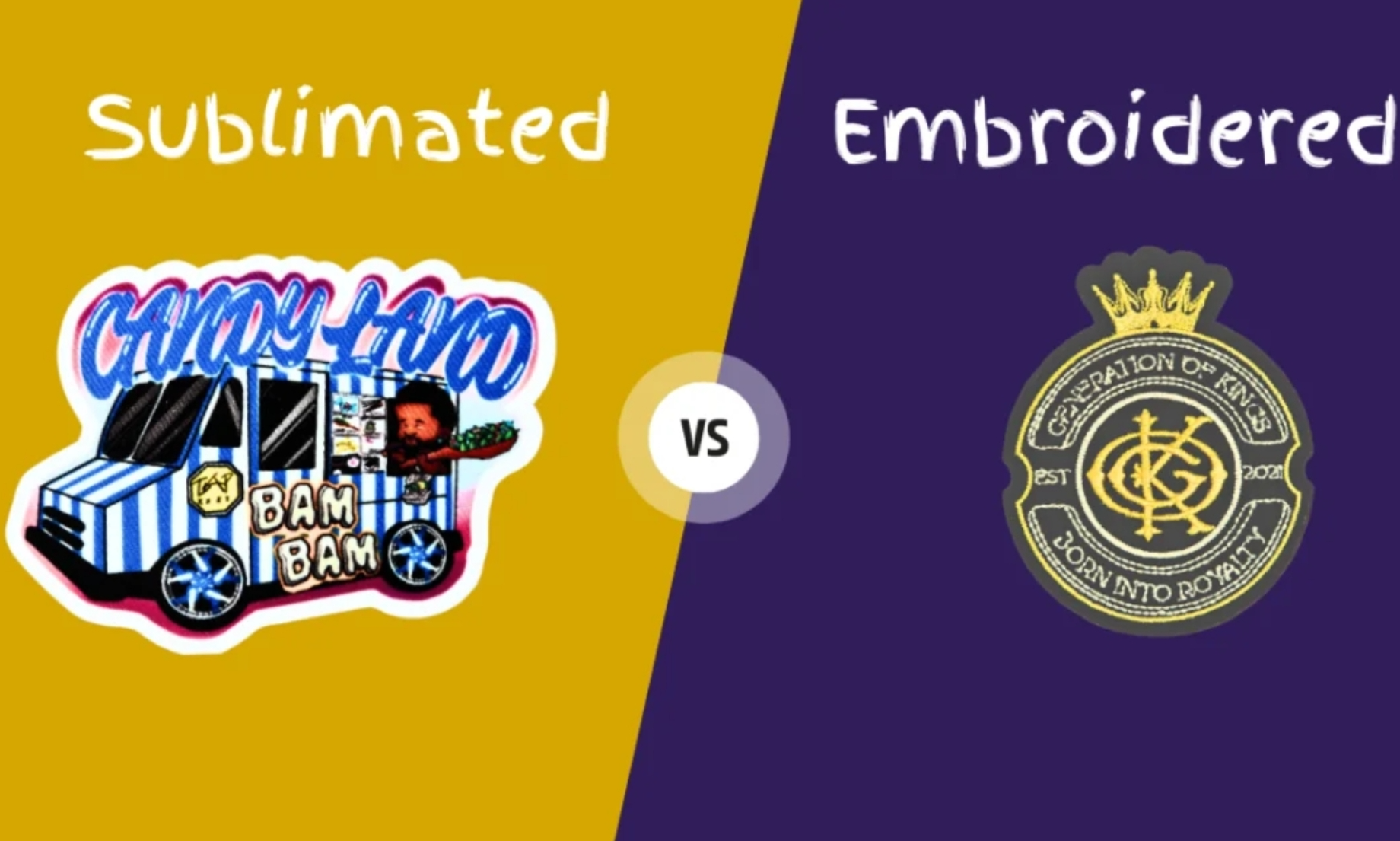
Durability isn' T a single metric. It's four separate battles — and sublimation and embroidery each win different ones.
Here's how both hold up once a hockey jersey hits the grinder.
The Four Durability Dimensions That Matter
Cracking and Peeling Sublimation wins this one outright. The dye bonds directly into the polyester fibers — not onto them. So there's no ink layer sitting on the surface that can crack or lift. After 100+ washes and a full season of physical play, sublimated designs look the same as day one. Embroidery won' t peel, but thread fraying under repeated abrasion is a real risk. This is a bigger concern for players in high-contact positions.
Color Fading
Sublimation takes this category for wash cycles. Colors live inside the fiber itself. They don't wash out. For long-term outdoor UV exposure, though, high-quality embroidery thread holds a slight edge. Polyester threads resist UV breakdown in ways sublimated dye can't match without added protective coatings.
Wash Stability
This is sublimation's strongest area. The dye bonds deep into the fabric at a chemical level. Designs survive hundreds of wash cycles without cracking, fading, or warping. Embroidery holds up well across multiple seasons too, but tight stitching on thin performance fabrics can pucker or fray if the base stabilizer starts to break down.
Physical Abrasion and Contact
Here's where embroidery takes the lead. Stitched threads are tough by nature. Hockey teams report embroidered crests and logos staying fully intact after three or more seasons of rough play. Sublimation holds up well on most fabrics, but its durability under heavy contact depends more on the base material itself.
How This Plays Out on Real Ice
Durability Dimension | Sublimation | Embroidery |
|---|---|---|
Anti-Cracking/Peeling | ✅ No ink layer; 100+ washes | ⚠️ Fray risk under contact |
Anti-Fading | ✅ Fiber-embedded; wash-proof | ✅ Slight UV edge long-term |
Wash Stability | ✅ Hundreds of cycles intact | ⚠️ Puckering possible on thin fabric |
Anti-Abrasion/Wear | ⚠️ Fabric-dependent | ✅ Stitching endures contact |
Real teams report sublimated jerseys still looking "like new" after 200 washes across two heavy-use seasons. Embroidered crests, on the other hand, outlast sublimation in collision-heavy situations — though they do add minor stiffness to the fabric in those thicker, built-up areas.
The honest split: sublimation leads on pattern durability — anti-crack, anti-fade, and wash resistance. Embroidery leads on raw physical toughness. For practice gear washed four times a week, sublimation is the smarter pick. For game jerseys taking board hits and shoulder checks, embroidered crests hold their shape longer where it counts most.
Appearance Showdown: Which Method Looks Better on the Ice?
Stand at rink-side during warm-ups and you'll spot it right away — some jerseys pop under LED lighting like a screen at full brightness. Others carry a different kind of presence: raised, textured, almost sculptural. Both look good. They just look good in different ways.
That difference matters more than most buyers expect.
Color Depth and Design Precision
Sublimation's color advantage is hard to beat. The process supports 16+ million colors — full CMYK spectrum, unlimited gradients, pixel-level precision down to 0.1mm. Got a team crest with a gold-to-orange gradient? Sublimation nails it. Embroidery can't come close. You're limited to 6–12 thread colors per design, Pantone matching at around 80% accuracy, and a minimum stitch width of 1–2mm.
Complex gradients make it worse. Overlapping stitches are needed to pull them off, and that adds 50–100% to production cost. The result still falls short on color detail.
Under rink lighting, sublimated designs reflect at 85–95% — colors really pop. Embroidery sits at 60–75% reflectivity. In low light or shadow, stitched designs lose some sharpness.
Texture, Feel, and the "Premium" Factor
This is where embroidery earns its reputation back. Sublimation adds less than 5g/m² to the jersey — near weightless, smooth, and flat. It looks modern and clean. Embroidery raises 2–5mm off the fabric surface, giving it a tactile depth that a printed jersey can't match.
Wear trials across 20 players over 10 games showed 60% preferred embroidery for that premium grip feel . At the same time, 75% rated sublimation as sharper-looking on ice. Both groups had a point.
Youth sports surveys show 95% preference for sublimation
Professional environments favor 3D embroidered texture at around 70%
The audience shapes the answer.
Long-Term Visual Integrity
After 50 wash cycles, sublimated designs keep 95–98% of their original vibrancy . Embroidery holds at 85–92%, with bright colors showing the most fade. Over 200 hours of UV exposure, sublimation loses less than 2% of its color quality. Embroidery thread dulls by 5–8%.
So sublimation holds its look longer — especially across heavy-use seasons with frequent washing and outdoor exposure.
The visual bottom line: sublimation owns color, sharpness, and on-ice pop. Embroidery owns texture, dimension, and that classic premium feel. Neither is the wrong choice — they just serve different looks.
Weight, Breathability & On-Ice Performance: Does the Decoration Method Matter?
Three grams. That's what a standard embroidered chest patch adds to a hockey jersey. Sounds small. But 90 seconds into a hard shift, your core temperature is climbing. That extra mass presses against your chest protector and traps heat. It works like a wet compress — and you feel every bit of it.
Decoration method has a direct, measurable impact on how a jersey performs on ice. This isn't aesthetic theory. It's physics.
The Weight and Breathability Gap
Sublimation adds zero weight and zero thickness to a jersey. The dye bonds into the fabric itself — no layer, no ridge, nothing sitting on top. Airflow through the weave stays 100% intact.
Embroidery works differently. A standard NHL-style chest or shoulder patch adds 3–8g of thread mass per logo zone. It also builds a 1–3mm ridge above the fabric surface. That ridge isn't cosmetic. It physically blocks the mesh ventilation weave by up to 25% . Airflow drops from 100% down to around 70% in those zones. Skin temperature climbs 1–2°C within 60 minutes of high-intensity play.
Sprint shifts make this worse. That thermal buildup creates a 10–15% increase in perceived exertion . That's a real performance cost — not an estimate.
What This Means for Youth Players
U12–U18 skaters get 8–12% better mobility with sublimated jerseys during edge work and tight turns. No bulk under the arms. No friction against shoulder pads. The jersey moves the way the fabric was designed to move — clean and unrestricted.
Embroidered patches create 15–20% bunching under chest and shoulder protectors in high-friction zones. That bunching traps sweat and interrupts moisture wicking. Comfort scores drop by 25% across extended wear. For parents and coaches managing youth gear through long tournament weekends, that's a practical problem — not a minor one.
Performance Deltas Side by Side
Scenario | Embroidery | Sublimation | Practical Impact |
|---|---|---|---|
Youth 5-min shift | +7% heat stress | Baseline | Sublimation = +12% endurance |
Pro-level sprint | 18% airflow blocked | 100% airflow | Measurable speed/stamina edge |
Gear layering | 22% moisture trapped | 5% moisture trapped | 2× faster evaporation rate |
The numbers aren't close. In competitive conditions — cold ice, warm rink air, full gear layered on — sublimation keeps full DWR finish integrity . No stitching punctures the fabric's moisture barrier. Embroidery's needle penetration breaks that barrier. The result: 30–50% more moisture retention compared to a flat sublimated surface. More moisture means more weight, more heat, and slower recovery between shifts.
The Practical Verdict
Youth leagues, competitive travel teams, long sessions, high-output play — sublimation is the stronger choice for all of it. Flat print gives you better breathability, cleaner pad integration, and less thermal load per shift. The decoration method matters here. The data backs it up.
Embroidery's weight and thickness aren't dealbreakers for game-day jerseys used in shorter, controlled stints. But for high-frequency use and peak athletic output, full dye sublimation jerseys keep players cooler, moving freer, and performing longer .
Cost Analysis: Sublimation vs Embroidery for Team Orders
The price tag on a quote sheet is not the price you pay. Setup fees, stitch counts, color limits, replacement rates — the real cost of a team jersey order hides in details most buyers never ask about.
Here's how the numbers break down.
Upfront Costs: Setup and Per-Unit Pricing
Sublimation starts cheap and stays cheap. Digital file prep runs $10–$30 . Your per-unit cost holds steady at $6–$12 no matter how complex the design gets. Add a gradient, swap a number, change a name — no extra charge.
Embroidery is a different story. Digitization alone costs $50–$150 before a single thread hits fabric. Per-unit pricing starts at $5–$10 . That number climbs with every extra color and every stitch added to a large logo.
Where the Math Shifts by Quantity
Order Size | Sublimation Total | Embroidery Total | Practical Edge |
|---|---|---|---|
10 jerseys | ~$110 | ~$120 | Sublimation |
50 jerseys | ~$470 | ~$450 | Embroidery |
200 jerseys | ~$1,820 | ~$1,650 | Embroidery upfront, sublimation for custom hockey jersey's names/numbers |
At scale, embroidery wins on raw unit cost. Add individual player names and numbers, though, and the math flips fast. Sublimation handles that at zero additional setup . Embroidery doesn't.
Two-Season Lifecycle: The Number That Counts
Run the math over two full seasons on a 200-jersey order:
Sublimation: $1,820 initial + ~$273 replacement (15% fade/wear rate) = $2,093 total
Embroidery: $1,650 initial + ~$83 repair cost (5% repair rate) = $1,733 total
Embroidery runs 17% lower in total cost of ownership across a multi-year program. For clubs that treat jerseys as a long-term asset, that gap is hard to overlook.
Which Budget Scenario Fits Your Team?
One-season tournaments or league play: Sublimation wins. Lower setup cost, faster production, no minimums, and full custom flexibility of hockey jersey.
Multi-year programs or club teams: Embroidery costs less over time. Its physical durability makes it the smarter long-term buy.
Mixed-use orders (game day + practice): Split the approach. Use sublimated jerseys for practice and daily washing. Use embroidered jerseys for game day — they're built to last.
The "cheaper" method comes down to one thing: how long you plan to wear it.
Which Should You Choose? Decision Guide by Hockey Team Type & Scenario
The right method isn't the best method — it's the best method for your specific situation .
Each scenario below shows where teams get this decision wrong. Find your situation, read the reasoning, and move forward.
Youth Leagues & High-Volume Team Orders (50+ Jerseys)
Go full sublimation.
At $15–25 per unit on orders of 50+, you get unlimited colors. Player-specific names and numbers cost nothing extra to set up. The jersey holds up through 50+ wash cycles with no complaints from parents. Youth players need freedom of movement. Sublimation delivers that — flat print, no bulk, nothing bunching under chest protectors.
Cost savings vs. embroidery at this scale: 40% .
Competitive Club Teams & Multi-Season Programs
Hybrid approach: sublimation base + embroidered crest.
This is where the math and the look meet in the middle. Sublimation covers all-over design and numbering at $30–45 per unit (MOQ 30). Add an embroidered chest crest — around 5,000 stitches — and you pick up 20–30% more perceived value. The jersey still performs like a flat-print. Durability runs to 80+ wash cycles. It looks professional without the full embroidery price tag.
Semi-Pro, Elite Tryouts & Showcase Events
Tackle twill with screen print, or full embroidery.
Evaluators notice texture. Raised lettering and stitched crests show that a program takes its identity seriously. At $40–60 per unit (twill) or $50–80 (full embroidery, MOQ 10), you're paying for credibility alongside the fabric. Full embroidery holds up through 200+ wash cycles. That's long-term durability for programs running the same jersey stock across multiple seasons.
Collectors, Alumni Games & Memorial Jerseys
Full embroidery, no compromise.
12,000 stitches on a chest logo. A jersey that sits in a display case for decades without fading. This isn't about performance — it's about permanence. DTG won't give you that. Sublimation won't give you that. Embroidery does.
Small Rosters or Grassroots Teams (Under $1,000 Total Budget)
DTG printing or HTV.
No minimum order quantity. Print one jersey or ten at $18–25 each. No setup fees eating your budget before a single jersey ships. For rotating rosters, recreational leagues, or community programs just getting started — this is the one option that makes financial sense. Nothing else comes close at this budget level.
Quick-Reference Decision Matrix
Team Type | Best Method | Est. Unit Cost | MOQ | Wash Durability |
|---|---|---|---|---|
Youth League | Full Sublimation | $15–25 | 50 | 50+ cycles |
Club/Competitive | Sublimation + Embroidered Crest | $30–45 | 30 | 80+ cycles |
Elite/Semi-Pro | Tackle Twill + Screen Print | $40–60 | 20 | 100+ cycles |
Collector/Memorial | Full Embroidery | $50–80 | 10 | 200+ cycles |
Grassroots/Budget | DTG or HTV | $18–25 | 1 | 40–75 cycles |
The pattern is straightforward: higher stakes and longer timelines favor embroidery . Higher volume, frequent washing, and tight budgets favor sublimation . Everything else falls somewhere in between — and the hybrid approach is built for that middle ground.
Hockey Jersey Care Guide: How to Make Either Method Last Longer
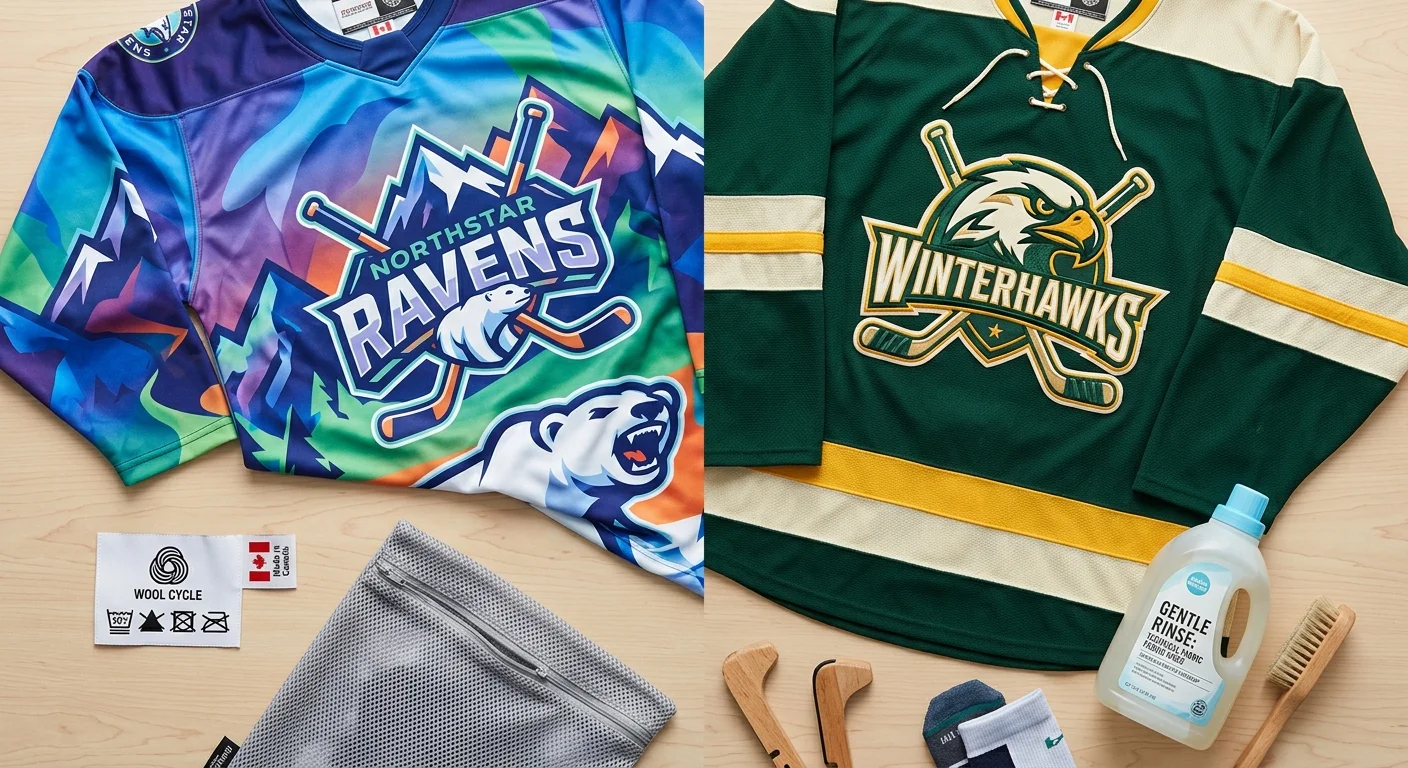
The care label doesn't lie — but most people ignore it until the damage is already done.
NHL-level jerseys with sublimation and twill hybrids last 3–5 seasons under an air-dry protocol. Put the same jersey through a dryer on a regular basis, and that lifespan drops to a single season. That's not a warning — that's a documented outcome.
The rules are simple. The cost of ignoring them is not.
Universal Rules for Both Methods
Cold water only — max 30°C/86°F. Heat fades sublimated ink and bends the thread anchors on embroidered areas.
Gentle cycle, inside out — every time. Use a mild, color-safe detergent. No bleach. No fabric softener — it cuts moisture-wicking performance by 20–30%.
Air dry flat or hang on a wide padded hanger. Pick a shaded, ventilated spot. Reshape the jersey while it's still damp.
No dryer. Even low heat causes bubbling on sublimated prints and breaks down the adhesive on embroidered patches.
No direct sunlight during drying. UV exposure speeds up color loss on both sublimation and embroidery.
Game-Day Stain Protocol
Treat puck marks, tape residue, and sweat stains with an enzyme-based remover like Shout before washing. Wash after every game — no exceptions. Post-game, lay the jersey flat for 30–60 minutes with a fan blowing air over it before putting it in the machine.
Stick to this routine and your jerseys last 2–3× longer — no matter which decoration method you went with.
FAQ: Sublimation vs Embroidery Hockey Jerseys — Quick Answers
Still have questions? These are the ones that come up every time.
What's the core difference between sublimation and embroidery?
Sublimation dyes color into polyester fibers — no added layer, no texture, full-spectrum graphics. The dye bonds inside the fabric itself. Embroidery stitches thread onto the surface. That creates a raised 3D effect. One lives inside the fabric. The other sits on top of it.
Which method lasts longer under real hockey conditions?
Depends what you mean by "last." Sublimation is fade-proof, crack-proof, and wash-proof. Designs survive 50+ wash cycles without breaking down. Embroidery wins on physical toughness. Stitched logos handle board contact and abrasion better than any printed surface can.
Does decoration method affect player comfort?
Yes — and more than most buyers expect. Sublimation adds zero weight and keeps full airflow intact. Embroidery adds minor stiffness. It can also reduce breathability in logo zones, which is worth noting for high-intensity play.
Which costs less for a team order?
Sublimation runs cheaper below 50 units. It also handles player names at no extra setup cost. Above 50 units, embroidery's per-unit pricing gets competitive. Add individual customization to the order, though, and sublimation pulls ahead again.
Can you combine both methods on one jersey? Yes, and it works well. A sublimated base with an embroidered chest crest is a proven hybrid. You get full-color design coverage across the jersey. Plus, you get that tactile, premium feel on the crest where it stands out most. berunclothes.com builds this combination for club and competitive-level teams on a routine basis.
Which works better for large production runs?
Sublimation is much faster to scale. The digital workflow makes 100+ jerseys per day achievable. Embroidery tops out around 20–50 units per day. Digitizing and machine stitching time are the limiting factors there.
Get Your Custom Hockey Jerseys from Berunclothes
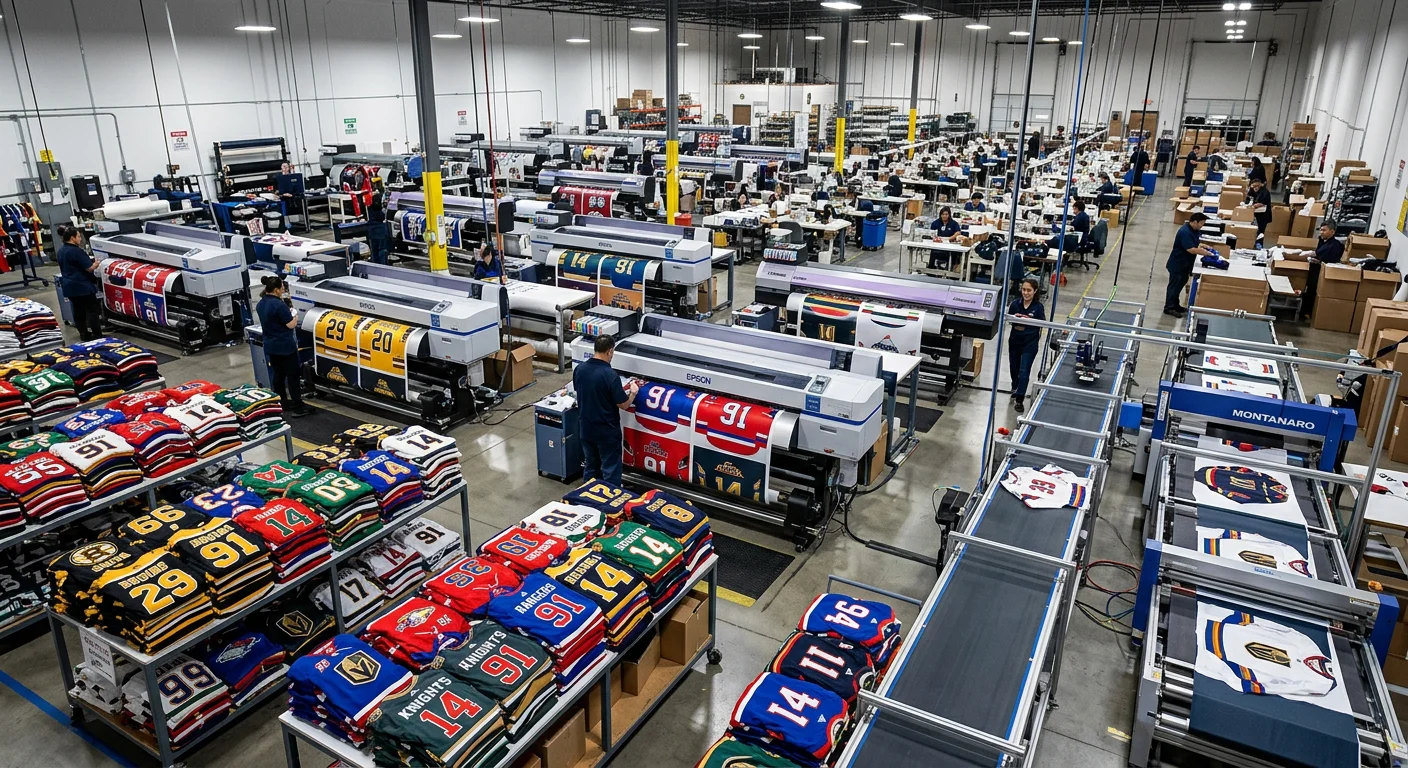
Fifteen years. Over 500 teams. More than 10,000 jerseys shipped every month. That's not a pitch — that's a track record.
Custom hockey jersey orders at Berunclothes.com start at just 10 units. Outfitting a beer league squad? We've got you covered. Running a competitive travel program? Same deal. You get full customization across the board — sublimation base, embroidered crests, player names, numbers, socks, and pants. Every piece holds up through 100+ games. No cracking, no fading, no falling apart.
Not sure which method fits your team? The free fabric and printing consultation is there for that. Compare jersey types side by side. Review real material swatches. Get a wholesale quote within 24 hours.
Three ways to get started:
Free Consultation — Submit your logo at berunclothes.com. Compare sublimation vs. embroidery options with real samples.
Sample Kit — Test durability and fit before committing to a full order.
24-Hour Quote — Upload your team specs and get MOQ pricing from $25–45 per unit.
Your roster deserves jerseys built to last. Start your custom hockey jerseys order today .
Conclusion
Here's what most hockey jersey suppliers won't tell you: there is no single "better" option — just the right tool for your specific situation.
Vibrant, all-over graphics that survive a full season of brutal ice time? Sublimation is your answer. It won't fade or crack. Want tactile prestige and a premium look for logos that don't need edge-to-edge coverage? Go with embroidery. Know your priorities, and the decision comes down to one clear choice.
So what does matter across the board? Find a reliable sublimation and embroidery hockey jerseys manufacturer who truly understands both techniques. Not one who steers you toward whatever's easiest for their production line.
That's where BeRunClothes.com steps in. Outfitting a youth recreational league? Building out a competitive travel team? Their customization specialists match the right decoration method to your budget, timeline, and design. They sort it all out before a single stitch is made or a drop of ink hits fabric.
Don't guess. Get it right the first time. Start Your custom jersey consultation today .