Moving your hunting jacket production to Mexico sounds simple. But three months in, you might be staring at a shipment of blaze orange jackets that failed ASTM safety minimums — or camo patterns that bled in the wash. That's a costly place to learn your lesson.
The gap between a profitable nearshore partnership and an expensive mistake comes down to what you check before you sign anything.
This guide gives you a structured, field-tested framework for vetting any Mexico garment factory for hunting wear . It covers:
The technical capabilities that matter most
The compliance traps most brands miss
The exact steps to go from a cold supplier list to a trial order you can trust
Core Technical Capabilities to Demand From Any Mexico Hunting Jacket Manufacturer
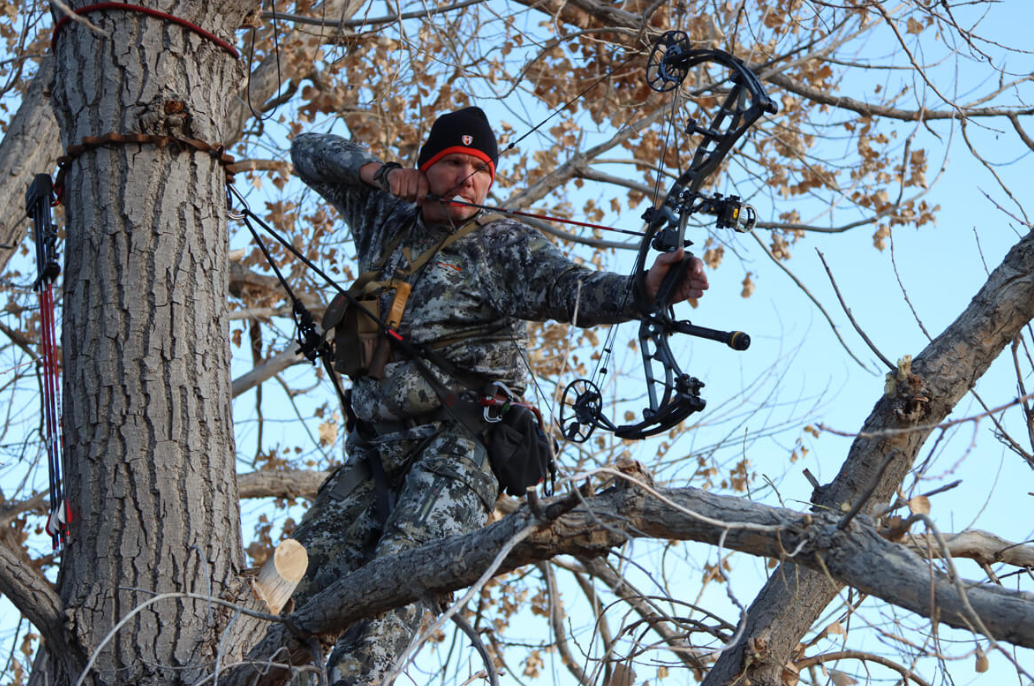
Not every factory that sews jackets understands hunting. That distinction alone can save you months of painful back-and-forth.
Evaluating a Mexico garment factory for hunting wear means holding it to a higher technical standard than regular outdoor apparel. Hunting jackets aren' t just weatherproof shells — they're functional systems built for silence, warmth management, and field-specific movement. Here's what to demand.
Quiet Fabric Engineering
Noise is a deal-breaker in the field. Any credible camouflage jacket manufacturer in Mexico needs hands-on experience with low-noise fabric constructions: brushed-face softshell, bonded fleece, ripstop shells with noise-controlled finishes, and wool-blend systems built for silent movement.
Don' t accept verbal assurances. Ask for:
3 physical samples — an unfinished swatch, a sewn panel, and a finished jacket in the same construction
Audible rustle tests (bend the garment several times and listen)
References from prior hunting, military, or quiet-shell programs with article numbers and order quantities
Evidence of fabric finishing control: brushing, peaching, napping, or bonded-layer handling
No documented finishing control means "quiet fabric" is a marketing claim — not a specification.
Waterproof Execution — With Numbers
Require actual production experience with 2L and 3L laminates , TPU/PU membranes, and taped seams across the full garment. Then verify it with data:
Application | Minimum Hydrostatic Head |
|---|---|
Basic weatherproof hunting shell | ≥ 10,000 mm |
Sustained-rain / tree-stand outerwear | ≥ 20,000 mm |
Pair waterproof data with breathability ratings too. A jacket that traps moisture on a spot-and-stalk hunt is just as problematic as one that leaks.
Confirm the factory tapes all critical leak zones : shoulder seams, hood seams, armhole seams, zipper plackets, and pocket bags. Find out whether taping is done in-house or outsourced . Then ask for proof of operator training, tape-width standards, and wash-durability retention results.
Field-Specific Performance Engineering
A capable custom hunting apparel factory knows that a spot-and-stalk jacket and a tree-stand jacket are two different products entirely:
Spot-and-stalk demands mobility, moisture vapor transmission, lower bulk, and temperature-swing management
Tree-stand demands static warmth retention, wind blocking, silent face fabric, and longer back length
A manufacturer worth your business proposes at least two field-specific variants — one lightweight shell for high-output hunts and one insulated or bonded version for cold-weather sitting. One "all-season" shell pitched as a catch-all? That's a red flag.
USMCA Sourcing Transparency
This is where outdoor clothing OEM /ODM Mexico partnerships either generate real cost advantages — or expose your brand to unexpected tariff liability without warning.
Ask the factory for a fiber-to-finished-garment supply map that names every fabric mill, membrane supplier, seam-tape vendor, zipper, and trim source by country. Then verify:
Which inputs are USMCA-originating vs. only assembled in Mexico
The landed-cost model under both qualifying and non-qualifying scenarios if Asian fabric is used
Whether the factory holds North American mill relationships that preserve your jacket's noise profile, hand-feel, and waterproof spec without losing tariff eligibility
Assembly in Mexico alone does not make a garment USMCA-compliant. No bill of materials broken down by origin? Treat that as high sourcing risk.
Quick Audit Checklist
Before requesting samples, run every prospect through this filter:
✅ Proven constructions: brushed-face softshell, bonded fleece, ripstop shell, 2L/3L laminates
✅ Proof pack: sample set, hydrostatic head report, seam-tape report, BOM by origin, prior hunting program references
✅ In-house process control: cutting, sewing, tape application, membrane handling, traceable QC records
✅ Field-fit understanding: separate builds for spot-and-stalk vs. tree-stand use
✅ Commercial readiness: clear MOQ, lead time, and landed cost under both North American and imported-fabric scenarios
Hunting-Specific Compliance: Camo, Blaze Orange & Safety Standards
Compliance failures in hunting apparel don't show up during production. They appear at the port of entry, in a wildlife officer's citation, or in a lawsuit from a California hunting apparel retailer hit with a Prop 65 notice. Getting this right isn't optional — it's the difference between a product line and a liability.
Here's what your Mexico garment factory for hunting wear needs to prove before a single yard of fabric gets cut.
Camouflage Print Execution: Process, Performance & IP Control
Not all camo Printing methods perform the same on the quiet fabrics hunting jackets require. Before approving any camouflage jacket manufacturer in Mexico, request printed samples in all three production methods. Test each one against the same specification:
Print Method | Best For | Key Risk on Quiet Fabric |
|---|---|---|
Digital direct print | Small runs, complex multi-color patterns, brand-custom camo proofing | "White root" effect on deep-pile brushed fleece — fibers don't absorb ink well |
Heat transfer / sublimation | Polyester-base constructions, mid-volume runs, blaze orange + camo combos | Can flatten nap on thick brushed face fabrics with wrong pressure/temp settings |
Rotary screen print | High-volume classic camo patterns, stable color lot production | Limited gradient detail; not suited for photographic-tier camo reproduction |
For each method, demand measurable data — not visual approval alone:
Friction noise : Test fabric panels at 20–30 dB ambient using a rubbing rig. It should simulate a draw-stroke (bowstring vs. sleeve) and a rifle mount (stock vs. armpit/shoulder). Industry quiet-fabric benchmarks target ≤ 40–45 dB(A) peak friction noise.
Abrasion resistance : On brushed or peached camo faces, require Martindale ≥ 20,000 cycles with no significant color loss before approving print coverage.
Color fastness : Set hard minimums — wash, perspiration, and dry-crock fastness all ≥ Grade 4 (AATCC/ISO standard) . Camo patterns that shift in hue after three washes don't just look bad. They also break the visual disruptive effect the pattern was built to create.
IR reflectivity (if relevant): For tactical crossover programs or premium hunting lines, confirm whether the factory's ink system includes IRR/NIR-suppression dye chemistry . Most factories won't bring this up on their own — you have to ask directly.
IP protection matters just as much as print quality. Your proprietary camo pattern is a brand asset. Ask any custom hunting apparel factory these specific questions:
Does the factory have signed bilateral NDAs with other camo brands — agreements that bind both parties, not just the factory?
Is there a documented artwork management SOP that covers encrypted storage, internal access controls, and sample destruction protocols?
Are pattern files stored on isolated servers or encrypted drives — not shared via WhatsApp or personal USB?
Can they show a Realtree or Mossy Oak license agreement cover page (redacted) as proof they've handled licensed camo IP correctly before?
"We handle it case by case" is not an acceptable answer to any of these. Walk away.
Blaze Orange Compliance: The State-by-State Reality Your Factory Must Understand
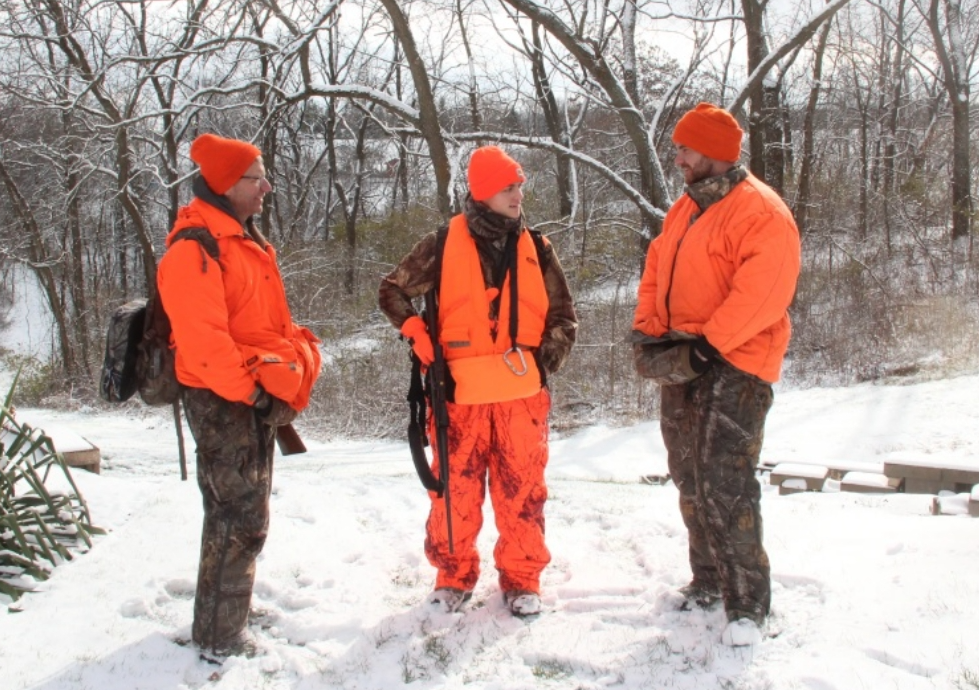
Blaze orange isn't just a color choice. It's a legal requirement. The legal minimums vary enough by state that a jacket built for Michigan can get a hunter cited in Alabama or Colorado.
Here's what the regulatory landscape looks like:
State | Minimum Blaze Orange Requirement | Camo Orange Permitted? |
|---|---|---|
Alabama | ≥ 144 in² solid hunter orange on upper body | No — solid only |
Michigan | ≥ 50% of outer garment surface in hunter orange | Yes (with camo) |
Arkansas | ≥ 400 in² above waist + orange headgear | Yes |
Colorado | ≥ 500 in² blaze orange or pink + head covering | No — solid only |
New Mexico (select areas) | ≥ 244 in² blaze orange | Yes |
The standard design approach: build upper-body blaze orange coverage to ≥ 500 in² in solid (non-camo) construction. This clears the most restrictive states — Colorado and Alabama. It also covers most Canadian provinces, which tend to set similar high-visibility rules for big-game firearm seasons without listing hard square-inch minimums.
What to demand from your blaze orange supplier in Mexico:
Your blaze orange hunting jacket supplier must back color compliance with third-party test data. Fading that reduces visual intensity doesn't just hurt aesthetics — it can make a garment fail legal requirements mid-season. Build these minimums into your tech pack:
Wash fastness : AATCC 61-2A / ISO 105-C06 ≥ Grade 4
Light fastness : AATCC 16 Option 3 / ISO 105-B02, ≥ Grade 4 at 40 hours xenon arc exposure
Dry crocking : ≥ Grade 4 ; wet crocking ≥ Grade 3–4
Perspiration fastness : AATCC 15 ≥ Grade 4
Require the factory to provide a recent third-party test report (SGS, BV, ITS, or UL) with the standard cited and lot number visible. No blaze-orange-specific test on file? Make re-testing on your designated fabric a condition of sample approval — not something you deal with later.
Chemical Safety: REACH & Prop 65 in a Mexico Manufacturing Context
This is the compliance layer most outdoor clothing OEM/ODM Mexico buyers skip during vetting. It's also the one that produces the most expensive surprises later.
REACH (EU market): Your outdoor brand apparel supply chain feeds European retail? Your Mexico factory's chemical inputs must meet EU SVHC limits. Key textile benchmarks:
Phthalates (total): ≤ 0.1% by substance weight
Azo dyes that break down into restricted aromatic amines: prohibited outright
Heavy metals (nickel release, lead, cadmium, hexavalent chromium): strict ppm ceilings
Ask for a current REACH compliance declaration confirming no SVHC above 0 . 1%, plus documented chemical supplier agreements referencing ZDHC or bluesign-approved inputs. A test report covering inks, coatings, and membranes within the last 12 months is the baseline — not optional.
Prop 65 (California): Selling into California means selling into almost every major U.S. outdoor retailer's distribution network. The risk categories to test include lead compounds, phthalates (DEHP, DBP, BBP), formaldehyde, and PAHs. Control points:
Printed panels, zipper pulls, metal hardware, and PVC/PU components carry the highest risk
Industry practice targets lead and phthalates at < 90–100 ppm total to avoid mandatory warning labeling
Ask your factory directly: have they run Prop 65 panel tests for a U.S. outdoor or hunting brand in the last 24 months? Get the report summary if yes. Treat it as a gap to close before first-production approval if no.
Compliance Verification Checklist
Before confirming any Mexico textile manufacturing partner for hunting production, verify:
✅ Three camo print samples tested for friction noise, abrasion, and color fastness with lab data attached
✅ Bilateral NDA template reviewed; artwork management SOP documented and verifiable
✅ Licensed camo IP experience confirmed (Realtree/Mossy Oak reference or equivalent)
✅ Blaze orange upper-body design at ≥ 500 in² solid construction with third-party color fastness report on file
✅ REACH compliance declaration + supplier chemical agreements provided
✅ Prop 65 panel test history confirmed for U.S.-market programs
Production Models Explained: OEM vs ODM vs White Label for Hunting Brands
Three hunting brands can source from the same Mexico garment factory and walk away with completely different results — not because of the factory, but because of the production model they chose.
Getting this decision wrong doesn't just cost money. It costs you an entire season.
Here's how the three models work in a hunting apparel context, and which one fits where you are right now.
OEM: Full Custom, Full Control
OEM means you bring a complete tech pack. That includes pattern specs, size grading, seam construction, camo print parameters, quiet-fabric finishing requirements, functional zoning, and test standards. The factory executes your instructions. Every design decision belongs to you — every pocket layout, every IR-suppression ink spec.
Who it's built for: Established hunting brands developing a signature product. Think proprietary camo patterns, dedicated shooting-side articulation, or a custom MOLLE configuration no competitor can copy.
What it costs to get there:
Development Cost | Typical Range |
|---|---|
Pattern development | $150–$400 per style |
Camo color separation / screen setup | $300–$800 per pattern |
Custom hardware tooling | $200–$1,000+ |
Timeline reality: Plan for 6–9 months from concept to finished goods. Field testing for noise, waterproofing, and temperature management can push that to 12 months if fit or performance issues come up. OEM is not a model you run to hit this fall's whitetail season.
ODM: Factory Base, Brand Customization
The factory already holds a library of proven hunting patterns — softshell jackets, camo windbreakers, insulated tree-stand coats. You pick a base style, then customize within set parameters: camo library selection, fabric switches, pocket layout changes, logo placement, zipper and trim options.
The pattern IP stays with the factory. What you're buying is speed, lower development cost, and a foundation that's already been wear-tested.
Who it's built for: Growing brands that need real differentiation — a season-specific camo, an added MOLLE system, a proprietary blaze orange coverage layout — without a full in-house design team or a $50K development budget.
Timeline: 2.5–4 months. First-fit samples for a functional hunting jacket with camo printing or waterproof membranes run 4–6 weeks for the first round alone. Budget for 1–3 sample iterations before locking production.
MOQ benchmark: 300–800 pieces per style, 200–400 pieces per colorway. The base pattern is already amortized, so factories tend to be more flexible on minimum quantities here than in full OEM runs.
The differentiation risk to manage: The factory sells similar base patterns to other brands. Skip exclusivity negotiations on your specific camo combination, fabric spec, or regional distribution — and a competing hunting brand could run a near-identical jacket in the same season. Get that restriction in writing.
White Label: Speed to Market, Zero IP
White label is the factory's finished inventory with your logo applied. You pick from a current catalog — a universal camo jacket, a blaze orange vest, a greenfield softshell. Your name goes on it. Turnaround is fast: 4–8 weeks from selection to shelf-ready product, including a logo sample approval round.
Who it's built for: Startups testing a new market, brands running a limited-run gifting or group-purchase program, and e-commerce operators building initial SKU depth before committing to a proprietary line.
Cost advantage: Zero development fees. Per-unit pricing runs 10–30% below equivalent ODM production. Sample costs range $50–$150 per style where they apply at all, and factories credit that against your first order.
The hard truth about white label in hunting: The same jacket you're selling may be on 10 other brands' pages at the same time. Serious hunters build product credibility through field performance and word-of-mouth. Undifferentiated product is a ceiling, not a strategy. White label works for market validation — not for building a brand with long-term staying power.
Matching the Model to Your Stage
Brand Stage | Recommended Model | Key Advantage |
|---|---|---|
Pre-launch / market testing | White Label | Fastest speed to market, lowest capital risk |
Growing brand, 1–2 seasons in | ODM | Real customization without full development overhead |
Established brand with proven demand | OEM | Full IP ownership, maximum product differentiation |
A common mistake: brands jump straight to OEM because it sounds more professional. Then they spend nine months developing a jacket before confirming whether hunters want the product at all.
The smarter sequence: Start with 2–3 ODM styles to build revenue and collect customer feedback. Run one OEM style alongside if you have a specific proprietary feature ready. Use ODM revenue to fund the OEM development cycle — and use your status as an active customer to negotiate better MOQ terms from your Mexico garment factory for hunting wear . A cold inquiry gets a different answer than an established account.
MOQ Negotiation Tactics That Work
Standard MOQ floors are not fixed. There's room to negotiate — especially with a custom hunting apparel factory that wants a long-term account:
Bundle fabrics across styles. Your camo jacket and camo pants share the same printed fabric? Negotiate the 1,000-meter minimum across both styles, not per style. You hit fabric minimums while keeping per-style quantities at 300–500 pieces.
Lead with ODM volume to unlock OEM flexibility. Commit to 1,500–2,000 total pieces across ODM styles. That gives you leverage to negotiate a 300–500 piece OEM pilot run on your custom style. The factory won't treat it as a one-off anymore.
Trade unit price for lower MOQ. Offer a straight 5–10% price premium in exchange for 200–300 pieces per color. Factories absorb low-volume runs far more readily when the margin covers the line changeover cost.
Build a pilot run clause into your agreement. Target 100–200 pieces at a 5–15% premium over bulk pricing. Roll into a full production order within 3–6 months, and negotiate that pilot premium as a credit against the bulk order — or structure it as a tiered discount once you cross 500 pieces.
Step-by-Step Vetting Process: From Longlist to Trial Order
Most brands treat supplier vetting as a binary decision — factory looks good, place the order. That's how you end up with a blaze orange jacket that fades by December and a manufacturer who can't explain why.
The smarter approach is a structured funnel. Start wide, cut fast, and don't commit real money until the evidence earns it.
Stage 1: Build Your Longlist (Target: 15–30 Factories)
Run bilingual searches — " hunting jacket manufacturer in Mexico" alongside Spanish-language variants — across Alibaba, Made-in-China, and industry trade directories from MAGIC and SHOT Show. Pay attention to overlap. A factory that shows up on both a sourcing platform and a trade show floor is signaling real commercial intent. Start your longlist there.
The initial cut is straightforward. Keep factories that list outdoor or hunting apparel as their primary category , hold North American export history, and can point to comparable client programs. Drop the rest.
Stage 2: Send a Structured RFQ (Cut to 5–8 Factories)
A vague RFQ gets vague responses. Your request for quotation needs three hard numbers upfront:
Target FOB price range — a band, not a single figure
Annual volume estimate — broken down by SKU, colorway, and size run
Product function brief — windproofing, waterproofing, quiet fabric construction, mobility zones, pocket and zipper placement
Require these documents with every response:
Fabric BOM — weight, composition, coating or membrane, lining, trims
Test reports — performance, colorfastness, tensile strength
Client references — same category, same target market
Factory credentials — export records, OEM/ODM experience
A factory that responds without documentation is telling you something. It's showing you how they operate.
Stage 3: Factory Audit — Remote or On-Site (Cut to 2–3 Factories)
Remote audits verify process and records. On-site audits confirm whether the equipment and trained operators are present in the building — not just listed on paper.
For custom hunting apparel production , six areas matter most:
Cutting room : lay planning, bed scale, waste control
Sewing floor : workstation count for critical operations, machine types, skilled operator ratio
Seam sealing : dedicated waterproofing equipment, not a shared station
Sample room : independent grading, fitting, and tech file archiving capability
QC infrastructure : inline inspection records, final audit process, and documented rework rates
Worker conditions : PPE, fire egress, machine guarding
Pull three records on-site: incoming material inspection, in-process inspection, and outgoing QC. Ask straight for first-pass rate, rework rate, and critical process failure rate . Factories worth your business keep these numbers ready. The ones that don't are running blind.
Stage 4: Sample Evaluation
Test every sample against field-use criteria — not just visual finish. A quiet-fabric hunting jacket needs to pass a movement test, not just a hanger check.
Check samples across five dimensions:
Fabric noise — bend, rub, and draw-stroke test against a 40–45 dB(A) quiet-fabric benchmark
Seam strength — stress points at shoulder, armhole, pocket bag, and zipper placket
Fit and mobility — raise arms overhead, simulate a rifle mount, bend at the waist. Does the jacket move with you?
Functional detail — pocket access, zipper pull behavior, reinforcement placement
Spec conformance — does the finished sample match your tech pack, or did the factory make substitutions without telling you?
Stage 5: Trial Order — Validate Before You Scale
A trial order isn't production. It's a stability test. Set the parameters before you place it:
AQL threshold and acceptable defect classifications
Timeline milestones : order confirmation, pre-production sample sign-off, mid-production inspection, ship date
Claims structure : penalties for late delivery, major quality failure, or batch rework liability
After the trial order, track four numbers: on-time delivery rate, first-pass quality rate, rework rate, and customer complaint rate .
A factory that hits all four metrics with consistency is a Mexico garment factory for hunting wear worth scaling. If the numbers fall short, you have the data to negotiate corrective action — or move straight to your second shortlist candidate without starting from zero.
Quality Certifications & Compliance Documentation That Matter
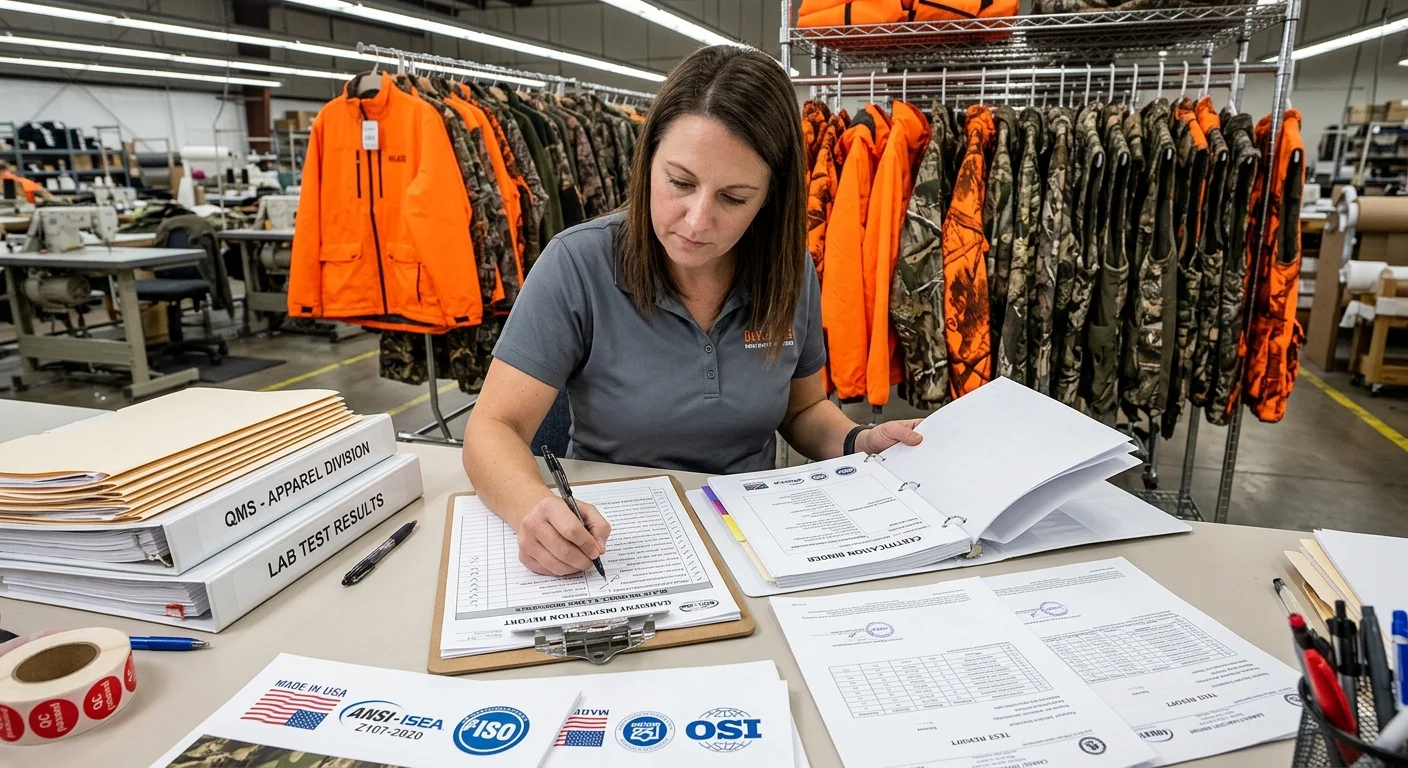
Paperwork isn't glamorous. But one missing compliance document can hold your shipment at the port, trigger a retailer chargeback, or land your brand on a CPSC recall list. Here's what to demand — and why each document gets checked.
Labeling Compliance: TFPIA, Care Labels & Canadian Requirements
The U.S. Textile Fiber Products Identification Act (TFPIA) requires every garment to carry three things:
- Fiber content listed in descending order by weight percentage
- A manufacturer name or registered number (RN)
- Country of origin
The enforcement tolerance on fiber content is ≤ 3% variance from the declared composition. A jacket labeled 60% cotton / 40% polyester must test at no less than 57% cotton. That's not a suggestion — that's the threshold third-party auditors and CBP use.
Your factory needs three hard documents for every fabric run:
Fiber content test reports from SGS, Bureau Veritas, or Intertek — tied to specific lot numbers
A cross-reference log matching production fabric batches to the label version used
Internal composition sampling records, minimum one test per color per batch
For care labeling (16 CFR 423) , "reasonable basis" is the legal standard. Your factory must back every wash instruction with test data. That means AATCC 135/150 cycles, minimum 5–10 wash rounds, confirming no shrinkage, color loss, or seam damage. Build the test report number into your tech pack's wash label approval form.
Selling into Canada? Keep a separate bilingual label set for every style. Fiber names must follow regulatory terminology — Lyocell , not Tencel . Store your CA number registration and a dual-language label compliance approval log as standalone documents in your supplier file.
Retail Certification Requirements: ISO 9001, BSCI & SMETA
REI's factory profile intake form has a hard field for ISO 9001 certificate number, certifying body, and expiration date. Cabela's and Bass Pro run the same checks for active outdoor vendor accounts. For a Mexico garment factory targeting U.S. outdoor retail, this is not optional — it's a gate.
Here's what buyers pull from an ISO 9001-certified custom hunting apparel factory:
AQL incoming inspection records, in-process audit logs, and final inspection reports — all in standardized formats
Corrective action records with named owners and closed dates
Annual management review minutes and internal audit results
Operator training records covering sewing skills and quality awareness, version-controlled against current workstation SOPs
For social responsibility, mid-to-large outdoor retail accounts require a BSCI, WRAP, SMETA, or SA8000 audit completed within the last 12 months. SMETA needs at least 2-pillar coverage (labor + health and safety). BSCI Grade C or above. Ask for audit type, grade, audit date, validity period, auditing body, and closed corrective action evidence — photos, training sign-in sheets, and payroll samples.
Performance Testing: The Numbers Retailers and Buyers Verify
Every performance claim on your blaze orange hunting jacket or waterproof camo shell needs a third-party test report behind it. Build these minimum specs into your QA agreement:
Performance Metric | Minimum Threshold | Test Standard |
|---|---|---|
Hydrostatic head (basic shell) | ≥ 10,000 mm | ISO 811 / AATCC 127 |
Hydrostatic head (sustained exposure) | ≥ 20,000 mm | ISO 811 — post 5-wash |
Breathability (MVTR) | ≥ 10,000 g/m²/24h | JIS L 1099 B1/B2 / ASTM E96 |
Tear strength (mid-weight nylon/poly) | ≥ 15–20 N | ASTM D1424 / ISO 13937-1 |
Tear strength (Cordura/heavy oxford) | ≥ 30–40 N | ASTM D1424 |
Seam strength (main seams) | ≥ 150–200 N | ISO 13935-2 / ASTM D1683 |
Seam slippage (at 180 N load) | ≤ 4 mm displacement | ISO 13935-1 |
Wash colorfastness | ≥ Grade 4 | ISO 105-C06 / AATCC 61 |
Dry crock fastness | ≥ Grade 4 | ISO 105-X12 / AATCC 8 |
Wet crock fastness | ≥ Grade 3–4 | ISO 105-X12 |
Light fastness (camo patterns) | ≥ Grade 4 | ISO 105-B02 |
Two points most outdoor clothing OEM/ODM Mexico buyers miss in seam testing. First, reports must name the seam type (e.g., 504 overlock + 301 topstitch), stitch density, and thread weight. Second, some factories test fabric edge trimmings instead of sewn panels. That's a common workaround that inflates results. Require test specimens pulled from shoulder seams, side seams, and armhole seams.
How to Hard-Wire Document Requirements Into Your Agreement
Don't chase compliance paperwork after production. Write it into your tech pack and QA protocol before sampling begins. Here's the contract language that works:
"All functional performance indicators — hydrostatic HEAD , MVTR, tear strength, seam strength, and colorfastness — must be supported by third-party laboratory reports in English from SGS, Bureau Veritas, or Intertek. Reports must be dated within the last 12 months, include a report number, sample photographs, and the applicable test standard citation. Production fabric acceptance depends on receipt of conforming reports before cutting authorization."
That last clause is the enforcement mechanism. Tie cutting authorization to document receipt. Without it, factories ship first and file paperwork late — or not at all.
Compliance Documentation Checklist
Before approving any Mexico textile manufacturing partner for hunting production, confirm:
✅ TFPIA fiber content test reports by lot number, within 12 months
✅ Care label reasonable-basis test data (AATCC 135/150, ≥5 wash cycles)
✅ Bilingual Canadian label set with CA number and compliance approval log
✅ ISO 9001 certificate with certifying body name and active expiration date
✅ BSCI / WRAP / SMETA audit report — Grade C or above, completed within 12 months
✅ CAP closure evidence for any open corrective actions
✅ Third-party performance reports covering hydrostatic head, seam strength, tear strength, and colorfastness — post-wash data included
✅ Cutting authorization protocol tied to document receipt confirmation
Common Pitfalls When Sourcing Hunting Jackets in Mexico (And How to Avoid Them)
Four mistakes cause most failed Mexico hunting jacket partnerships. They're not random — they follow a predictable pattern. And every one of them is avoidable. You just need to know what to look for before money changes hands.
Mistaking "Outdoor Factory" for "Hunting-Specialist Factory"
A factory that makes softshells and hiking pants is not a hunting jacket factory. Most buyers don't see that difference until it's too late.
Scan any serious candidate's product catalog for at least 20–30 styles. A factory with real hunting experience will show 5–10 existing patterns with these features:
- Blaze orange panels meeting ≥ 400 in² visibility requirements
- Brushed or pile face fabrics built for silent movement
- Purpose-built pocket layouts — game bags, shell loops, drop-in mag pockets
90% of their samples are softshells, yoga pants , and trail jackets? No high-vis orange. No noise-controlled construction. That's a hard disqualifier. Move on.
Test them with a direct question too. Ask: "Which brushed fleece weights do you run for noise-controlled applications — and have you done any acoustic comparison testing?" A qualified factory gives you specifics: 220–280 g/m² brushed polyester , dense knit brushed tricot, and construction notes on avoiding stiff TPU films at shoulder seams and armholes. Vague answers mean they don't have the experience.
Misreading USMCA Rules of Origin
"Made in Mexico" does not mean zero tariff by default. This mistake costs brands tens of thousands of dollars in CBP back-assessments.
Hunting jackets (HS 6201/6202) require yarn-forward or fabric-forward origin compliance under USMCA. A jacket cut and sewn in Mexico from Chinese 150D polyester twill fails that test. It stays subject to MFN tariff rates of 16–27% . CBP can pursue back-assessed duties across five prior import years . That's a serious financial risk.
Before sampling, get the factory's fabric mill names, countries of origin, and HS codes in writing. Send that to a licensed customs broker and get a written origin determination. Then add a contract clause: the factory absorbs penalty costs up to 15–25% of order value if their origin declaration turns out to be wrong. Put it in writing before you commit.
Writing Vague Waterproof Specs
"Waterproof" in a tech pack with no number attached is a liability, not a specification. It gives the factory room to interpret — and they'll interpret it in their favor every time.
Lock down every parameter before sampling starts:
Hydrostatic head : ≥ 10,000 mm (ISO 811) for standard shells; ≥ 20,000 mm for sustained-rain or tree-stand builds
Seam taping scope : List every zone in writing — shoulder, hood, armhole, sleeve top, front zipper placket — and mark each one on the pattern diagram
DWR retention : AATCC 22 ≥ 90/100 on the initial test; ≥ 70/100 after 20 home wash cycles (ISO 6330)
Tie cutting authorization to a third-party lab report that confirms these numbers. Post-delivery testing shows non-conformance? The contract spells out a minimum 10–20% value deduction or mandatory rework. No verbal promises. No "we'll do better next time."
Taking Capacity Claims at Face Value
A factory quoting 30,000 units per month is describing their ceiling — not their floor. Real, stable output at most Mexican mid-size garment operations runs at 60–70% of stated capacity .
The rule is simple: never place a first order above 50% of their stated monthly capacity . Go past that threshold and delays become near-certain, not just possible. Start with a controlled trial order. Track on-time delivery rate and first-pass quality rate. Then scale based on verified performance — not on what the sales rep wrote in the quote.
How to Structure a Long-Term Partnership With Your Mexico Manufacturer
The brands that win with nearshore manufacturing aren't the ones who found the best factory. They're the ones who built the best relationship with it.
A Mexico garment factory can start as a trial-order vendor and grow into a core strategic partner. It can handle new product development, hold reserved capacity, and act as a direct extension of your supply chain team. To get there, you need to structure the relationship with purpose from day one.
Here's the three-stage roadmap that works.
Stage 1: Validate First (Months 0–12)
Start with ODM or white label. Keep quantities small — 100–200 pieces per style during a trial window. Scale to 200–500 pieces as quality and delivery performance hold up. The goal isn't volume. It's baseline data.
Track four numbers from your first order:
- On-time delivery rate
- First-pass quality rate
- Rework rate
- Communication response time on critical issues
Ask for a full cost breakdown upfront — fabric, trims, labor, overhead, margin. A factory that won't open its cost structure isn't a long-term partner. It's a transactional vendor.
Stage 2: Scale With Shared Skin in the Game (Months 12–24)
Once you've confirmed performance baselines, shift the relationship from buyer-supplier to co-development. This is where custom hunting apparel production partnerships start building real competitive advantage.
Two mechanisms make this work:
Rolling forecasts with locked near-term windows. Share 12–18 month rolling volume projections and update them each month. Commit to locking the nearest 3 months within ±20% variance. Your Mexico garment factory for hunting wear gets the purchase order visibility it needs to secure fabric and book capacity. You earn priority placement before production floors fill up.
Co-development cost sharing. Split sampling, lab testing, and tooling costs 50/50. In return, negotiate an 18–24 month exclusivity window on your camo fabric combination, pocket architecture, or quiet-fabric construction. The factory gets margin protection. You get a product edge no competitor can copy next season.
Add a quarterly KPI review to your agreement. Target on-time delivery at ≥ 95% and push defect rates down from 2% to under 1% within 12 months. Strong performance earns a 1–2% pricing incentive next season. Missed targets trigger a written corrective action plan — not a phone call.
Stage 3: Lock in Strategic Capacity (Month 24+)
At this stage, your outdoor brand apparel supply chain should run a full OEM model with seasonal development calendars and pre-booked production capacity.
Reserve 30–60% of the factory's output each month as brand-dedicated capacity. Lock it in with a take-or-pay clause. Use less than 80% of reserved capacity in a given period, and you cover a portion of the fixed costs. In return, you get guaranteed production slots, stable unit pricing, and first priority when raw material shortages hit.
Build a reverse production calendar for each season:
Milestone | Timing |
|---|---|
Pattern & material development | T-6 months |
Confirmed sample approval | T-4 months |
Pre-production sample (PPS) | T-3 months |
Bulk production start | T-2 months |
First delivery to DC | T=0 |
The Dual-Source Model: Mexico + Asia
Outdoor clothing OEM/ODM brands scaling past 5,000 units per style face real risk with a single-source setup. Here's the structure that works:
Role | Factory Location | Sweet Spot |
|---|---|---|
Core volume / cost optimization | Asia (Vietnam, Bangladesh) | 5,000–10,000+ units, 45–90 day lead time |
Fast replenishment / new product testing | Mexico | 100–1,000 units, 15–30 day lead time + 2–7 day truck transit |
Use an ABC product tiering logic:
A-tier (proven bestsellers): Bulk in Asia, hold 10–20% replenishment capacity in Mexico for in-season restocks
B-tier (growth styles): First 200–500 units in Mexico to validate, then shift bulk to Asia while keeping Mexico as the replenishment buffer
C-tier (test/trend styles): Mexico only — absorb the higher unit cost, cut the inventory risk
Be straight about the Mexico premium. Expect to pay 10–25% above your Asia FOB cost for the same style. The math still holds once you count avoided stockouts, fewer emergency airfreight orders, and shorter cash-to-cash cycles.
Brands that treat their nearshore apparel manufacturing partner as a strategic asset — not a cost center — build product lines competitors can't catch. Start the relationship with discipline. Build it with data. Give the factory a real reason to prioritize your production slots while everyone else fights for the same floor time.
Conclusion
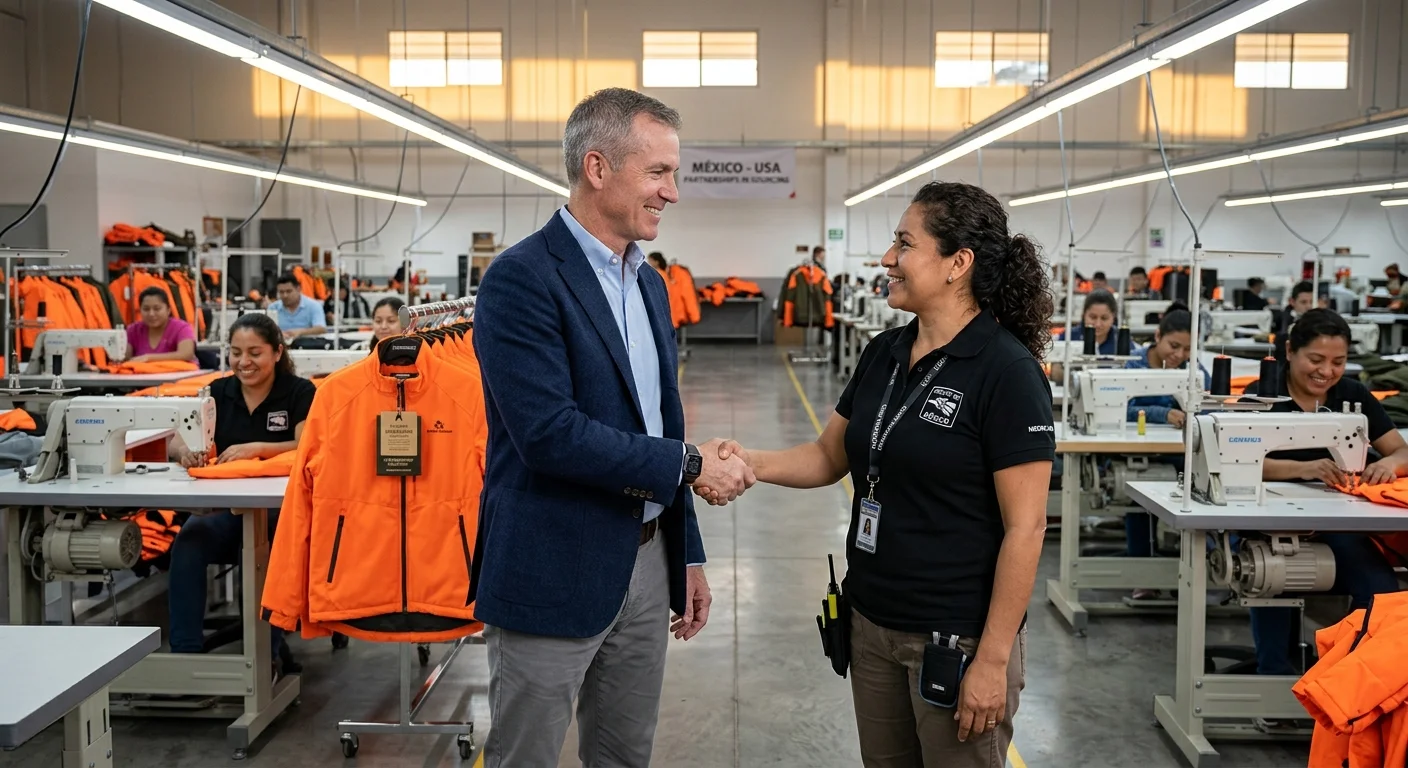
Finding the right hunting jacket manufacturer in Mexico isn't one decision. It's a series of smart ones, made in the right order.
Here's the framework you now have:
Evaluate technical fabric capabilities first
Verify blaze orange and camo compliance before signing anything
Structure your partnership around shared quality standards — not just the lowest unit price
Mexico's nearshore advantage grows stronger with a manufacturer who truly understands hunting gear. One that delivers on that promise, not one that just talks about it.
The brands winning in outdoor apparel right now aren't chasing the cheapest factory. They're building supply chains that hold up. A new season launches. A retailer doubles their PO. A compliance issue surfaces at customs. The right partner handles all of it.
That's the real competitive edge.
Ready to vet a custom hunting apparel production partner who checks every box on this list? Berun Clothes is built for this conversation.
Start with a sourcing consultation. Your next best-selling jacket starts here.