A hockey jersey hanging in someone's basement is just fabric. A hockey jersey worn by Wayne Gretzky during a playoff run — authenticated, provenance-documented, and preserved under museum-grade glass — that's a different conversation. The gap between those two objects isn' T sentimental alone. It's measurable, historical, and in some cases, worth more than a car.
Behind that ecosystem, even specialized hockey dress suppliers play a role in producing licensed apparel that eventually feeds into the broader memorabilia pipeline.
Most people stumble into the NHL memorabilia market blind. They don' t understand why certain jerseys hold value for decades while others collect dust at a fraction of their original retail price. That difference isn't random.
There are clear patterns at work. They're rooted in scarcity, player legacy, championship history, and the deep human instinct to hold onto something that felt, for one moment, electric. This is an exploration of those patterns.
What Separates a Collectible NHL Jersey from Just a Jersey

Three things determine whether a jersey is worth thousands or worthless as a collectible: scarcity , historical significance , and authentication . Remove any one of them, and the value collapses.
Scarcity That Can Be Measured
Not all scarcity is equal. Game-worn NHL jerseys are built for on-ice use. They're made in Canada, stitched at a single Quebec facility that has supplied the league for close to fifty years. Each team gets only a few hundred per season. Standard retail replicas? Tens of thousands.
Special event jerseys are even rarer. Hockey Fights Cancer and Military Appreciation warm-ups are made at about one per player, per game — around twenty to twenty-five units per team, per night. That's a completely different level of scarcity.
Then there are jerseys that are, in practice, one of one . Board burns on a sleeve. Stick tape marks. A repair stitched mid-season. These physical signs of game use can be matched to broadcast footage, frame by frame. No NHL hockey jersey factory can produce that.
Historical Significance: The Event Behind the Fabric
Scarcity without meaning produces curiosity pieces, not collectibles. A jersey earns serious NHL memorabilia status through its connection to something that mattered .
Auction records make this clear. Heritage Auctions and Classic Auctions data shows that jerseys tied to milestone moments — a 500th goal, a Stanley Cup clincher, a record-breaking night — sell for 5 to 10 times the price of generic game-worn examples from the same player. Sidney Crosby and Alexander Ovechkin playoff jerseys often reach mid-five to low-six figures USD . Non-event game-worn pieces from the same era? Often $5,000 to $20,000.
Era matters too. Ice hockey jersey manufacturers like CCM , Koho, and the early Reebok EDGE line represent closed production cycles. Adidas replaced Reebok, and every authentic EDGE jersey became a sealed artifact. Its specs are frozen in time. Its supply will never grow.
Authentication: Where Value Is Either Confirmed or Capped
A jersey can be genuinely rare and tied to a major moment — and still sell for a fraction of its real worth. That happens without proper paperwork.
The MeiGray Group works directly with NHL teams. They provide serialized interior tags, detailed letters of authenticity, and photo-match references. Major auction houses — Heritage, Classic Auctions, Goldin, Lelands — catalog game-worn jerseys by season, set number, player size, and customization style of ice hockey jersey.
The gap between documented and undocumented is steep. A claimed Cup-clinching game-worn jersey with no letter of authenticity or photo match sells at 10 to 25 percent of what a fully authenticated piece brings. Authentication doesn't add value — it unlocks value that was already there.
Physical details back up the paperwork too. Look for the correct fight strap, multi-layered tackle twill with 3D embroidered crests instead of heat-pressed patches, and era-specific NHL shield placement. Fanatics Authentic Pro jerseys carry a holographic NHL Shield at the front neck that shifts color by viewing angle. Serious collectors know these details — and so do serious buyers.
Why All Three Must Be Present
Each element alone is not enough.
1.Scarcity without significance : A practice-worn jersey from a depth player may be a true one-of-one, yet sell for only low hundreds of dollars at auction. Rarity without a story has a ceiling.
2.Significance without authentication : Big provenance claims with no supporting paperwork get priced to match — low and speculative.
3.Authentication without scarcity : Mass-signed retail runs of five hundred pieces, no matter how well-documented, rarely beat a single authenticated, photo-matched game-worn jersey from a meaningful night.
The vintage hockey jersey prices that make headlines — Gretzky and Orr game-worn pieces topping $250,000 at auction, Classic Auctions hockey-only sales reaching low-to-mid seven figures — come from all three factors landing in the same object at once. That's what separates a collectible NHL jersey from fabric with a number on it.
The Scarcity Factor: Why Rarity Drives NHL Jersey Prices Up
Supply and demand is a cold equation. In the NHL jersey collectibles market, it creates something surprisingly personal — the quiet satisfaction of owning something no one else can replicate.
Scarcity in this market falls into three clear tiers. Knowing them helps you buy smart instead of overpaying for the wrong things.
Limited-edition event runs — Stadium Series, Winter Classic, anniversary drops — come in small, time-locked batches. Once the retail window closes, no more stock comes in. That's it. Discontinued alternate jerseys follow a slower path. Fans often skip them at launch, then chase them years later once nostalgia kicks in and replacement stock dries up. The New York Islanders' "Fisherman" era jerseys are a perfect example. Fans mocked them at release. Today, those jerseys are hard to find, and secondary-market prices would shock anyone who picked one off the rack in 1996.
Then there's the top tier — game-worn, one-of-one pieces — where no second copy exists by definition.
The numbers make this clear. A Fanatics Authentic Pro jersey retails at $425 USD blank , against $180 for the premium tier . That's a 2.3× jump for the version closest to what touches the ice. Scarcity and closeness to the game drive that gap — not fabric weight alone.
One pattern shows up across the memorabilia market:
1.Numbered runs get more valuable as the sequence shrinks
2.Event-only designs gain urgency the moment the event ends
3.Discontinued alternates go from ignored to in-demand the instant production stops
The core rule stays the same. Rare plus meaningful plus documented — that combination turns value from a guess into something that holds.
Player Legacy and Hall of Fame Impact on Jersey Value
Numbers tell part of the story. A jersey worn by a fringe roster player might fetch a few hundred dollars at auction. The same garment — same fabric, same stitching, same era — worn by a Hall of Famer during a milestone game? The price doesn't climb. It vaults.
Player legacy is the single most powerful value driver in the NHL memorabilia market. Everything else — scarcity, authentication, condition — builds on what legacy already created. Without it, those factors are interesting. With it, they become transformative.
Why Retirement Changes Everything
A player steps away from the game. The market shifts. New game-worn supply from that career stops. No more playoff runs. No more record nights. No more fresh inventory.
Demand doesn't fade with it. It stays — driven by nostalgia, by a fanbase that grew up watching, by collectors who know the career story is now complete. Nothing more will be added. That supply squeeze starts slow. Then it becomes obvious once attention locks onto a legend's name.
Wayne Gretzky's jerseys are the clearest example. His playing days are long over, yet his game-worn pieces hold as long-term assets. No new supply is coming to push the ceiling down. The cultural weight grows with time. Mario Lemieux sits in the same tier — Hall of Fame status, a career built on extraordinary peak performance, and memorabilia from his era that is well-documented but genuinely hard to find.
The Hall of Fame Catalyst
Induction doesn't create value from nothing. What it does is accelerate the pricing of value that was already forming . Industry observers note a clear price lift around induction announcements — especially on signed jerseys and autograph-heavy pieces, where the effect shows up most.
For players already seen as blue-chip legends, the lift may be small. The market had priced in their status years earlier. For players whose Hall of Fame cases were debated or delayed, induction can produce a sharper, more sudden move.
The practical rule holds firm:
Legend + retired + authenticated game use = highest tier
Legend + signed + strong COA or hologram = premium autograph tier
Legend + milestone game (retirement night, induction year, championship clincher) = event premium stacked on top of legacy premium
Legend + weak provenance = legacy still supports value, but the ceiling drops hard
The Rookie Season Exception
There's one category worth separating out: early-career jerseys from players who later became locks for the Hall.
Sidney Crosby's rookie-era jerseys carry a specific premium. They were collected before full legacy pricing settled in . That's the key. They mark the origin point — the first chapter of a story that turned out to be exceptional. A collector holding a jersey from Crosby's early Pittsburgh seasons holds something rare. It captures both the moment and the promise, documented before anyone could be certain how the story would end.
That combination — historical significance plus the feeling of having called it early — is what pulls collectors toward rookie-era pieces from eventual legends. The jersey becomes a kind of proof.
What Legacy Without Documentation Leaves Behind
A player's reputation is permanent. Authentication is not.
Even the most iconic name in hockey history can't rescue a jersey from incomplete provenance. No photo-matching, no credible letter of authenticity, no broadcast correlation — and a claimed game-worn piece from a legend sells well below the upper market band. Not because the player's legacy is in doubt. Because the connection between the player and that specific object stays unconfirmed.
Legacy sets the ceiling. Documentation determines how close to it a jersey actually sells.
Game-Worn vs. Signed vs. Retail: How Jersey Type Determines Collectible Value
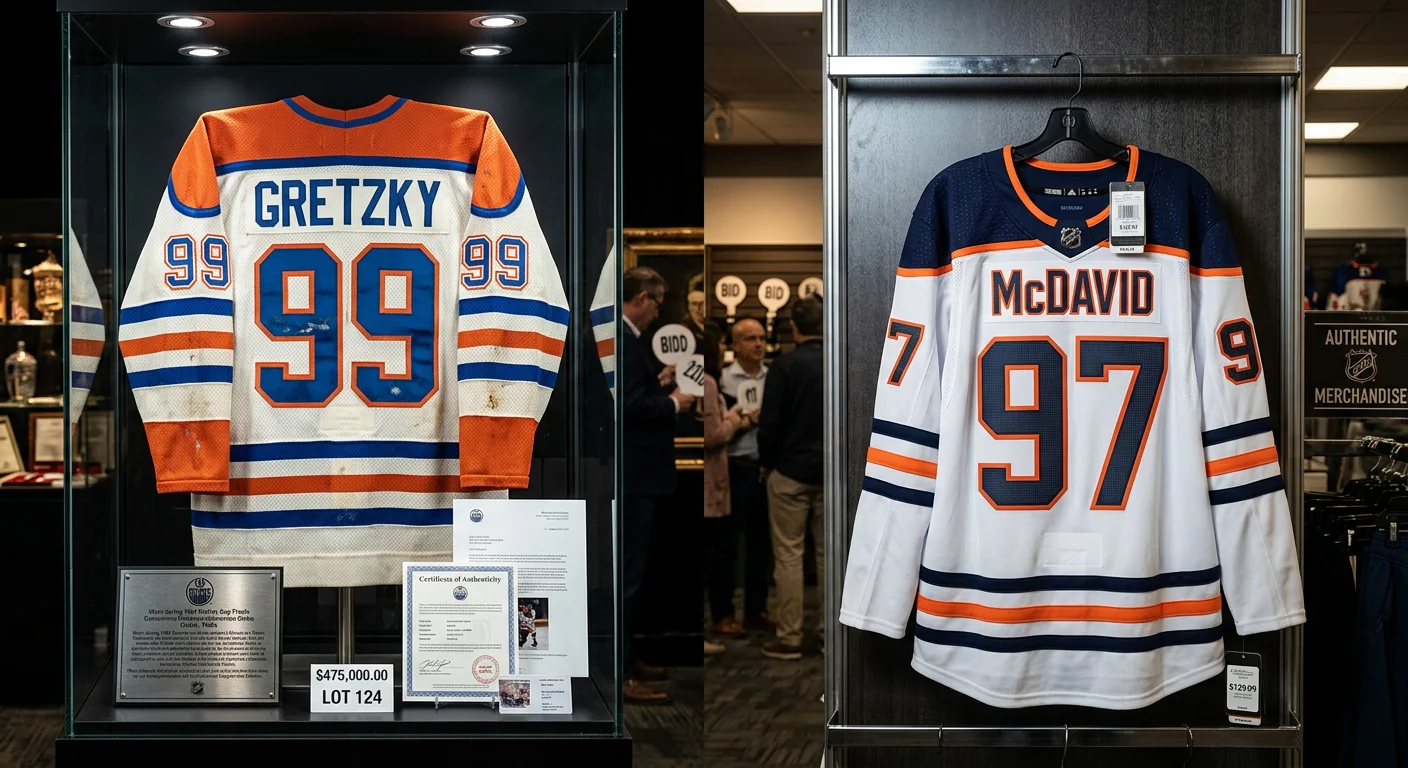
Four categories. One spectrum. The gap between the bottom and top is not about personal taste — it's about thousands of dollars. Knowing where a jersey sits on that spectrum is the first real skill a serious collector builds.
Replica jerseys sit at the lowest rung. New, they run $80 to $180. They lose value fast — reselling at 30 to 60 percent of retail in most cases. A role player's signature won't rescue them. Even a Hall of Famer's autograph on a replica trades below what an unsigned authentic would sell for. The materials give it away. Wrong fonts, heat-pressed cresting, no fight straps — experienced buyers spot these details on sight, and they price the piece to match.
Retail authentic jerseys — the Adidas Pro, the Fanatics on-ice spec, anything in that $230 to $350 range — hold up better. Most drop to 50 to 80 percent of retail on the secondary market. One exception stands out: discontinued manufacturer runs of ice hockey jersey. A 1990s CCM or Starter authentic, never worn in a game, now sits in a closed production cycle. No new supply exists. Nostalgia adds value every year. That puts it in a different conversation than last season's Adidas.
Signed authenticated jerseys bring in a factor the other categories don't have: the player. A signature from a generational talent on an authentic jersey — hologrammed, registry-verified through Fanatics Authentic, Upper Deck, or MeiGray — reaches $300 to $1,200 for current stars, and $1,000 to $5,000 for names like Gretzky and Lemieux. The authentication source matters a lot here. A generic COA from an unnamed dealer can strip 30 to 60 percent of a piece's value compared to a top-tier certified equivalent. Documentation isn't just paperwork. It's the price tag.
Game-worn jerseys sit in a different class entirely — not just a higher tier, but a separate category.
A regular-season game-worn jersey from a depth player on a mid-market team lists at $200 to $400 through primary sources like Hangar Hockey or MeiGray. A star player's equivalent runs $1,000 to $5,000. Above that, the math shifts again. Cup Final jerseys. Record-night pieces. Milestone game sets. These trade at 2 to 10 times the price of the same player's standard game-worn jersey.
That premium doesn't come from sentiment alone — it comes from meaningful wear . Board burns, stick tape residue, visible repairs stitched mid-season. Collectors seek out these marks on purpose. MeiGray and team letters of authenticity grade wear on a clear scale: light, moderate, heavy. Heavier, photo-matchable wear can add 20 to 100 percent over a lightly worn comparable. The damage is the proof.
Here's how the value stacks up across types:
1.A star's standard regular-season gamer: 1.5 to 3 times the value of a signed authentic from the same player
2.A milestone or event gamer from that same player: 5 to 10 times the signed authentic's value
3.An unsigned authentic: often valued above a signed replica — build quality and long-term scarcity outweigh a signature on weaker materials
One more factor shapes the signed jersey market. The jersey substrate matters . A signature on an authentic on-ice spec jersey carries about 1.5 to 2 times the value of the same signature on a replica. Add a special edition — Winter Classic, Reverse Retro, a numbered run of 100 — and the premium climbs further still.
Strip it all down, and the logic is this: jersey type sets the floor; player legacy and event significance build the ceiling; authentication determines how close to that ceiling a piece actually sells . Each layer rests on the one below it. Miss any single layer, and the numbers shift — usually in ways that catch sellers off guard and reward buyers who studied the market first.
Historical Moments That Turned Ordinary Jerseys Into Million-Dollar Memorabilia
Some moments in sports carry a price tag. It's not written down anywhere. Nobody agrees on it in advance. But it builds over decades — until someone sits in an auction room and places a bid that confirms it.
That's how an Oilers jersey became worth $1.452 million.
The Last Night in Edmonton
Wayne Gretzky's final game-worn jersey from his Edmonton Oilers days sold in 2022 for US$1.452 million . That number doesn't reflect the weight of a single garment. It reflects everything the garment stands for: the end of an NHL dynasty, the last chapter before the August 1988 trade to the Los Angeles Kings, and the close of an era when a small Canadian city held the hockey world in its hands.
The Oilers won four Stanley Cups in five years — 1984, 1985, 1987, 1988. Gretzky still holds over 60 NHL records. His all-time points total of 2,857 sits so far ahead of the next competitor that statisticians say you'd need decades just to close the gap. Every bit of that history came with the jersey on its way to the auction block.
Still, what set this jersey apart from other Gretzky game-worn pieces wasn't just the player. It was the specificity of the moment . Photo-matched, documented, tied to one identifiable game at the end of a dynasty. The total number of authenticated, photo-matched Gretzky Oilers playoff jerseys from the 1980s sits in the dozens — not hundreds. Buyers competing for something that rare face a completely different price equation.
One Goal That Outweighs an Entire Career
Paul Henderson was not Wayne Gretzky. In 707 NHL games, he posted 477 points — a solid career, not a legendary one. His name sits nowhere near the Hall of Fame on statistical merit.
And yet, in 2010, his jersey sold for US$1.275 to $1.3 million — the auction record for any piece of hockey memorabilia at that time.
The reason came down to 34 seconds.
At 19:26 of the third period of Game 8 of the 1972 Canada–USSR Summit Series, Henderson scored the goal that won Canada the series. Every Canadian of a certain generation knows exactly where they were at that moment. The Summit Series was never just a hockey tournament. It was a Cold War proxy, a question of national identity — a moment so embedded in Canadian collective memory that it gets replayed on its anniversary the way other nations replay moon landings.
The jersey tied directly to that one decisive moment. Photo-matching confirmed it against the footage. Henderson's career statistics stopped mattering. The history-defining weight of the moment pushed the price to a place career numbers alone could never reach.
That's the Henderson lesson: a jersey doesn't need a GOAT to be worth a million dollars. It needs an unrepeatable moment with the full weight of history behind it.
The Patterns Behind the Price
Gretzky and Henderson are outliers. But they're instructive outliers — the kind that expose the underlying rules rather than break them.
Look across both cases, and across comparable sales in other sports — the Babe Ruth "Called Shot" jersey at US$24.12 million in 2023, Michael Jordan's 1998 Finals jersey at US$10.091 million , Maradona's "Hand of God" jersey at £7.1 million — and the same conditions keep appearing:
A single, replayed historic clip exists. The moment needs to be visually recognizable — a goal, a celebration, an iconic freeze-frame. No footage means the story fades. With footage, the story resets every time a documentary airs.
Game context is pivotal. Series-clinching, title-clinching, series-saving, or — as with the Summit Series — a political and cultural proxy. Ordinary games don't produce these prices. Extraordinary contexts do.
The player is GOAT-level or a national cult hero. Gretzky sits at the statistical GOAT tier. Multiple jerseys from his career can clear seven figures when tied to championship moments. Henderson occupies a different tier — national hero status, built from a single defining event, producing perhaps one or two pieces at that price ceiling. Both tiers produce million-dollar results. Each gets there by a different road.
Photo-matching removes all doubt. At this price level, buyers aren't purchasing a jersey from a season. They're purchasing the jersey from that game. Photo-matching services check wear patterns, fabric repairs, and board-burn details against high-resolution game footage, frame by frame. Without strong photo-matching, top-tier NHL game-worn pieces sell at a 30 to 60 percent discount compared to fully matched equivalents. At million-dollar valuations, that discount is devastating.
Media keeps the story alive. Jordan's "Last Dance" jersey jumped in value after the Netflix documentary dropped. Gretzky's profile stays high through steady NHL coverage and anniversary retrospectives. Henderson's goal runs on a reliable cycle in Canadian media. Anniversary specials — the 25th, the 40th, the 50th — regularly push auction prices 20 to 50 percent above prior ranges. The story keeps doing work on its own.
Where These Pieces Sit in the Broader Market
Gretzky and Henderson sit at the absolute top of the NHL memorabilia market. To see just how far above the baseline they land, look at the full structure:
Tier | Category | Price Range |
|---|---|---|
Tier 1 | GOAT / all-time legends in milestone games | $250,000 – $1,500,000+ |
Tier 2 | Hall of Famers in playoffs or record seasons | $25,000 – $250,000 |
Tier 3 | Solid stars, non-milestone games | $2,000 – $25,000 |
Tier 4 | Role players, modern mass-issued jerseys | $500 – $2,000 |
Both players occupy the very top of Tier 1 — trading at 10 to 50 times the price of typical Hall of Fame game-worn examples. They aren't the market. They are the market's ceiling. They show what's possible when scarcity, legacy, a defining historical moment, and strong documentation all land on the same object at once.
Most jerseys will never get there. But understanding why these two did makes every other purchase in the hockey jersey collectibles market sharper — and more deliberate.
The Role of Authentication and Provenance in NHL Jersey Collectible Value
Paperwork is unglamorous. It sits in folders, yellows at the edges, gets lost in moves. And yet, in the NHL memorabilia market, paperwork is often worth more than the jersey it describes.
Provenance — the documented chain of history connecting a jersey to the player, the game, and the moment — is the single factor that separates a four-figure sale from a three-figure one. Not condition. Not the player's reputation. Not how the fabric feels. Documentation.
What Full Provenance Really Looks Like
Collectors use the word loosely. In practice, real provenance at the highest level means several things working together:
Team equipment manager documentation — set labels like "Set 1 2022–23," internal inventory numbers, letters or emails from equipment staff confirming the jersey was issued and worn
Chain of custody records — original auction receipts, MeiGray purchase invoices, prior ownership history traceable to known collectors
Photo-matching evidence — high-resolution game footage reviewed frame by frame, matching board burns, loose threads, stitching irregularities, and puck marks on the jersey to a specific game
Letters of Authenticity (LOA) — strongest from the team or league itself, specifying player, season, set number, and the exact distinction between "game-worn" and "game-issued"
Each layer builds on the last. Remove one, and the structure weakens. Remove several, and the price drops — fast.
The Numbers Behind the Paper
The price gap between documented and undocumented game-worn jerseys is stark. Here is what the market produces for a modern NHL star:
Provenance Level | Typical Price Range |
|---|---|
Retail authentic, unsigned, no provenance | $150 – $400 |
Signed, third-party autograph COA only | $300 – $800 |
Team-issued, equipment documentation, no photo-match | $500 – $1,500 |
Game-worn, MeiGray LOA, no specific game photo-match | $1,000 – $3,000+ |
Game-worn, photo-matched to milestone or playoff game | $3,000 – $10,000+, multiples higher for elite players |
That bottom row — game-worn, fully documented, tied to a meaningful game — is not just a higher tier. It is a different conversation. Take that same jersey and strip away its paperwork. It trades closer to the team-issued or even retail-signed range. Buyers hedge. Auction houses take the conservative position. The jersey becomes a question mark instead of a statement.
Where Authentication Goes Wrong
The most common value-killers in hockey jersey authentication are not forgeries. They are paperwork failures — vague, incomplete, or misscoped documentation that leaves buyers uncertain.
Watch for these specific problems:
A COA that says "authentic jersey" but never states "game-worn" or "team-issued"
Autograph authentication (JSA, PSA/DNA, Beckett) mistaken for jersey provenance — these services verify the signature , not the garment's history
Phrases like "believed to be game-worn" with no photo archive or set tracking to support the claim
Older LOAs issued before modern standards, carrying no photo database reference and no set-number detail
Collectors who know the market cut prices on these pieces by 30 to 70 percent compared to equivalents with modern, specific documentation. Heavy wear with poor records can work against a jersey too. Buyers start to wonder whether the distressing was manufactured.
Provenance as a Collector's Discipline
Building a serious collection and treating provenance as an afterthought is expensive. The habit to build is simple. It starts at the moment of purchase.
Keep every original document — team LOA, MeiGray reports, auction invoices, equipment manager correspondence — in protective sleeves. Store digital backups in a separate location. Give each jersey an internal reference number. Maintain a provenance sheet that links that number to purchase date, source, price, authentication details, and condition notes. Selling or trading? Hand copies of the full document set to the next owner and record the transaction.
Strong NHL jersey grading condition notes matter here too. Photograph the front, back, interior tags, and any specific wear marks at the time of purchase. Note every change after that — a new signature, reframing, cleaning. A clear condition history adds to value rather than hurting it.
The practical rule is this: buy from team programs or MeiGray-partnered sources where possible, use JSA or PSA/DNA for autographs while understanding they cover the signature only, and treat the complete document file as part of the jersey itself.
A jersey without its papers asks buyers to take a risk. Documentation can shift a price by several thousand dollars. Most serious buyers will not take that risk — and they do not need to.
Team Legacy, Dynasty Eras, and the Nostalgia Premium
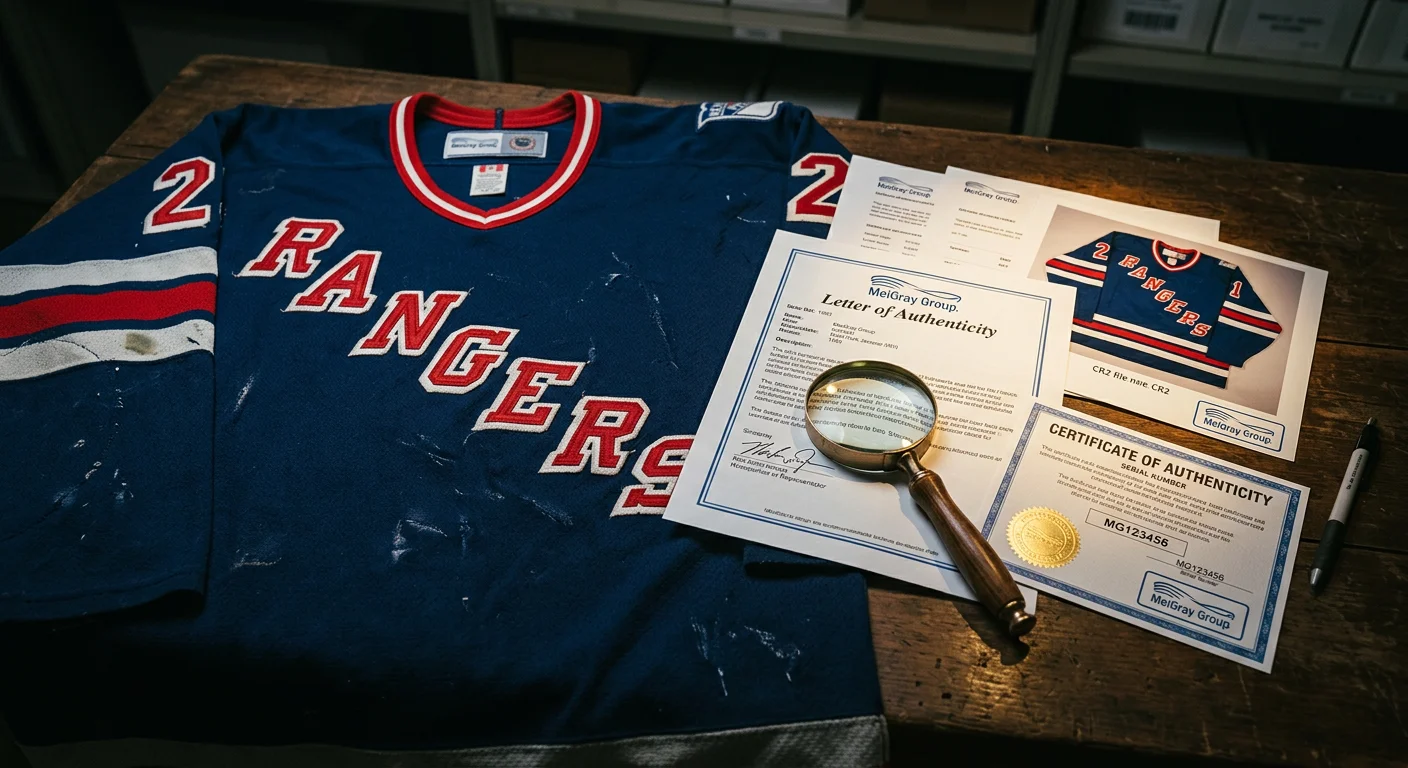
Some franchises carry weight that newer clubs haven't earned yet. The collectibles market prices that weight with striking accuracy.
Secondary market data from eBay, Heritage, and Classic Auctions makes the gap clear. Original Six jerseys — Montreal, Toronto, New York Rangers, Boston, Detroit, Chicago — trade at a 30 to 80 percent premium over comparable jerseys from non-Original Six teams of the same era and player calibre. A 1970s Guy Lafleur game-worn Canadiens jersey clears $40,000 to $70,000 at auction. A Hall of Famer of equal standing from the Flyers or Islanders in the same decade? More often $15,000 to $30,000 . Same era. Same talent tier. Different legacy.
The same logic applies to retail throwbacks. A 2017 Adidas authentic Canadiens home jersey, new with tags, resells in 2024 for $220 to $260 — a 23 to 45 percent gain over its $179 MSRP. A comparable Columbus Blue Jackets authentic from the same year sits between $140 and $190 . Legacy franchises don't just attract more buyers. They hold value when others don't.
Why Dynasty Eras Create a Triple Premium
Dynasty-era jerseys stack three separate price drivers at once. Each one alone lifts prices. All three together produce something in a different category entirely.
First: team success density. The 1980–83 Islanders won four straight Cups. The 1984–90 Oilers won five in seven years. The 1997–2002 Red Wings won three in six. Tight championship windows pack historical meaning into a short run of jerseys. Every surviving piece carries the full weight of that run.
Second: genuine scarcity. In the 1980s and into the early 1990s, teams issued two to four jerseys per player per season — home, road, and one or two backups. That puts a hard ceiling of fewer than ten game-worn pieces per player, per design, per year. Pre-Edge era retail authentics were just as limited. CCM and Starter pressed Cup-year or patch variants in the low thousands, compared to tens of thousands for modern alternate drops.
Third: emotional lag. After a dynasty collapses or a star retires, prices don't jump right away. The repricing comes later — three to ten years after the era ends. That's the point where the generation that grew up watching those teams has disposable income and wants something real from that time.
The Oilers and Red Wings as Case Studies
The 1980s Edmonton Oilers are the clearest proof of concept. Wayne Gretzky game-worn jerseys from his 1981–84 Oilers seasons now sell at $300,000 to over $1,000,000 , depending on Cup year and photo-matching. Even non-Cup Gretzky seasons from that era — the 1979–80 period before the dynasty took shape — still clear $200,000 and above . That tells you the dynasty-era halo stretches well beyond the actual championship years.
Non-Gretzky dynasty stars from those same Oilers rosters — Messier, Kurri, Coffey — pull $15,000 to $60,000 for Cup-era game-worn examples. Compare that to $5,000 to $20,000 for Hall of Famers from non-dynasty markets in the same decade.
Retail throwbacks tell a similar story. CCM Vintage 1980s Gretzky authentics retailed around $200 in the early 2000s. Today, in the mid-2020s, they fetch $450 to $800 new with tags — a 125 to 300 percent gain .
Detroit's 1990s dynasty adds a second data point. Steve Yzerman game-worn Cup-year jerseys from 1997–98 sell for $20,000 to $60,000 with strong photo-matching. Equivalent-era non-Cup captain jerseys? $5,000 to $15,000 . The "winged wheel" template stayed visually consistent across those years. So collectors pin down dynasty pieces by Cup patches, fight straps, and interior tagging — details they pay a 20 to 40 percent premium to verify.
The Nostalgia Premium and When It Arrives
Nostalgia, in economic terms, is a delayed fuse.
The 1990s Starter jacket market barely moved in 2003. By 2018, clean examples had risen 100 to 300 percent . The buyers were people who were kids during that era and now had money to act. The same cycle runs through NHL jerseys.
Auction archives and resale platforms show that jerseys from a closed era — a relocation, a rebrand, a dynasty breakup — tend to gain 5 to 10 percent per year for the first decade, after a quiet period of three to five years. A major nostalgia catalyst changes that pace fast. Hall of Fame inductions, jersey retirement ceremonies, 25th or 30th Cup anniversaries — these events push short-term auction prices 20 to 50 percent above prior realized prices.
Certain triggers reliably accelerate this cycle:
Discontinued branding — Quebec Nordiques, Hartford Whalers, original Winnipeg Jets, 1990s logo sets that no team will ever wear again
Rule-change eras — the open-ice 1980s before the trap, the pre-lockout 1990s before the game slowed down
Pop culture imprint — teams fixed in 1990s video games, Saturday night broadcasts, or trading card culture, whose visual identity is locked into a specific generation's memory
Building a Framework for Legacy Value
For collectors deciding whether a jersey has real long-run upside, check these factors in order.
Team legacy first. Is this an Original Six club or a recognized dynasty franchise — 1980s Oilers, 1980s Islanders, 1990s Red Wings, 2010s Blackhawks? A yes means a structural legacy premium exists above the league baseline.
Era marker second. Cup year, Finals patch, anniversary patch, or final season in an iconic building — the last year at the Montreal Forum, the last game at Joe Louis Arena — each adds a measurable history score on top of the team premium.
Player status third. Franchise icons produce the highest ceilings: Gretzky, Yzerman, Sakic, Lemieux, Roy. Cult-hero role players from dynasty runs — the players fans remember because of what the team meant , not just what the player did — carry their own niche premiums in the right markets.
Timing fourth. The best entry points fall within zero to three years of a rebrand, relocation, or star's retirement , before nostalgia reprices the market. Buying ahead of a known catalyst — an induction date, a round-number Cup anniversary, an upcoming documentary — is where patient collectors find real value.
Long-run comparison data backs this framework. Original Six throwback authentics show a compound annual growth rate of 6 to 10 percent in real terms for popular star names over the 2010–2024 period. Expansion-era teams without major dynasty success show 0 to 4 percent CAGR , with many tracking inflation alone or dropping once the player moves on.
The market already knows what history is worth. Collectors who understand the legacy hierarchy read that pricing more clearly than everyone else.
How to Preserve a Collectible NHL Jersey Without Damaging Its Value
Acquiring the right jersey is half the work. The other half is less glamorous — but it determines whether that piece holds its value for decades or destroys itself in a closet.
The fundamentals aren't complicated. Keep temperature between 65–70°F (18–21°C) and relative humidity at 30–40% RH . Those two numbers matter more than most collectors realize. Heat warps fabric. Humidity invites mold onto stitched crests and name bars. Temperature swings beyond 5°F — even small daily ones — fatigue stitching over time. They also curl heat-pressed graphics in ways that can't be fixed.
Light is a quiet enemy. Direct sunlight produces measurable signature fading within 6–12 months . Use UV-filtering acrylic or glass rated at ≥90–99% UV block for any framed display. Museums target ≤50 lux for textiles. That's a solid benchmark for anything investment-grade.
For game-worn jerseys: do not wash them. Ever. Puck marks, board burns, and sweat patterns are not flaws. They are the photo-matching evidence that proves the piece is real. Washing removes them. Gone for good.
Storage materials matter just as much as climate control. Acid-free tissue paper, archival boxes, Tyvek garment bags — these protect your jersey. PVC vinyl bags are a different story. They off-gas plasticizers that cloud vinyl lettering and break down fight-strap hardware over years of contact. Skip them.
One overlooked rule: never hang a jersey by its neck tag or a single metal clip. Collar distortion shows up in condition grades — and condition grades show up directly in sale prices.
FAQ: NHL Jersey Collectibles — What Collectors Most Want to Know
Collectors ask the same questions. The answers are more interesting than most expect.
Why are some NHL jerseys worth thousands of dollars?
Three things drive the price: scarcity, historical weight, and paperwork that proves both. Wayne Gretzky's final Oilers game jersey sold for $1.452 million in 2022. Paul Henderson's 1972 Summit Series jersey fetched $1.3 million in 2010. Neither sale was about fabric. Both were about moments that can never happen again — and the documents that prove it.
What makes a hockey jersey collectible?
Five factors determine value, in this order:
- Player tier
- Game-worn status
- Event significance
- Condition
- Authentication
Take away any one of these, and the price ceiling falls fast.
Are signed NHL jerseys a good investment?
Some are. Others are not. Jerseys signed by Gretzky, Crosby, or Ovechkin — authenticated and on quality substrates — tend to hold or grow in value. Mass-signed replicas from lesser-known players? They struggle to clear $300 and rarely go beyond that.
Do game-worn jerseys increase in value over time?
The right ones do. Puck marks and board burns that photo-match to a meaningful game are features, not flaws. They are the proof the jersey was actually there.
How important is authentication?
Very. Pieces without authentication sell at 50 percent or less of what documented examples fetch. Authentication does not create value. It unlocks value that was already there.
Should beginners chase rare pieces right away?
No. Start with authenticated game-worn jerseys from popular teams in the $400–$800 range. Get comfortable with the market first. Learn how it works before it teaches you a costly lesson.
Conclusion
Every jersey tells a story. But only some stories grow in value over time — and now you know why.
What separates a dusty piece of fabric from a five-figure collectible? A few key forces work together: a player's legacy, the scarcity of the moment a jersey came from, the paper trail that proves its history, and the passion of a fan base that keeps the memory alive.
That knowledge is your edge.
Say you're holding a Sidney Crosby rookie-era jersey in your closet. Or maybe you're eyeing a signed game-worn piece at auction. Either way, knowing why some NHL jerseys become expensive collectibles over time is what separates the collector who waits and wins from the one who sells too soon — or picks the wrong piece to begin with.
Treat your collection like the archive it is. Store each piece with care. Document everything you have. And never underestimate the long memory of hockey.