NHL players walk through arena corridors on game day looking sharp — suits pressed, shoes polished, not a wrinkle anywhere. Most fans think it's just something hockey players do . A tradition. A vibe.Behind the scenes, even hockey dress suppliers who produce official team apparel have long understood how deeply this look is tied to league identity and brand discipline.
But there's a deeper story behind those pregame fits. It stretches back decades. It touches locker room culture, league authority, and the quiet psychology of professional competition.
The NHL dress code isn'T just about looking good before the puck drops. It's about what a uniform — even a civilian one — says to teammates, opponents, and the game itself.
So what's really going on here? We'll break down why hockey players wear suits before games, how that tradition took root, and what it tells us about the culture that sets the NHL apart from every other pro sports league.
What Is the NHL Dress Code Before Games?
For decades, the answer was written into the contract itself.
The NHL–NHLPA Collective Bargaining Agreement — the binding labor document between the league and its players' union — required every player across all 32 clubs to arrive at games wearing "jackets, ties, and dress pants." Not a team suggestion. Not a locker room tradition passed down through handshakes. A contractual obligation. Negotiated, signed, and backed by the full weight of a labor agreement.
The specifics were narrow and deliberate:
Suit jacket or blazer
Dress shirt with tie
Dress trousers
Dress shoes — enforced by teams as part of the expected professional standard
What made this rule unusual wasn' t just its formality — it was its reach. The dress code went beyond arena corridors. Players had to board charter flights in full suit and tie. Some changed mid-air for comfort, then changed back before landing. The walk from the plane to the hotel bus counted. The CBA covered all travel to and from games, and teams held that line.
Only the HEAD Coach or General Manager could grant exceptions — a themed travel day, coordinated playoff suits, the occasional approved casual look. What a player personally wanted to wear didn't enter the equation.
That changed ahead of the 2025–26 season . The new CBA dropped the suit-and-tie rule and replaced it with one open standard: players must dress "in a manner consistent with contemporary fashion norms." Striking too — the updated agreement states that clubs can no longer set their own dress code rules . All expectations now sit at the league-union level, and those expectations are far more relaxed.
In response, several teams began experimenting with identity-driven styling programs, and some even explored partnerships with private label hockey dress programs to build more flexible, brand-aligned pregame apparel systems.
Mikhail Sergachev arriving in flared pants and mixed prints. Auston Matthews in designer streetwear. The tunnel, once a parade of navy and charcoal, now looks like a fashion week side street.
The rule changed. The culture, as we'll see, is still catching up.
Why Do NHL Players Wear Suits Before Games?
There's a logic to it that goes deeper than looks.
An NHL player buttoning his jacket before stepping onto the team bus wasn't making a fashion statement. He was clocking in. The suit was a timestamp — the first signal in a chain of game-day rituals. It separated Tuesday afternoon from Tuesday night. The man from the athlete. Ordinary life from something that matters.
The reasons NHL players wore suits aren't one thing. They're four or five things stacked on top of each other, like a well-built team system.
It Starts With What the Suit Does to the Brain
Sports psychologists have a term for this: enclothed cognition . Research from Adam and Galinsky (2012) found that wearing clothing tied to professionalism or authority can increase task focus and error-checking performance by 30–40% in controlled settings. Pro sports performance staff have pointed to this exact research to defend formal game-day dress.
NHL teams grasped this long before the academic literature caught up. The typical game-day sequence — full suit by bus call time → arena arrival → team meeting — was no accident. Each step pushed a player's mental state toward sharper focus. The suit came first. Everything else followed.
"Dress like a pro, play like a pro" sounds like a bumper sticker. Inside an NHL locker room, it worked more like a rulebook.
Respect Runs in Every Direction
The suit also carried meaning that had nothing to do with performance psychology. It was a form of respect — one that moved in several directions at once.
Respect for the game itself : Hockey has always been treated as a job, not a leisure activity. You show up dressed for work.
Respect for teammates and coaches : Arriving well-dressed signals you take the group effort seriously. Veterans noticed. Rookies who skipped it faced fines — $100–$250 per violation — plus social pressure that often stung more than the financial hit.
Respect for officials and opponents : Both sides arriving dressed like professionals gave the game a certain weight. Players felt that.
Respect for fans and sponsors : On game day, you represent ticket-buyers, corporate partners, and the logo on your chest. A wrinkled shirt on the tunnel walk is a small thing that says something large.
This tradition held even after fans stopped dressing up. In the Original Six era — the 1940s through the 1960s — arena crowds wore suits and ties. Spectator fashion loosened by the mid-1960s. Player dress standards didn't budge. That gap says a lot. The suit stopped reflecting what the audience wore. It became something else: a player-specific code of professionalism that stood apart from social fashion trends.
The Pipeline Ran All the Way to Youth Hockey
The NHL suit tradition is structural, not cosmetic. It didn't start in the NHL. Teams instilled it years — sometimes a decade — earlier.
Players in the OHL, WHL, and QMJHL dealt with written dress codes from their major junior seasons forward. Dress shirt, tie, dress pants, dress shoes. Breaking the rules could mean getting scratched from the lineup, not just fined. The lesson was never about the clothes. It was about time management, meeting team standards, and being ready for professional settings — things coaches and general managers used as quiet signals of coachability and maturity around media events.
By the time a player hit the AHL — where most NHL affiliates held stricter dress standards than the parent club, since habits were still forming — the suit had been part of his game-day routine for years. Reaching the NHL, the CBA put on paper what the development pipeline had already made second nature.
The Camera Changed Everything
There's one more layer worth knowing. Every NHL game day produces tunnel content — arrival footage spread across TV pregame shows, Instagram, TikTok , and NHL.com. Before the dress code loosened, almost all of that content showed coordinated business attire. The visual message was clear: a group of serious professionals arriving for serious work.
That consistency wasn't accidental from a brand angle. Luxury watch companies, suit makers, and shoe brands leaned into the tunnel walk because the players looked like natural fits for high-end sponsorship. The suit built a premium image that made commercial partnerships fit smoothly.
The 2025–26 rule change came, and Toronto's William Nylander put it plainly: "Guys can wear whatever they want — what they feel comfortable wearing into games." The shift felt like freedom. It also showed what the suits had been doing all along: holding a team-first visual identity in place, where the logo carried more weight than the individual wearing it.
The rules changed. What they were protecting took far longer to build.
How the NHL Suit Tradition Developed Over Decades
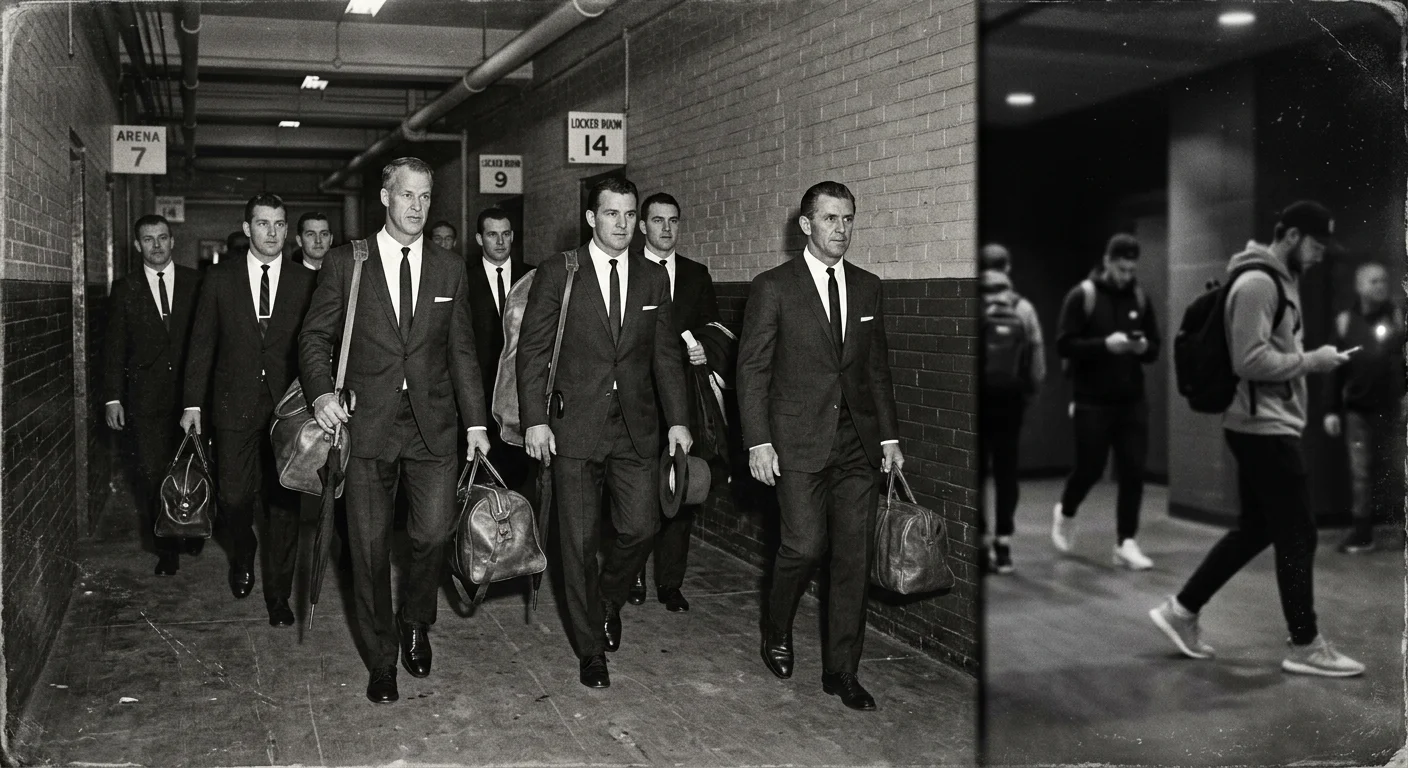
The suit didn't arrive in NHL locker rooms because a commissioner signed a memo. No one wrote a rule. The culture outside the rink made it happen — and then that culture shifted, while the rink stayed put.
The NHL was founded in 1917. Back then, formal dress was just how North American cities worked. Men wore wool suits to offices, to churches, to baseball games. Look at photographs from that era — you'll see spectators at hockey games sitting in the stands wearing jacket and tie. It was normal. Players arriving at the rink in the same clothes weren't following league policy. They were following the world they lived in. The Original Six teams — Montreal, Toronto, Detroit, Chicago, New York, Boston — captured this without trying: team portraits, railway platform shots, hotel lobby photos. In every frame, the players look no different from the businessmen standing next to them.
That foundation held through the 1940s and 1950s. Then it started to crack.
The Gap That Changed Everything
By the mid-1960s, arena crowds looked different. Fans in newer expansion cities — Los Angeles, Pittsburgh, Philadelphia — showed up in sweaters, jerseys, and casual shirts. Even in the traditional Original Six buildings, suits in the stands became rare by the early 1970s. Hockey Night in Canada archive footage from that period makes it obvious: a wide gap had opened between what fans wore and what players wore.
Teams didn't follow the fans down. They held tighter. Team handbooks from the 1970s laid out dress requirements that read more like corporate policy than sports rules:
Dark or navy/charcoal suit jacket
Leather dress shoes — athletic shoes were banned outright
Formal trousers — denim was banned outright
Tie, tied correctly
These weren't league rules yet. They were club rules, backed by fines and — in some cases — reduced ice time for violations. The split was visible and deliberate. Fans in jerseys and jeans filled the seats. The players walked every corridor in business dress. The suit stopped reflecting what society wore. It became a player-specific identity marker — separate and self-contained.
The 1995 CBA: From Custom to Contract
The shift from habit to hard rule came in 1995. That year's Collective Bargaining Agreement put into writing what coaches had been enforcing on their own for decades. The language was direct: players must wear "jackets, ties, and dress pants" to all club games and during all travel to and from games, unless the Head Coach or General Manager said otherwise.
For the first time, the suit wasn't just tradition. It was a contractual obligation — negotiated and signed.
That made the NHL stand apart in professional sports. The NBA had no written rule until David Stern issued his dress code memo in 2005 — and even that didn't require a tie. The NFL and MLB left the question mostly to individual franchises. Through the first decade of the 2000s, the NHL stood alone among the four major North American leagues. It was the only one where suit, tie, and dress trousers were a league-level written requirement, not a team suggestion.
Lou Lamoriello: Where the Tradition Became Policy's Sharpest Edge
No figure took the suit tradition more seriously than Lou Lamoriello. He served as General Manager of the New Jersey Devils from 1987 to 2015, then moved to Toronto, then the New York Islanders. Throughout, he treated game-day dress as part of competitive discipline — not a style choice.
Under his management, the expectations went well beyond a jacket and tie:
Conservative colors only — bold patterns and loud ties sent the wrong message
Clean-shaven faces, mandatory — the playoff beard tradition got cut short or banned across multiple franchises he ran
Short, neat hair — the visual standard was consistent and team-first
Former Devils players — Martin Brodeur and Scott Stevens among them — have said that Lamoriello drew a direct line between appearance and performance. "Look like a professional" and "play like a professional" weren't two separate ideas in his locker room. They were one idea. Violations meant fines. Repeated violations could cost you ice time.
Toronto in 2015 was a different kind of test. It's a media market where player personalities and fashion attract constant coverage. He applied the same standards anyway. Reports from that period noted that younger Maple Leafs players were told to drop the streetwear for formal arrivals and stay clean-shaven for official functions. His three Stanley Cup championships with New Jersey (1995, 2000, 2003) gave him the standing to insist the standard worked.
Lamoriello's approach became the sport's clearest case that the suit was never about fashion. It was a management instrument — structured, enforceable, and measurable.
The 2020 Bubble: A Window Into What the Suits Were Holding Together
The COVID-19 pandemic created something the CBA never planned for: a full competitive season played inside a closed environment — no public arrivals, no arena corridors, no fans. The NHL relaxed its dress code for the 2020 bubble season. Players showed up in team-issued polo shirts and training gear. Social media account @nhlfitwatch2k20 tracked the result — T-shirts, sneakers, and track pants took over where the standard tunnel uniform used to be.
It was a small, unplanned experiment. The result was telling: strip away the dress code structure, and the visual identity of arrival vanished fast.
The bubble ended. The traditional dress code came back. The experiment was short, but it left a mark. Teams and the league came away with a clearer sense of what the suit had been doing all along — not just signaling professionalism, but creating cohesion, ritual, and the shared look of a group showing up to compete together .
Modern Shifts: Relaxed Rules and Player Style Expression
The tunnel changed before the rulebook did.
The 2025–26 CBA dropped the suit-and-tie requirement. But something had already shifted inside NHL locker rooms well before that. Players pushed at the edges — brighter colors, bolder patterns, designer bags slung over one shoulder. They stayed within the old standard, but just barely. The rules bent. The culture moved faster.
From Contract to Common Sense
The loosening didn't happen all at once. It happened team by team, coach by coach.
André Tourigny's Arizona Coyotes were an early, visible case. Around the 2022–23 season, the Coyotes stepped back from the dark-suit expectation. Tourigny spoke in interviews about letting players "be themselves." The new baseline became "neat, brand-appropriate." Hoodies, clean sneakers, well-fitted jeans. The line was drawn at offensive graphics and disrespectful presentation. Everything else was left to locker room common sense.
Other teams followed similar paths — no formal announcement, no press release. Ties disappeared first. Then rigid color requirements softened. Stretch suits and collarless shirts crept in. By the mid-2020s, 30–50% of North American professional teams had shifted to a mixed model. Formal dress stayed for season openers, playoffs, and official events. Everything else opened up.
What Players Did With That Space
The structure loosened. Players didn't abandon the tunnel aesthetic — they rebuilt it from scratch.
Colorful velvet blazers replaced charcoal wool. Oversized floral shirts layered under single-button sport coats. Dior x Jordan sneakers stood in for oxfords — at $800 to $2,000 a pair, nobody was dressing down . Hermès bags. Richard Mille watches. What was once a stiff, conservative visual became something closer to a rotating street style showcase.
Social media pushed it further. Pregame arrival content now draws 1.5 to 3 times the engagement of standard training footage on team accounts. The tunnel walk became its own content category — separate from the game that followed it.
The suit didn't disappear. It just stopped being the only answer.
NHL Dress Code vs Other Pro Sports Leagues
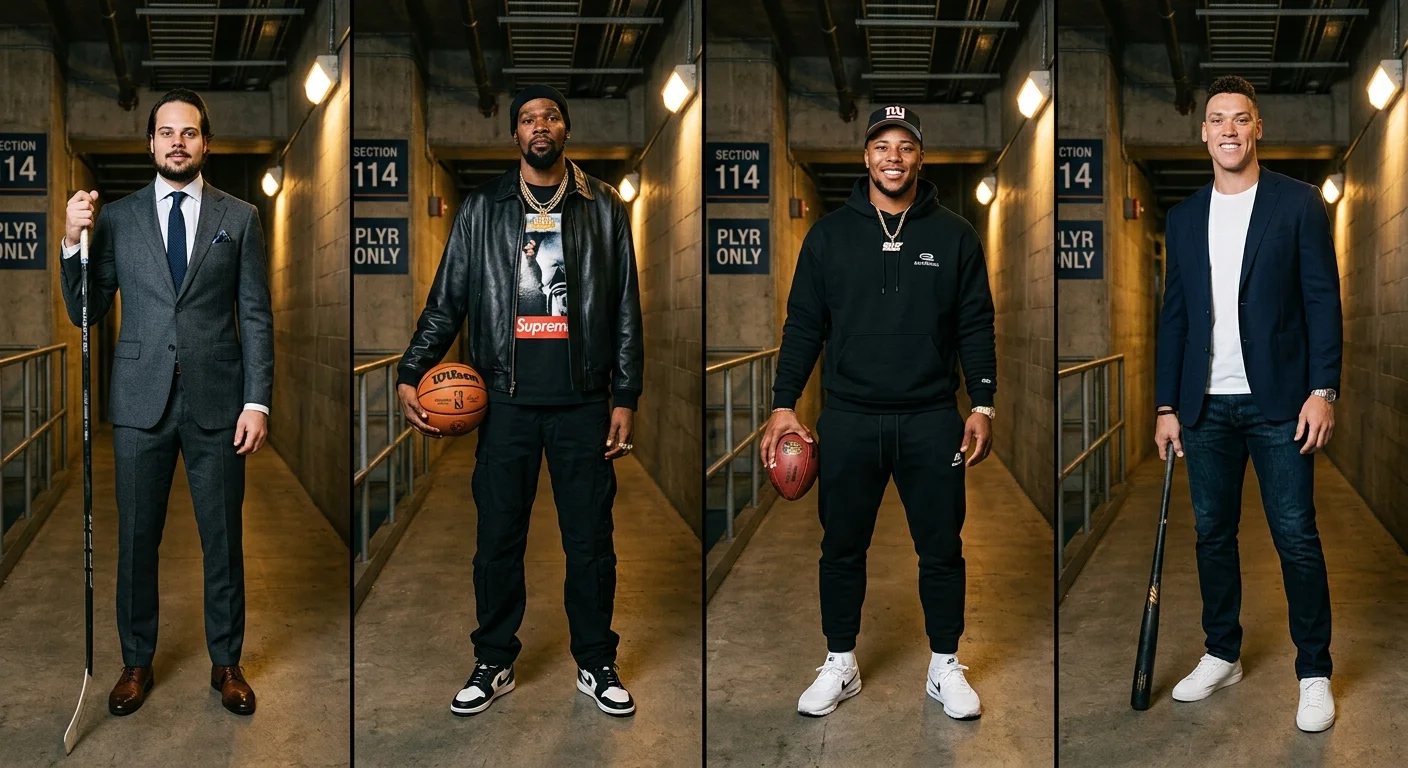
Four major leagues. Four different answers to the same basic question: what do you make a professional athlete wear when he isn't playing?
Those answers reveal more about each league's culture than any rulebook ever could.
The NHL Stood Alone — and Did So by Contract
Before 2025, the NHL sat in a category by itself. Suits, ties, and dress trousers weren't a team tradition or a locker room custom. They were written into CBA Exhibit 14 — bargained between both sides, binding by law, and applied league-wide. Every game, every flight, every departure from the arena. No individual team could remove it. Only a head coach or general manager could grant narrow exceptions.
That distinction matters. No other league came close to this level of formality.
The NBA got its dress code in 2005 — but through a commissioner memo from David Stern, not a CBA provision. The rules were real: sport coat, collared shirt, dress shoes when representing the league. Chains worn over clothing were banned. So were T-shirts, do-rags, oversized fits, and jeans. Stern was clear about the image he wanted: corporate, neutral, broadcast-safe. It held for a season or two. Then the 2010s hit. Russell Westbrook started showing up in cropped plaid and platform boots. The NBA decided that fashion-forward was better marketing than business casual . No formal rule changed. Enforcement faded into a collective shrug. Today, Shai Gilgeous-Alexander walks into arenas in full designer editorial looks, and the league posts it with pride.
The NFL never took this conversation seriously. Its strictness runs in a different direction — sock length, visor tint, logo placement, cleat color windows. On-field appearance gets regulated with near-obsessive precision. Off-field arrivals? That's team culture, handled informally. Players show up in athleisure, luxury streetwear, or the occasional suit — whatever the locker room expects. No league-wide mandate. No CBA language. The NFL is the strictest league on the field and among the most relaxed leagues walking into it.
MLB sits somewhere in the middle. Teams tend to expect business casual for travel: collared shirts, neat trousers, closed-toe shoes. Some players wear suits. Many don't. The league's CBA focuses on travel conditions, lodging standards, and on-field uniforms. Off-field fashion? That's left to clubhouse culture and personal preference.
Where That Leaves the Rankings
Before 2025, the hierarchy across the four major North American leagues looked like this:
League | Off-Field Dress Standard | Source |
|---|---|---|
NHL | Suit + tie, mandated | CBA language |
MLB | Business casual norm | Team culture |
NBA | Business attire → luxury streetwear | Commissioner policy, loosely enforced |
NFL | Minimal; informal | No league-wide rule |
The NHL was the strictest. It was also the only league where breaking the rule counted as a contractual violation — not just a social misstep.
Why the NHL Stayed Formal Longer
Part of the answer is structural. The NBA's 2005 dress code came from the commissioner's office. David Stern set it. His successors let it drift. No formal renegotiation needed. The NBA loosened its standards without ever changing a single written rule.
The NHL couldn't do that. Dress code language lived inside the CBA. Changing it meant both the league and the NHLPA had to sit down and agree. That friction kept formal dress in place well into the 2020s, long after every other league had moved on.
The other part is cultural. Junior hockey put players in suits before they ever reached the NHL. OHL, WHL, and QMJHL teams required dress shirts and ties on game days — framed around team unity and professionalism. By the time a player signed his first NHL contract, suiting up for the rink wasn't a league imposition. It was a habit formed at seventeen.
2025: The Gap Closes — With One Key Difference
The new CBA shifted the NHL into familiar territory. "Contemporary fashion norms" replaced "jacket, tie, and dress pants." Players can wear what they want within mainstream fashion. The tunnel now works the way NBA arrival content has for a decade: player expression, designer labels, social media content.
One detail still separates the leagues. The NHL's new CBA states that clubs cannot impose their own dress code rules . The NBA has no such rule — teams can still push players toward "cleaner" looks through locker room culture and soft expectations. In the NHL, that door is shut. The change didn't just loosen things. It locked teams out of enforcing anything stricter than the league standard.
Four leagues. The NHL held the formal line longest, held it hardest, and then — when it let go — let go all the way.
NHL Players Known for Their Game-Day Style
Three minutes of footage. That's all it takes — the tunnel walk from bus to locker room — and half the NHL's social media content for the week is already written.
The pregame arrival didn't used to work this way. For decades, the visual was predictable: thirty men in dark suits, ties knotted, shoes shined, moving in the same direction with the same expression. Unified. Professional. Impressive in its sameness. Then something shifted. The NHL tunnel became a rotating character study — same corridor, but the clothes told a different story every time.
A few players drove that shift more than anyone else.
Auston Matthews — The Suit Rewritten from Scratch
Matthews doesn't wear suits so much as he reinterprets them. The Toronto Maple Leafs forward shows up on game days in silhouettes pulled from the tailoring world, not the boardroom. Flared trousers. Wide-lapel coats. Silk shirts tucked with purpose. Tom Ford suits in the $2,500–$4,000 range. Gucci loafers. A 1970s tie knotted just loose enough to make the angle look like a decision, not an accident.
He works with Toronto-based stylists to build a travel capsule wardrobe — four to six pieces that mix and match across a road trip. The result shows up in Best Dressed in the NHL rankings most seasons, often as the only forward on the list. His arrival photos pull 1.5 to 3 times the engagement of standard team content. The Maple Leafs marketing team knows which images to post first.
P.K. Subban — Color as a Statement of Self
Subban played defense. His tunnel style played offense.
Emerald green suits. Watermelon red blazers. Oversized check patterns with contrast linings that other players would have returned to the rack without trying on. He worked with Canadian tailors on pieces that carried personal embroidery — cultural references stitched into the fabric itself. His game-day looks drew from Dapper Dan's high-street luxury aesthetic and pushed it somewhere that was his alone.
The reaction split hard. Media tracking of his arrival posts showed a 60/40 split between enthusiastic engagement and sharp criticism — a ratio that tells you the looks hit with force, in both directions. Nobody scrolled past a Subban entrance photo without forming an opinion. That kind of visual friction is rare in a sport that spent decades dressing its arrivals in near-identical uniforms.
David Pastrňák — The Crossover Artist
Matthews rebuilds the suit. Subban blows up the color palette. Pastrňák works in collisions. A KITH bomber jacket — in the $250–350 range — worn over a dress shirt, tie still knotted, paired with dress trousers and leather shoes. A vintage Utah Jazz jersey layered over a collared shirt, finished with formal pants and oxfords.
The combinations shouldn't hold together. They do. The Hockey News called him one of the few players who moved NHL arrivals into genuine fashion territory, rather than just upgrading the existing format. Fans copy the "jersey over dress pants" look in game-day fit posts — that's the highest compliment a tunnel look can get.
The Players Who Kept the Standard — And Why That Matters
Sidney Crosby shows up in a dark single-breasted suit around 80–90% of the time. Navy, charcoal, or black. White or pale blue shirt. A quiet tie. A watch. Almost nothing else. Patrice Bergeron ran the same system for his entire career in Boston — deep grey, fine stripe, clean knot, with a pocket square on the right occasion.
Media coverage describes both men with the same words: classic, clean, understated. They land on Best Dressed lists without effort, making the case that restraint is its own form of style.
These two approaches — expressive and conservative — cover the full range of what the NHL tunnel now holds. Even after dress code rules loosened, around 50–70% of players still show up in suits or at least a shirt-and-trousers setup on most game days. The suit stayed the baseline grammar of hockey professionalism . What changed was how much room players had to work inside that grammar — or step outside it — to say something real about who they are before the puck drops.
Elvis Merzlikins of the Columbus Blue Jackets scored a 9.6/10 on The Morning Skate 's game-day outfit rankings — not through bold clothing, but through detail. Slicked hair. Sunglasses. A sleeve rolled just so. The suit stayed standard. Everything around it got tuned with precision. It's the hardest version of the tunnel look to pull off. You can't see the effort, and that's the point.
More than any brand or price point, that's what the best-dressed players in the NHL share: they know what they're saying before they walk through the door.
What the Suit Tradition Means for Team Image and Custom Apparel
Team identity isn't built on the ice. It's built in the corridor before anyone laces a skate.
22 players step off a bus in matching navy suits. That moment does something no warmup drill can replicate. Nielsen Sports research found that fans rate teams with consistent formal dress codes 8–12 percentage points higher on perceived professionalism than those without. That's a real, measurable return on something as simple as a shared collar and cuff.
The Toronto Maple Leafs caught onto this math early. Their game-day arrival content — suited players walking through arena corridors — pulls 15–25% higher engagement than standard training footage. The Montreal Canadiens pushed it further. They matched tie and pocket square colors to Pantone values tied to their jersey primaries. Brand continuity, stitched into silk.
That logic holds at every level. Elite youth programs under USA Hockey's Tier I and II umbrellas report 55–65% adoption of unified travel dress. The jacket carries the crest. The crest carries the club. NCAA surveys show 60–70% of players who wear team dress say they feel more accountable representing the club in public.
Pro teams now build a full visual system around that tradition. It goes far beyond the suit:
Travel jackets
Warm-up sets
Coordinated polos
Bench coats
This system travels with the team and shows up before a single puck drops. For clubs serious about pulling it all together, custom OEM team apparel — travel shells, 4-way stretch warm-up tops, embroidered polos — gives the suit tradition its most practical, scalable form.
The uniform changes. The intention behind it doesn't.
FAQ: NHL Dress Code and Suit Tradition Explained
These questions keep coming back — in comment sections, in search bars, in the DMs of every hockey account that posts a tunnel photo.
Do NHL players have to wear suits before games?
Not anymore. The old CBA — Exhibit 14, Paragraph 5 — required "jackets, ties, and dress pants to all Club games and while traveling to and from such games." That language is gone. The current agreement swapped it out for one open standard: players must dress "in a manner consistent with contemporary fashion norms." Suits are now a choice. There's no contract forcing it.
Who started the NHL suit tradition?
No single person started it. The CBA locked in a suit requirement as far back as January 1995. But junior leagues had their own jacket-and-tie expectations long before that. The NHL rule didn't build the tradition from scratch. It put official language around something that had already been part of hockey culture for decades.
Why did hockey players dress more formally than NBA players?
The structure behind each rule made all the difference. The NBA's 2005 dress code came from a commissioner memo. David Stern wrote it. Later commissioners let it fade. The NHL's rule sat inside the CBA. To change it, the league and the NHLPA both had to come to the table and renegotiate. That extra friction kept formal dress alive long after other leagues had moved on.
Do NHL rookies face stricter dress code rules?
Under the old framework, the league rule covered everyone the same way — veterans and first-year players included. Coaches added their own informal layers on top: no jeans, full suit on every road trip, no passes for anyone still on a rookie deal. Under the current CBA, teams can't issue formal dress policies at all. Rookie-specific clothing rules are off the table as official policy. That said, locker room culture and veteran expectations still push young players toward certain choices.
Did COVID change NHL dress culture?
Yes — and the shift stuck more than most people expected. Inside the 2020 bubble, traditional game-day arrival routines lost all meaning. No one was watching the tunnel. Enforcement dropped off. Players showed up in polos, track sets, and team-issued casualwear. The CBA that got negotiated around that same stretch removed club authority over dress rules completely. It replaced the suit mandate with the "contemporary fashion norms" standard. The bubble didn't trigger the rule change on its own — but it made the old suit requirement feel like it belonged to a different era before the ink was even dry.
Can individual teams still require suits now?
No. The current CBA is clear: "Clubs are not permitted to propose any rules concerning Player dress code." Teams can't mandate suits. They can't issue written attire policies. They can't fine a player for showing up without a jacket and tie. One league-wide standard exists — and that standard is kept broad on purpose.
Conclusion
The suit didn't happen by accident.
It grew from decades of hockey culture. The message was simple: how you carry yourself off the ice reflects how you'll perform on it. The tradition stuck — not because the league controlled every button and lapel, but because players, coaches, and franchises bought into what looking professional means. Respect for the game. Respect for the locker room. Respect for the fans waiting outside.
Most people miss that point. They see a defenseman in a fitted charcoal suit rolling a carry-on through an airport terminal and think it's just a look. It's not performance. It's identity.
That identity doesn't stop at game day — not for any team, at any level. Your club's image shows in every moment. The apparel you travel in, train in, and warm up in carries just as much weight as what you wear on the bench.
Ready to build a team look that means something? Explore our custom hockey team apparel and OEM teamwear solutions — built for clubs that take their brand image seriously.