Counterfeit Castelli jerseys have gotten frighteningly good — and that's what makes them dangerous. Scroll through any third-party marketplace today and you'll find listings that look convincing enough to fool even experienced riders: the right colorways, the right logo placement, the right price point to feel like a deal.Many experienced retailers actually compare suspicious listings against pricing from authentic Castelli clothing suppliers before deciding whether a deal is legitimate or counterfeit.
But underneath that polished exterior, the differences are very real. Get it wrong, and it costs you.
Maybe you just received a jersey that doesn't feel right. Maybe you're about to buy a discounted kit and something's nagging at you. Either way, this Castelli cycling jersey authentication guide covers what separates genuine gear from a well-packaged fake — fabric hand-feel, zipper pull weight, stitching details. Those are the areas where counterfeits give themselves away almost every time.
Price Red Flags: How Much Should Authentic Castelli Clothing Cost?
Price is the fastest lie a counterfeit tells you. Wholesale listings advertising bulk discounts sometimes trace back to fake Castelli cycling clothing wholesalers, which is why extreme price drops should immediately raise suspicion.
Here's the truth: authentic Castelli jerseys run $105–$160 . Bib shorts start at $119 for entry-level and climb past $350 for premium. Jackets range from $130 to $420 depending on insulation and technology.
Those numbers aren't random. Real materials, real construction, and real performance engineering drive those costs up.
Legitimate discounts do exist — authorized retailers like Backcountry and Competitive Cyclist run 30–55% off on seasonal items. A Castelli Alpha 150 Jacket at 40% off ($252) is reasonable. An end-of-season clearance hitting 65% off? Still plausible.
But a current-season jersey dropping to $35 — that's a 75% cut on a $140 garment. That's not a deal. That's a red flag. Our guide on cheap vs expensive cycling jerseys explains why genuine materials cost what they do.
Jerseys priced under $40 (standard retail: $105–$160)
Bib shorts under $50 (standard retail: $120–$350)
Premium jackets under $80 (standard retail: $200–$420)
An entire storefront slashed 70%+ across the board, with zero seasonal variation
Pull up two or three authorized retailers — Backcountry, Competitive Cyclist, BIKE24 — and compare prices directly. A price gap over 20% on identical items? That difference alone is a serious warning sign.
Fabric & Material Test: Real Castelli Cycling Clothing Texture vs. Fake
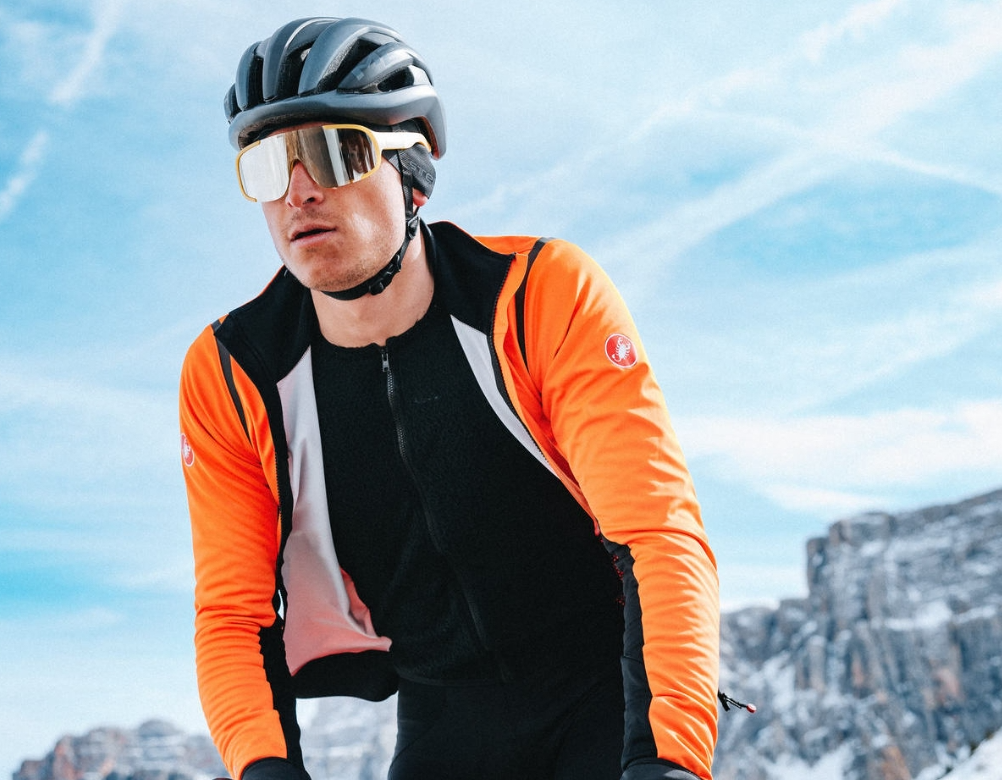
Touch tells you everything.The engineered texture you feel in real jerseys reflects the same material standards used in custom performance authentic Castelli cycling clothing production, where breathable membranes and stretch recovery are carefully controlled.
Skip the tag. Skip the zipper. Just run the fabric between your fingers first. Real Castelli cycling clothing has a distinct texture: fine ridges, a micro-grip surface, and a density that feels intentional. Counterfeits feel exactly like what they are — cheap polyester knit pretending to be engineered gear.
Real Castelli jerseys use a 3-layer nanofiber membrane built through electrospinning. The process pulls hydrophobic polymer filaments at 20,000 volts. Each strand is about 100 times thinner than a single human hair. That structure gives you an MVTR of 35,000 g/m²/24h (sweat vapor transfer) and a hydrostatic head of 5,000 mm . Those are hard performance numbers. Fakes cannot hit them at their price point — full stop.
Three quick tests you can run right now:
Light Test — Hold the fabric up to your phone flashlight. Real Castelli blocks most light. The nano-membrane layer forms a dense, opaque barrier. Fake jerseys go see-through, like gauze. About 90% of counterfeits fail this test on the spot.
Stretch Recovery Test — Pinch a 5cm section and stretch it to double the length. Real fabric snaps back fast, with full recovery above 95%. Fake polyester wrinkles, goes limp, and stays deformed. Around 80% of counterfeits fail here.
Texture Rub Test — Drag your thumbnail across the inner surface with light pressure. Real fabric has a clear ridged, grid-like texture — the rib-knit structure that lifts fibers off your skin and traps air. Fakes feel flat and slick, with no technical texture at all.
The numbers confirm what your hands already pick up:
Property | Real Castelli | Fake Polyester Knit |
|---|---|---|
MVTR (g/m²/24h) | 35,000 | <10,000 |
Stretch Recovery | >200% | <150%, permanent deform |
Fabric Weight | 298 gsm | <200 gsm |
Texture | Ridged, lofty | Flat, transparent |
That weight gap alone — 298 gsm versus sub-200 — is something you notice the second a real jersey lands in your hands.
Logo, Badge & Label Authentication: Spot the Difference
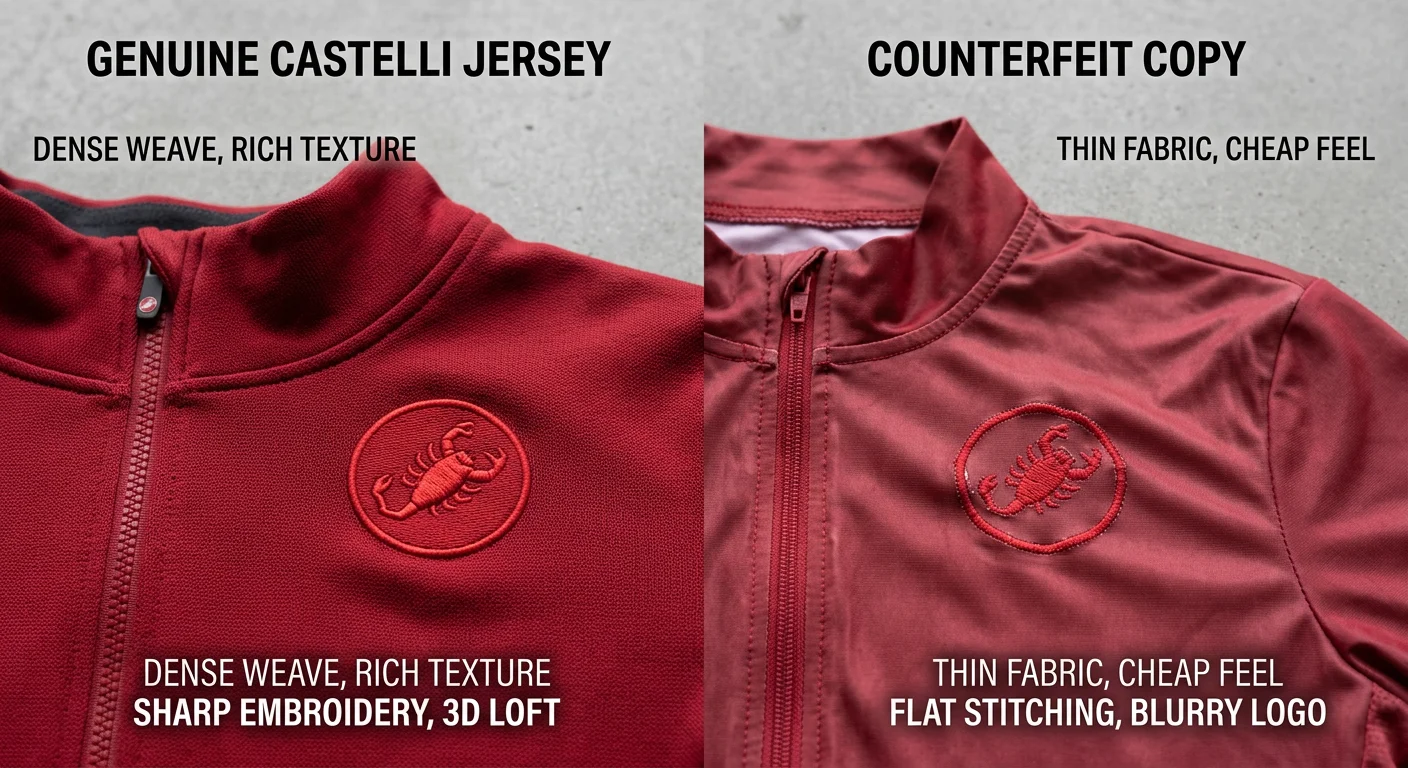
The logo is where counterfeiters get lazy.True branding precision usually starts at the cycling clothing factory level, where embroidery density, color calibration, and tag alignment follow strict manufacturing specs.
They know you're looking at price first, fabric second — so they cut corners on details they think you'll never notice. That's a mistake you can use.
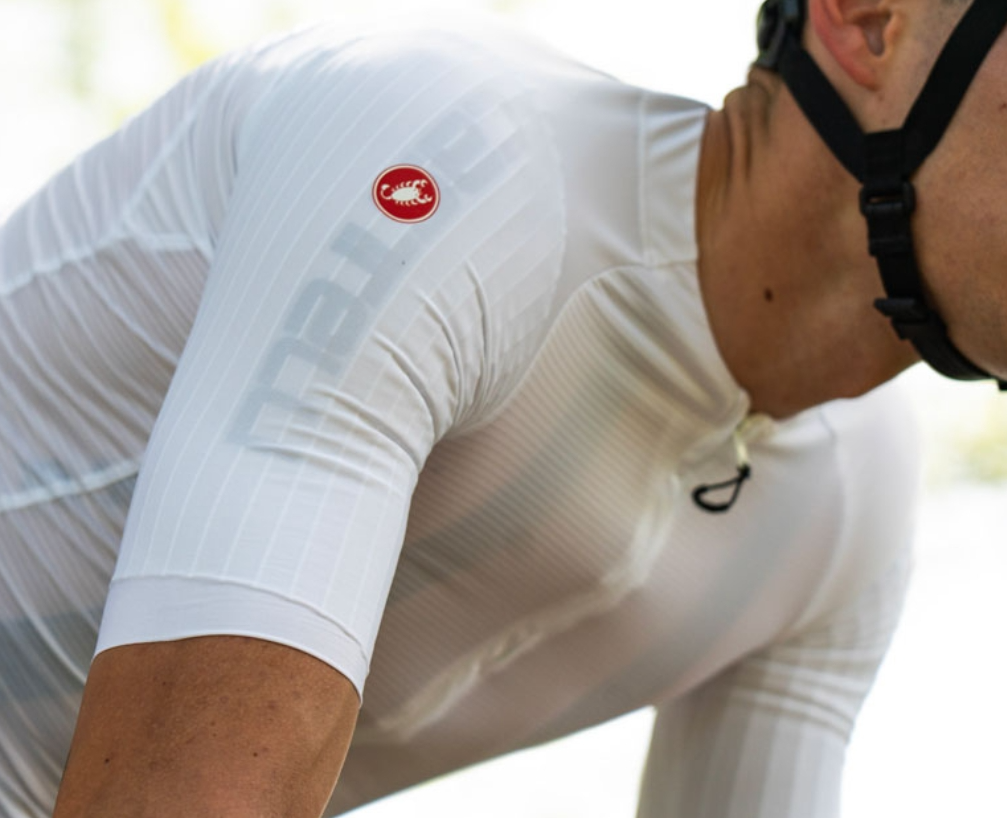
Start with the embroidered badge on the chest. On a genuine Castelli jersey, the iconic scorpion logo sits with sharp precision. Every leg, every curve of the tail — clean, crisp, no thread bleed. The stitching is dense enough that the badge feels raised under your fingertip. Press it. Real embroidery has structure. Fake logos go flat. Threads loosen at the edges. Color bleeds into the base fabric like a cheap ironed-on patch.
Check the logo print on sublimated panels. Authentic Castelli uses high-definition dye sublimation — colors lock into the fiber, not sit on top of it. Run your thumbnail across a printed logo on a genuine jersey. You feel nothing. No edge. No raised lip. On counterfeits, the ink layer sits above the surface. You can feel exactly where it starts and ends.
Tag and Label Verification
Pull out the interior neck tag. This is where most fakes fall apart.
Font consistency : Genuine Castelli tags use a specific typeface — uniform weight, clean spacing. Fakes drift off: letters crowd together or spread too wide.
Care symbols : Real tags show ISO-standardized washing symbols, printed sharp and spaced with consistency. Counterfeit care labels are often blurry, misaligned, or missing symbols altogether.
Country of origin : Authentic Castelli garments come from specific, verified production facilities. "Made in Italy" printed in uneven ink — or with inconsistent capitalization — signals a fake right away.
Barcode scan : Real product barcodes register on Castelli's system without issues. Counterfeits often carry non-functional barcodes. Scan one with any free barcode app and see for yourself.
The label doesn't lie. Counterfeiters put their budget into the outside. The tag is always an afterthought.
Sleeve Cuffs, Waistband & Hem: The Details Fakes Almost Always Get Wrong
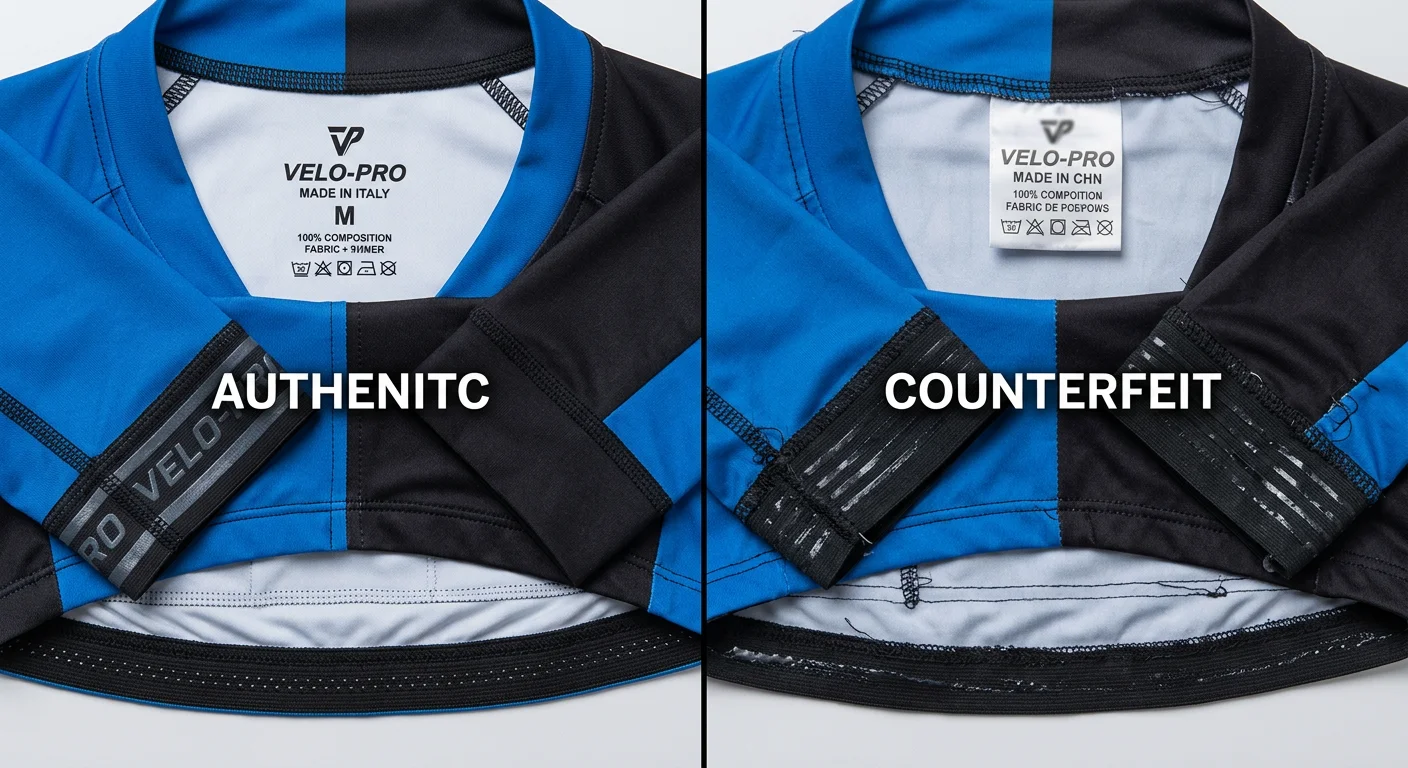
Counterfeiters spend their budget on what you see first.These structural details also reveal the difference between mass-produced fakes and garments developed through real OEM/ODM cycling jersey services focused on performance construction. The cuffs, the waistband, the hem — these are the spots they cut corners on last. They assume nobody looks that hard. They're wrong.
Start at the sleeve cuff. Genuine Castelli uses a raw-edge cutting process. Clean, intentional, no folded hem. Run your finger along the inner edge. You'll find silicone anti-slip strips, 2–3mm wide, printed with Castelli's own branding in a specific font. The lettering is crisp and raised. On fakes, those strips are plain white silicone — blank, unbranded, and wider at 3–5mm. Some counterfeits skip the raw edge altogether and fold the cuff over instead. That adds bulk where there should be none.
The waistband and hem tell the same story. Real Castelli jerseys use a drop-tail cut. The rear hem runs 2–5cm longer than the front. That keeps you covered while riding bent over the bars. Fakes shorten that drop by 1–3cm, leaving a near-even front-to-rear profile. Check the silicone strip here too. Genuine versions carry the same branded lettering. Counterfeits run unprinted or faded strips that smear under a thumbnail.
Construction Details Worth Checking
Build quality separates authentic from fake. Here's what to look for:
Stitch density : Genuine flatlock and coverstitch seams hit ≥10 stitches per cm with zero puckering. Fakes run loose.
Elastic grade : Real Castelli uses graduated elastic, 2–3mm narrow and fully covered. Fakes leave raw elastic edges exposed.
Reinforced zones : Genuine jerseys have double-stitching at the bicep and shoulder junction. Counterfeits use a single pass.
Fraying : Authentic gear has no exposed raw edges inside. Counterfeits often show frayed cut-edges on the interior.
Hem looks even front and back? Silicone strip is blank? Inner edges are fraying? You already have your answer.
CTA SectionNeed Authentic Custom Cycling Apparel?
As an OEM/ODM cycling clothing manufacturer, BeRun Sports produces genuine performance gear with verified materials and construction.
Get a Free QuoteStitching, Seams & Construction Quality: A Closer Look at How Real Castelli Is Built
A single genuine Castelli jersey has over thirty individual components. Fabric panels, labels, zippers, grippers — each one cut to exact tolerances, then hand-stitched by skilled seamstresses, piece by piece. That's not a marketing claim. That's the actual production process. And that's why the seams on a real Castelli feel unlike anything else.
Flatlock seams throughout. That's the baseline standard. Every seam sits flat against the body — low-profile, smooth, zero ridge. Castelli maps those seam positions using CFD (computational fluid dynamics) analysis, tuned for airflow at 30–55 km/h. Then a tape layer bonds the interior seam for long-term durability. The result is a garment that's, as Castelli themselves put it, almost as beautiful on the inside as the outside .
Run your finger along the interior seams of a genuine jersey. Clean. No raw edges. No thread ends. No puckering. Part of that comes down to fabric weight — some panels use a 50g/m² Lycra, about a third lighter than fabrics at Tour de France level. Lighter, tighter-knit fabric produces thinner seams. Thinner seams mean zero friction on long rides.
Counterfeits can't fake that. Here's what you find instead:
Loose thread ends left hanging at seam junctions
Uneven overlocking that creates a raised, bumpy ridge along the stitch line
Protruding seams that cause real chafing after 60+ minutes in the saddle
Raw interior edges on cut panels — the kind of finish that falls apart after three washes
Check the back panel too. Genuine Castelli uses a stiffer mesh construction at the rear, built to stop pockets from sagging under load. Fakes use the same stretch fabric front-to-back. Load a counterfeit's rear pocket with a gel and a phone — it droops straight away.
The seams don't just hold a Castelli jersey together. They're engineered from the ground up. That difference shows up every single time you look close enough.
Zipper Quality Check: One of the Easiest Ways to Authenticate Castelli Gear
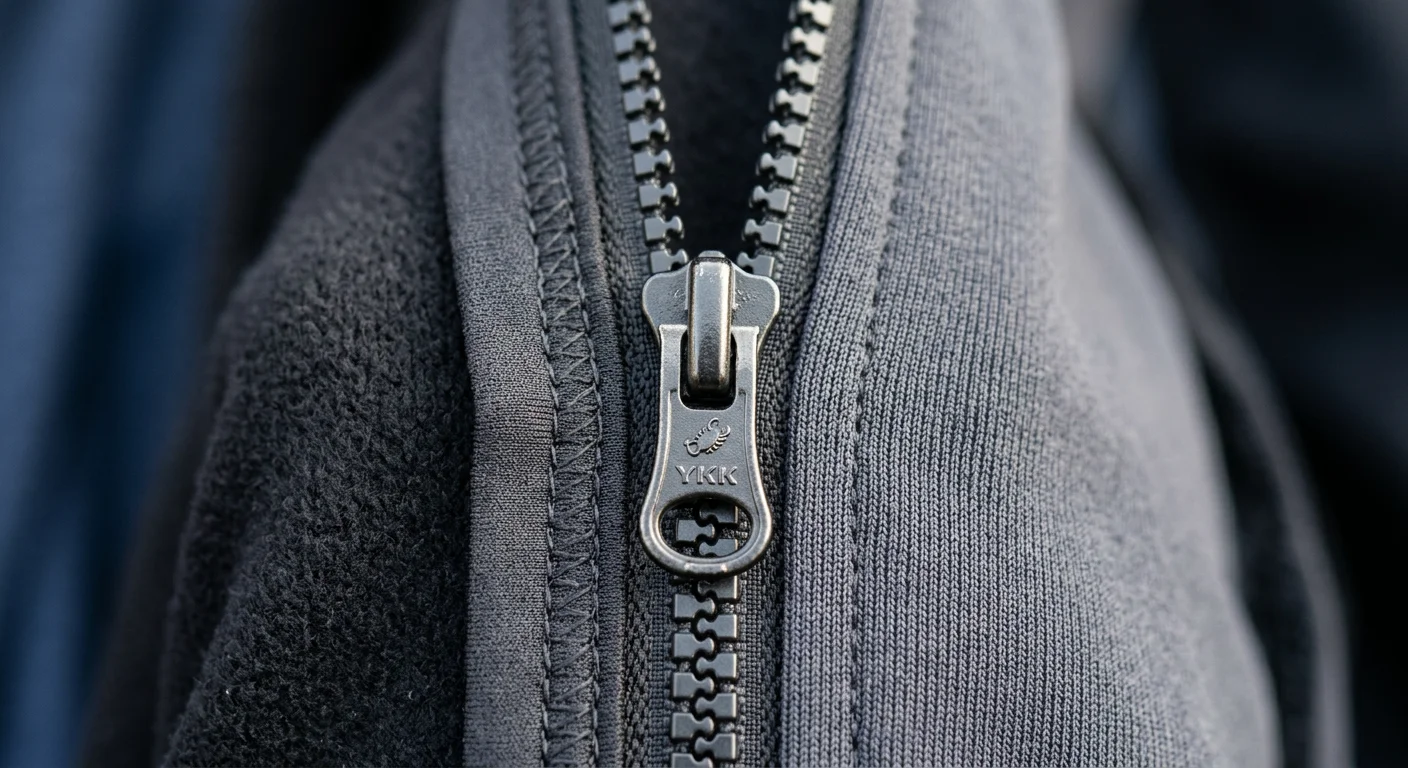
The zipper on a genuine Castelli jersey isn't an afterthought. It's a specification decision — and counterfeiters get it wrong every time.
Castelli sources zippers from YKK, the global benchmark for performance sportswear. The series depends on the garment type: #3C coil zippers go on lightweight jerseys and base layers, #5CV Vislon® on jackets and wind vests, and #8EX Excella® on premium limited-edition pieces. Each series has clear, checkable traits. Fakes use cheap generic substitutes across all of them.
The 60-Second Check
Flip the slider over and look at the back face. On a real YKK zipper, "YKK" is die-stamped into the metal — raised, crisp, permanent. On a fake, it's printed or laser-etched. It rubs off. That one detail exposes most counterfeits on the spot.
Then work through the rest:
Tooth alignment — Close the zipper and view it edge-on. Real teeth interlock with zero gaps, no shift, no wobble. Any misalignment points to poor mold calibration. That means fake.
Pull tab rivet — Tug the tab sideways. A genuine slider pivots on its rivet with no wobble or creak. Counterfeit rivets break down within 20–30 uses .
Slider operation — Run it up and down several times. Real YKK glides. Fakes stutter, catch fabric, or need force.
Locking mechanism — On full-zip Castelli jackets like the Gabba or Perfetto RoS, the slider locks firm when closed. Fake sliders don't engage. The zipper creeps open mid-ride.
What the Numbers Say
Authentic YKK zippers hold up for 5,000+ open/close cycles . Counterfeits break down within 50–100. One real cycling clothing manufacturer saw a 37% spike in warranty claims after dropping YKK — and zipper failure was the main cause.
Check the tape too. Real YKK tape is dense, supple, and color-matched to the garment. Run a fingernail along the edge — you'll feel consistent density and no loose threads. Fake tape feels stiff or rough, and the color rarely matches the shell fabric.
The zipper is small. Easy to miss. That's why it's one of the most reliable authentication points you have.
CTA SectionLooking for Quality Cycling Jersey Manufacturing?
From YKK zippers to flatlock seams, BeRun Sports delivers the same construction quality found in premium cycling brands.
Explore Cycling ApparelFit & Cut Comparison: Race-Cut Authentic vs. Baggy Fake
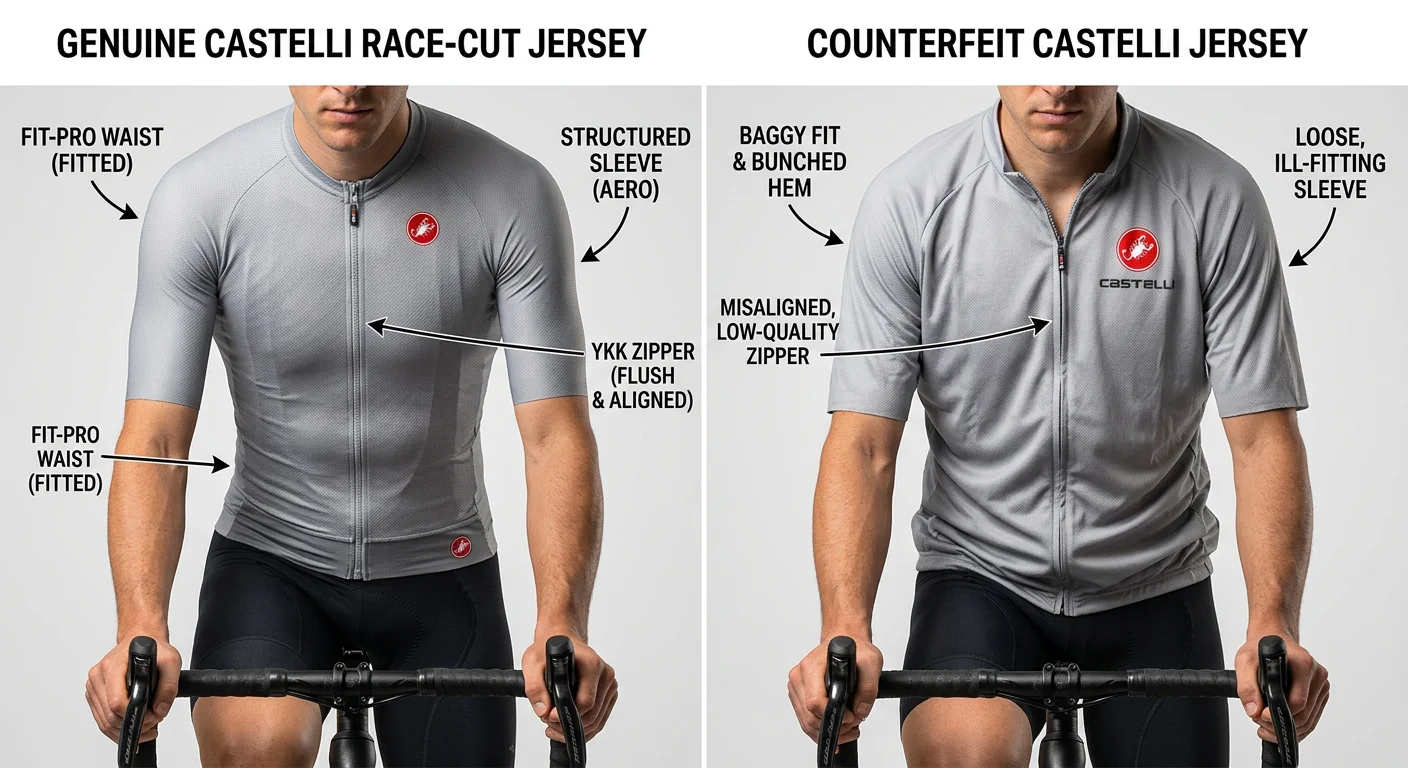
Put on a fake Castelli jersey and ride. Within ten minutes, the sleeves creep up your arms, the waist billows out, and the hem bunches around your stomach like a crumpled map. That's not a comfort issue. That's a cut issue — and it's the clearest way to spot a counterfeit from genuine race-cut construction.
Real Castelli jerseys are built for one position: bent over the bars at 70–90 degrees. Understanding proper cycling jersey sizing helps you spot fakes that don't match authentic measurements. Every design choice flows from that. The rear hem runs 8–10 cm longer than the front. On a genuine medium, that means a front length of 68 cm and a rear of 76–78 cm . Fakes shrink that drop to under 6 cm — sometimes less. Stand upright and both jerseys look similar. Clip in and ride, and the fake rides up and exposes your lower back within minutes.
The sleeves make it worse. Real Castelli cuts each sleeve with a 2–3 cm pre-shaped drop and a tight bicep fit — about 1 cm of stretch clearance. Push your arms forward at 90 degrees. The sleeve stays in place. Counterfeit sleeves run 3–5 cm shorter with no pre-shaping. They shift upward by 4–6 cm the moment you reach for the bars.
The waist tells the same story. Genuine jerseys taper with a 5–7 cm compression band that grips the body in the aero position — skin gap of 1–2 cm at most. Fakes skip the taper entirely. The waist sits 4–6 cm loose , leaving a gap that catches wind and wipes out any aerodynamic gain.
Size Chart Red Flag
Counterfeits mislabel sizes on purpose — and they do it in a consistent pattern. They run large across the board:
Authentic Size | Fake Label | Chest Difference | Length Difference |
|---|---|---|---|
S | M | +4–5 cm | +3 cm front, flat rear |
M | L | +5–6 cm | +4 cm front, +1 cm rear |
L | XL | +6–7 cm | +5 cm front, +2 cm rear |
Your jersey labels as one size but fits like the next size up? That gap alone is worth a closer look.
Quick Verification Checklist
Measure the drop-tail — Authentic ≥8 cm front-to-rear difference; fake <6 cm
Sleeve shift test — Arms at 90° forward; genuine stays put, fake moves 4+ cm
Waist pinch — Authentic grips at 1–2 cm gap; fake floats at 4+ cm
Weigh it — A genuine medium runs 220–240g ; fakes tend to land under 200g
Fit tolerance — Real Castelli holds ±1 cm per size; fakes vary by ±3–5 cm across the same labeled size
Reflective Elements & Safety Features: What Fakes Cut Corners On
Counterfeits don't just waste your money. They put you at risk.
Genuine Castelli cycling apparel uses retroreflective tape that returns up to 500 candelas per square meter — visible from over 1,000 feet away under direct light. That tape is dimensional. It sits on the chest, back, and shoulders in deliberate patterns. The geometry serves a purpose. It forms a clear human silhouette, so drivers get a split second to spot you, read your position, and track your direction.
Fakes swap that tape for flat-printed reflective patterns . Printed ink scatters light in every direction. Real retroreflective tape sends it straight back to the source. That's not a small difference. Vehicle braking tests show that low-grade reflective materials create blind spots that even modern automatic emergency systems can't fix.
Then there's durability. A few wet rides and counterfeit reflective prints fade, peel, or wash out. Real Castelli tape holds its performance through repeated washes and wears.
What genuine Castelli reflective elements include:
- Dimensional retroreflective tape — not printed substitutes
- Multi-zone placement for full 360° silhouette recognition
- Weather-resistant bonding that holds through rain, mud, and temperature swings
Fakes rely on a single reflective system with no backup. It fails — and it does fail. After that, you're invisible.
Where to Buy Real Castelli Cycling Clothing: Authorized Retailers & Safe Channels
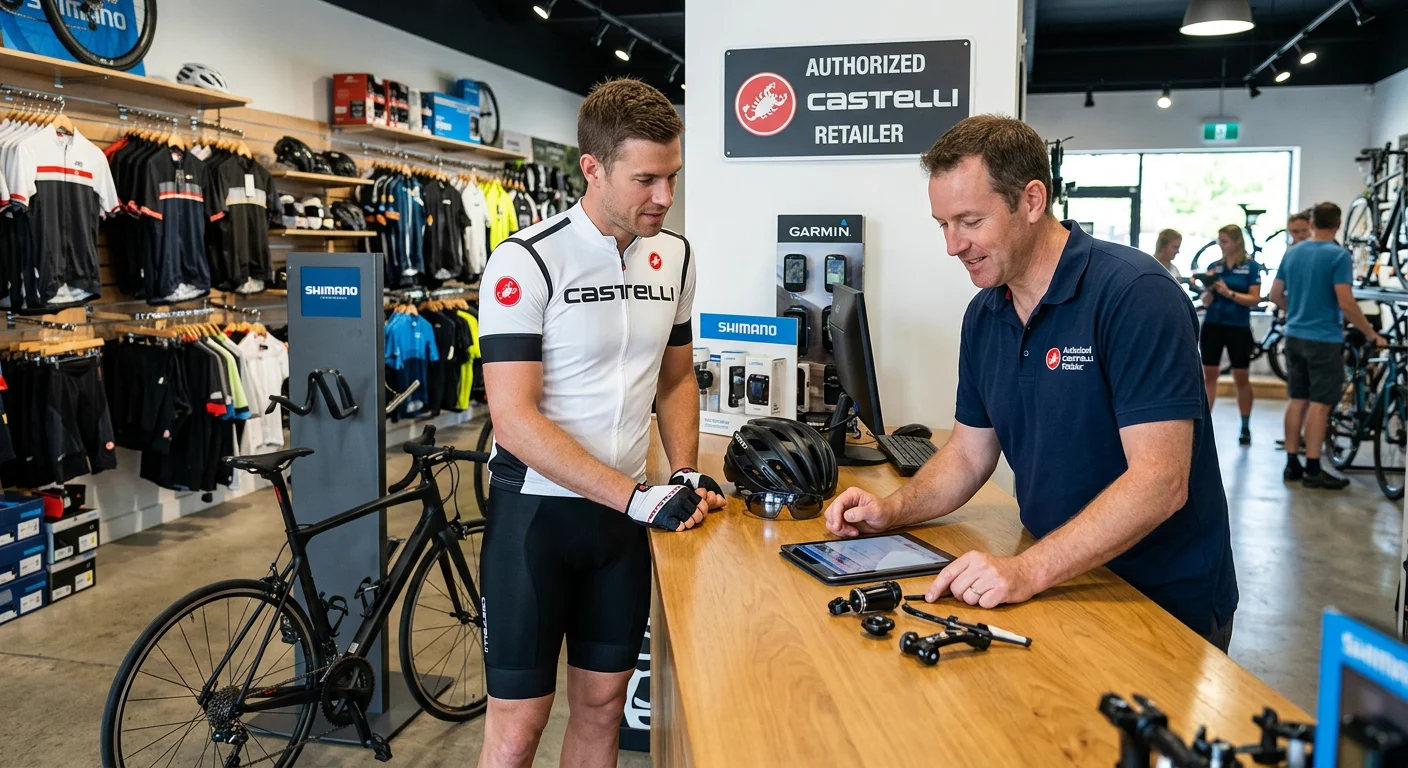
Castelli keeps this simple. Go to castelli-cycling.com/US/en/store-finder . Enter your postcode. The tool shows every authorized retailer — physical or online — near you. That's the whole system. Use it.
The official store at castelli-cycling.com ships free on US orders over $99. Every other option is a judgment call — and some carry real risk.
Channels You Can Trust
castelli-cycling.com — the baseline. No ambiguity.
Authorized local bike shops — found through the Store Finder above
Verified online retailers — Backcountry, Competitive Cyclist, BIKE24. These are professional sites with working phone numbers and real addresses you can check on Google Maps.
Castelli says it straight: "Buy only authentic Castelli products from your local or online authorized Castelli retailer." That's not brand positioning. That's a warning.
Channels That Should Make You Stop
Auction platforms. Deep-discount sites based overseas. Independent pages with no physical address, no working contact, and five-star reviews that all read like the same person wrote them — because one person likely did.
Castelli's own counterfeit guidance flags a clear example: a €249.95 Windstopper® jacket listed at ~€60 . That's a 76% cut. Their verdict: near-certain fake. This rule holds across the board. Any price more than 30–40% below the authorized RRP puts you in 99% counterfeit territory.
Copied product images are another trap. Counterfeiters steal photos straight from castelli-cycling.com. A listing with perfect images proves nothing. The photos can be lifted in minutes.
Quick channel check:
Signal | Safe | High-Risk |
|---|---|---|
Price vs. RRP | At or near RRP | >30–40% below |
Address verifiable | Yes — Google Maps confirms | Untraceable |
Contact number | Answers, sounds professional | Dead line or scripted |
Castelli authorized | Confirmed | Unknown |
A site that fails two or more of those checks? Walk away. Also, bought from a suspicious source already? Castelli's customer service team tracks counterfeits — reach out to them directly. They want to know.
Conclusion
Spotting a fake Castelli jersey isn't about being paranoid. It's about respecting your money, your performance, and your safety on the road.
At this point, you know what to look for. The weight and grip of genuine Castelli fabric. The precision of race-cut construction. YKK zipper hardware that slides clean. Logo detailing that counterfeiters butcher — no matter how hard they try. These aren't small differences. They're the gap between gear that works and gear that lets you down mid-ride.
Use this Castelli cycling jersey authentication guide each time you shop outside official channels. Bookmark it. Share it with your riding club. Come back to it.
Want to skip the guesswork? Shop through authorized retailers. The real thing costs more for a reason — because it is more.
Your watts are earned. Make sure the kit carrying them is too.
CTA SectionPartner with a Trusted Cycling Apparel Manufacturer
BeRun Sports provides custom OEM/ODM cycling clothing with genuine materials, rigorous quality control, and competitive pricing. Start your project today.
Contact Us Now