Okay, so you've decided you want to skate. Maybe you saw someone gliding through the park and thought, that looks fun — and something I could do without wiping out on day one — and now you're standing in front of a wall of wheels, totally lost. Nobody warned you there would be options.Many beginner programs now partner with custom quad hockey jersey suppliers to outfit players safely while keeping them excited to hit the rink.
Roller skating vs rollerblading. Quad skates vs inline skates. Four wheels in a square versus four wheels in a row. This choice matters more than it looks. And yes, everyone online has very strong opinions about it.
Here's what most people don'T realize: picking the wrong skate for your skill level is the number one reason beginners quit. They struggle, get frustrated, and walk away — before they ever get a real feel for it. That's a shame, because the right setup makes a huge difference.
So before you spend a dollar, let's sort this out. The goal is simple — get you rolling steady on your own, not grabbing a stranger's arm in a parking lot just to stay upright.
Stability & Balance: Quad Skates vs Inline Skates for Beginners
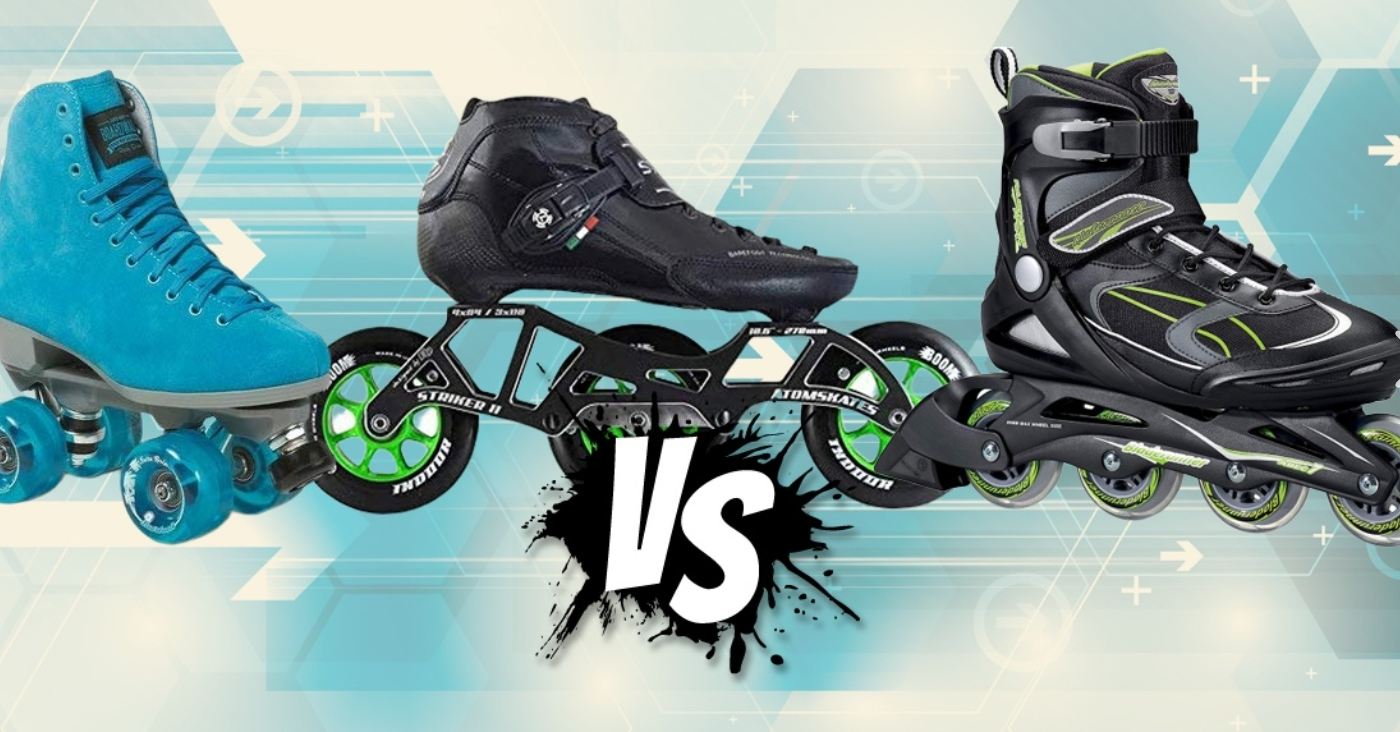
Here's the thing nobody tells you upfront: "stable" is not a single, simple quality. It has directions. The two types of skates are stable in different directions — that's exactly why this comparison gets so confusing online.
Quad skates are wider side-to-side. Inline skates are longer front-to-back. Those two facts explain almost everything about how each type feels underfoot for a beginner.
Why Quad Skates Feel Stable (And Where That Feeling Lies)
Quad skates have a 2×2 wheel layout — four wheels arranged in a rectangle about 8–10 cm wide and 10–12 cm long. That box-shaped footprint keeps small sideways wobbles inside the base. Your wheels don' t tip off their edges as easily. Standing still on quads feels solid and reassuring. Your ankles aren't fighting gravity every second just to stay upright. Many beginner quad sets also use smaller wheels (52–62 mm) and lower plates. This keeps your center of gravity closer to the ground. That does a lot for the mental side of learning — you stop feeling like you're one wrong move away from the floor.
Youth leagues often work with OEM/ODM quad hockey jersey manufacturers to provide coordinated gear that boosts confidence on the rink.
But here's the part that catches people off guard: quad skates have a short wheelbase. The distance between front and rear axles is around 120–150 mm. That's a narrow front-to-back margin for error. Lean backward — even just 5–10 degrees — and your hips drift past the rear wheels. Nothing is there to catch you. Skatefresh flags this directly: quad skaters are "far more likely to fall over backwards" because that short wheelbase gives almost no warning before you tip.
The most common fall on quads? Straight backward onto your tailbone. Gear priority for quad beginners: padded shorts first, then wrist guards, then helmet.
The fix is a forward posture — and you have to commit to it. Think "chair-sit": knees bent 20–30°, weight pressed into your big toes, chest angled forward. It feels unnatural at first. Do it anyway.
Why Inline Skates Feel Wobbly (And Where They're Stronger)
Inline skates are the opposite story. The single-row wheel layout is about 24–28 mm wide — a narrow line underfoot. Any sideways shift pushes you onto the wheel's curved edge fast, like a blade catching the floor. Skatefresh says it clearly: "Inline skates are more unstable sideways than roller skates, so bladers are more likely to have a sideways fall." Ankle strength and edge awareness aren't extras on inlines. They're the foundation of everything.
Here's the surprise for most beginners: inline skates are more stable front-to-back. Fitness and recreational inline frames run 230–280 mm wheelbase. That long base makes it hard to tip forward or backward from a small posture shift. Decathlon describes it well: "Inline skates have wheels that extend beyond the front and back of the foot, creating a long base for better balance."
Many beginner inline boots also use high, rigid plastic cuffs with locking straps. These limit ankle roll from a structural level. That helps with the side-to-side weakness — but it doesn't fix it. Clubs supporting recreational hockey programs often rely on private label inline hockey jersey solutions to streamline uniforms and branding.
You still need to build ankle alignment and control.
The most common fall on inlines? Sideways, at low speed. The fix is an A-frame stance:
- Feet in a slight V shape (toes out 10–20°)
- Knees bent
- Ankles stacked over your wheels
Practice slow side-to-side weight shifts while standing still. Get familiar with your edges before they catch you mid-roll.
The Practical Bottom Line on Balance
Quad Skates | Inline Skates | |
|---|---|---|
Lateral (side-to-side) stability | ✅ Better | ❌ Weaker |
Fore-aft (forward/back) stability | ❌ Shorter wheelbase, higher backward-fall risk | ✅ Longer wheelbase, more forgiving |
Most likely fall direction | Backward | Sideways |
Key beginner fix | Deep knee bend, weight forward | A-frame stance, ankle alignment |
Priority protective gear | Tailbone pad, wrist guards | Knee pads, wrist guards |
Neither skate is "more stable" across the board. They each fail in a different direction. Knowing which direction your skate wants to throw you — that's the most useful thing you can learn before you ever strap in.
Learning Curve Compared: How Fast Can Beginners Progress?
Most beginners assume both skate types will feel awkward for about the same amount of time. That assumption is wrong — and it's why the "just pick one" advice fails so many people.
The two skate types follow different learning timelines. Here's how that breaks down, milestone by milestone.
The First 3 Hours: Where Quad Has a Real Edge
In the first 1–2 hours on quad skates, 70–80% of adults with zero experience can stand steady and roll 5–10 meters without grabbing anything. The wide four-point base and toe-stop braking match your natural instincts. Press your foot forward in a panic — that's the right move on quads. It works in your favor.
Inline skates need a bit more patience up front. That first hour on a single-row wheel frame? Your ankles will feel like they have their own agenda. Expect wobbling. Most beginners hit that same 5–10 meter mark in 2–4 hours. Not much longer, but the experience of getting there feels more unsettling.
Hours 4–10: The Curves Cross
Here's where things flip.
Quad skates around the 5–10 hour mark put most learners in a solid indoor groove — smooth floors, low speed, basic turns. Comfortable. Predictable. Step outside onto cracked pavement or a small slope, though, and progress stalls. Full outdoor confidence on quads takes 15–30 hours total. The biggest hurdle is downhill control.
Inline skates pick up speed once you push past that shaky first phase. To outfit small inline hockey teams efficiently, many programs source inline hockey jersey wholesale price options that fit multiple players on a budget.By hours 5–8, many adults cruise 1–2 km at 8–12 km/h with real rhythm. Coaches call it a "suddenly it clicks" moment. Choppy, stop-start practice turns into something that feels like gliding.
Quick Reference: Hours to Each Milestone
Milestone | Quad Skates | Inline Skates |
|---|---|---|
Stand + roll 5–10 m | 1–3 hrs | 2–4 hrs |
20–30 m + basic turn + brake | 3–5 hrs | 4–6 hrs |
Smooth 10–15 min cruise, minimal falls | 5–10 hrs (indoors) | 5–8 hrs (outdoors) |
Casual urban skating, 3–5 km | 15–30 hrs | 10–20 hrs |
The short version: quads give you a friendlier first afternoon; inlines give you a faster route to going somewhere real .
Indoor vs Outdoor Skating: Which Skate Type Fits Your Environment?
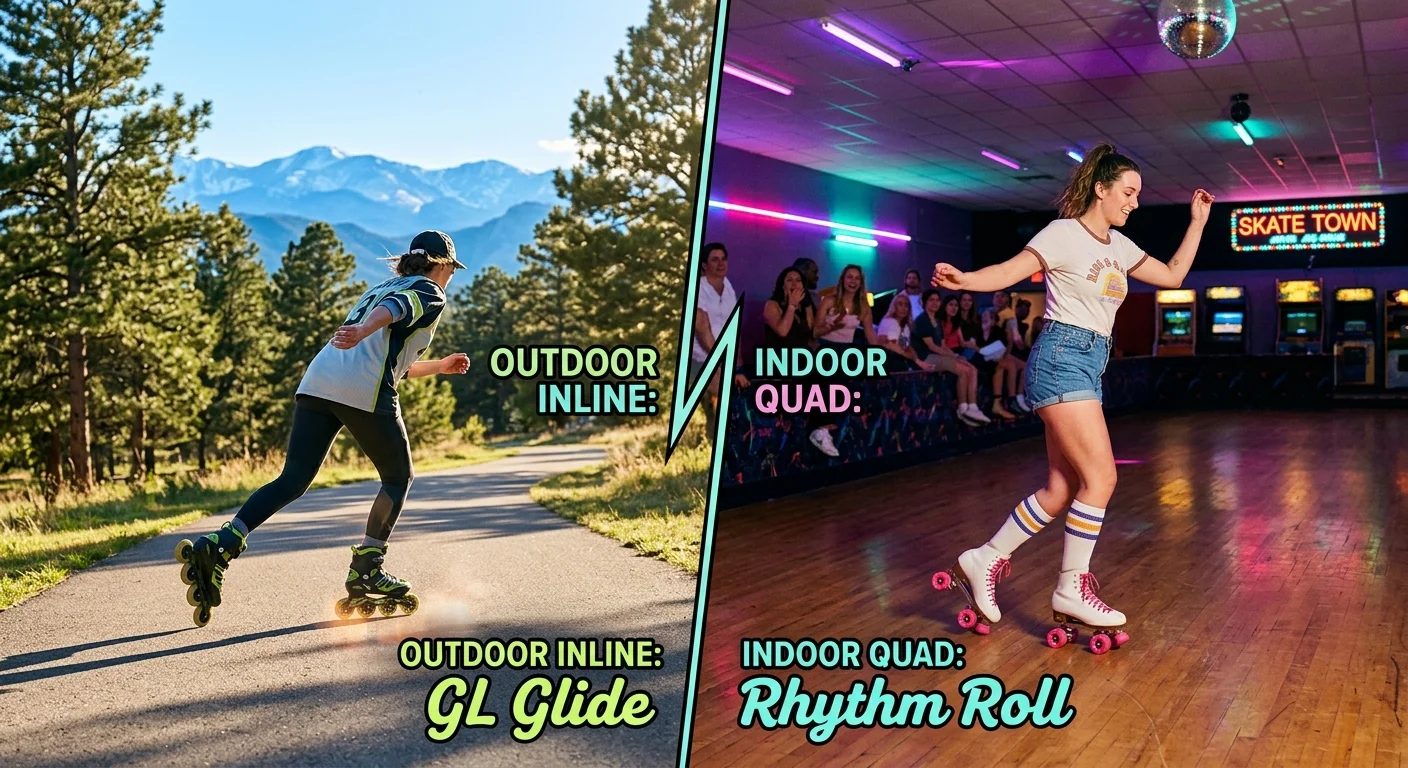
The floor beneath your wheels changes everything — and almost no one talks about this before you buy.
Quad skates were built for indoor rinks. Smooth wood floors, controlled speed, a crowd of people doing the same wobbly shuffle you're doing — that's their natural habitat. The hard wheels (88A–103A, 55–60 mm) roll fast and precise on polished surfaces. The four-point base keeps you steady while you figure out T-stops and plow stops — no tree roots to dodge. Most rental rinks hand you quads by default. They fit slower bearings on purpose to keep beginners from going too fast, too soon.
Step outside on those same wheels, though, and everything changes. Quad outdoor wheels run softer (78A–82A) and a bit larger (60–70 mm) to absorb road imperfections. Even with the right setup, cracks and pebbles catch wider wheels more than you'd expect. Skatefresh rates outdoor quad skating as an intermediate-level challenge for this reason. That wide contact patch snags pavement edges. Downhill control also demands real leg strength — more than most beginners realize.
Inline skates perform differently outdoors. Larger wheels (80–110 mm) roll over most sidewalk gaps instead of into them. The same rough stretch that leaves a quad skater picking gravel out of their wheels? That's just Tuesday for an 80 mm inline setup.Beginners and recreational programs sometimes buy from quad hockey jersey manufacturers who can provide high-quality, durable jerseys to last the season.
Quick environment guide:
Scenario | Better Choice |
|---|---|
Indoor rink, smooth floors | ✅ Quad |
Outdoor paths, cracked pavement | ✅ Inline |
Long-distance fitness skating (5 km+) | ✅ Inline |
Roller disco, dance, artistic | ✅ Quad |
Skating both indoors and outdoors? Start with a quality quad. Swap to softer outdoor wheels (78–82A) for outside sessions — all you need is a wrench. Your skating life is mostly outdoors with occasional rink visits? Go inline-first. That setup makes more sense for your situation. One thing to check first: some roller discos don't allow inline skates at all. Look up the venue policy before you show up.
One thing worth avoiding: don't try to learn both skate types from scratch at the same time. The braking systems conflict in muscle memory. Quads use toe stops. Inlines use heel brakes. In a genuine panic moment, your brain goes blank about which foot does what. Pick one environment. Pick one skate. Skate it for four to eight solid weeks. Then introduce the other type like a second language — not a simultaneous one.
Speed, Braking & Control: What New Skaters Need to Know
Speed is the part nobody warns you about. Not in the "wow, look how fast I'm going" way — in the "I have lost all control of my legs and the parking lot is not slowing down" way. This section keeps you off the pavement.
Here's a number worth remembering: at 20 km/h, you travel close to 6 meters before your brain even registers there's something to stop for. Add beginner braking distance on top — another 10 to 20 meters — and that's 25 meters of pure consequence before you stop. Speed management isn't an advanced topic. It's Day One material.
How Fast Will You Go?
Recreational inline skates (80–90 mm wheels) cruise at 12–20 km/h , with bursts up to 25 km/h once your stride settles in. Quad skates with typical outdoor wheels (58–65 mm) run a bit slower — 8–15 km/h sustained, maybe 18 km/h at full confidence. That gap isn't just a bragging-rights number. It's a physics gap. Larger inline wheels roll over cracks with less effort and shed about 30–40% less energy to rolling resistance than smaller quad wheels. Fewer strokes, more glide, more speed — so you need stronger braking to match.
Braking: Two Systems, Two Very Different Learning Curves
Quad toe stops feel natural right away. Drag the front rubber stop behind you, add pressure, slow down. Most beginners get a working drag-stop in 30 to 60 minutes of practice. It holds up well at parking-lot speeds (5–12 km/h) on flat ground.
The catch: on any slope steeper than 3–4%, toe stops turn on you. Press the front stop while rolling downhill and your weight shifts forward. The skate stops. You don't. Skate instructors are nearly unanimous on this — toe stops are not a hill brake. For real slopes, quad skaters use the plow stop (legs wide, toes in, inside edges dragging) or the T-stop. Both take real practice before they hold up under pressure.
Inline heel brakes take a bit longer to master. A basic stop from 10 km/h takes most adults 1 to 2 hours to nail. A clean, controlled emergency stop from 20 km/h — smooth, no wobble, under 15 meters — takes closer to 3 to 5 hours of focused practice . The mechanics matter: staggered stance, hips low, toe lifted, pressure added step by step. Slamming the heel pad won't stop you faster. It just makes the fall look more dramatic.
Past the heel brake — and you'll get there — T-stops and later powerslides take over. A solid powerslide brings you from 30 km/h to a full stop in under 10 meters. Getting there takes time, edge control, and a real willingness to practice falling in a chosen direction.
The Slope Rule Skate Schools Use
Plain and simple: stop from 20 km/h within 10 meters on flat ground first. No slope steeper than a gentle driveway (≈3% grade) until you can do that. This rule applies to both skate types. The slope doesn't care which wheels you're wearing.
What to Practice Before You Chase Speed
Skill Drill | Why It Matters |
|---|---|
Braking from walking speed first (~5 km/h) | Builds muscle memory without consequence |
Wide slalom turns across the path | Bleeds speed using direction, not friction |
One-foot glides, 5–10 m each leg | Cuts down wobble during braking |
10 consecutive controlled stops per session | Turns emergency braking into automatic response |
Build up to 10 clean, controlled stops from 15 km/h before you skate anywhere with a slope, a crowd, or anything you'd rather not hit. That benchmark isn't random — it's the line between skating being fun and skating ending in an insurance claim.
Age & Body Type: Quad or Inline — What's Right for Kids vs Adults?
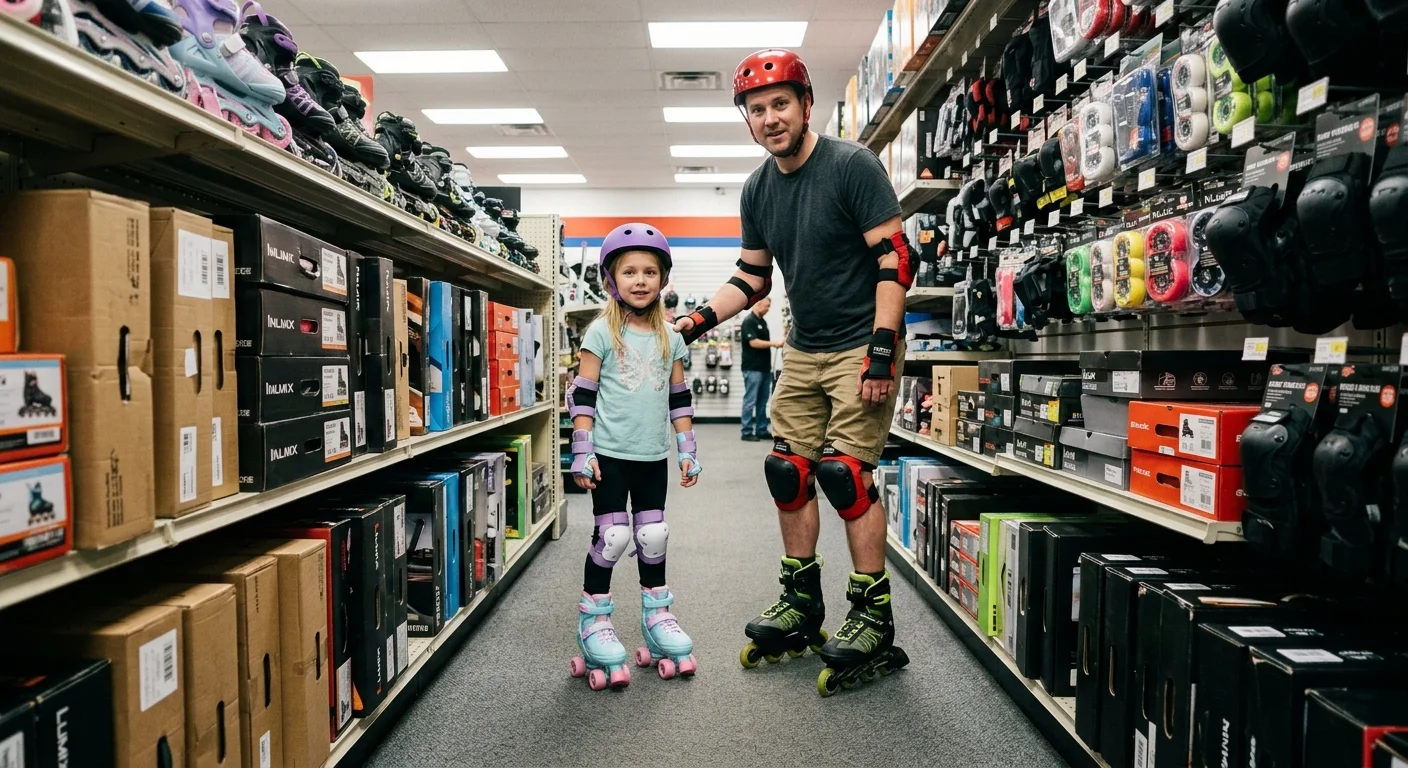
Age changes this equation more than most buying guides admit. A five-year-old and a forty-year-old are not solving the same problem. Even if they're both standing in the same skate aisle, holding the same box, wearing the same look of mild panic.
For young kids (under 5), quad skates are the near-universal recommendation. The reason is mechanical: that 2×2 wheel layout creates a wider base. Smaller sideways wobbles stay inside the footprint. A child who still wobbles during regular walking lacks the ankle strength and single-leg balance that inline skating demands from the first push. SkatePro states it clearly — the youngest skaters have a real advantage starting on quads, because of that side-to-side stability.
As kids get older and balance improves, the choice shifts:
Ages 3–5, first-ever skates → Quad first. Wider base, more forgiving, friendlier for "stand up before you slide."
Ages 6–9, decent balance, wants to skate outdoors → Inline becomes viable. The longer wheelbase handles sidewalk cracks and bumps better. Rolling efficiency improves as well.
Adults don't follow the same rulebook. SkatePro is direct about this: adult beginners have no requirement to start on quads before "graduating" to inline. That assumption holds beginners back for no good reason. The real decision factors for adults are:
Your Situation | Better Starting Choice |
|---|---|
Weak ankles, poor core stability | Supportive fitness inline (high cuff, firm closure) |
Casual fun, retro vibes, dance, jam skating | Quad |
Fitness, cardio, long-distance | Inline (90–110 mm wheels) |
Urban commuting, speed | Inline |
One thing worth noting: adults who skated as kids adapt to inline faster than true beginners. They already carry brake memory, weight-forward habits, and basic balance from their earlier years. That foundation maps well onto inline's single-row frame. The learning curve gets shorter and less steep.
The short version: age under 5, start quad. Adult beginner, skip the defaults. Match the skate to your ankles, your goals, and where you plan to skate.
Side-by-Side Comparison: Quad vs Inline Skates at a Glance
Seven dimensions. Two skate types. One table that cuts through the confusion fast.
Dimension | Quad Skates | Inline Skates | Winner & When |
|---|---|---|---|
Stability (standing/slow speed) | Wide side-to-side base, easy to stand still | Long front-to-back base, narrow side-to-side | Quad wins — no experience, kids, indoor practice |
Learning curve | Basic control in ~3–5 sessions | Same level takes ~4–8 sessions | Quad wins for true beginners; Inline matches with ski/ice background |
Best surface | Indoor rinks, smooth floors, wood | Outdoor pavement, rough concrete, long distances | Indoor → Quad; Outdoor → Inline |
Speed & efficiency | Moderate cruise speed | ~10–20% faster at equal effort | Inline wins — fitness, distance, anything over 3 km |
Braking | Front toe stop — easy to use from day one | Rear heel brake — takes practice to shift your weight | Low speed → Quad easier; Higher speed → Inline scales better |
Best age/user | Young kids, dance, social skating | Teens/adults, fitness, urban commuting | Kids & casual → Quad; Fitness & distance → Inline |
Entry price (adult) | ~$80–$150 | ~$120–$200 | Budget-conscious → Quad; Fitness-focused → Inline value holds |
Three questions decide most choices: Where will you skate most? What's your experience base? What's your budget? Run those three through the table above. The answer tends to jump right out.
So, Which Is Easier to Learn? The Honest Answer for New Skaters
Neither. Both. It depends on what you want — and that's the most useful thing anyone can tell you here.
Here's the real answer: quad skates are easier to learn indoors; inline skates get you to your outdoor goals faster. Those are two different questions. They just look the same on the surface.
Skating mostly at indoor rinks, slow speeds, social nights? → Quad wins. That wider base (90–110 mm vs 30–40 mm for inline) gives you 2–3× more side-to-side support underfoot. Over 60% of first-timers in rink programs say quads feel less intimidating on day one. That's a real difference.
Outdoor fitness, longer distances, or commuting? → Go inline. Yes, the first two sessions feel shaky. But larger wheels, a longer wheelbase, and lower rolling resistance all work in your favor. Push past those early wobbles and the ride clicks into place fast.
Still can't decide? Run through three quick questions:
Where will you skate 80% of the time? Rink → Quad. Outdoor paths → Inline.
Any ankle concerns? Weak ankles do better with a quad boot's wider base.
What's your actual goal? Rink dancing → Quad. Cardio or commuting → Inline.
Still tied? Outdoors beats indoors as a tiebreaker — go inline.
FAQ: Common Questions From Beginner Skaters
Eight questions. Real answers. No skating puns — okay, maybe one.
Q: Are roller skates harder than rollerblades for beginners?
It depends on what kind of "hard" you mean. Quad skates are wider side-to-side, so standing still feels steady. Inline skates are longer front-to-back, so they absorb forward and backward lean better. Outdoors, inline wheels (78A–85A, 80–84 mm) roll right over sidewalk cracks that would stop quad wheels cold. Got weak ankles? A high-cuff inline boot gives your ankle more structural support than a low-cut quad boot — no emotional support included.
Q: How long does it take to learn?
Here's a rough breakdown:
Basic rolling and balance: 2–6 focused sessions (45–60 minutes each) for an average adult
Full start-stop-turn confidence: 10–20 hours over 3–6 weeks, skating 2–3 times a week
Comfortable on mixed outdoor surfaces: 30–50 total hours
Kids aged 6–12 tend to pick it up about 20–30% faster. Adults over 40 may need 20–30% more time. Consistency matters far more than age.
Q: Is there a maximum age to start skating?
Schools like Skatefresh teach first-time adult skaters well into their 60s and 70s. No maximum age exists, as long as you're cleared for light impact exercise. Proper protective gear cuts wrist and knee injury risk by 50–60%. One to three coached lessons at the start will knock out bad habits faster than months of solo "rolling and hoping."
Q: What gear do beginners need?
Minimum kit:
- Certified helmet (CPSC/EN1078) — sit it level, two fingers above your eyebrows, strap snug
- Wrist guards — palm splint goes on the palm side, not the top
- Knee and elbow pads — hard cap centered on the joint, straps firm enough that they don't spin when you bend
Most skate coaches train beginners to fall forward onto knees and wrists on purpose — not backward — to protect the tailbone. It's a skill worth learning early.
Q: What are the biggest beginner mistakes?
Straight legs → your center of gravity goes too high. Fix: hold a 20–30° knee bend at all times.
Looking at your feet → wobble spiral, guaranteed. Fix: eyes forward, locked on the horizon.
Arms locked tight → you lose your ability to react. Fix: relax your elbows, let your arms float out a bit.
Skipping braking practice → fear builds fast. Fix: nail one solid stop before you chase speed.
Loose boots → over 90% of new students show up with skates laced too loose. Fix: tighten from toe to ankle, firm all the way up. Your heel should not lift inside the boot.
Q: What's the step-by-step progression for a complete beginner?
Gear up and tighten skates from toes upward — firmest over instep and ankle
Practice the athletic stance off-skate first: feet shoulder-width, knees bent, arms out
On-skate static balance — V-shape stance, heels together, toes out about 45°
Shift your weight side to side without lifting your skates
Small "lemon" pushes — toes out, then in, rolling at a slow pace
Master one stop from walking speed before picking up pace
Gentle leaning turns with soft knees
Q: Where should beginners practice — and what should they avoid?
Good surfaces: smooth dry concrete, empty parking lots, quiet cul-de-sacs, indoor rinks.
Stay away from, at first:
- Wet ground — grip drops fast
- Slopes over 3–4% grade before you can brake with control
- Rough asphalt, gravel, or bricks
Clean your bearings on a regular schedule. Dirt and water create random instability underfoot. Nothing kills confidence faster than vibration you can't figure out.
Q: How do I know if my skate setup is right for a beginner?
Check these specs:
Outdoor inline wheels: 76–84 mm diameter, 78A–85A durometer
Outdoor quad wheels: 58–65 mm, 78A–85A
Indoor quad rinks: 88A and above
Trucks should be medium-tight. Loose trucks feel twitchy before your reflexes are ready for them. The boot should support your ankle with no painful pressure points. Toes touching the front of the boot is fine. Cramped toes are not.
Right setup, much shorter learning curve. Wrong setup, much louder parking lot.
Conclusion
Here's what nobody tells you before buying your first skates: the "right" choice is the one that gets you moving.
Quad skates give you a wider, stable stance. Your brain can relax and find balance faster. That's why most beginners do better on four-wheel skates first. Inline skates bring speed and outdoor freedom once your ankles build some strength.
Nervous beginner? Start with quads. Chasing trails and open-air rides? Inline is your pick.
Either way, you're going to fall. You're going to laugh. You're going to get back up. Somewhere between roller skating vs rollerblading debates and shaky first laps, you'll find what works for you.
Now stop researching and go skate. Browse our beginner skate collection at berunclothes.com and find the pair that starts your story.
Teams and leagues looking for uniform solutions often partner with suppliers of inline hockey jersey to ensure young athletes have safe, comfortable, and stylish gear while learning the ropes.