Every sport has its cathedral moments — but cycling has an entire hierarchy of suffering. Some races break riders over three weeks of mountain passes and altitude. Others detonate them in a single brutal afternoon across medieval cobblestones.The global attention surrounding these legendary races is closely followed by prestigious cycling apparel wholesalers, who track how iconic events shape demand for performance jerseys and team kits.
The real question isn't which professional road cycling events are the most prestigious. It's why certain races occupy a different psychological universe from everything else on the calendar. From the golden mythology of the Tour de France to the quiet, devastating beauty of Il Lombardia, here is a ranked breakdown of the five races that define what elite cycling demands — of the body, the machine, and everything in between.
#1 Tour de France — The Gold Standard of Cycling Prestige (Difficulty Score: ★★★★★)
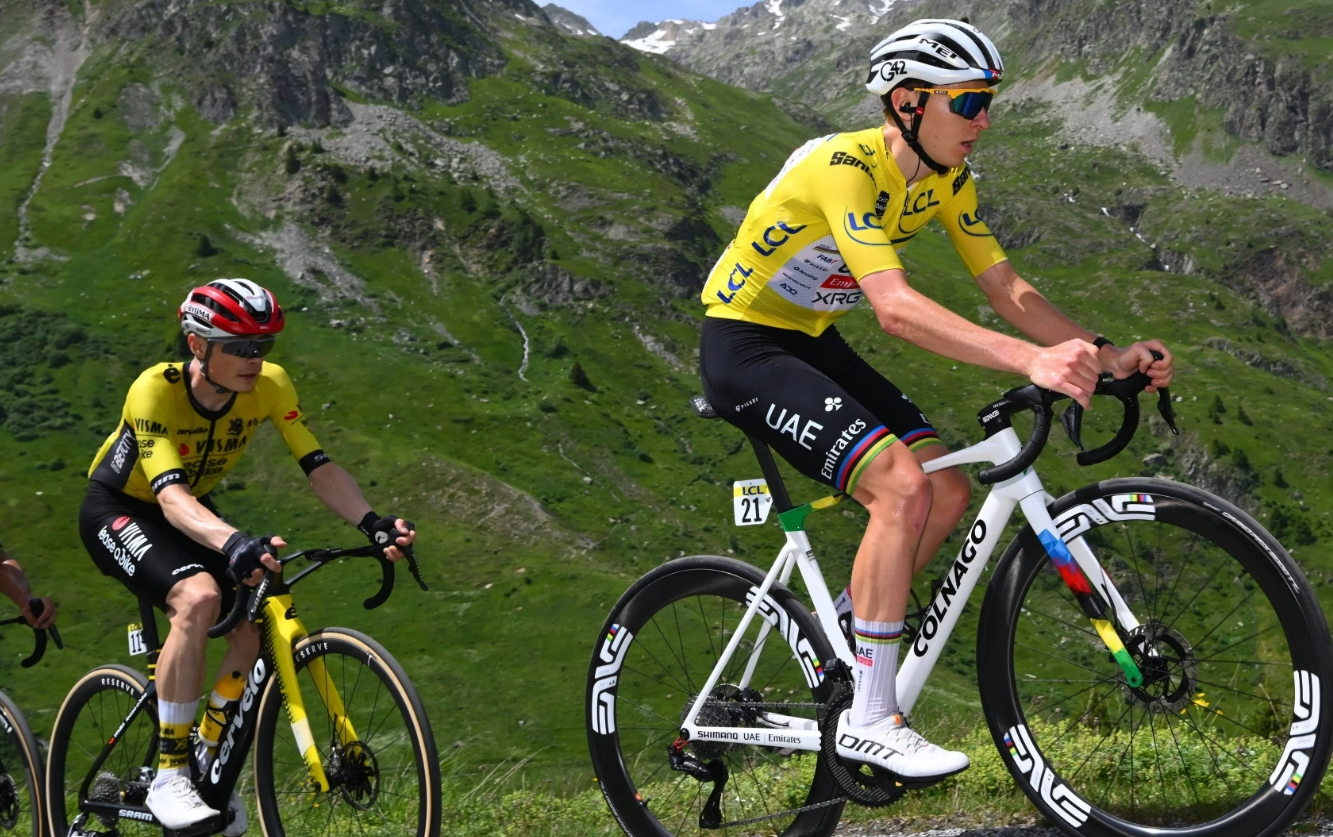
Three weeks. Twenty-one stages. More than 3,400 kilometers. Somewhere inside those numbers lives the most recognizable trophy in professional road cycling — the Maillot Jaune , the yellow jersey.Preparing national squads and sponsor kits for races of this scale usually involves coordination with global cycling apparel suppliers supporting WorldTour teams and national federations.
A cultural symbol that has carried weight since 1919.
No ranking of Grand Tour cycling races starts anywhere else.
What the Numbers Mean
The Tour de France doesn't just test riders. It breaks them down, piece by piece, then asks what's left. Take Stage 8 as a reference point. That's 151 kilometers, over 11,000 feet of climbing, close to five hours of racing, and a WHOOP strain score of 20.6. Riders hit the start line at 70% recovery. They finish in a darker place.
Over 21 days, the total caloric demand hits 120,000 calories . That figure isn't dramatic. It's just physiological math.
The climbs make that math brutal:
Mont Ventoux (Bédoin): 20km at 7.7% average, with ramps hitting 20%. The 2021 double ascent pushed more than 4,500 meters of total climbing into a single day
Alpe d'Huez : 21 hairpins, 8.1% average gradient. Less a road, more a verdict
Col du Tourmalet : The "Circle of Death" chain — Aubisque, Tourmalet, Aspin, Peyresourde — has built Tour legends for over a century
Hautacam (2025): Profile score of 237.8, the hardest single climb on the 2025 route
Miss the time cut — set at 8–25% beyond the stage winner's finish time — and you're done. On a queen stage, that margin gets razor-thin.
Why It Sits Above Everything Else
The Tour broadcasts into 190+ countries . More than 3.5 million spectators line the roads each year. At Col de Granon in 2022, Jonas Vingegaard pulled time on Pogačar — 11 kilometers at 10% grade, 1,052 meters of elevation gain. That moment didn't just decide a race. It traveled across the world.
That's the difference. Other elite cycling competitions produce results. The Tour de France produces history .
#2 Giro d'Italia — The Brutalist Climber's Grand Tour (Difficulty Score: ★★★★★)
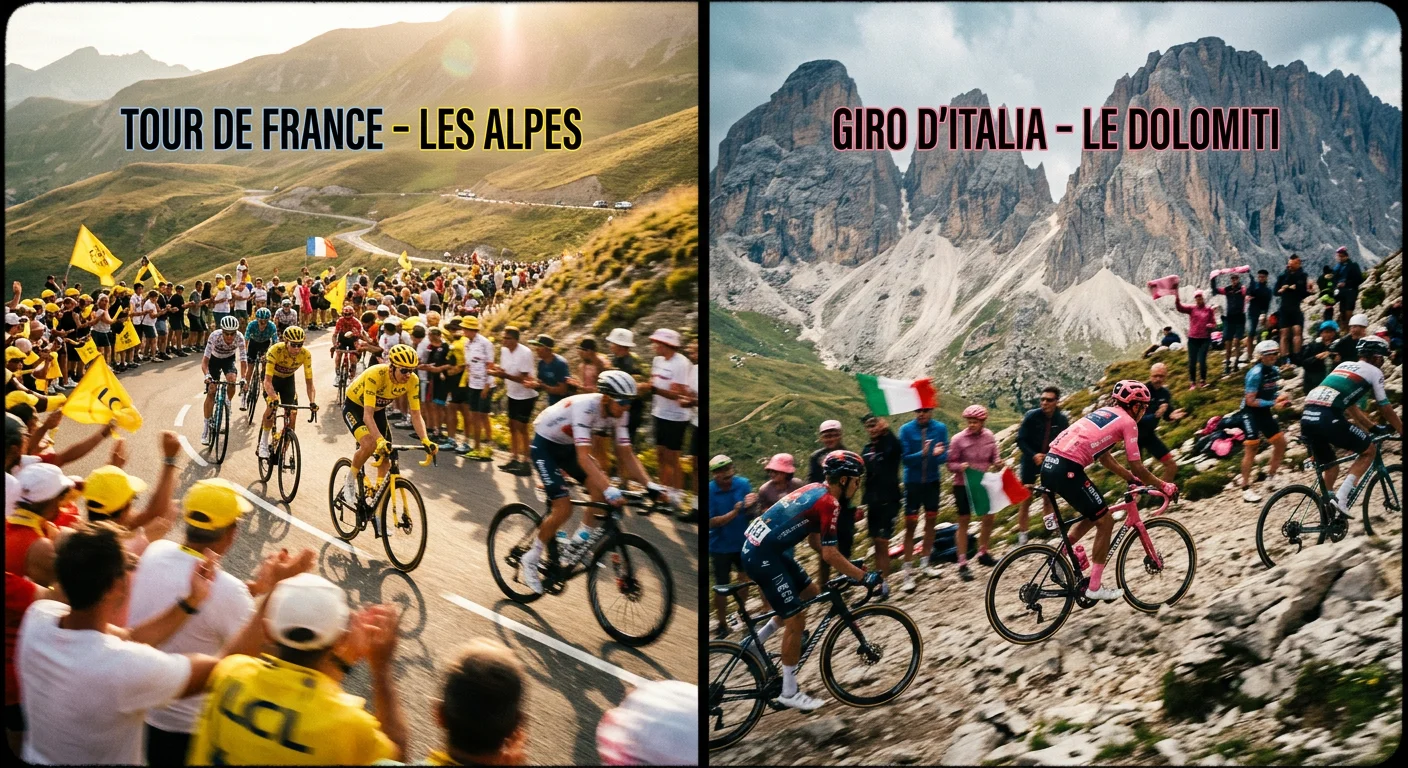
Italy doesn't do anything quietly — and neither does its Grand Tour.Climbing-heavy races like the Giro also inspire limited-edition race kits developed by custom Prestigious Cycling Races cycling apparel suppliers for teams targeting mountain-stage visibility.
The Giro d'Italia is where climbers go to be destroyed and remembered. Riders preparing for these conditions often invest in top winter cycling clothing for early-season mountain training. Not in the clean, cinematic way the Tour de France destroys them. In something rawer. More personal. The Dolomites don't care about your training camp or your power numbers. They just rise, and keep rising, until you either find something inside yourself or you don't.
The Mountains That Decide Everything
The 2026 edition covers 3,459 km across 23 days. Total elevation gain sits between 49,150 and 50,000 metres . You get six summit finishes and one flat time trial — a contrast that feels almost cruel.
Stage 19 is where the race gets honest. Feltre to Alleghe: 151 km, 5,000 metres of climbing. The route stacks five major passes back to back:
Passo Duran
Passo Staulanza (variants hitting 19%)
Passo Giau — the Cima Coppi at 2,236 metres, tackled from its hardest side
Passo Falzarego
Final ascent to Piani di Pezzè — 10% average, spikes to 15%
No recovery. No mercy. Classic Dolomite brutalism, stretched across a brutal modern distance.
Stage 7 goes even longer: 246 km from Formia to Blockhaus . That makes it the longest mountain stage in recent Giro memory. The final 13 km climb is steep and relentless. This is the first real GC test. The race splits riders into two groups here — those still fighting, and those already counting their losses.
Stage 20 closes the mountains with a double ascent of Piancavallo . This is the same climb where Marco Pantani sealed the 1998 Giro overall . History is built into the gradient itself.
Why It Belongs at #2
The Giro gives pure climbers their cathedral. The Tour carries more cameras. The Giro carries more altitude — and a raw, unforgiving kind of suffering that turns good riders into legends. You just have to survive long enough to finish.
#3 Vuelta a España — The Late-Season Mountain Monster (Difficulty Score: ★★★★☆)
By late August, the best riders in the world are already broken. Producing the wide range of team jerseys seen across Grand Tours typically relies on specialized cycling apparel manufacturers capable of handling elite-level aerodynamic fabrics and race cuts.
Legs that carried them through the Dolomites in May and the Alps in July — those same legs arrive at the Vuelta a España worn down and fragile. And then Spain asks them to climb anyway.
That's the cruelty that makes the Vuelta distinct.
The Weight of Late Season
Timing is the Vuelta's secret weapon. It runs from late August through mid-September — the 2026 edition goes 22 Aug to 13 Sep . By that point, riders have already absorbed 3,000 to 4,000 kilometers of Grand Tour racing. Rider surveys show that built-up fatigue raises the perceived difficulty of the Vuelta's GC battles by 20–30% compared to the same climbs raced with fresh legs.
The body doesn't lie at kilometer 3,275.
The Vuelta covers around 3,335 km total, split across 21 stages of mostly mountain terrain. The 2026 route hits hard early. Stage 4 throws riders into a 104.9 km individual time trial through Andorra . Mountain stages follow one after another: Valdelinares, Alto de Aitana, Calar Alto, Peñas Blancas, and Collado del Alguacil. Eight summit finishes across three weeks.
The Climbs That Define It
No climb in professional road cycling matches the Angliru for raw, sustained punishment. At 12.5 km long with gradients hitting 23.5% , it's not just steep — the steepness never lets up. The Zoncolan hits similar peak percentages, but the Angliru holds that pain across a much longer distance. That's the difference between a shock and a sentence.
Route reforms after 2018 added 40% more mountain stages to the Vuelta. The race now averages 8–10 HC and Category 1 summit finishes per edition. The results tell the story clearly: 90% of Vuelta podiums since the reform belong to climbers with a BMI under 21.5. Sprinters don't finish this race. They survive it, or they don't.
The prestige has climbed with the difficulty. In the last decade, seven of ten Vuelta winners were prior Tour or Giro contenders. Pogačar won stages in 2024. Vingegaard claimed three in 2025. The gap between the Vuelta and cycling's top tier has closed — the top-10 GC overlap with the Tour de France now sits at 85% .
#4 Paris-Roubaix — "The Hell of the North" One-Day Cobblestone War (Difficulty Score: ★★★★☆)
259 kilometers. 30 cobbled sectors. One velodrome finish that feels like crawling out of a war.The brutal one-day classics also inspire commemorative kits and fan editions produced through custom Cycling Races cycling apparel factory programs tied to historic races like Paris-Roubaix.
Paris-Roubaix doesn't build suffering slowly across three weeks like the Grand Tour races do. It hits all at once. One single April afternoon carries a full season's worth of punishment. Founded in 1896 , it stands as one of cycling's five Monument classics — and the one race that uses the road itself as a weapon.
The Cobbles Do the Work
The Arenberg Forest sector is where the race breaks people mentally. It sits at 9/10 difficulty — the hardest rating of any pavé sector on the course. Those 2.4 kilometers of ancient stone hit around the 100 km mark. By then, legs are already burning and gaps are already forming. Thirty sectors total. 55 km of cobbled racing spread across the full distance. The stones don't just punish your speed. They threaten your wheels, your collarbone, and your race position all at once.
The data tells a clear story. The average winning time across all editions is 7 hours, 11 minutes . Mathieu van der Poel finished in 5:25:58 in 2024 — holding 47.80 km/h across those same cobblestones. He won again in 2025. That's three consecutive titles . Only Francesco Moser and Octave Lapize have matched that in the race's entire history.
Winners here don't look like climbers. The average winner BMI is 23.03 — built for raw power and absorbing punishment, not climbing mountain gradients. Belgium dominates this race: 57 wins to France's 28. Roger De Vlaeminck and Tom Boonen each took four victories .
#5 Il Lombardia — The Monument of Champions in Autumn (Difficulty Score: ★★★☆☆)
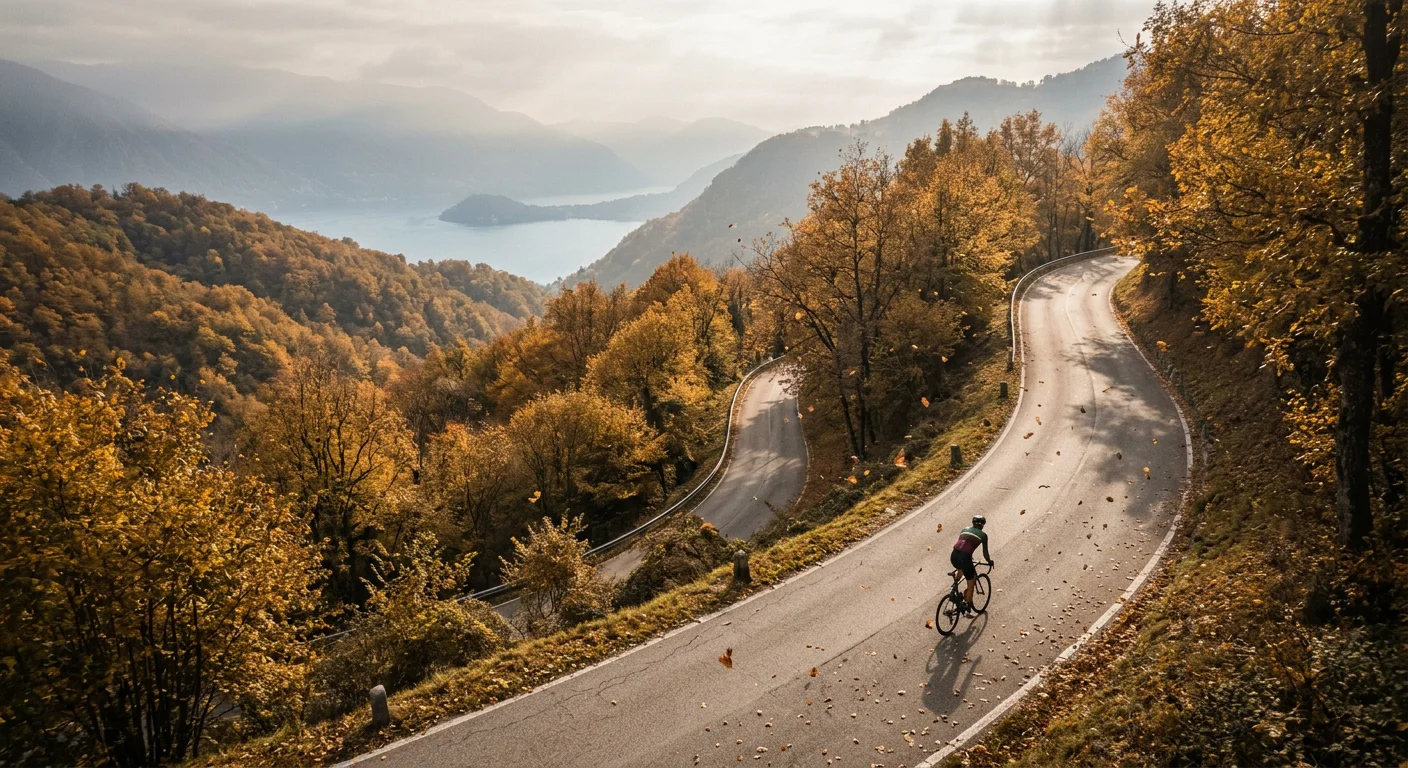
October in Lombardy looks like a painting someone couldn't bear to finish. The leaves are turning. The lakes are still. Somewhere between Bergamo and Como, the greatest climbers in professional road cycling are tearing each other apart — in near silence.
Il Lombardia is the oldest of the five Monument classics still racing its original concept — 120 editions since 1905 . They call it "The Race of the Falling Leaves." That name does something the difficulty score doesn't. It tells you what kind of suffering this is. Not savage, like Paris-Roubaix. Not relentless, like the Angliru. Lombardia is elegant suffering. 243 kilometers of it, through hills that look too beautiful to be this cruel.
The Numbers Behind the Autumn Classic
The average winning time across all editions is 6 hours, 49 minutes . That range stretches from Alfredo Binda crawling home in 1926 at 25.42 km/h to modern editions pushing past 41 km/h. The 2025 race covered 241 km in 6:04:58 . Tadej Pogačar averaged 41.92 km/h and climbed 4,639 meters of elevation. He attacked on Passo di Ganda. Then he rode solo all the way into Bergamo. Evenepoel finished 1 minute 48 seconds behind. Storer was another 3:14 back.
That gap says a lot. A Pogačar at full strength doesn't just win Il Lombardia. He turns it into a completely different race — one only he seems to be riding.
Pogačar's Five-Year Reign
No rider in Monument history has ever won the same race five times in a row. Pogačar did it from 2021 through 2025. He matched Fausto Coppi's all-time record of five victories. Then he went further — doing it in consecutive years. Coppi's five wins spread across eight years. Pogačar's came on five straight autumn afternoons.
That streak changed how the cycling world sees this race. Il Lombardia used to reward the pure climber — the specialist who peaked once in October and built a whole career around that one result. Damiano Cunego won three times. Sean Kelly won three. Thibaut Pinot took 2018 on raw emotion and gradient alone. Now, the race belongs to the all-rounder — the rider who can climb, attack, and time-trial, all in a single afternoon.
The 2026 edition runs October 10, Bergamo to Como . The route stays familiar. The hills don't change. The one question that does: can anyone stop him?
Difficulty Comparison: Grand Tours vs Monument Classics — Which Is Harder?
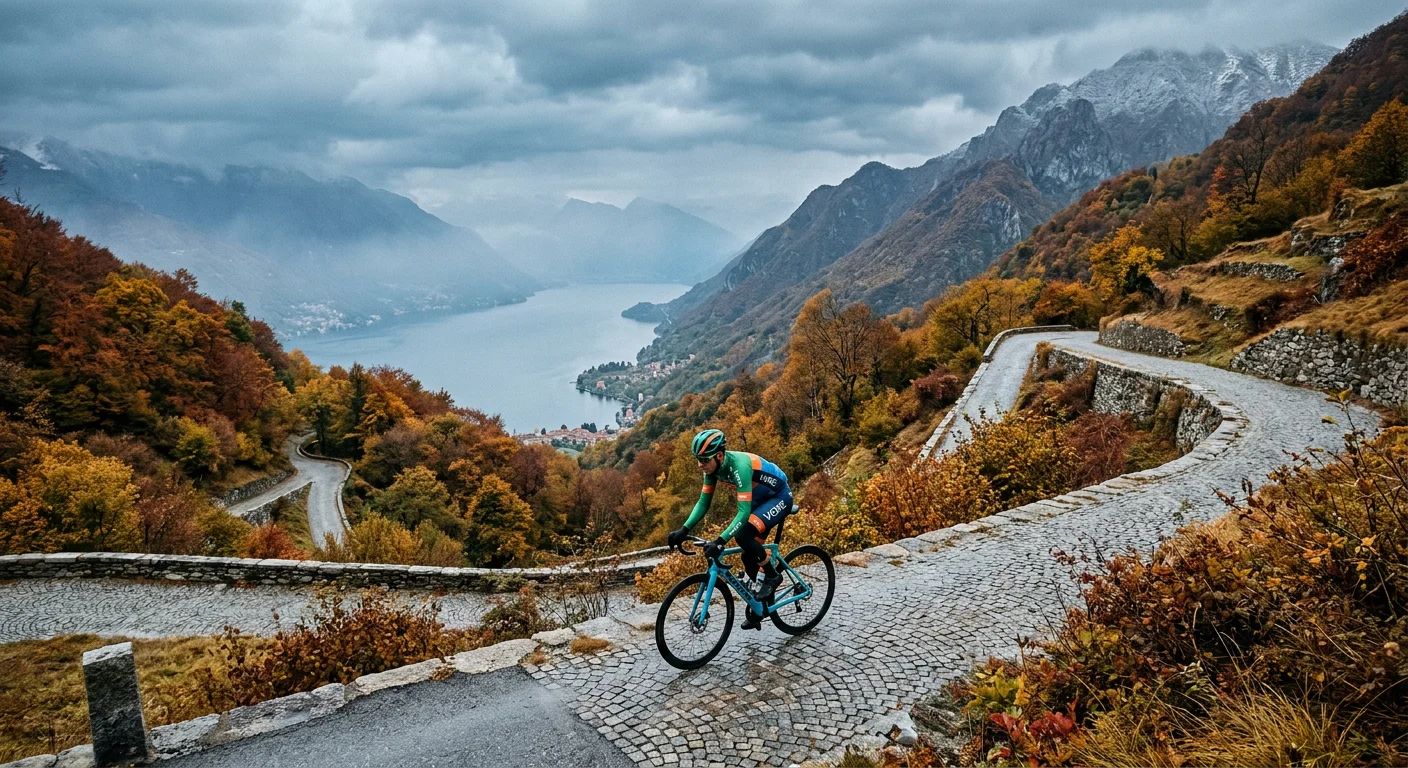
Ask a professional cyclist this question and watch what happens. They don't answer right away. They look past you, running some kind of private calculation — three weeks of mountain suffering on one side, six hours of cobblestone punishment on the other. Then they say something honest: it depends on what you mean by hard.
That ambiguity is the point.
Two Different Languages of Pain
Grand Tours and Monument classics aren't rival versions of the same race. They test the human body in two separate ways.
The numbers make that clear:
Dimension | Grand Tours | Monument Classics |
|---|---|---|
Total Distance | 3,500 km across 21 stages | 240–260 km, single day |
Cumulative Elevation | 50,000–60,000m | 4,000–5,000m |
Duration | 21 days, 6–7 hrs/day | 6–7 hours total |
Road Surface | Mixed paved/mountain | Cobblestones, 20%+ hellingen |
Weather Exposure | Multi-day risk | Single brutal window |
On paper, it's not close.
But the score hides something important.
Grand Tour difficulty is chronic . Think 120,000 calories burned over three weeks. Legs that never get a real rest. Mornings where riders clip in already at 70% capacity. Chris Froome described it as a slow burn — day-after-day pressure with no exit. The body keeps going while it breaks down piece by piece.
Monument difficulty is acute . One afternoon. Every match burned at once. Mathieu van der Poel calls the cobblestones and 20% gradients of Flanders bone-chattering — harder than any single Grand Tour stage he's ridden. No GC math. No recovery day waiting tomorrow. Every rider crosses the finish line shattered.
Eddy Merckx — the one man who ruled both — never ranked them against each other. He didn't need to. Winning both, year after year, was his answer.
What These Elite Races Demand: Cycling Apparel & Gear Performance Standards
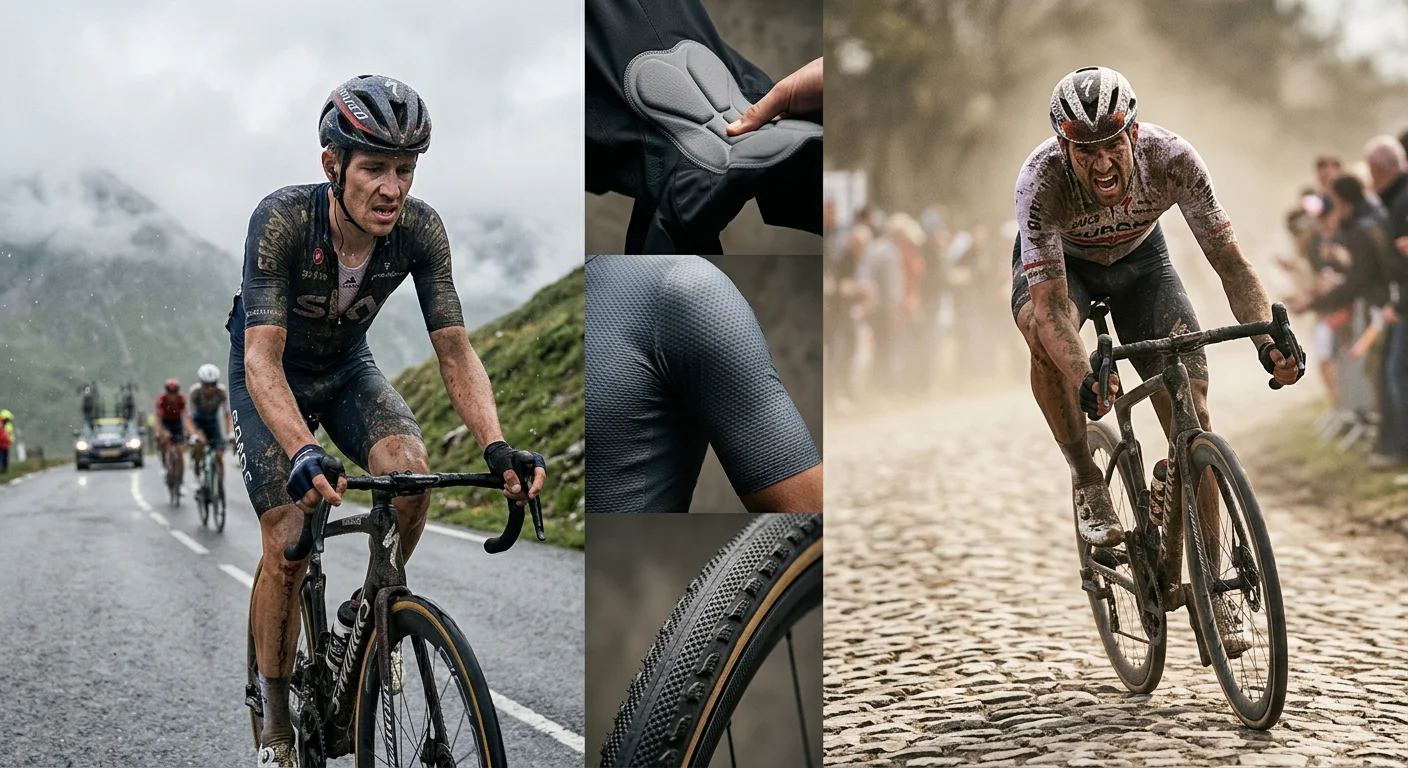
The riders you've been reading about don't survive these races on legs and willpower alone. The gear is doing work you can't see.
At the World Tour level, GC contenders need to sustain over 6.3 W/kg for 20 minutes and hold 4.4 W/kg for four hours straight . Those numbers don't just define training targets. They define what every piece of equipment touching the rider's body has to handle. Fabric. Tire compound. Bearing friction. All of it carries consequence.
Two Races, Two Different Problems to Solve
Grand Tour gear and Classics gear aren't the same thing in different packaging.
The challenge is duration. Apparel needs multi-zone temperature control for big elevation changes -- from valley heat to alpine cold within a single stage. Fabrics tested in wind tunnels cut drag at sustained speeds. Over 240 minutes of hard effort, even small friction savings add up to something real.
The problem is raw punishment. Fifty-five kilometers of cobblestones produce constant vibration. That vibration breaks down both the rider and the equipment at the same time. High-performance panels with shock-absorbing and sweat-wicking properties aren't comfort features -- they're structural requirements.
Race Type | Core Demand | Gear Priority |
|---|---|---|
Grand Tour | Sustained power, temp variability | Fatigue-resistant, multi-layer, aero fabrics |
Monument Classics | Vibration, short burst sprints | Shock absorption, moisture management, grip tires |
What This Means Beyond the Pro Peloton
The same performance logic applies at lower levels too. Understanding the difference between cheap and expensive cycling jerseys helps riders make informed gear choices. Riders training at 5.5+ W/kg can match Grand Tour apparel specs to their own power output. That means prioritizing aerodynamics on climbs and durability on rough terrain. For hot-weather stage races, see our guide on choosing cycling apparel for hot weather. At Berunclothes.com, we build custom good cycling kits around this kind of thinking — pro-derived specs, shaped to fit how real riders ride.
The races set the standard. The gear answers it.
Conclusion
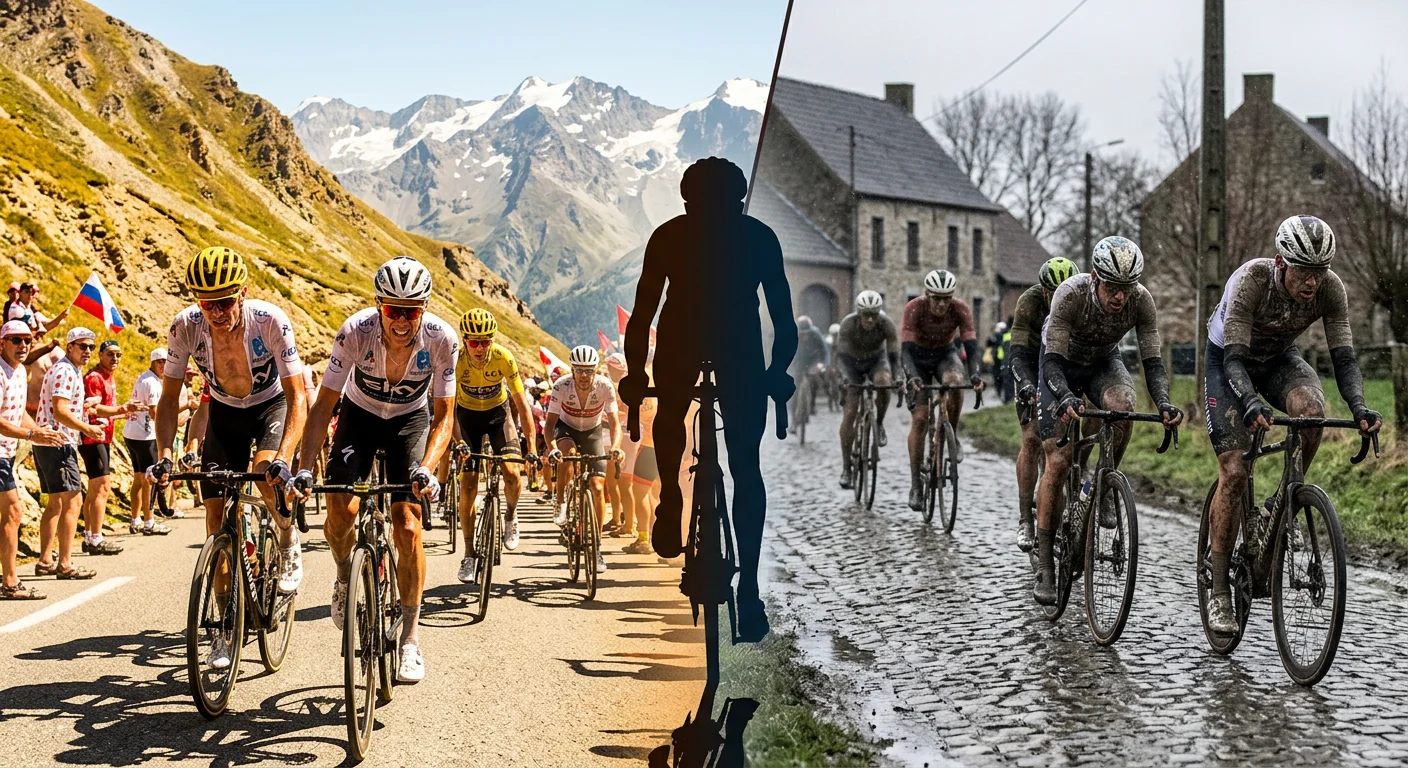
The greatest cycling races don't just test legs — they test character. The Tour de France puts you through sun-scorched Alpine cols. Paris-Roubaix throws bone-rattling cobblestones at you. Each of these five elite races demands something different from every rider who lines up. That's what makes professional road cycling so fascinating — there's no single definition of hard. Each race breaks you in its own way.
Gear matters. At this level, it's not an afterthought. The margins are too thin for that. Watching from the roadside or riding your own version of these routes on a Saturday morning — what you wear shapes how you perform. It shapes how you feel out there too.
Check out Berun's cycling apparel collection . It's built for riders who know the difference between showing up and showing up ready .
The race is always harder than it looks. Dress for it.
Video Section