The ice hockey apparel market holds a massive opportunity — and most entrepreneurs haven'T spotted it yet. Mainstream sportswear gets more crowded every day. Ice hockey, though, stays a loyal and underserved niche. Teams still struggle to find manufacturers who truly understand the sport. That's your edge.
You want to build a private label sportswear brand from scratch. Or break into custom hockey team uniforms. Or turn your passion for the game into a real business. The path is clearer than you think.
This guide covers every stage of launching an ice hockey apparel brand with private label manufacturing in 2026. You'll learn how to choose the right product line, find a manufacturer that specializes in hockey, and position your brand for real market traction.
Step 1: Define Your Ice Hockey Apparel Brand Model Before Touching a Single Product
Most ice hockey apparel brands fail before producing a single jersey — not because of bad designs or wrong fabrics. The real problem? The founder never picked a clear business model.
There are three paths into this market. Each one needs a different budget, skillset, and risk tolerance. Pick the wrong one and you waste months of effort and thousands of dollars.
The Three Models — Side by Side
Team Order (Club Supply) Model
You sell jerseys, training wear, and uniforms to hockey clubs, youth leagues, and recreational teams. Startup costs run USD $10,000–$25,000 — the lowest barrier to entry of the three. A single club order can be worth $5,000–$50,000 per year . Gross margins sit at 45–70% , with cash back in 30–90 days . Inventory risk? Close to zero. You produce on-demand after collecting deposits.
E-Commerce DTC Brand
You build a direct-to-consumer brand online. Add in ads, sampling, and logistics, and startup investment jumps to $40,000–$120,000 . Gross margins are the highest here — 60–80% . But net margins after advertising and returns tend to land at just 5–15% in the early stages.
Retail Wholesale Brand
This is the most capital-heavy path. Plan to spend $80,000–$250,000 to build inventory, secure shelf space, and develop 200–600 SKUs. Capital can sit locked up for 6–12 months before returns come in.
Choose Your Path Based on What You Have Right Now
Under $30K? Start with Team Orders. Lock in 3–5 clubs using presale deposits and keep inventory at zero.
$30K–$80K? Think about pairing Team Orders with a lightweight DTC channel — a good fit if you already have an audience or a coaching network behind you.
$100K+? You have enough runway to build a full retail or full-scale DTC brand.
Budget is not your only filter. Your existing connections matter just as much. A former coach with 10 club relationships has a big HEAD start in the Team Order model. A content creator with a hockey-focused following can launch DTC with far less ad spend. Be straight with yourself about what assets you bring to the table — then pick your lane.
Step 2: Plan Your Ice Hockey Product Line — Start With 1–3 Hero SKUs
New brands die from too many products, not too few.
That's not a theory. It's a pattern that repeats across every niche apparel market — and ice hockey is no exception. You'll feel the pull to launch with jerseys, base layers, training tops, protective shorts, and socks all at once. Don't. Resist it hard.
Start with 1–3 Hero SKUs . Nail those. Then expand.
The Four Core Product Categories (And What to Do With Each)
The ice hockey apparel market breaks down into four main product types:
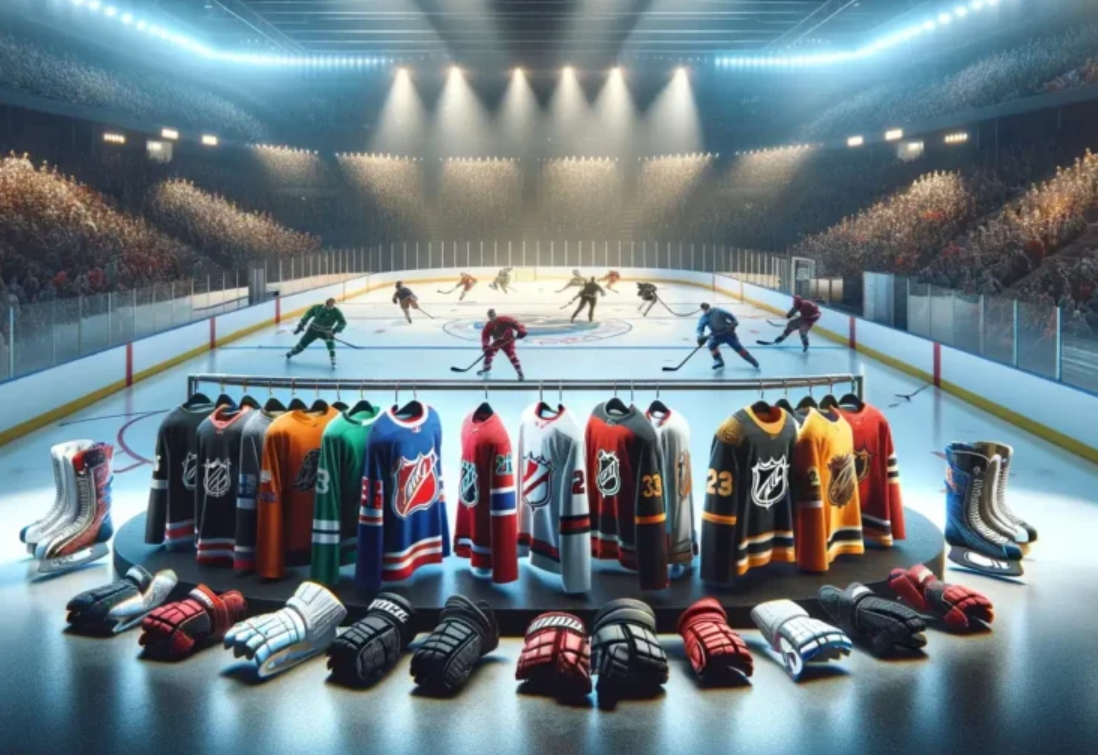
Sublimated jerseys — the highest-value team order product, around $60–$120/piece at retail
Base layers (compression tops and bottoms) — high repurchase frequency, low manufacturing complexity
Training tops (tees, hoodies, pullovers) — flexible for both team and retail channels
Protective apparel (padded shirts and shorts) — high margin, but complex to produce and slow to reorder
Not all four deserve equal attention on day one.
Your First Hero SKUs — A Practical Shortlist
Hero SKU #1: Sublimated ice hockey jersey
This is your anchor product. A single 20-player club needs 40–80 jerseys per season. Teams refresh their kit every 1–2 years. Youth teams refresh even faster as players grow.
In a team order channel, jerseys make up 50–70% of total apparel spend per club. Manufacturing cost runs $14–22 per piece (190–220gsm 100% polyester). Team pricing lands at $40–70 per piece . DTC retail pushes $60–120 . Gross margin hits 40–70% depending on your channel.
Jerseys also work as a natural upsell anchor. Clubs that order jerseys almost always come back for matching socks, training tops, and base layers too.
Hero SKU #2: Base Layer (Compression Top or Bottom)
Most apparel founders miss one key trait in base layers: reliable repurchase cycles . Active players rotate through 2–3 sets. They replace worn pieces every 6–12 months.
Manufacturing cost sits at $7–12 per piece. Retail pricing lines up against Under Armour, Bauer , and CCM — around $30–60 per piece. DTC gross margins reach 65–75%. Sizing is standard. Tooling is minimal. The same production line handles full customization runs for team orders.
Hero SKU #3 (Optional): Training Top
A well-designed training top sells in both channels. Clubs order it branded. Individuals buy it retail. A basic training tee costs $5–9 to produce and retails at $25–45 . A hoodie costs $10–18 and retails at $50–80 . Both land in the 55–70% gross margin range.
Leave Protective Apparel for Later
Padded shirts and shorts carry strong margins ( 60–70% ) and retail at $80–150 . But production complexity is much higher — dense foam padding, mesh construction, multi-step QC. Get your supply chain dialed in first. This category will drag you down before it pays off.
The Three Hard Rules for Picking Your First SKUs
Finalize your Hero SKU list by running each product through these three filters:
1. Low manufacturing complexity
Keep cut pieces under 25 per garment. Stick to industry-standard fabrics — 190–220gsm polyester for jerseys, 85/15 poly-spandex for base layers. Limit each SKU to 1–2 fit templates and one unified size chart. This cuts sampling rounds down to 1–2 per style instead of 3–4.
2. High customization potential
Sublimated jerseys let you swap team colors, numbers, names, and logos on the same production line — no retooling needed. Training tops take screen print or heat transfer logos. Customization justifies premium pricing. It also keeps team clients coming back.
3. Strong repurchase drivers
Base layers wear out. Teams grow. Rosters turn over. Jerseys get redesigned. Pick products that generate reorders on their own — not ones that sit in a closet for three years.
Why Over-Expanding SKUs Early Destroys Margins
Here's what over-expansion costs you at the operational level:
10 styles × 100 units average inventory × $15 cost = $15,000 locked in stock . Sell-through stretching from 3 months to 9 months drops your cash recovery rate by 66%
Each new fabric type or construction method needs a redefined QC checklist. Going from 3 SKUs to 10 can double or triple your quality control workload
10 styles × 2 sample rounds = 20 sample revisions to manage — a real operational burden for a small founding team
Marketing budgets spread thin across many SKUs build no momentum. Concentrate 80–90% of ad spend on 1–2 core selling points per SKU and you'll scale far faster
The math favors focus. Three winning SKUs, sold to the right channel on repeat, will beat ten mediocre ones every time.
Step 3: Understand the Ice Hockey Private Label Manufacturing Process End-to-End
Here's what most manufacturers won't tell you upfront. The difference between a brand that launches in 90 days and one still "in development" 18 months later comes down to one thing — know the production timeline before you sign anything.
The Six-Stage Production Flow
Ice hockey private label manufacturing runs through six distinct stages. Each stage has a real timeline attached to it.
Stage 1 — Brand Concept (1–2 weeks)
Lock down your target retail price, your market (North American rec leagues vs. elite travel teams), and your projected annual volume before approaching a single factory. Factories look at that volume number — 3,000–20,000 pieces/year — to decide if you're worth a production slot.
Stage 2 — Tech Pack Development (2–4 weeks)
A complete tech pack covers your measurement spec, fabric composition, print placement diagrams, and trim list. This document is not optional. Factories that receive a complete tech pack hit a 70–85% first-sample pass rate . Factories working from a mood board and a rough sketch? That number drops to 30–50% . You're also looking at 2–3 extra sample rounds.
Stage 3 — Sampling (2–6 weeks)
Three sample types matter here:
- Fit Sample — confirms sizing
- Color Strike-Off — checks sublimation color accuracy, targeting ΔE ≤ 3
- Pre-Production Sample — signs off on everything before bulk runs
Budget USD $50–150 per style in sample fees. Most factories credit this amount against your production order.
Stage 4 — Revision & Approval (1–3 weeks)
Plan for 1–3 revision rounds. Each round adds 7–14 days. A tight tech pack shrinks the full development window from 8–10 weeks down to 4–6 weeks .
Stage 5 — Bulk Production (4–8 weeks)
Mid-sized hockey factories produce 300–800 jerseys per day . A 3,000-piece order gets through cutting and sewing in about 1–3 weeks. From approved Pre-Production Sample to factory completion: 30–45 days under standard conditions.
Stage 6 — Logistics (2–4 weeks)
Sea freight from Asia to North America or Europe takes 25–35 days . Air freight cuts that to 5–10 days but costs 4–8× more .
The Realistic Timeline You Should Plan Around
Fast track: ~60 days (air freight + complete tech pack ready on Day 1)
Standard: ~90 days
Conservative: 90–120 days (peak season + sea freight + multiple revision rounds)
Build your launch calendar backwards from these numbers — not forwards from wishful thinking.
Step 4: How to Choose Right Ice Hockey Uniform Manufacturer
Most brands don't fail at design. They fail at this stage — picking the wrong factory.
A generic sportswear manufacturer can print logos and sew seams. But ice hockey apparel needs a different capability set entirely. Pick the wrong factory and you'll spend months fixing quality problems, dealing with sizing complaints, and chasing delayed orders right before tournament season.
Here's how to tell the difference.
Hockey-Specific Factory vs. General Sportswear Factory
The gap is bigger than most founders expect.
Fabric inventory is the first tell. A hockey-specialized factory stocks 200–320 g/m² high-density polyester. It's built for sublimation at 200–220°C and rated for 40,000+ Martindale abrasion cycles. General sportswear factories stock 140–180 g/m² fabrics — the kind designed for soccer and running. Order hockey jerseys from them, and they source heavy fabric on the spot. That adds 3–7 extra days to sampling. Plus, you get batch inconsistencies with ±3–5% color and shrinkage variation.
Equipment tells the same story. Hockey factories run flatbed and drum sublimation presses (≥1 . 6m width) for full-garment prints. They use heavy-duty multi-needle machines for thick multi-layer construction. Their 8–20 head embroidery units handle frequent number and logo switching. General factories use equipment sized for t-shirts and soccer jerseys. The specs don't match hockey production needs.
Sizing is the third gap. A real hockey manufacturer handles Adult Regular/Tall, Youth YS–YL, and Goalie Cut — all at once. Chest width runs 64–68cm, and shoulders are cut wide enough to fit over padding. Most general factories offer five standard sizes (S–2XL) based on t-shirt grading. No Goalie Cut. No allowance for protective gear.
The 6 Questions to Ask Every Manufacturer Before Committing
Skip the catalog pages and WeChat pitch decks. Ask these questions straight.
1. What's your MOQ for custom hockey jerseys? Hockey-specialized factories accept 10–30 pieces per design, or as low as one full team (18–25 sets). An answer of 300–500 pieces minimum? You're talking to a mass-production sportswear factory — not a team customization specialist.
2. How long does sampling take?
Sublimation samples: 3–7 days. Embroidery-plus-lettering samples: 7–10 days. Vague answers like "about a week" or "pretty fast" signal unclear internal processes. Push for specifics.
3. Can you show me two hockey team orders from the last 12 months?
Ask for photos — front, back, collar, cuff, and number detail. Get basic data too: team type, quantity, delivery time, and whether the client reordered. Soccer and basketball cases don't count.
4. Who supplies your hockey fabric?
A solid factory names its long-term fabric partners. It can provide gsm specs, fiber content (100% polyester or 97% PES/3% Spandex), and third-party test reports (SGS, Intertek). Color fastness should hit dry rub ≥ Grade 4 and wet rub ≥ Grade 3–4. "We source based on the order" is a red flag.
5. What's your QC process?
Professional factories use AQL 2.5–4.0 as the final inspection standard. They run 100% color-checks post-sublimation and pull ≥10% of garments for dimensional measurement. An answer of "we check everything before shipping" with no data or process detail — walk away.
6. What happens if delivery is late?
Delays of 3–7 days should come with a 2–5% discount or free accessory compensation. Delays beyond 14 days that affect a tournament should trigger a partial refund (5–10%), or the factory covers expedited freight. A factory that won't put delivery accountability in writing is a serious risk for seasonal team orders.
How to Verify Before You Sign Anything
Ask for physical samples — not just photos. A proper adult l hockey jersey should weigh 350–550g. Check stitch density at 2.5–3.5mm. Look at reinforcement at the shoulders, underarms, and side seams. Numbers and names should sit flat with no heat-glue bleed.
Get a factory video walkthrough. Look for wide-shoulder hockey pattern pieces on the cutting table — not t-shirt panels. Check for a dedicated sample rack with clear size labels, including Goalie.
Last step: ask for three to five reference clients (anonymized is fine). Get country, league type, and whether they're repeat buyers. That list tells you more than any sales deck ever will.
Step 5: Build Your Brand Positioning and Go-To-Market Strategy for the Hockey Market
Brand positioning isn't about taglines. It's about picking who you're selling to, what problem you solve better than anyone else, and which channel gets you your first paying customer fast.
In ice hockey apparel, three go-to-market paths exist. Each rewards a different strength.
Channel A: Team Orders — The Fastest Path to Real Revenue
One city has 2–5 rinks. Each rink supports 10–50 teams. That's 20–250 potential clients within driving distance — before you spend a single dollar on ads.
A standard team order covers 20–30 sets per squad. It runs US$1,600–6,000+ . The range depends on whether you're selling entry-level kits ($80–120/set) or premium custom packages ($150–220/set). Margins sit at 45–70%. Reorder cycles run 1–2 years. A satisfied club comes back.
The key conversion lever? Offer a team store template . That's an online order page where players pick their own sizes and pay on their own. That one move lifts coach acceptance rates from 20–30% up to 40–60%.
Channel B: Retail — Save It for Stage Two
Pure Hockey, HockeyMonkey, and Pro Hockey Life set the bar high. You'll need to carry US$50,000–100,000 in inventory before they take you seriously. Start with a local pro shop inside a rink instead. Go consignment — 30–100 pieces — and use a rink-exclusive design. That gives the shop a real reason to push your product.
Channel C: DTC — Grow It Around Your Teams
"Custom hockey jerseys" pulls 8,000–12,000 monthly searches in the US alone. Cold traffic converts at just 1.5–3%. Warm traffic — fans and parents clicking a team-specific link — converts at 5–10% .
Build your DTC channel around your team clients first. Don't run it ahead of them.
Match Your Positioning to Your Factory's Strengths
Your price point should reflect what your manufacturer does well:
High-volume sublimation, fast turnaround → target US$80–120/kit, recreational leagues, youth associations
Small MOQ (10–20 pieces), flexible production → target US$150–250+, AAA travel teams, semi-pro clubs
Pick one lane. Own it before you expand.
Step 6: MOQ, Sampling Costs, and Production Planning Basics for New Brands
Numbers don't lie — and in private label manufacturing, the numbers that kill most new brands aren't production costs. They're the minimums you didn't plan for.
MOQ: What to Expect by Product Type
Ice hockey apparel categories each come with their own minimums:
Jerseys (sublimated, custom numbers/names): 100–500 pieces per design. More customization layers push that floor higher.
Training tops, tees, hoodies: 100–300 pieces per style. Stick to the factory's stock fabrics and standard patterns, and you can drop to 50–100 pieces.
Jackets, training pants, zip hoodies: 150–300 pieces minimum. Add specialty hardware — heavy zippers, padded liners — and MOQ jumps to 300+.
Per-color MOQ: Most factories set minimums per colorway — 50–100 pieces per color. Go below that and you'll face a 10–30% small-run surcharge.
Per-size MOQ: 10–20 pieces per size is standard. Concentrate 60–70% of your order in core sizes (M/L/XL) to protect cash flow.
Sampling Costs and How to Get Them Back
Plan for $50–150 per style on standard samples. More complex styles — full sublimation, embroidery, name-and-number sets — can run $80–200+ .
Here's the upside: most solid factories will credit your sampling fees against your first bulk order. You need to hit a volume threshold — 300–500 pieces is the usual range. Before you pay a single sample fee, pin down four things:
Is the fee refundable?
Can it offset a bulk order?
What's the minimum order to trigger that credit?
Do revision rounds cost extra?
Get clear answers in writing before you commit.
Production Planning: Work Backwards From Season Day One
Ice hockey runs on a calendar. Your production plan should too.
For custom jerseys, count back 12–16 weeks from your target delivery date. Simpler training wear needs 8–12 weeks . Here are the milestones to hit:
Weeks 12–16: Finalize specs, fabrics, logos, and size charts
Weeks 10–12: Complete sampling and lock approvals
Weeks 6–10: Bulk production runs
Weeks 4–6: Mid-production QC
Weeks 0–4: Final inspection, packaging, shipping buffer
On your first order, cover 60–80% of projected demand — no more. Keep room for a replenishment run. One bloated inventory position in the early stages can stall your brand for months. Don't let a single over-order slow everything down.
7 Critical Mistakes That Kill New Ice Hockey Apparel Brands
Seven mistakes. That's all it takes to turn a promising hockey apparel brand into an expensive lesson.
Most founders don't lose because the market rejected them. They lose because of decisions made in the first 90 days — decisions that felt reasonable at the time and cost everything later.
Mistake #1: Using a Non-Hockey Factory
This is the single most expensive mistake on this list.
A generic sportswear factory prints on polyester every day. Hockey jerseys are different. They need high-density 200–320 g/m² fabric, sublimation tuned for deep color fastness, and reinforced seams built to handle board contact and stick friction. Standard apparel factories focus on softness. Hockey gear needs abrasion resistance. Those two goals don't match.
The real-world consequences hit hard:
Panel shade variation — you see visible color differences between the front, back, and sleeves. This comes from inconsistent ink sets and heat calibration
Washed-out darks and misaligned striping after cutting and sewing post-print
Numbering errors — wrong twill placement, wrong sleeve assignment, wrong team font. Every corrected piece becomes a rework item or scrap
Hockey-specialized suppliers run pre-production strike-offs, digital proof sign-offs, and size-set approvals before bulk production starts. Brands that skip this — or partner with factories that don't offer it — end up with the highest defect rates.
Mistake #2: Submitting a Weak Tech Pack
Vague artwork files and verbal specs create one outcome: an endless sample loop.
Here's what that loop costs in real numbers. Each revision round adds 3–10 days. A standard first-sample cycle runs 7–21 days. Brands that go through 3–5 rounds before approval spend $150–$1,000+ per style in revision fees before a single bulk unit gets cut. Complex hockey sublimation and numbering revisions alone run $50–$200+ per round .
Lock down every item in your tech pack before you send it:
Front/back/sleeve artwork placement with mm-level position notes
Fabric GSM, fiber composition, stretch percentage
Stitch type, seam allowance, reinforcement points
Number font size, tackle twill vs. sublimation spec
Grading chart across all sizes
Pantone/CMYK targets and approved reference sample photos
Use a one-page approval matrix. Six columns: fabric, color, artwork, numbering, size spec, packaging. Nothing moves to bulk until every column gets a sign-off.
Mistake #3: Expanding SKUs Before You Have Traction
Run the math on this one.
Five sizes × four colorways = 20 SKUs. Order 30 pieces per SKU and you're sitting on 600 units. At a landed cost of $18–$35 per unit, that's $10,800–$21,000 tied up in a single jersey style. Add name and number variants and that same style becomes 40–60 sellable variants — each carrying its own dead-stock risk.
A healthy first-run sell-through for early-stage apparel brands sits at 70–85% within 60–90 days . Anything below that points to SKU overextension or a price-fit mismatch.
There's a hockey-specific trap here too. Teamwear sells in small league bundles. Retail styles need broader market proof. Mix both channels too fast and you inflate returns and pile up unsold inventory at the same time.
Mistake #4: Ignoring the Team Customization Market
Most hockey apparel spending doesn't happen at the individual level. It happens at the team level — leagues, tournaments, sponsors, club programs.
A team order gives you a higher average order value, lower cost per unit to acquire, and natural reorder cycles tied to seasons and roster changes. A single fan retail sale gives you none of that. Brands that launch with generic fan tees and hoodies miss the coaches, managers, and parents out there searching for consistent team-set solutions.
Build tiered team programs into your structure from Day One:
Tier | Quantity | What to Offer |
|---|---|---|
Entry | 12–24 units | Standard kit, 2 artwork revisions |
Mid | 25–49 units | Price break, faster turnaround |
League | 50+ units | Custom packaging, dedicated rep |
This structure sets your brand apart from generic activewear resellers .
Mistake #5: Choosing a Supplier Without Hockey-Specific Proof
A portfolio of t-shirts and soccer hoodies does not qualify a factory to produce hockey jerseys.
Before committing to any manufacturer, watch for these red flags:
No hockey-specific samples in the portfolio
No documented color-control workflow
No inline inspection photos or bulk QC process
Can't speak to AQL standards, top-of-production approvals, or rework policies
The benchmark to know: reputable hockey apparel suppliers operate at AQL 2.5 for major defects. Your brand sells to teams where every piece carries a player name and number. Don't work with any factory that can't explain how it handles defects before shipment.
Mistake #6: Underpricing Custom Hockey Products
Custom hockey jerseys are not generic activewear. Price them like they are and you'll burn through your margin before the first reorder arrives.
Custom production carries real cost layers that generic pricing skips over: artwork setup, name and number personalization, sampling, higher QC burden, smaller run sizes, and specialized fabrics and trims.
Here's the math that works. Your landed cost is $20–$35 . Your wholesale price needs to sit at a minimum 2.2–3.0× landed cost to cover freight, defect replacements, commissions, and marketing. A jersey sold at $45 wholesale with a $25 landed cost leaves $20 gross profit. One remake on a small custom order wipes that margin out completely.
Price for low-volume complexity. Not commodity volume.
Mistake #7: Placing Bulk Orders Without Proof-of-Quality
Jumping straight from spec to bulk is how brands end up with thousands of dollars in unsellable inventory. Jerseys personalized with wrong names and numbers can't be liquidated. You can't even discount them in any meaningful way.
Follow this sequence — it's not optional:
Finalize tech pack
Approve fabric, color, and artwork proof
Produce and evaluate one fit sample
Produce and approve one pre-production sample
Test wear, wash, and abrasion — in that order
Then place the bulk order
New brands should start with 1–3 hero SKUs . Add new products after you have repeat team inquiries, stable size sell-through data, consistent supplier QC, and clear reorder signals. All four conditions need to be in place. Any SKU added before that is a liability, not an asset.
Is Starting a Private Label Ice Hockey Clothing Brand Right for You?
Not everyone who enters this market will succeed. The right person — with the right starting assets — can build a profitable ice hockey apparel brand faster than expected.
Three types of founders win here.
Existing teamwear suppliers already have club relationships. Those connections generate 60–80% repeat orders year over year. Adding a private label layer means upgrading your brand identity and supply chain — not learning the apparel business from zero.
Hockey community operators — coaches, former players, league managers — have audiences of 200–2,000 engaged members. That built-in network converts at 5–10× the rate of cold traffic at launch. You're not starting from scratch. The trust is already there.
Experienced private label operators from adjacent categories like fitness or basketball already know sampling, MOQ negotiation, and QC workflows. The learning curve is hockey-specific specs — not manufacturing basics.
Recognize yourself in any of these three profiles? The opportunity is real — and closer than you think.
FAQ: Starting a Custom Ice Hockey Apparel Brand With Private Label Manufacturing
Every serious founder asks these questions before placing their first order. Here are straight answers.
What's the minimum order quantity for custom hockey jerseys?
Most hockey-specialized factories start at 12 pieces per design . Repeat orders can drop to 6 pieces per colorway. Training tops and hoodies need at least 50 pieces. Full custom team sets — with numbers, names, and embroidery — run 50–100 pieces per style.
Private label or custom manufacturing — which one should I start with?
Start private label. Use the factory's existing patterns, swap the labels, colors, and logo. You get lower MOQ, faster turnaround, and less risk. Once a style proves itself, move it to full custom manufacturing. That's the path most successful brands take.
How long does sampling take?
Standard patterns go from design to first sample in 7–14 days . Each revision round adds 3–7 days . New patterns with custom fabrics? Set aside 4–8 weeks before you get an approved sample in hand.
What 8 numbers should I ask every supplier upfront?
Ask for these eight things from the start:
MOQ — minimum order quantity
Sample fee — what it costs before you commit
Fabric GSM and fiber content — weight and material breakdown
Production lead time — how long from order to shipment
Reorder MOQ — minimum for repeat runs
Available techniques — sublimation, embroidery, heat transfer
Certifications — OEKO-TEX, GRS, and any others relevant to your market
Carton specs — packaging dimensions and per-carton quantities
Conclusion
The ice hockey apparel market isn't waiting for the perfect moment — and neither should you.
You now have a clear roadmap. Start by defining your private label brand model and picking your first hero SKUs. Then find a manufacturer who truly gets hockey fabric performance, sublimation printing, and team customization at scale. The brands that win here aren't the ones with the biggest budgets. They're the ones who move smart, start focused, and lock in the right ice hockey clothing supplier from day one.
That last part matters more than most people realize.
Your manufacturer isn't just a vendor. They're the foundation your entire brand stands on.
So here's your next step: stop researching and start executing. Request samples. Validate your hero SKU. Get your first team order across the finish line.
The rink is open. Your competitors are already skating.
Don't just watch the game — build the brand that outfits it.