Every great running apparel brand started with someone who had a vision, a niche, and zero clue how to turn fabric into a real business. The good news? You don't need a fashion degree, a factory connection, or a six-figure budget to launch yours.
Private label running apparel manufacturers have changed the game. They give ambitious founders, athletes, and e-commerce entrepreneurs a direct path from concept to branded product — no need to build production infrastructure from scratch.
But here's where most people stumble:
They jump straight to sampling before nailing their positioning
They sign with the wrong manufacturer and burn through their launch budget chasing quality that never shows up
This guide covers every key decision in the running gear brand launch process. You'll go from carving out your niche and picking the right production model, to vetting manufacturers, protecting your margins, and getting your brand in front of the runners who need it most.
Step 1: Find Your Running Niche Before You Touch a Single Fabric Swatch
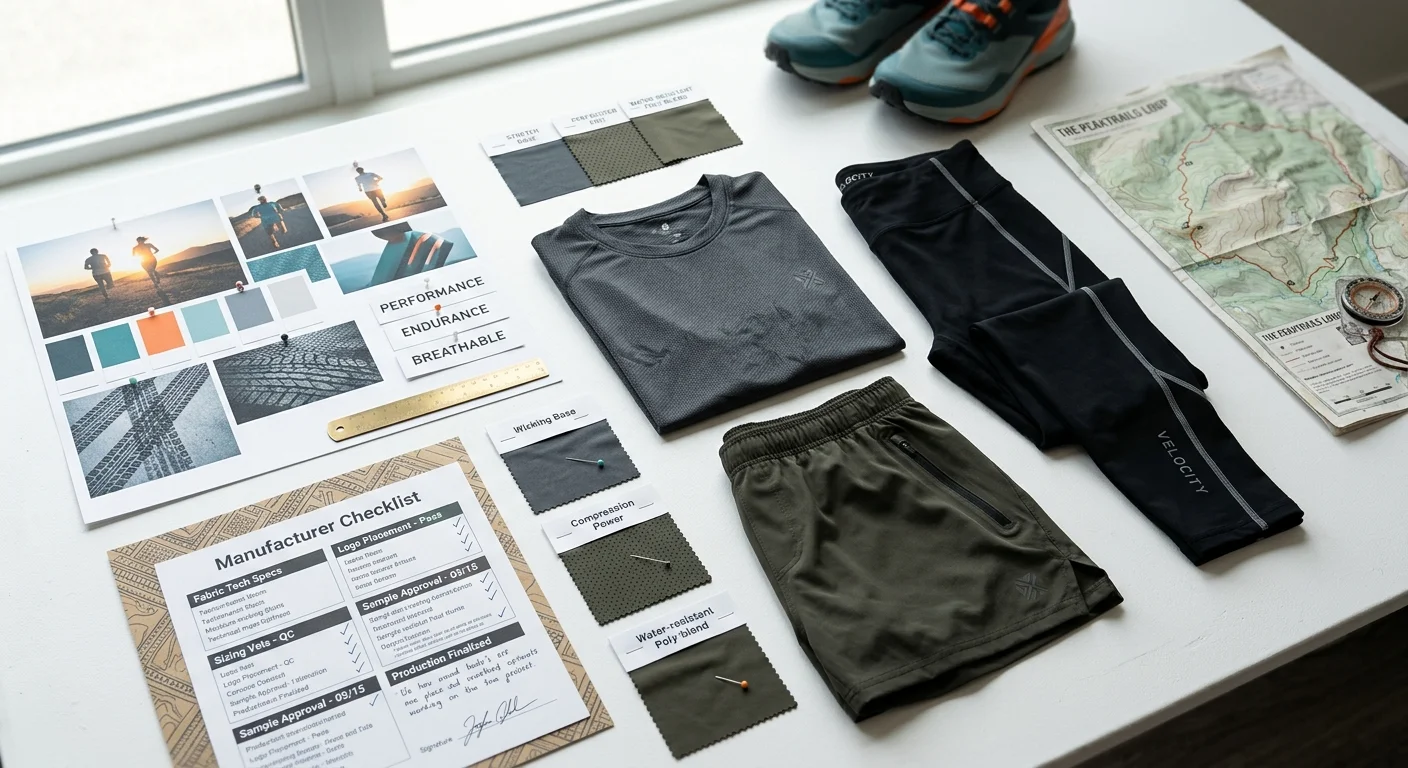
The running apparel market isn't one market — it's a dozen overlapping sub-markets. Each has its own buyer psychology, price tolerance, and unmet needs.
That distinction matters a lot when building a brand from scratch.
Four variables define your niche: product type, target audience, price bracket, and brand values . A compression shirt for marathon trainees aged 30–45 who spend $200+ per season is a different business entirely from a stylish hybrid tee for urban joggers paying $40–80 for athleisure looks.
Use data, not gut instinct, to find your opening:
Google Trends : Compare search patterns like "women trail running gear" vs. "marathon training tops" to spot demand spikes
Amazon Best Sellers : Dig into running sub-categories — women-specific anti-chafe shorts, for example, show up in top 10% underserved segments again and again
Strava communities : Real runner behavior reveals real gaps — trail runners are active but style-focused gear rarely serves them well
Here's a quick breakdown of where the real opportunities live:
Sub-Niche | Core Buyer | Avg. Spend | Key Gap |
|---|---|---|---|
Marathon Training | 30–45yo performance runners | $200+/season | Compression + moisture-wicking kits |
Trail Running | 25–40yo adventurers | ~$150 | Durability + reflectivity over aesthetics |
Urban Casual | 18–35yo city joggers | $40–80 | Athleisure hybrids, online-first |
Women-Specific | 20–45yo fit-focused females | $100+ premium | Anti-chafe, bra-integrated, community-driven |
One segment deserves serious attention: maternity running apparel . Pregnant runners are a fast-growing group that the market largely ignores. Analysts project up to 30% market share growth potential in cute, functional styles built for them.
Evaluating any niche? Aim to balance functional and emotional demand at 60/40 . Ninety percent of runners rank sweat-wicking as a top priority. So that's your functional baseline. At the same time, 50% of women look for activewear that reflects their personal style. Both signals need to show up in your product brief.
Nail this before you ever request a fabric swatch.
Step 2: Define Your Core Product Line — What Running Apparel to Start With
Most new brands don't fail because they picked the wrong manufacturer. They fail because they tried to launch 12 products at once and ran out of cash before a single one gained traction.
Start with 2–4 core SKUs . That's it.
The global running apparel market hit $16 billion in 2024 and is projected to reach $25 billion by 2033 (5.1% CAGR). There's plenty of room to grow. You don't capture market share by spreading thin, though. You capture it by going deep on a focused product range. Pick items that private label manufacturers can produce at scale, on budget, and without quality surprises.
Here's where to focus first:
Moisture-wicking running shirts — the highest-volume category, easy to private label, and production-ready at most OEM running apparel facilities
Training shorts — fast-moving, low complexity, strong repeat-purchase behavior
Running tights — demand is rising fast, particularly in women's segments
Hoodies — multi-use, higher price point, strong brand-building vehicle
These four categories dominate for one reason: they solve the problem runners care about most — performance under sweat . White label sportswear suppliers have built standardized production lines around these items. That means faster sampling, fewer surprises, and lower minimum order quantities.
Lock Down Your Fabric Specs Before You Talk to a Single Manufacturer
This is where most athletic apparel startups lose money. They walk into manufacturer conversations with no technical requirements. They accept whatever "standard fabric" gets offered. Then they wonder why the finished product feels cheap.
Don't do that. Come prepared with these benchmarks already defined:
Spec | Target Standard |
|---|---|
Fabric blend | 85–92% polyester + 8–15% spandex |
Moisture-wicking rate | >200% absorption, dry time <1 hour (ASTM D737) |
4-way stretch | >30% elongation, >95% recovery |
UPF protection | UPF 50+ (fabric thickness 0.2–0.4mm) |
Breathability | >100 cfm airflow |
Pilling resistance | Grade 4+ |
These numbers aren't guesswork. They separate performance running clothing that holds up in real use from a generic product that gets returned and buried in bad reviews. Know these specs before your first running apparel supplier call. It signals you're serious, and it protects your margins.
Build a Tech Pack — Even If You're Not a Designer
Get a tech pack ready before sampling. No exceptions.
A tech pack is your product blueprint. It tells manufacturers what to build, down to the stitch. No tech pack means handing creative control to a factory. Their job is efficiency — not your brand vision.
The essentials:
Flat sketches — front/back technical drawings (use Clo3D or hire via Fiverr for $50–200 per style)
Size spec sheet — cover S through XXL, with ±1cm tolerance on chest, waist, and length (ISO 8559 standard)
Fabric callout — gsm range (150–200gsm), blend ratio, and Oeko-Tex certification requirement
Logo file — vector format (AI/EPS), Pantone color codes, placement dimensions (1–3cm height)
No design background? Start with free Canva or Figma tech pack templates. Many Alibaba-based manufacturers also offer base templates you can customize for your specs. The barrier is lower than you think.
One number to keep front of mind: top-performing running apparel items command 50% higher average selling prices than the market baseline (2025 H1 data). That premium doesn't come from fabric alone. It comes from the brand story you build around the product. And that story starts with being clear on what you're making and why.
Step 3: OEM vs ODM vs White Label — Choose the Right Private Label Model
Three production models shape the private label activewear space. Pick the wrong one at the wrong stage and you're not just slowing down — you're burning through your budget before a single sale.
Here's how they break down:
Model | Customization | MOQ | Lead Time | Best For |
|---|---|---|---|---|
White Label | Minimal (logo + packaging) | 100–500 units | 1–2 months | Brand validation |
ODM | Partial (modify existing designs) | 1,000–5,000 units | 2–4 months | Early growth |
OEM | Full (your specs, your IP) | 10,000+ units | 6–12 months | Scaling brands |
Match the Model to Your Stage
Starting from zero? White label is your move. A white label sportswear supplier lets you test market demand with low risk. Low MOQ, fast turnaround, no design overhead. You're not building your forever product. You're confirming people will buy.
Building an audience? Shift to ODM running apparel production . You tap into the manufacturer's existing R&D. You can adjust silhouettes, fabrics, and performance features without paying for full tooling. It's the fastest path to a product that feels like your own.
Ready to scale? That's where OEM fits in. You control every spec. You own the IP. You protect what makes your custom athletic wear brand stand out from every competitor on the shelf.
Most successful athletic apparel startups follow this exact progression — White Label → ODM → OEM. Don't skip stages. Each one funds the next.
Step 4: How to Find and Vet Reliable Private Label Running Clothing Manufacturers
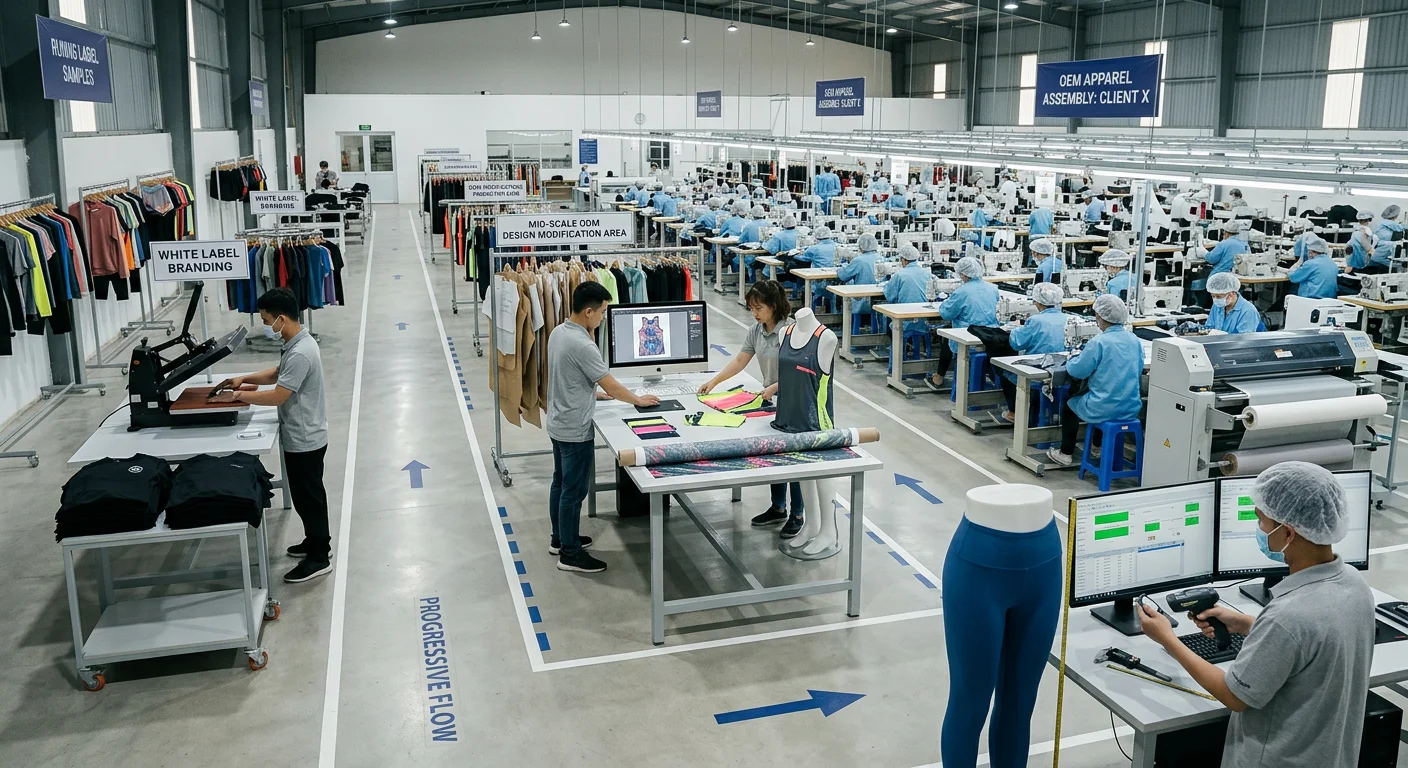
Finding a manufacturer is easy. Finding one that won't sink your brand six months in — that's the hard part.
The global running apparel market hit $16 billion in 2024 . Hundreds of factories want a piece of that growth. Not all of them deserve yours.
Here's how to separate the serious partners from the ones who'll cost you everything.
The Four Non-Negotiables Before You Sign Anything
1. Running-Specific Manufacturing Experience
Don't partner with a factory that mostly produces fast fashion. Performance running clothing has real technical demands. Think moisture-wicking construction, 4-way stretch recovery, and seam placement to prevent chafing. A generalist factory can't meet those standards the way a focused private label activewear manufacturer can. Ask for their activewear client portfolio before anything else.
2. Certifications That Count
Get documented proof of all three:
- SMETA 4-Pillar ethical compliance certification
- OEKO-TEX or GOTS certification for fabric and material sourcing
- EU Digital Product Passport compliance — now a growing requirement for international markets
No paperwork, no deal.
3. Vertical Integration
Outsourced washing, dyeing, and inspection are red flags. Once critical processes leave the factory floor, quality control goes with them. QIMA's 2024 data shows apparel defect rates in Asia-Pacific manufacturing rose 12% year-over-year . The main cause? Fragmented production chains.
Keep everything under one roof. It protects your product.
4. AQL 2.5 Inspection Standards
This is the industry benchmark for OEM running apparel production at scale. For a batch of 3,200 units, it means 200 pieces get inspected at random — with a maximum of 10 defects allowed. A quality-focused manufacturer will know this number without blinking. If they hesitate, that tells you something.
The Questions Every Serious Brand Must Ask
Before committing to any white label sportswear supplier , run through this checklist:
Question | What You're Testing |
|---|---|
What's your MOQ per style? | Budget fit and production flexibility |
How long does sampling take? | Operational efficiency (standard: 2–4 weeks) |
What's your bulk production lead time? | Private label: 4–6 weeks / Custom cut-and-sew: 10–16 weeks |
What's the deposit structure? | Financial risk exposure |
How many design revisions are included? | Hidden cost exposure |
Do you sign NDA/IP protection agreements? | Brand asset protection |
Can you provide verified activewear client references? | Real accountability |
These aren't just routine questions. Each one reveals how a supplier actually operates under pressure.
Red Flags That Should End the Conversation
Walk away fast if you spot any of these:
No physical facility open for inspection or third-party audit
Refuses to provide client references — or gives ones you can't check on your own
Pushes for large order commitments before finishing a pilot production run
Vague answers on quality control or certifications
Undisclosed outsourcing of washing, dyeing, or inspection
No documented pattern development or grading procedures
Sample-to-bulk inconsistency — the single most expensive mistake in performance running clothing production
One red flag is a warning. Two or more is a dealbreaker.
Start Small, Then Scale With Purpose
Don't place a 5,000-unit order with a manufacturer you've never tested under real conditions. That's how brands lose money fast.
The smartest athletic apparel startups use a phased rollout:
Test run : 200–500 units across 2–3 core styles
Validated run : Scale to 2,000 units after documented quality approval
Full production : Expand capacity with set checkpoints already in place
Each phase funds the next. Each phase cuts the risk for the one after it.
Also, don't wait for the final shipment to check quality. Demand weekly production updates at every stage — with photo documentation, fabric lot tracking, and wash test results included.
That's how you protect your margins. That's how you build a running gear brand that lasts.
Step 5: Sampling Process — How to Test Quality Before Committing to Bulk Orders
Sampling is where brands are made or broken — long before the bulk order ships.
Most founders treat sampling as a formality. They get one sample back, it looks decent, they approve it and move forward. Then 5,000 units arrive with sleeves that shrink, logos that peel, and seams that split mid-run. That's not a manufacturer problem. That's a process problem.
Here's the sampling sequence that protects your investment:
Submit your tech pack — Include fabric weight (180–220 g/m² for running tops), construction drawings, and stitch specs (double-needle, 0.8–1.0cm spacing). Vague briefs produce vague samples.
Confirm pricing — Proto samples run $20–50 per piece. Get quotes from at least three factories and target under $30. Timeline: 2–3 weeks per round.
Evaluate the proto sample — Inspect across 10+ dimensions. Defect rate above 20%? Reject it and restart. Don't negotiate with a bad first sample.
Give precise feedback — Skip "the fit is off." Say "sleeve opening shrank 3% after washing." Cap revisions at 2–3 rounds. Keep the total within four weeks.
Approve the PP Sample — This pre-production sample covers 3–5 pieces. It needs a 95%+ pass rate before you authorize bulk production. Keep two copies as your reference standard.
Test the Sample Like a Runner, Not a Retailer
Put the garment through real conditions before signing off:
Test | Standard | Pass Threshold |
|---|---|---|
Treadmill wear test (5km @ 10km/h) | 30 minutes continuous | Seam shift <1cm, no shoulder split |
Machine wash (AATCC 61, 40°C × 5 cycles) | Shrinkage + colorfastness | Shrink <3%, color grade 4+ |
Moisture-wicking dry time (ASTM D737) | Wet-to-dry cycle | Dry in <30 minutes |
Logo adhesion pull test | 500g force for 10 seconds | >90% adhesion, zero lifting after wash |
Validate With Real Runners Before You Scale
One to three samples is enough to run a low-cost market test. Recruit 20–50 target users — runners aged 25–40 from running apps or local communities. Give each one a sample and a structured feedback form. Ask them to run at least 10km across three sessions. Have them score fit, comfort, and purchase intent on a 1–10 scale.
Your go/no-go threshold: 70% of testers scoring 8+ across all three dimensions . Hit that benchmark? Authorize production. Miss it? Revise before you spend another dollar.
Total cost for this validation round? Under $200 — around $100 in samples and $100 in participant incentives. That's the cheapest insurance policy in performance running clothing production .
Step 6: Branding Your Private Label Running Apparel — From Generic to Iconic
85% of people remember a company name from custom clothing. Compare that to traditional advertising. It's not even close.
Your product passed testing. Your manufacturer is locked in. Now comes the work that builds a real business — turning a well-made garment into a brand runners choose on purpose .
Build Your Visual Identity Around Running Culture
Color isn't decoration. It's psychology.
Neon orange/yellow signals energy and speed — tests show a 20% lift in perceived performance
Electric blue and black create a slim, fast look that connects with serious runners
Graphite/grey with accent pops drives a 15% higher loyalty rate in brand preference studies
Look at Gymshark and Alo Yoga. Both built their color palettes with clear intent. Every shade reinforces the brand promise.
For typography, go bold sans-serif — Futura or Montserrat at 10–14pt. Add an italic slant and you're communicating motion before a runner takes a single step. Drop the serifs. They signal tradition, not speed.
Place Your Logo Where It Earns Attention
Position | Size | Spec |
|---|---|---|
Chest | 8–12cm | Left side, 5cm from neckline |
Sleeve | 6–10cm | Outer bicep |
Leg | 10–15cm | Outer thigh |
Back | 20–30cm | Upper or lower back |
Brands like Tracksmith and Saysky own the chest placement. Bandit built recognition through the sleeve. Pick one anchor position. Stay consistent across your entire line.
Sweat the Small Branding Details
Every label touchpoint adds up:
1.Neck label (woven satin, 2–4cm): $0.10–$0.30/unit — your most-seen brand moment
2.Heat transfer logo : $0.50–$1.50/unit — ideal for speed-themed graphic designs
3.Embroidery (3D puff, 5–8cm): $1.00–$3.00/unit — adds premium texture and depth
4.Hangtag (5×7cm cardstock): $0.05–$0.20/unit — your brand story in 20–50 words
Don't skip the hangtag. One sharp line — "Engineered for speed, crafted sustainably. From indie trails to elite races — run iconic." — boosts first purchase by 25% and repeat purchase by 40% . Those numbers matter.
Build the brand into every seam. That's what separates a forgettable private label from a running brand people talk about.
Step 7: Pricing Strategy and Profit Margin Calculation for Your Running Apparel Brand
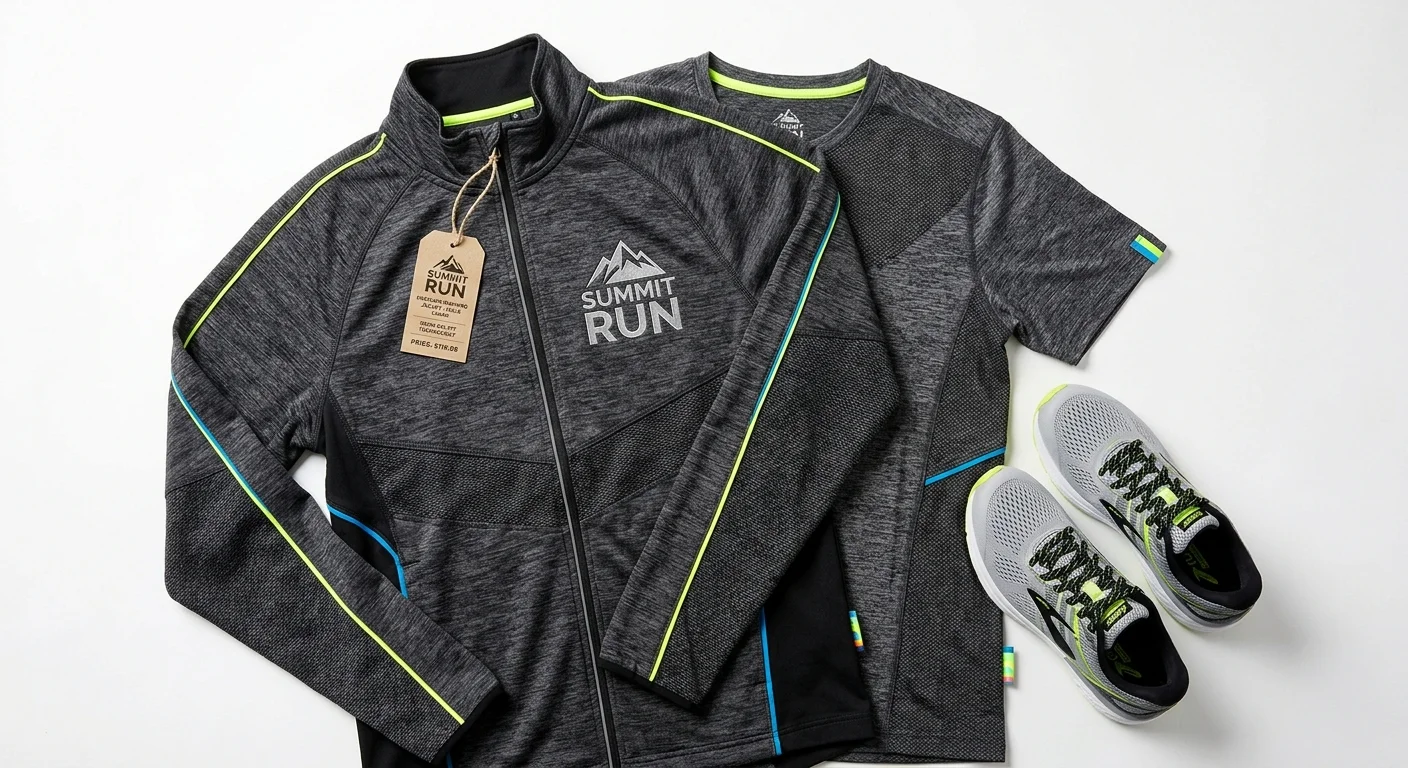
Most running apparel brands don't die from bad products. They die from bad math.
Before you set a single price, know your true landed cost. Here's what that breaks down to for a running shirt:
Fabric ($3.50) + labor ($4.20) + custom trims/packaging ($0.80) + freight ($1.50) + import duty ($0.76) + warehousing ($0.40) = $11.16 landed cost per unit . That's your floor. Everything above it is margin. Everything below it is a mistake.
Pick Your Multiplier Based on Your Channel
Channel | Multiplier | Retail Price | Gross Margin |
|---|---|---|---|
Wholesale | 2.1–2.4x | $23–27 | 46–53% |
DTC / Founder-led | 2.5x | $28 | 55% |
Amazon / Ad-heavy brand | 4–6x | $45–67 | 60–75% |
DTC wins for early-stage brands because your CAC is lower. You don't need a 6x markup to survive.
Mid-to-premium positioning calls for higher multipliers. Push 3–4x on core basics ($33–45). Go 5–6x on performance or printed styles ($56–67). Trend-driven SKUs carry more R&D and inventory risk — the higher multiplier covers that.
Industry benchmarks to hit by 2026 : gross margin 60–70%, operating margin 20–30%, net margin 10–20%. Numbers not tracking there? Your multiplier is too low. Or your cost structure needs a straight conversation with your manufacturer about renegotiating terms.
Control Inventory Risk With Smart MOQ Sizing
Start your first run at 100–300 units . Lock your size ratio at S:20% / M:30% / L:30% / XL:20%. Cap color variants at 3–4. Keep total inventory under 500 units until you have real sell-through data.
Ready to reorder bigger? Two signals tell you it's time:
- Your first batch hits 80%+ sell-through
- Your repeat purchase rate clears 15%
Hit both? Scale to 500–1,000 units, expand to six colorways, and open up full sizing.
One last tactic worth using: price a loss-leader basic at 2.5x to pull in traffic. Place a premium performance style at 5x right beside it. The gap between the two makes the premium price feel earned — and it pushes conversion up across your whole line.
Step 8: Launch and Market Your Running Apparel Brand
Production is done. Now you have to sell it.
The running apparel market is projected to hit $35 billion by 2025 . That's not a crowded-out market — it's a market where the right positioning and the right channels build traction fast. Here's how to build yours.
Pick Your Launch Channels With Purpose
Not all channels are equal at the start:
Channel | Difficulty (1–5) | ROI Potential |
|---|---|---|
Shopify DTC | 2 | High — direct margin, direct data |
Amazon FBA | 4 | Medium — volume-driven, competitive |
Running community group buys | 3 | High loyalty, strong word-of-mouth |
Local race sponsorships | 3 | Targeted exposure, medium-high returns |
Start with Shopify DTC . The barrier is low. You keep full margin control. You also get direct access to customer data — and you'll need that data for every decision after launch.
Build Trust Before You Spend on Ads
Send 100–500 free samples to real runners. Ask for a Strava post or Instagram tag in return. This is how Nike seeded its 2023 sustainable line — organic UGC that no ad budget can replace.
Run a seed user program . Recruit 50–200 runners through Strava or Reddit. Kit them out. Collect structured feedback before launch. You walk away with testimonials, product validation, and brand advocates — all in one move.
After purchase, send a simple email sequence — Day 3, Day 7, Day 14 — with a 20% incentive to leave a review. Hit 50+ verified reviews before you scale any paid traffic.
Own the Content That Converts
Over 40% of buyers visit a physical store after social media exposure . That's not just a social media stat — that's a purchase intent signal.
Three content formats that move units in the running space:
1.Wear/teardown videos (30–60 seconds): real runners, real conditions, real product performance
2.Training log series : progress content posted each week that keeps your brand visible across the full training cycle
3.Race check-ins : post-marathon gear reviews aimed at the 35+ demographic, which drives one-third of category growth
For community-led growth, launch a branded Strava Challenge tied to your product debut. Brands that do this well see 15%+ engagement lifts on new product launches. Those runners also become your most credible advocates.
The brands winning right now — Lululemon at 14% projected growth, Li Ning at 10.5% — didn't just manufacture well. They marketed with precision. Do both, and your running gear brand launch builds real momentum over time.
Common Mistakes to Avoid When Starting a Running Apparel Brand with Private Label
98% of clothing startups fail within their first few years. Not because the founders lacked passion — but because they kept making the same avoidable mistakes.
Here's what kills running apparel brands before they gain traction:
Launching too many SKUs at once. One athleisure brand tested a 3-piece collection. Their factory's MOQ was 1,000 units per style. They only needed 100. The result? 900 unsold units per style and cash flow that came to a dead stop. Start with 1–3 styles at 100–200 units. That's it.
Skipping proper sampling. One missed fit issue or fabric flaw can make an entire bulk order unwearable. Budget €300–€400 per sample round — proto, revision, size set, and pre-production. That's not an extra cost. That's protection for your investment.
Ignoring IP protection. Before you share a single design file with any manufacturer, lock down your NDA, design ownership clauses, and exclusive style agreements. Without those in place, that factory can take your exact silhouette and sell it to your competitors next season. Nothing stops them.
Underestimating total operational costs. Shipping, warehousing, rework — founders overlook these costs far too often. Pick the wrong manufacturer, and you're looking at an average of $15,000 per launch just in rework expenses. That number adds up fast.
Copying big brands instead of owning a niche. 72% of consumers prefer brands that match their values (Nielsen, 2023). Generic brands don't convert. Specific ones do. Find your angle and own it.
Avoid these five mistakes, and you're already ahead of most brands that never make it past year one.
FAQ: Private Label Running Apparel Brand — Your Top Questions Answered

These questions come up in every conversation we have with new brand founders. Here are straight answers.
What's the minimum order quantity for private label running apparel?
Most manufacturers start at 100–300 units per style for white label. Custom OEM production needs 1,000+ units. Start small, validate, then scale.
How long does production take?
White label: 4–6 weeks. Custom cut-and-sew: 10–16 weeks. Always build 2–3 weeks of buffer into your launch timeline.
Do I need certifications?
Yes — and they matter more than ever. The 2026 PFAS ban on water-repellent coatings is changing how manufacturers source materials. It's already in motion. Require OEKO-TEX and GOTS-certified fabrics from day one. Stock that doesn't meet these standards won't sell. Full stop.
Which product should I launch first?
Tops and t-shirts own 41.6% of running apparel revenue. They sell fast. Buyers replace them often. Most private label activewear manufacturers have dedicated, well-built production lines for them. Start there.
Is the women's market worth targeting?
Women's bottoms — leggings, shorts, tights — are growing at 8.7% CAGR. That's the fastest-growing segment in the entire category. Building a niche brand? That's where the momentum is right now.
What about selling online vs. offline?
Online is growing at 9.07% CAGR through 2031. Offline still controls 60.35% of revenue today. For a startup, DTC e-commerce gives you margin control and direct customer data — both critical in your first 12 months.
Conclusion
Building a running apparel brand with private label manufacturers isn't a moonshot. It's a process. And like any great run, it starts with a single deliberate step.
You now have a clear roadmap:
- Find your niche
- Choose the right production model
- Vet your manufacturer with care
- Nail the sampling process
- Build branding that means something to your customer
Skip steps, and you bleed money. Follow the system, and you build an asset.
Here's what most brand guides won't tell you: your manufacturer is your co-founder . The right private label activewear manufacturer doesn't just cut fabric. They protect your margins, your timeline, and your reputation.
So stop researching and start moving.
Ready to launch your custom athletic wear brand? You need a manufacturer that checks every box — quality, MOQ flexibility, and real performance fabrics. See what BeRunClothes can do for your brand .
Your first sample is closer than you think.