Buying the wrong cycling kit is an expensive mistake — and it happens more than you'd think. A road cyclist who grabs mountain bike baggies "just to try MTB" ends up with too much fabric flapping at 30 km/h. A trail rider who squeezes into an aerodynamic road kit spends the whole climb wishing they had room to move.Experienced road & mtb cycling apparel manufacturers design these two categories around completely different riding mechanics — aerodynamics for road speed versus mobility and abrasion resistance for off-road terrain.
Road and MTB cycling apparel aren't just different in style. They're built for different demands entirely. Fit, fabric, chamois padding, pocket placement, protection — every design decision splits at a deep level. These aren't small tweaks. They're choices made for completely different riding conditions.
So whether you're picking up your first discipline-specific kit, wondering if your current gear crosses over, or sourcing apparel for a custom line — this guide breaks it all down. No marketing fluff. Just straight, useful answers.
Fit & Cut: Aerodynamic Tight vs. Trail-Ready Baggy
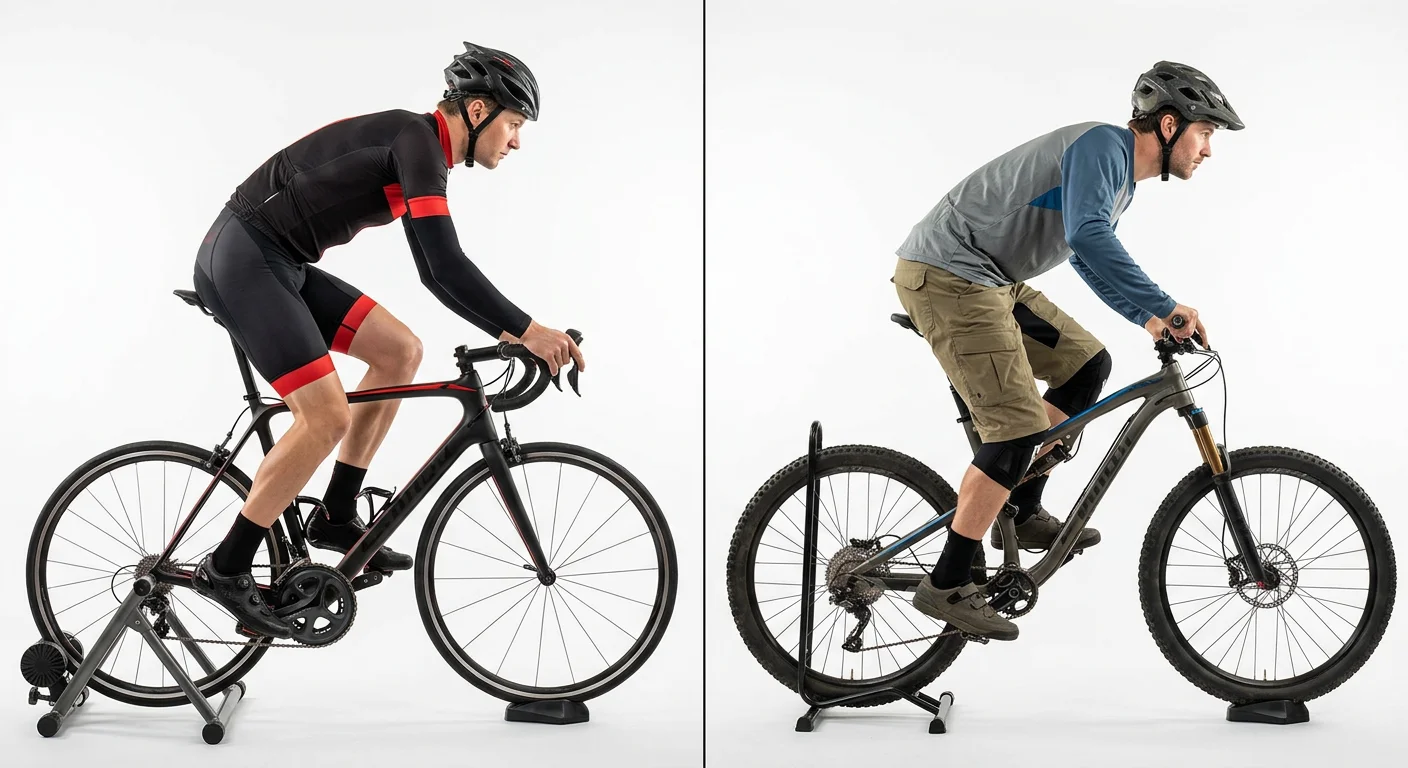
Fabric doesn't lie. Put on a road kit and you feel the lycra grip your quads like a second skin. Pull on MTB baggies and there's room — real room — to move like a human being instead of a wind tunnel test subject.
That contrast is no accident. It's the entire design philosophy, built into every seam.
Road Fit: Built for Speed, Not Comfort
Road cycling apparel has one obsession: reducing drag. A snug, compressive fit holds fabric flat against your body. This cuts down turbulent airflow that would slow you down. Above 25 km/h, that matters a lot. Tight-fitting kits stop fabric from flapping. That smooth contour around your legs keeps air attached longer before it breaks away.This same aerodynamic philosophy also drives how performance-focused custom road cycling apparel is patterned — tight panel mapping, minimal excess fabric, and race-position shaping designed to hold airflow close to the body.
Road kits come in two distinct cuts:
Race Fit — shorter sleeves (2–5 cm tighter), shorter inseam, minimal back panel extension. Built for an aggressive forward-lean position with elbows tucked. Every centimeter counts for aero efficiency.
Club Fit — longer sleeves (+3–5 cm), extended back coverage (+5–10 cm), more room through the torso. Made for upright recreational riding where full compression isn't the goal.
Race fit cuts drag by 5–10% in a forward position. That's not a small number. Over a 100 km ride, that compounding effect adds up fast.
MTB Fit: Built for Movement, Not Milliseconds
Mountain bike baggies are built on a totally different logic — not just looser, but looser in all the right places.
Drop shoulder seams sit 5–8 cm lower than a road kit. You get a full 180° arm rotation without any binding, even through a technical rock garden. The crotch cut runs 10–15 cm deeper than standard, so you get real squat mobility for steep descents and hard pedal strokes. Thigh circumference runs about 1.5–2x that of a road tight.
That extra fabric does more than give you room. The controlled flap pulls air through and boosts breathability by an estimated 20–30% compared to compression fits. That's a big deal on a 45-minute grind before a descent.
Take those baggies onto pavement, though, and that same flap turns into pure drag. Expect a 5–10% aerodynamic penalty the moment you hit sustained road speed.
Choosing the Right Fit for Mixed Terrain
Your riding doesn't fit neatly into one box? Use these simple rules:
Gravel/road bias (<50% off-road) → Club or race tight. Pick up the aero savings on flat sections.
Technical XC/trail bias (>50% off-road) → Baggy. You need the shoulder and hip room.
>30% roots and rocks on your route → Baggy wins, full stop.
Cold or windy conditions on mixed terrain → A tight base layer under baggies covers both needs.
Do a quick fit check before you buy. Tights should show zero wrinkles and zero restriction — run a full squat to test your range of motion. Baggies should pass the two-finger thigh clearance test, with no chafing after 10 km of movement.
Fabric Technology Compared: Lightweight Aero vs. Snag-Resistant Durable
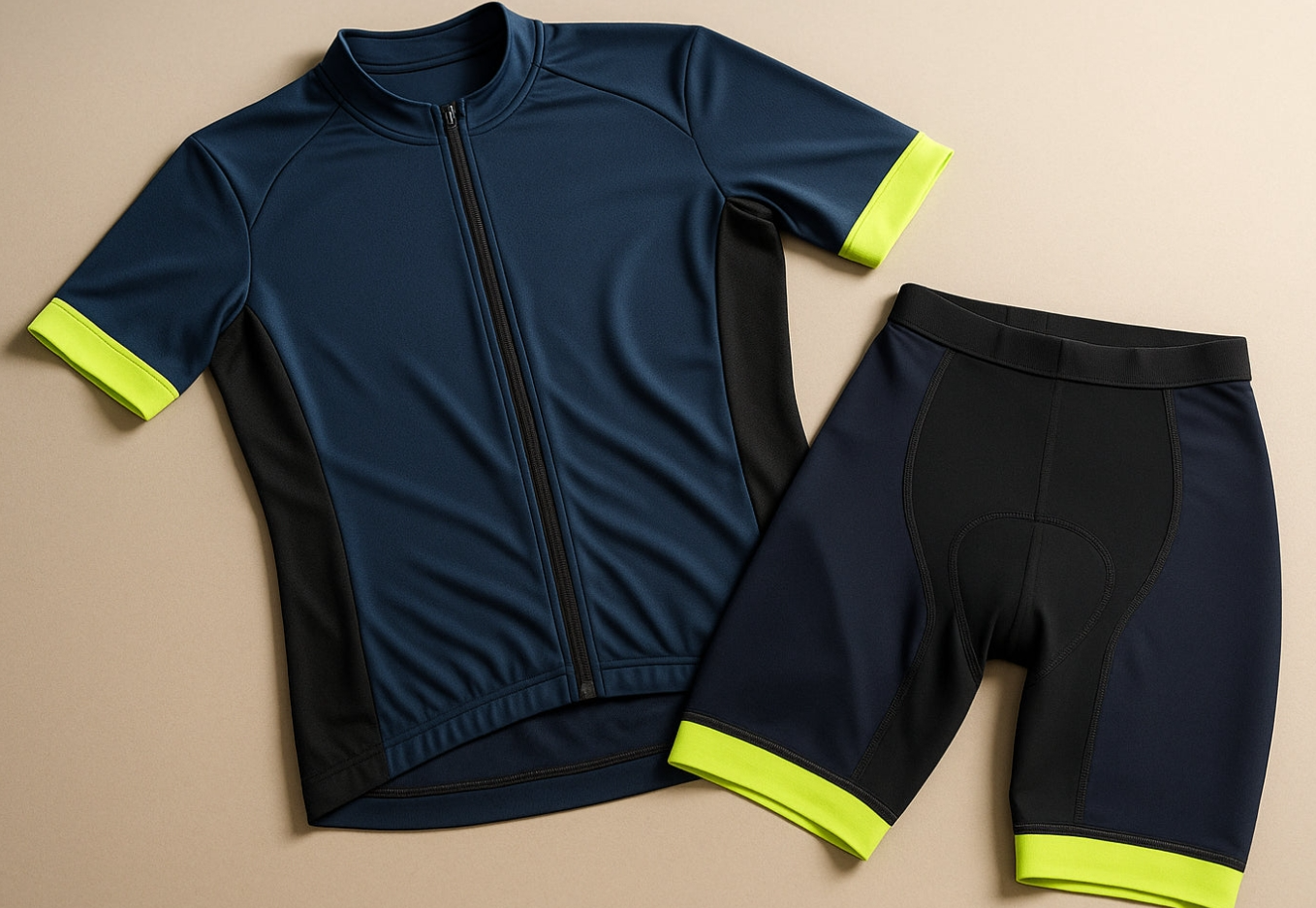
Road and MTB apparel don't share the same fabric goals. Each is built to solve a different problem — and the materials reflect that completely.
Road kits bet on speed. MTB kits bet on survival.
Road Fabrics: Engineered for Air
Road cycling apparel relies on Lycra/polyester blends — knitted or woven — with one priority: cut down on what the air catches.
Knitted constructions stretch up to 500% with spandex content . They hug your body so no fabric lifts or ripples at speed. Woven variants work differently — minimal stretch, but an ultra-smooth, flat surface that cuts friction drag better than knitted textures. Weight drops as low as 70–85 g/m² . You'll barely notice it's there.
Moisture management is strong. Polyester pulls sweat outward fast and evaporates it before the fabric gets saturated or heavy. The trade-off is airflow — denser woven constructions give up some ventilation to keep that smooth aero surface. It's a fair trade. At 30+ km/h, the drag savings outweigh the ventilation cost.
MTB Fabrics: Built to Absorb Punishment
Mountain bike apparel uses nylon and ripstop polyester . Trail riding is brutal on fabric, and these materials are chosen to handle that.Durability-first materials like ripstop nylon and reinforced polyester are exactly the types commonly specified when developing custom mtb cycling apparel intended for repeated contact with branches, rocks, and abrasive trail surfaces.
Nylon beats polyester in raw tensile strength by 1–2x . It also resists abrasion better than most materials at this weight. Ripstop constructions add a reinforcing grid weave that stops tears from spreading — one snag on a branch won't destroy your jersey. Weight ranges from 70–240 g/m² depending on protection level.
Road fabrics treat each panel the same way. MTB apparel goes in a different direction — zoned construction : high-airflow mesh panels sit in ventilation hotspots, while ripstop or nylon body panels cover areas with the highest contact and abrasion risk. DWR coatings bead water off the surface. Gore-Tex membranes — with 9 million pores per square inch — add waterproofing built to last 3–5 years of hard use.
Side-by-Side: What Differs
Property | Road Aero Fabric | MTB Durable Fabric |
|---|---|---|
Weight (g/m²) | 70–100 (ultra-thin) | 70–240 (protection-graded) |
Stretch | Very high (knit) / minimal (woven) | Medium, with spandex recovery |
Durability | Moderate | High — 10x cotton tear resistance |
Breathability | Good overall, limited in dense weaves | Excellent in mesh zones |
Moisture Management | Superior wicking, fast dry | Good wicking + water repellency |
Key Trade-off | Less abrasion resistance | Heavier, less smooth through the air |
Road fabrics win on aerodynamics and moisture speed. MTB fabrics win on longevity and terrain resilience. Neither works for everything — and that's the point.
Chamois & Padding: Road Endurance Cushioning vs. MTB Under-Short Liners
The chamois is where kit decisions get personal. Get it wrong and it stops being abstract — it starts hurting.
Padding isn't just padding. It's an engineering decision built around your riding position, your saddle angle, and how long you'll be on the bike. Road and MTB chamois solve different problems. Swap them and you'll feel it within two hours.
Road Chamois: Engineered for the Long Haul
Road endurance chamois run 8–12 mm thick — but thickness alone doesn't tell the story. The real engineering is in the zoning.
The perineal area gets the most attention. High-density foam inserts at 120 kg/m³ sit where pressure concentrates most on a road saddle. A central channel cuts through that zone — not for looks, but to keep blood flowing and fight off numbness during long efforts. The base foam runs at 60 kg/m³ , with single, dual, or triple density layers depending on the category.
That front-biased padding layout targets a 27°–28° saddle angle — the aggressive forward tilt of a road position. You're rotated onto your pelvis. The chamois meets you there.
The payoff is real. A well-specced road chamois can carry you for 8–12 hours . The K12 standard holds for eight hours. The G10 and K10 extend to ten or twelve. The RED 120 is built for professional multi-day loads.
MTB Liner Chamois: Built for Shock, Not Sitting Still
Mountain bike liner chamois look similar on the shelf. They aren't.
Liner thickness runs 9–15 mm , but most trail-focused liners stay in the 9–12 mm range — thinner than a plush road chamois by design. That's not a cost compromise. It's a deliberate choice. MTB riding demands constant position shifts: weight back on descents, forward on climbs, side to side through corners. Too much foam bulk kills that responsiveness.
The saddle angle changes everything here. MTB geometry runs 39°–40° — far more upright than road. Your weight loads rearward onto your sit bones, not forward onto the perineum. So the padding zoning reverses. Spreading pressure across the sit bones matters more than perineal protection.
Dual medium-density foams absorb shock without the bottoming-out you'd get from soft road-style cushioning. Thin mesh panels on the back and sides manage heat. Grippy silicone cuffs stop the liner riding up inside baggies during hard efforts.
The Giro Base Liner shows this format well at 12 mm, with a central channel carried over from road logic. The Ride Chamois goes minimal at 9 mm for riders who hate bulk. The VPDS Catalyst uses firmer foam for longer trail durability.
What Happens When You Get It Wrong
Road Endurance | MTB Liner | |
|---|---|---|
Thickness | 8–12 mm | 9–12 mm (liners), up to 15 mm max |
Density | High perineal (120 kg/m³) + medium base | Dual medium, shock-absorbent |
Position Design | Front/perineal (27°–28° aero) | Rear/sit bones (39°–40° upright) |
Ride Duration | 8–12 hr endurance | Dynamic trail efforts |
Priority | Ventilation, lightness | Movement freedom, durability |
Cross them over and the consequences are clear. Put a road chamois on technical trail and you get poor shock absorption. Sit bone pain starts early and builds. The perineal-biased padding pushes into the wrong zones as your weight shifts back on descents. After two to four hours, it compounds.
Go the other way — MTB liners in an aggressive road position — and the bulk works against you. The foam disrupts your forward pelvic tilt. It compresses the wrong way under sustained aero load. Blood flow gets cut off where it matters most. That leads to numbness, and numbness costs you a 10–20% efficiency drop from broken pedaling mechanics and lost power transfer.
Pockets, Storage & On-Ride Accessibility
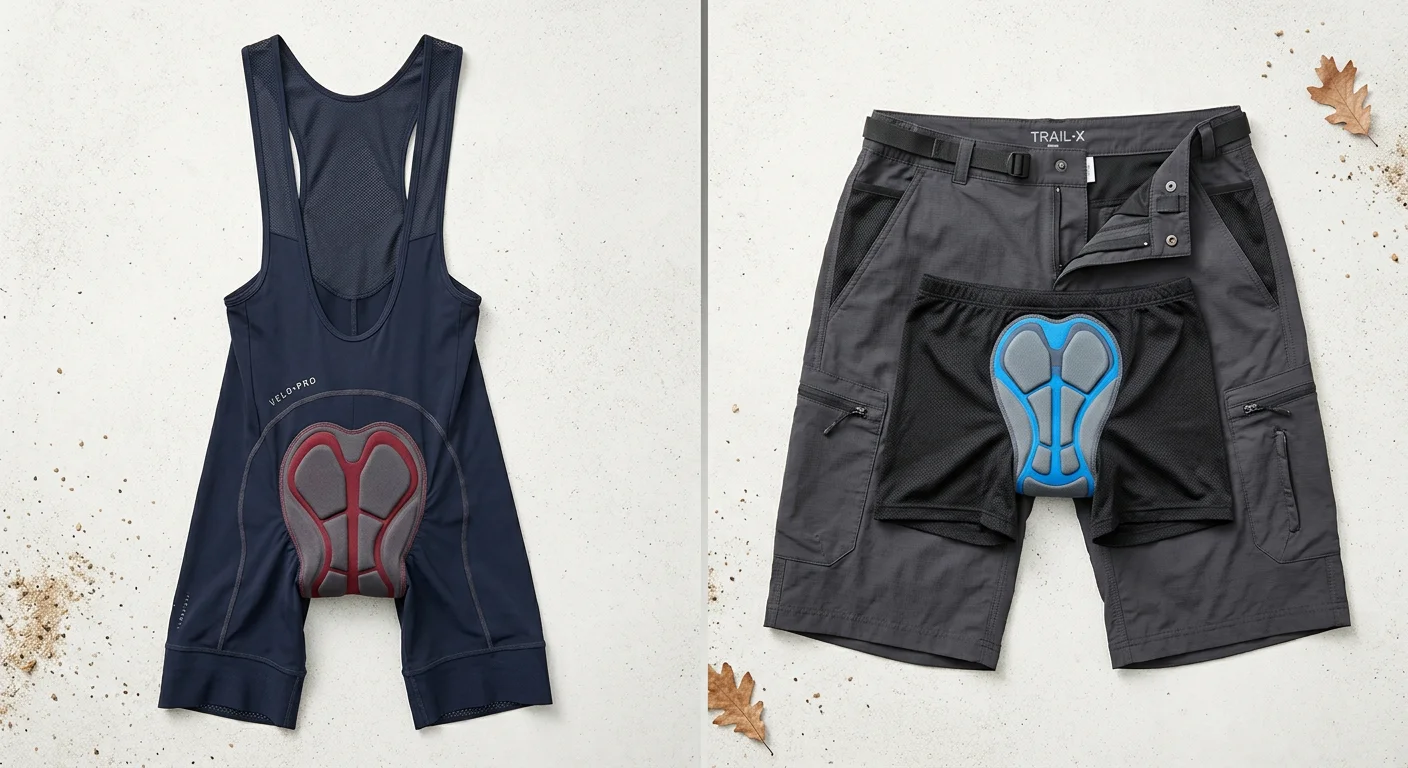
Where you put your stuff tells you everything about how you ride.
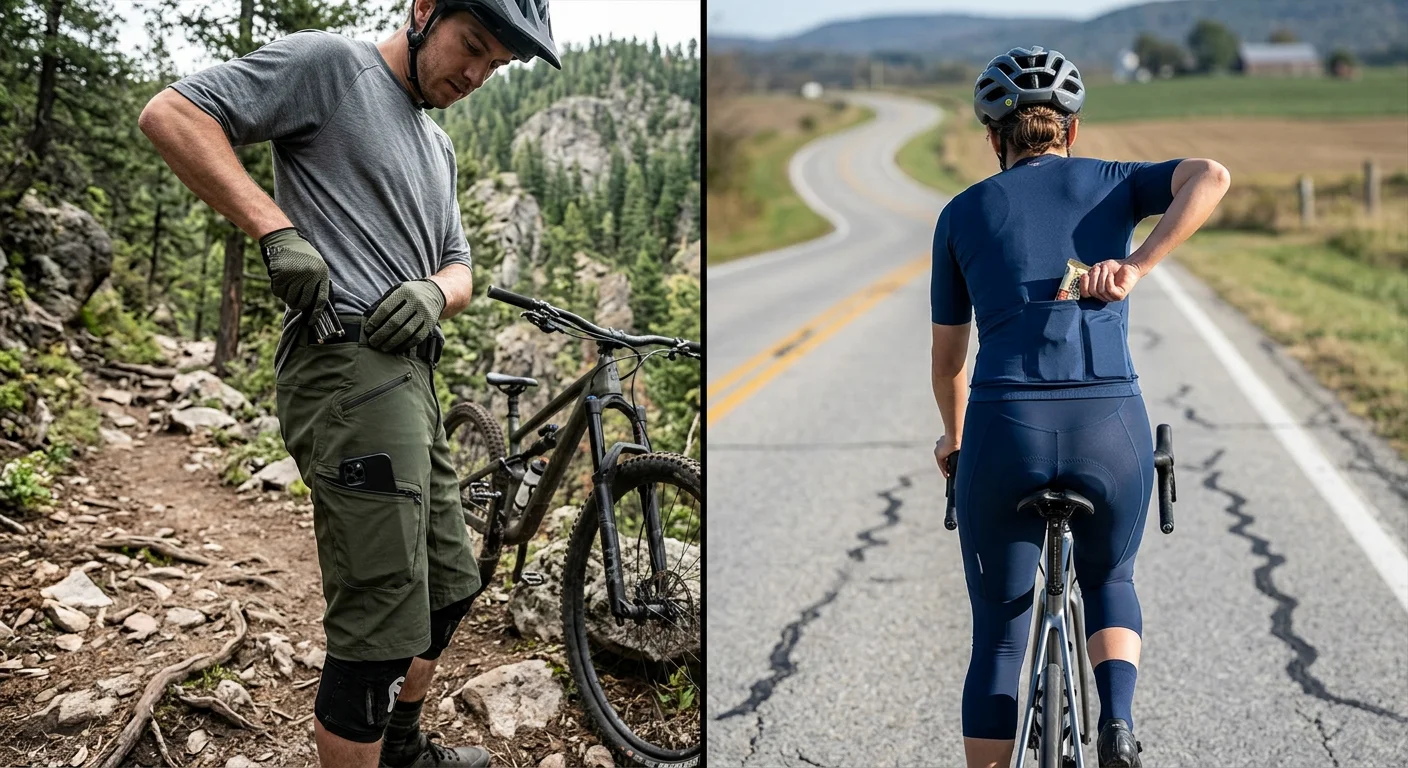
A road cyclist reaches back for a gel without breaking position. Fingers find the center pocket by muscle memory. No looking down. No slowing. The pocket sits flush against the lower back — three horizontal slots built to live right there, at the base of a forward-leaning torso. You can grab what you need without touching your aerodynamics or your tempo.
MTB jerseys don't follow that logic at all. Trail riders don't stay tucked. They stand, pivot, crouch, sprint. A back pocket that works on tarmac becomes out of reach mid-descent. Your weight is behind the saddle. Your elbows are out. So MTB apparel moves storage to where your hands go — chest pockets, zippered side pockets, drop-in hip pockets on baggies. Some trail jerseys add a single zip pocket at the rear, but that's secondary real estate.
The chamois pocket is a road-specific invention. A small zippered slot sewn into the bib short, sitting against the lower back or side hip. It holds one or two gels. Nothing more. It works because road riders stay in position — that pocket stays within reach. On a mountain bike, that same pocket gets compressed, twisted, and lost within the first rocky section. You stop thinking about it fast.
The practical split:
Road jerseys — three rear pockets (center + two side), often one valuables zip pocket, sometimes an aero zip closure
MTB jerseys — chest zip pocket, side zip pockets, limited or no rear storage; baggies add thigh and hip pockets for tools, phone, snacks
Riding trail with a phone, snacks, and a multi-tool? Baggies with built-in pockets handle that without a fuss. Road tights carry nothing — that's what jersey pockets are for.
Visibility & Protection: Traffic Safety vs. Trail Hazard Defense
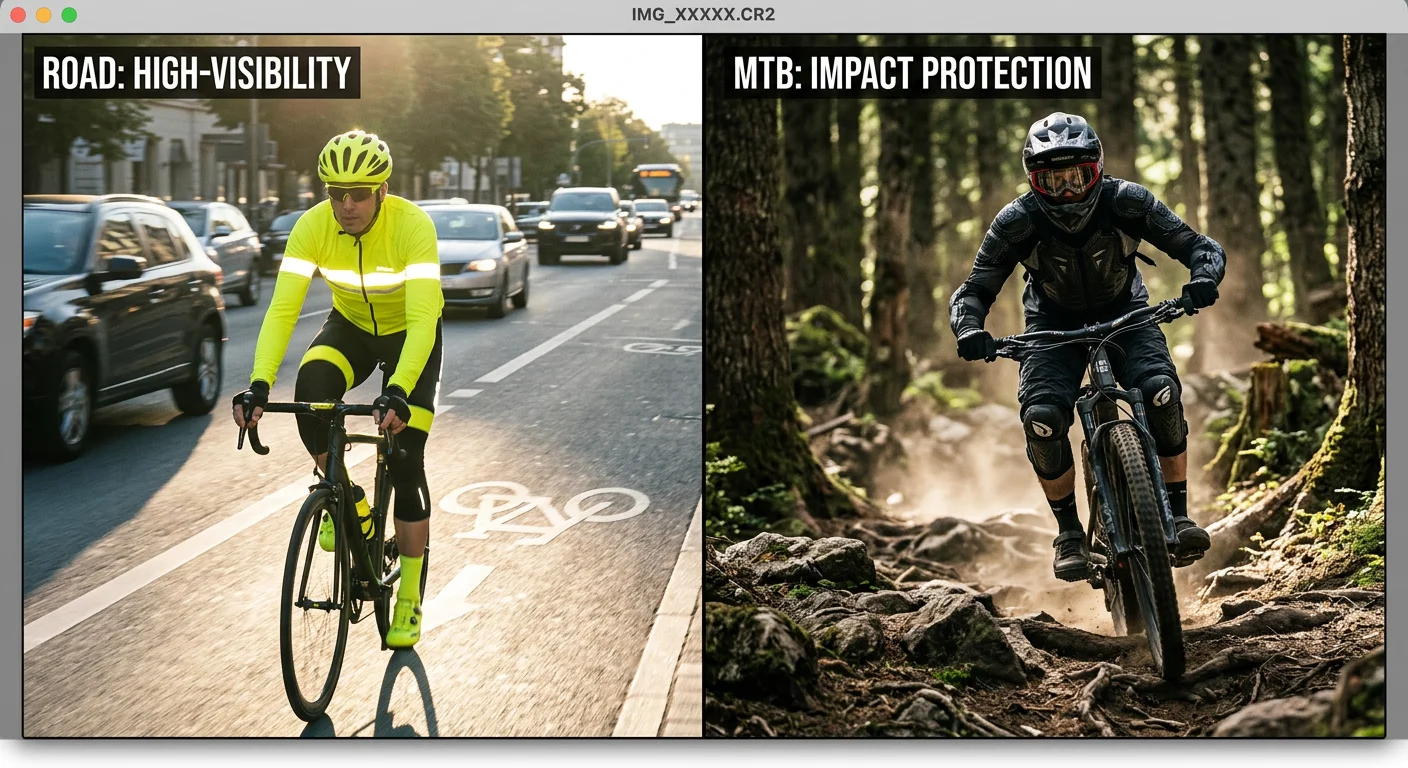
Two different threats. Two different answers.
Road cyclists get hit by cars. Trail riders get hit by trees, rocks, and the ground itself. That one distinction shapes every protection decision in each discipline — and the gear reflects it.
Road: Being Seen Is the Defense
On pavement, your worst enemy isn't a fall. It's a driver who doesn't see you until it's too late. Visibility standards exist to measure how bad that gap really is.
Without reflective gear, a driver spots you at under 30 meters . At 60 km/h, that's less than two seconds of reaction time. Add EN 13356-certified reflective accessories and that distance jumps to over 150 meters — a gap that saves lives.
EN 17353:2020 is the current standard for medium-risk situations. It covers vehicle speeds up to 60 km/h with active road users. The standard requires day and night visibility from all sides. Movement recognition is built into the design, so a driver's brain reads "person" before it reads "obstacle." It also leaves enough room for cycling-specific garment design. That sets it apart from EN ISO 20471 , which requires full 360° torso coverage — more suited to industrial use.
Fluorescent yellow gives you the strongest daytime visibility against busy street backgrounds. At night, retroreflective strips take over — but placement matters. Road jerseys put reflective elements at the back panel and rear hem . That's where a hunched-forward rider faces oncoming traffic. Shape recognition matters as much as brightness. Standardized band placement tells drivers "living person" faster than color alone.
Trail: Armor Over Visibility
MTB riders deal with physics, not traffic. Protection builds up based on how intense the terrain gets.
XC / Light Trail — a standard jersey and shorts do the job. Mid-calf socks (15–20 cm) protect your shins from basic debris strikes.
Enduro — an armored liner goes under your outer kit. You get CE-rated foam or D3O panels at shoulders, elbows, chest, and back. The outer jersey needs extra torso length and stretch panels to sit flat over all that bulk without creeping up mid-climb.
DH / Full Enduro — full-coverage armored liner, reinforced baggy shorts, and a separate CE Level 1 or Level 2 spine protector between layers.
CE certification controls the armor standards. EN 1621-1 covers limb protectors: Level 1 allows up to 35 kN of transmitted force; Level 2 drops that to 20 kN. EN 1621-2 covers back protectors: Level 1 caps at 18 kN, Level 2 at 9 kN. All testing runs at -10°C and +40°C to reflect real degradation across seasons. The numbers on the tag have to hold up year-round.
Sock height is protection most riders overlook. A standard road cycling sock sits at 8–10 cm — useless against a rock strike. An MTB trail sock runs 20–25 cm . DH-specific tall socks go beyond 30 cm . You wear them over shin guard base layers to stop slipping and cut down abrasion in crash slides.
Factor | Road | MTB / Trail |
|---|---|---|
Primary threat | Vehicle collision | Impact, abrasion, terrain contact |
Key protection | Retroreflective strips, fluorescent fabric | Armor liner, pads, tall socks |
Standard | EN 17353:2020 | CE EN 1621-1 / EN 1621-2 |
Speed context | ≤60 km/h traffic | DH self-generated 60–80 km/h |
Road kit stops drivers from hitting you. MTB kit handles what happens after you hit something else.
Riding Scenario Decision Guide: Which Apparel Fits Your Riding Style?
Most riders don't have one riding style. They have three — the one they planned, the one the weather forced, and the one the trail decided for them.
Matching apparel to scenario matters more than matching it to preference. Your kit needs to solve for actual conditions, not ideal ones.
Here's how to cut through it.
Road & Sportive Riding
Long hours in the saddle. Consistent position. Sustained speed. This is where aerodynamic cycling kit earns every penny. A race-fit or club-fit road jersey with compression bibs and a road-specific chamois covers everything from a 60 km weekend loop to a 200 km audax. Moisture-wicking cycling gear is non-negotiable here. You'll generate heat for hours with no airflow breaks like trail riding gives you.
Choose: Road bib shorts, aero jersey, 8–12 mm road chamois. Nothing baggy.
XC & Light Trail Riding
You're pedaling hard, covering distance, and the trail gets technical at times. MTB baggies over a liner short work well. You get the movement freedom on climbs without going full armor. Breathability matters a lot here. Look for mesh-paneled MTB jerseys with some chest storage. If you ride in hot weather conditions, breathable fabrics become even more critical.
Choose: MTB baggies + liner with 9–12 mm chamois, trail jersey with chest zip pocket.
Enduro & Technical Trail Riding
This is where trail riding apparel breaks away from standard MTB gear. The terrain calls for protection layering. That means an armored liner under your outer kit, CE-rated panels at shoulders and elbows, and longer jersey panels that stay in place mid-descent. Your chamois absorbs shock, not just saddle pressure.
Choose: Armored liner + baggies + longer-cut enduro jersey. Put durability first — weight is secondary.
Gravel & Mixed Terrain
Find the middle ground based on your route. Road-heavy route? Go with the club-fit road kit. More than 50% off-road? Baggies and a trail jersey handle both without compromise.
The honest answer: One kit does not cover everything well. No idea what to pick? Default to the terrain that punishes the wrong call the hardest — and that's almost always the technical stuff.
Professional Buying Checklist: 7 Factors Before You Purchase
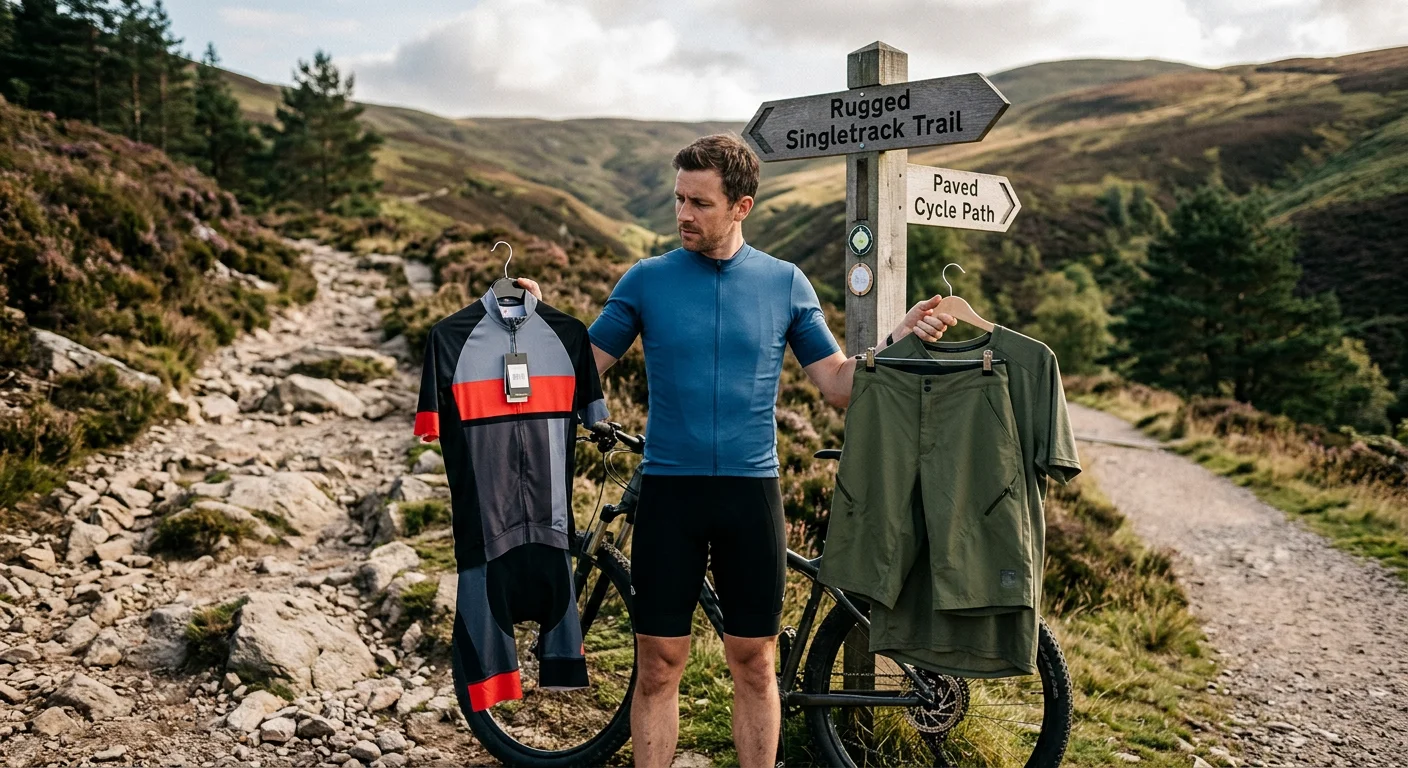
Seven questions. Answer them and you'll walk away with the right kit. Skip them and you're gambling with your money.
1. What terrain describes your rides?
Not your aspirational rides. Your real rides. 70% tarmac with occasional gravel? A road kit wins. You're out on roots and rocks most weekends? Baggies and a trail jersey are non-negotiable.
2. How long are your typical efforts?
Under two hours? Chamois spec matters less. Over four hours on the road? Get an 8–12 mm road chamois with proper density zoning. Cut corners here and you pay in discomfort, not savings.
3. What's your realistic budget — and where does it belong?
Put padding first. That's the right investment logic. A quality chamois in the $100–$300 kit range cuts comfort-related drop-off by 15–25%. Spend here before you spend on looks.
4. Do you need protection layering?
XC riders: no. Enduro and DH riders: yes. Once terrain gets technical, CE-rated armor is non-negotiable. Know your discipline before you buy.
5. What fabric spec fits your climate?
Hot and humid? Go for mesh panels and moisture-wicking cycling gear. Mixed seasons? Look for 180–220 gsm Lycra with UPF50+ for road, ripstop nylon for trail.
6. How does storage fit your routine?
Road riders live off three rear jersey pockets. Trail riders need chest and hip access. Think about how you carry your phone, food, and tools mid-ride. Match pocket design to that.
7. Are you buying one kit or sourcing for a brand?
Individual buyers: pick discipline first, then spec.
B2B buyers and custom road and mtb cycling apparel brand sourcing? A few things matter more than unit price alone:
- MOQ flexibility — look for 100–500 unit minimums
- Lead times — 4–6 weeks standard, 2–3 weeks for rush orders
- Custom cycling apparel chamois configurations that fit your product line
Run through this list before you click purchase. It takes three minutes. The wrong kit costs you far more than that.
Conclusion
The right kit does more than make you look good. It shapes how you feel at mile 40 — whether you're bent over a road bike chasing watts or threading a line through rooted singletrack.
Road and MTB apparel are not interchangeable. After reading this guide, you know why. Fit philosophy, chamois construction, and fabric durability are not small details. They are the whole game. Wear the wrong kit, and you'll spend your ride fighting your clothing instead of enjoying it.
Here's the bottom line: match your apparel to your terrain, not your budget category. A well-fitted MTB baggy with a purpose-built liner beats an expensive road bib the moment the pavement ends. Price doesn't win — fit and function do.For brands and clubs planning production runs, experienced road & mtb cycling apparel suppliers follow the same principle: performance-driven design always starts with the terrain the rider will actually face.
Ready to build the perfect kit — or source one for your brand? Check out Berun's custom cycling apparel options . You get what your riding style demands, built to spec from the ground up.
Because great rides start before you clip in.
Video Section