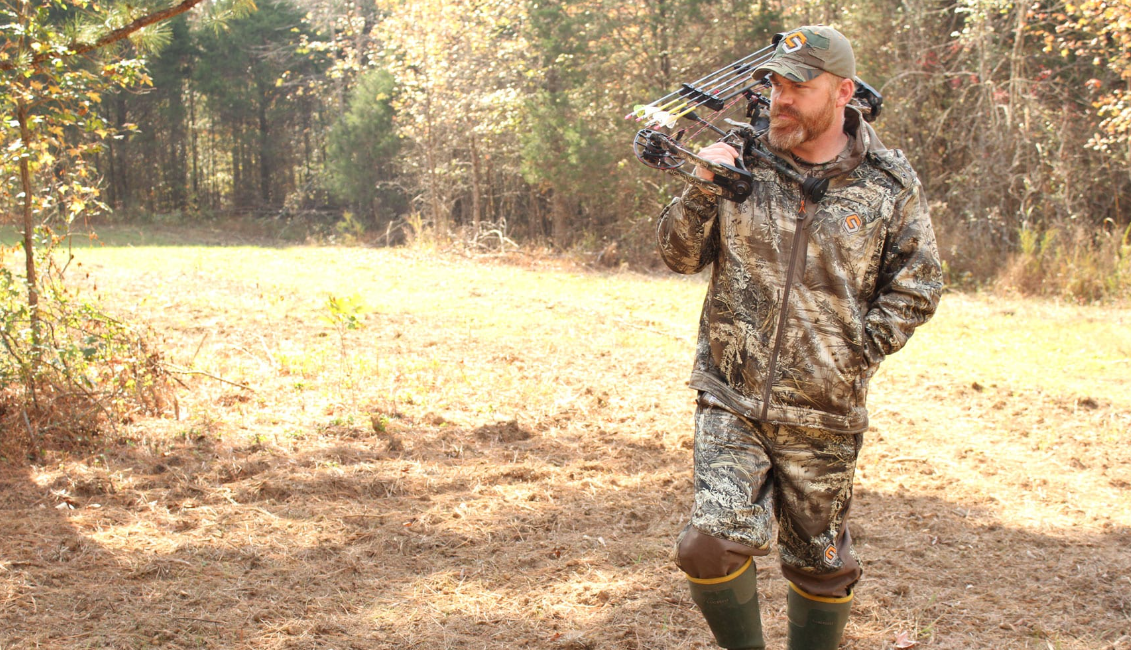
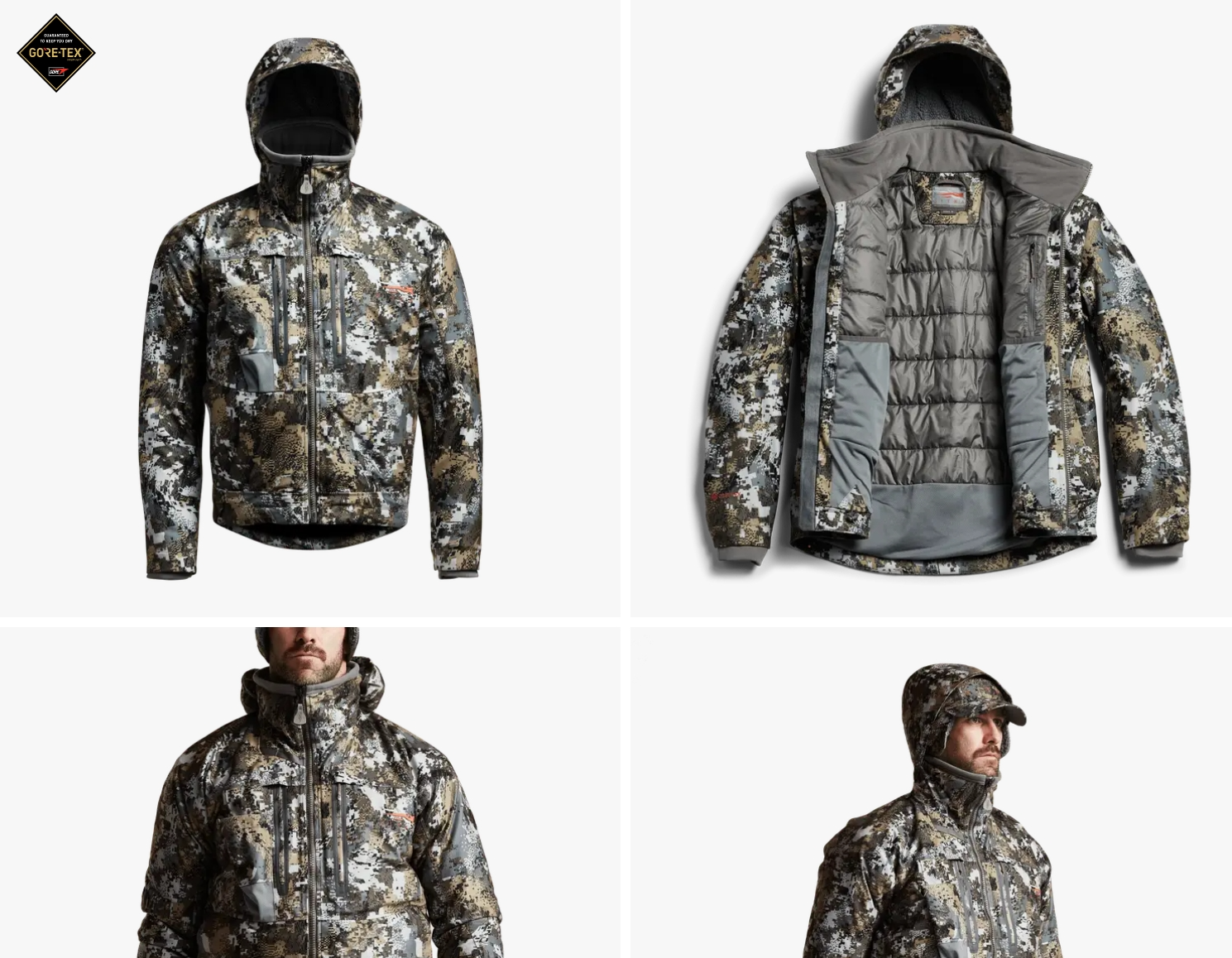
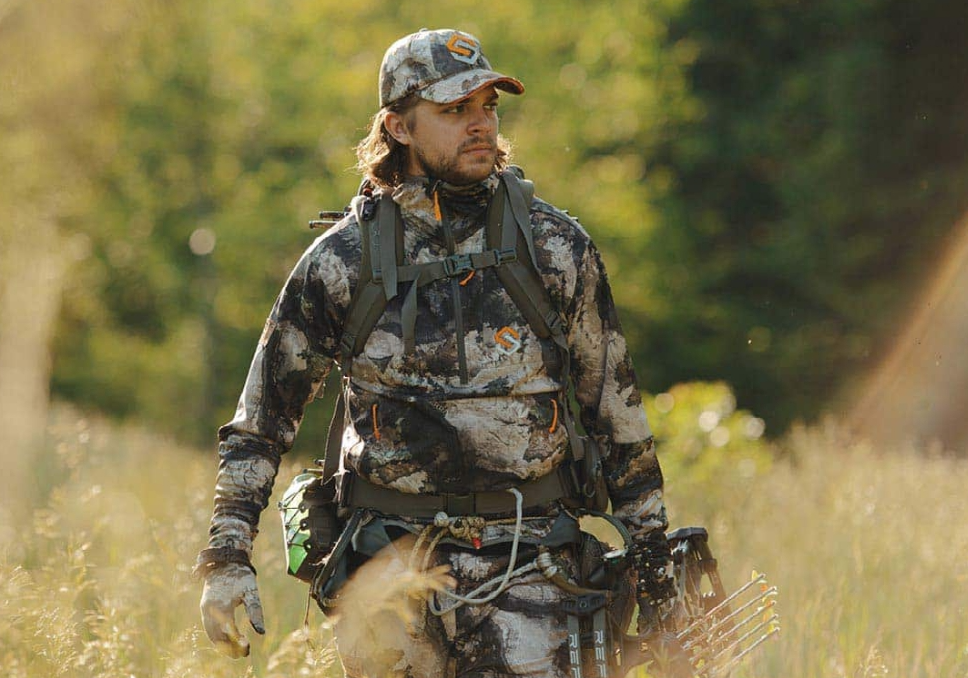
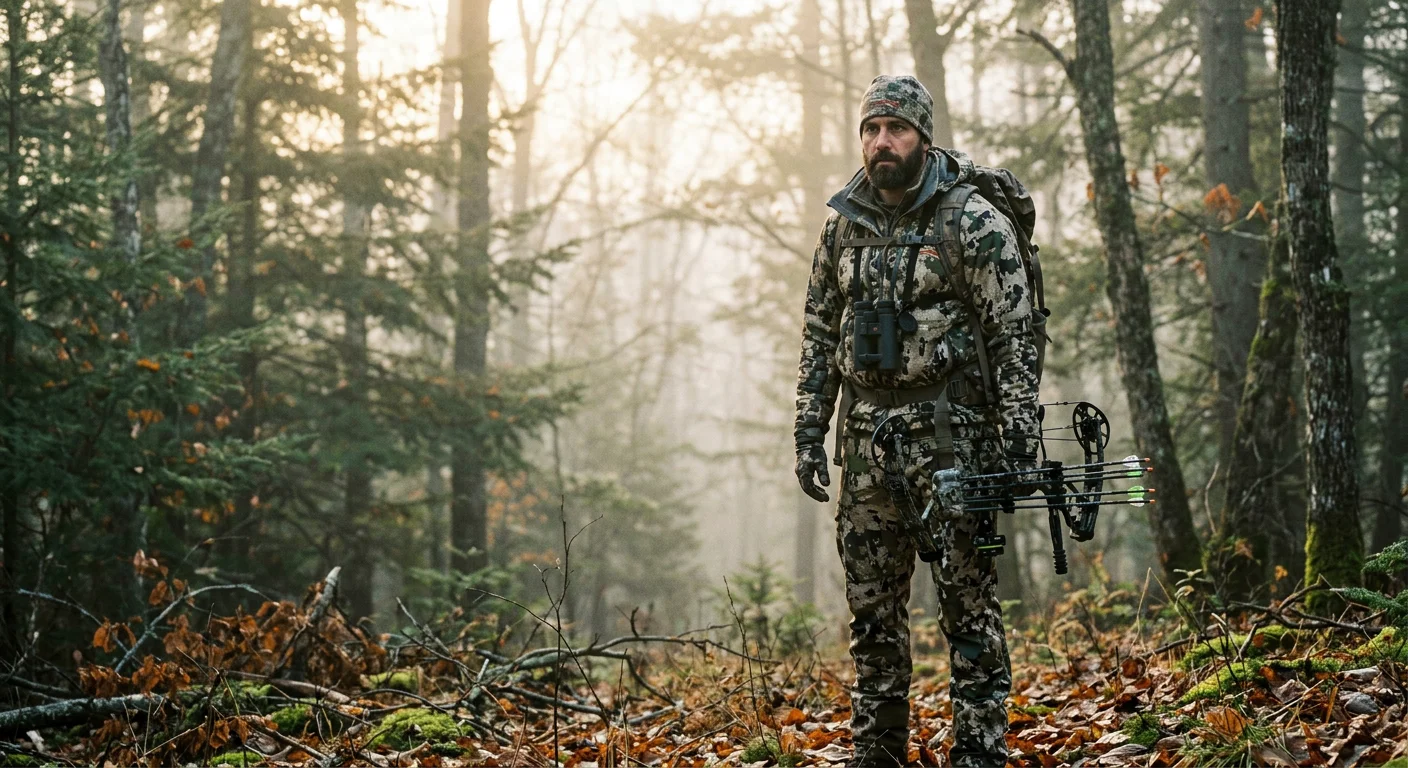
You've glassed a bull at 400 yards. The temperature has swung 35 degrees since dawn. You're three miles from the trailhead, and your pack is already grinding into your hips.
That's western big game hunting. The clothing system on your back will either make that stalk happen — or turn it into a suffer fest.
The lightweight vs. insulated gear debate isn' T just theory. It's the difference between tagging out and driving home empty.
Chasing elk through dark timber? Glassing mule deer across broken canyon country? Building the right elk hunting clothing setup means knowing what each system does — and where it breaks down.For retailers and brands evaluating hunting apparel collections, choosing the right technical hunting clothing supplier is often the first step toward building a reliable layering system.
Here's a straight breakdown of both approaches. You'll see how to layer them with purpose, and which high country hunting gear combinations hold up once the mountain turns ugly.
Lightweight vs Insulated Hunting Gear: Head-to-Head Comparison
Six dimensions separate these two systems. Weight, breathability, moisture management, packability, durability, and price — each one matters in its own way. The mountain decides which one matters most that day.That's why many serious hunters and outfitters are increasingly interested in custom fishing gear configurations tailored to specific regions and hunting conditions.
Here's how they stack up:
Dimension | Lightweight Gear | Insulated Gear |
|---|---|---|
Warmth | 150–200 gsm; built for high-output movement | 200–300+ gsm; designed for static cold |
Breathability | 15,000–30,000 g/m²/24h; some fleece has near-unlimited airflow | 5,000–10,000 g/m²/24h; windproof membranes restrict airflow |
Moisture Management | Dries in 30–60 minutes under normal conditions | Heavy insulation can take 90+ minutes to dry; synthetic beats down in wet conditions by 30–50% |
Weight & Packability | 10–16 oz; packs down to about 4–6 inches in diameter | 32–64 oz; bulks out to 8–12 inches packed; down compresses better but fails you when soaked |
Durability | 30–40D fabrics; rock and brush wear these down over time | 70–150D outer shells; quieter in timber, tougher against abrasion |
Price | $60–250 for quality mid-layers and softshells | $300–600+ for top-tier insulated hunting jackets; full cold-weather systems can run $600–1,000 |
The core tradeoff is simple : lightweight gear wins on the move. Insulated gear wins at the stop.
A packable hunting puffy jacket at 12 oz adds almost no weight to your pack on the uphill grind. Pull it out during a glassing session at 11,000 feet with the wind turning — it earns every dollar right there.
A heavy insulated parka with 160 g/m² synthetic fill holds your core temperature above 80°F after an hour motionless in pre-dawn cold. Put it on for a four-mile approach, and you'll be soaked before legal light hits.
Neither system is wrong. Using the wrong one for the wrong moment is.
Backcountry spot-and-stalk hunting — the kind of elk hunting clothing setup where you're moving 70–80% of the day — puts breathability and packability at a 9 out of 10 in priority. Warmth needs to hit a 6, no higher. A lightweight softshell hunting jacket paired with a compressible mid-layer covers that math well.
Flip the scenario to a late-season mule deer sit on a cold canyon rim. Warmth jumps straight to a 9. A moisture-wicking hunting shirt and a high country layering system alone won' t hold up. That's the moment insulated hunting layers justify their weight budget.
The Hunting Clothing Layering System: How Lightweight and Insulated Gear Work Together
Most hunters think about clothing in terms of individual pieces. That's the wrong frame. The mountain doesn't care about your jacket — it cares about your system.
Lightweight and insulated gear aren't competitors. Many hunting apparel brands working with OEM/ODM hunting gear partners now develop complete layering systems rather than focusing on individual garments alone.They're partners built around one central truth: your body's heat output changes all the time. Your clothing system has to keep up.
Here's how the layers stack — and what each one does.
Layer 1: The Merino Wool Hunting Base Layer (The One You Never Take Off)
Your merino wool hunting base layer is the foundation. It runs 24/7 from the trailhead to the sleeping bag. Its job isn't warmth — it's management. It pulls moisture off your skin, fights odor, and holds a baseline of 0 . 2–0.5 Clo insulation. That keeps your core from losing heat every time you stop moving.
Weight class matters here. A 120–170 g/m² lightweight merino handles high-output days — long approach miles, hard elevation gain. Step up to 250–300 g/m² for cold static sits. Serious hunters carry two sets: one for moving, one dry set saved for the moment they stop for good that day.
Swapping into dry merino before a long glassing session brings your core temperature back faster than piling layers over wet fabric ever will.
Layer 2: The Active Mid-Layer (The Breathing Engine)
This is the layer most hunters skip or misuse. An active mid-layer — a lightweight grid fleece or low-fill synthetic — sits between your base and your outer shell. It gives you 0.6–1.0 Clo of insulation on the move. That's the sweet spot: a puffy would overheat you here, and a base layer alone would leave you cold the moment wind picks up.
Think of it as your engine room. At 45–35°F with a medium-weight base , pairing a moisture-wicking hunting shirt with a grid hoodie mid-layer gives you a breathable, functional platform for miles of spot-and-stalk movement. The active mid-layer stays on nearly as much as the base layer. It's your constant.
Layer 3: The Softshell Hunting Jacket (The Wind Killer)
A softshell hunting jacket doesn't add big warmth on its own — maybe 0.2–0.4 Clo of direct insulation. Its real job is stopping wind from robbing your inner layers of their efficiency. Control the wind, and your active mid-layer performs 20–40% better . That's the real value.
Quality hunting softshells weigh 500–800 g for jackets, a bit less for waterproof hunting pants . They're quiet in timber, tough against brush, and breathable enough to keep on during steady movement at 35°F. Wind over 10 mph? The softshell becomes non-negotiable. It keeps your inner system working without forcing you to reach for the puffy too soon.
Layer 4: The Packable Hunting Puffy Jacket (The Glassing Layer)
Here's where most western hunters misread their own system.
The packable hunting puffy jacket — synthetic-filled at 60–150 g/m² or 800-fill down — is not a hiking jacket. It's a static heat engine . At full efficiency, it delivers 2.0–3.0+ Clo . Put it on during a hard climb, and it soaks your base layer and wrecks your whole system.
The rule is simple: puffy on when you stop, puffy off before you move.
Arrive at your glassing point. Wait 60–90 seconds. Let your core heat vent. Then pull the packable hunting puffy jacket from your pack and put it on before you get cold — not after. Most quality puffies compress to 1–3 liters and weigh 350–600 g . Keep it in your pack lid or top pocket. It costs you nothing to access.
Hunters freeze despite wearing heavy insulation for one reason almost every time: a wet base layer. That wetness comes from hiking in a puffy that should have stayed in the pack.
Layer 5: The Hard Shell (The Rain and Wind Override)
The hard shell — rain jacket and waterproof hunting pants — comes out only in rain or extreme wind. It adds little direct insulation, but it seals out wind and water and boosts everything underneath. The jacket weighs 450–700 g . The pants run 350–600 g . It's the layer you hope stays compressed at the bottom of your pack all trip.
The layering system works because every piece has a defined role. Pull one out, or use one in the wrong situation, and the whole system breaks down. A merino wool hunting base layer under an active mid, topped with a softshell hunting jacket for movement — then a packable hunting puffy jacket the moment your boots stop — that combination covers the full range of western big game conditions better than any single heavy garment ever could.
Season-by-Season Gear Breakdown: Early, Mid, and Late Season Western Hunts
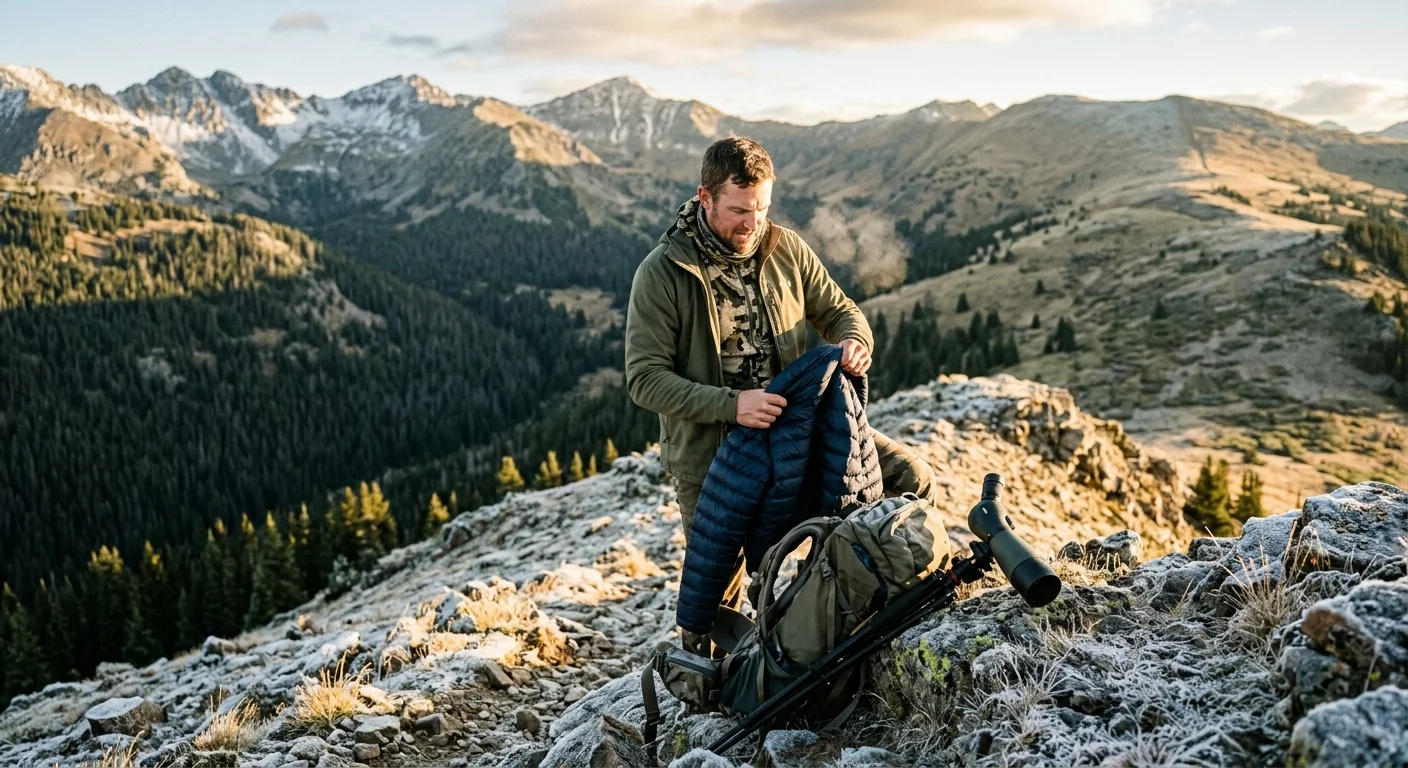
Western seasons don't ease you in. Each one hits differently — different temperatures, different terrain demands, different consequences for getting your gear wrong.
Here's how to build your system for each one.A specialized hunting apparel factory understands that early-season breathability and late-season insulation require completely different material and construction strategies.
Early Season (August–September): Lightweight Dominant, 30–75°F
The early season is a heat management problem, not a cold one.
At 8,000–11,000 feet, your mornings start at 30–40°F. By midday, you're hiking in 65–75°F sunshine with 30 pounds on your back. That 35-degree swing happens in four hours. A cold front rolls through, and your body feels it drop another 10–15°F in minutes.
Your clothing system needs to breathe hard on the climb and still protect you once the mountain turns cold.
The early season foundation:
Base layer: A 150–170 g/m² merino wool hunting base layer — tops around 150–200 g per piece, bottoms around 140–180 g. This is your all-day layer. It never comes off. Keep each piece under 220 g so it dries fast during hard effort.
Outer shirt: A lightweight synthetic long-sleeve at 90–110 g/m² fabric weight — about 180–250 g total. Sun protection, brush protection, done.
Optional mid-layer: A thin fleece pullover at 200–300 g. This lives in your pack lid for dawn and dusk. Once you're moving, it comes off.
Bottoms: Non-insulated, high-stretch pants at 150–200 g/m² fabric weight, total weight 350–500 g. This is your primary hunting pant for the whole day.
Rain shell: 2.5-layer or 3-layer hard shell, 300–400 g jacket plus 300–400 g pants. Early season storms tend to be fast and hard. You need ≥15,000 mm waterproof rating and ≥15,000 g/m²/24h breathability as your baseline.
Total system target: 3.5–4.5 kg worn on your body. Another 1.5–2.5 kg of backup clothing in the pack. Stay under 5–7 kg for your full clothing system. That's a solid lightweight high country hunting gear setup for early season conditions.
Mid Season (October): The Hardest Balance, 20–60°F
October breaks hunters who haven't thought this through.
Mornings sit at 20–30°F. Afternoons climb to 45–60°F. Add a 15–25 mph wind on a ridge, and wind chill pulls you back down to 10–20°F. You'll sweat hard on a morning approach, stand still glassing for 60 minutes, strip a layer at noon, and pull everything back on by 3 PM. That cycle repeats all day.
Cold fronts bring rain-snow mix. Wet cold demands more insulation than dry cold. But a system that's too heavy will grind you down over six to twelve miles before you ever find your animal.
Mid season is where your hunting insulation layer choices get serious.
Upper body — four layers, each with a clear job:
Base layer: Step up to 200–250 g/m² merino — single pieces at 220–280 g. A bit thicker than early season for better warmth at rest.
Active mid-layer: A grid fleece or light softshell hunting jacket with chest or underarm zips — 300–450 g. Those venting zips are non-negotiable on hard climbs. You'll use them every single day.
Core insulation: A synthetic or 650–850-fill down jacket at 350–550 g. This is your glassing layer. It needs to keep you functional at 25–35°F after 30–60 minutes without moving. It also needs to compress small enough to fit in your top pocket.
Heavy insulation (weather-dependent): A heavier synthetic or down piece at 600–900 g. Carry this only when the forecast shows extended cold or severe overnight temps. Don't carry it every day. That's 500–800 g you don't need on a mild October afternoon.
Lower body:
Primary pants: Medium-weight softshell or brushed-fleece-lined hunting pants, 450–650 g. Better wind resistance than early season bottoms.
Base layer bottoms: 200–250 g/m² merino at 200–260 g — strip these off mid-morning as it warms up.
Insulated pants (backup): Lightweight synthetic or down pants at 300–450 g. These stay packed during movement and come out for long glassing sits or camp.
The mid-season discipline: Keep your "always-on" layers at two or three pieces. Everything else follows a pull-out-when-you-stop system. Practice the transition so you move from hiking mode to glassing mode — base layer, insulation, hard shell — in under 60 seconds. You'll do it dozens of times. Make it automatic.
Mid season adds 700–1,500 g of insulation to your total system compared to early season. Carry it smart, and it's manageable. Carry it wrong — wearing it all day instead of rotating it — and you'll arrive at your glassing point soaked and cold despite having the right gear.
Late Season (November–December): Insulation Dominant, 0–40°F
By late season, the whole equation flips.
High-altitude mornings run 0–15°F. Midday tops out at 20–35°F on most days. There's snow on the ground, ice on the approach, and the wind never quits. Your daily mileage drops too — late season hunting typically means 2–6 km approaches followed by long static sits of one to three hours at a stretch.
You're no longer solving a breathability problem. You're solving a heat retention problem, with short bursts of movement mixed in. The mule deer hunting apparel system that got you through October needs a real upgrade.
Late season upper body:
Base layer: Heavy merino or synthetic at 250–300 g/m², single pieces at 250–320 g. This is your thermal foundation against sustained sub-freezing cold.
Mid-layer: A heavy fleece or thick synthetic hooded jacket at 350–500 g. This stays on during most movement — the cold is too consistent to leave it in the pack.
Primary insulation: A packable hunting puffy jacket with 150+ g/m² synthetic fill or 800-fill down at 500–750 g. Pull it over everything the moment you stop moving. At these temperatures, the puffy-on/puffy-off rule isn't optional. It's what keeps your base layer dry and your core temperature stable.
Hard shell: Heavier 3-layer construction at 400–550 g. Wind and wet snow make this a near-constant outer layer, not an emergency layer.
Late season lower body:
Insulated pants: Bib-style or standard synthetic-insulated hunting pants with 60–120 g/m² fill. A solid pair of waterproof hunting pants with built-in insulation covers everything from the approach to the sit.
Base layer bottoms: Heavy merino at 250 g/m², worn all day.
Knee and ankle protection: Gaiters add minimal weight and make a big difference on snow-covered terrain.
Gloves and HEAD :
Run a two-glove system: a thin fleece liner at 50–70 g for movement, plus a heavy insulated mitten or glove at 150–250 g that goes over the liner for static sits. A heavy knit hat at 80–100 g paired with a merino or fleece neck gaiter at 50–80 g cuts off two of your biggest heat-loss zones. In sustained sub-zero wind, solid head and neck insulation does more for you than adding another body layer.
Late season is where hunters go too light on scent control. They assume cold kills body odor. It does — but not completely. Sweat from even a short approach saturates a merino wool hunting base layer and still produces detectable odor. Keep your scent control hunting clothes routine consistent no matter the temperature. Swap into a clean base layer before your final sit after a hard approach.
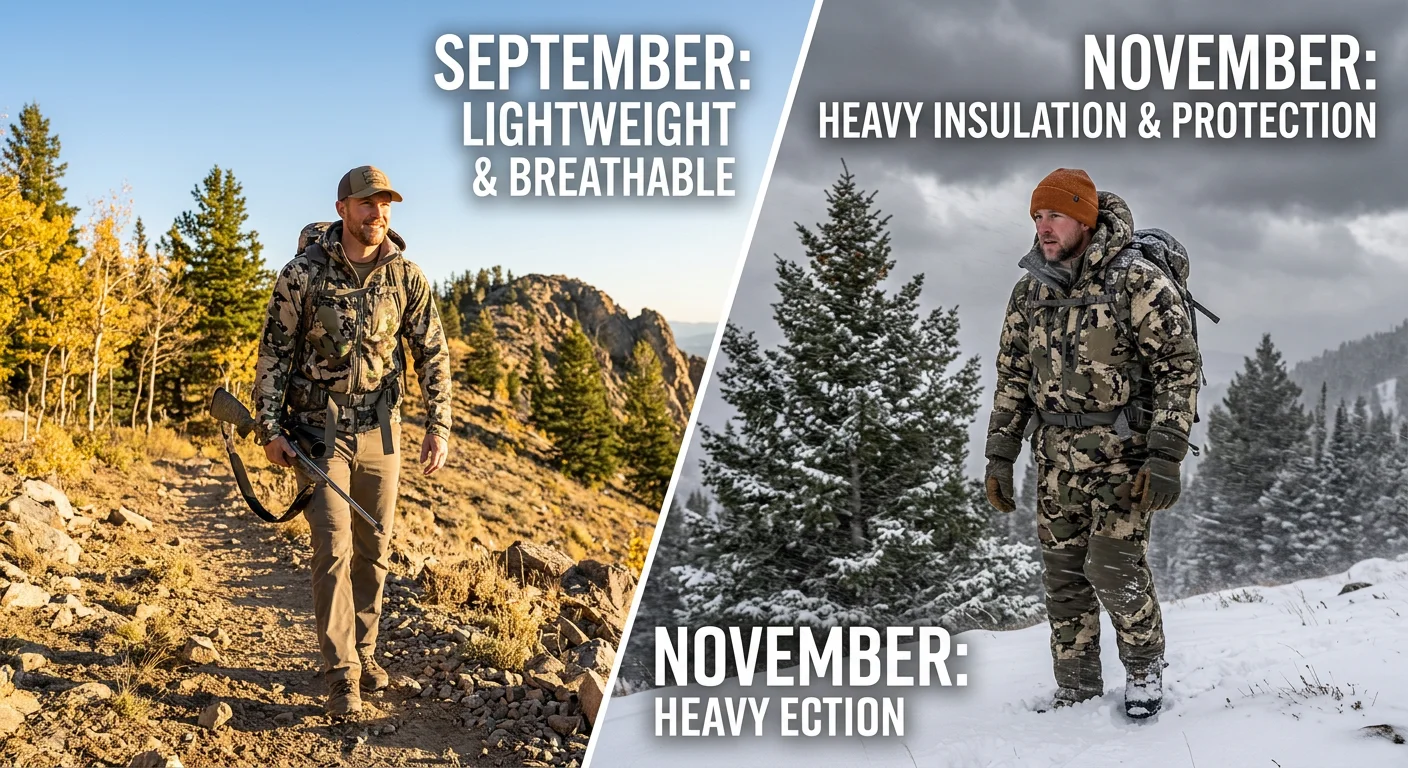
The season shapes the system. Run late-season insulation in September, or show up to a November sit in early-season breathable layers, and the mountain will make you pay for it. Match the gear to the conditions, and you stay in the game long enough to make something happen.
Match Your Gear to Your Hunting Style: Backcountry vs. Truck-Based vs. Stand Hunting
Terrain dictates everything — and so does how you hunt it.
High country that demands a 7 kg ultralight system from a backcountry hunter will swallow a truck-based hunter's heavy insulated bib without a second thought. These aren't the same game. Treat them like they are, and you end up soaked, frozen, or worn down before the real work starts.
Three hunting styles dominate western big game.Large outdoor apparel retailers and wholesalers often organize product assortments around these distinct hunting scenarios because gear requirements vary dramatically between them. Each one pulls your gear priorities in a different direction.
Backcountry Hunters: Every Ounce Is a Decision
Packing into the wilderness for three to seven days changes everything. Weight stops being a preference. It becomes a hard limit. Your clothing system fights for space against your shelter, sleep system, and food inside a 5,000–8,000 in³ pack.
Target a dry system weight under 7–9 kg — pack frame included. Every clothing layer needs to earn its place at a gram-per-function level.
That means:
Base layer: 145–200 g/m² merino or synthetic, individual pieces at 150–200 g. This is your constant layer. It never leaves rotation.
Active mid-layer: 60–80 g/m² synthetic or 150–200 g/m² fleece, jacket weight 300–400 g. Breathable enough to keep on during a hard climb. Warm enough to carry you through a glassing pause.
Insulation layer: An 800-fill down or high-end synthetic puffy — 80–120 g/m² fill weight, total jacket at 350–600 g. This piece handles static warmth down to -5 to -15°C alongside your other layers. It packs to the size of a water bottle.
Shell: 20–40D hard or softshell with ≥10,000 mm waterproofing and ≥10,000 g/m²/24h breathability. Wind and weather protection without adding dead weight.
One key rule on pack fit: load your hip belt so 70–80% of the total weight rides on your hips , not your shoulders. Push past 20 kg on the return haul with meat, and a bad-fitting system ends your hunt faster than any gear failure.
Truck-Based Hunters: Use the Weight Advantage
Drive to camp and hunt a 1–5 km radius — the math shifts. Your truck carries the heavy gear. You carry what you need for the day. Nothing more.
That opens the door to insulation levels and fabric weights a backcountry hunter can't touch. A 2.5–4 kg bibs-and-jacket combo would wreck a seven-day pack trip. Walking two kilometers from the tailgate? No problem at all.
Build two separate setups and keep both in the truck:
Movement kit — for the approach:
- Lighter softshell or minimal-insulation pants
- A shell layer on top, moisture-wicking hunting shirt underneath
- Enough breathability to move without overheating
Static kit — for when you reach your spot:
- Heavy insulated bibs with 100–200 g/m² synthetic fill
- A thick outer jacket with 150–200 g/m² insulation and ≥20,000 mm waterproofing
- Brushed or softshell exterior — quiet against timber and brush
The swap takes three minutes. That small effort makes the difference between holding your position through a long, cold sit and cutting the hunt short.
Stand and Ambush Hunters: Solve the Sweat-Then-Freeze Problem
Walk 30 minutes. Sit for four hours. That's the full thermal challenge of stand hunting — and it's harder to manage than it sounds.
Even a short approach generates enough heat to dampen your base layer. Stop moving, let the cold settle in, and that moisture turns against you fast. A wet merino wool hunting base layer under heavy insulation drops 30–40% of its effective warmth compared to a dry one.
The fix is simple, but it takes discipline:
Walk in underdressed. Wear one layer fewer than feels comfortable on the approach. Arrive at your stand cool — not cold. That keeps your base layer dry.
Layer up on arrival. Don't wait until you feel cold. Pull your insulation out of your pack within the first two minutes of reaching your stand. Maintaining warmth is far easier than rebuilding it.
Insulation spec for stand hunting:
- Upper body insulation: 150–250 g/m² fill weight in your primary puffy or hunting jacket — one full level heavier than backcountry hunters carry
- Bibs: 100–200 g/m² synthetic fill through the legs and core
- A heavy fleece or thick synthetic hooded mid-layer that stays on through most of the sit
Extended sits in sub-freezing cold mean your scent control hunting clothes discipline matters as much as your insulation. A short approach still builds enough sweat to create detectable odor, even in cold weather. Carry a clean base layer in a sealed bag. Swap into it before the final approach to your stand.
Your hunting style determines the system you need. Not the other way around. Match your layering to how you move — and your gear stops being a liability and starts being part of why you fill your tag.
6 Key Factors to Make the Final Call on Your Hunting Clothing System
Gear decisions made at home in July feel very different at 10,500 feet in October with sleet coming sideways. These six factors cut through the noise and tell you what your system needs to be — before you're standing on the mountain regretting it.
Work through each one. Answer honestly. The system builds itself.
Factor 1: Predicted Temperature Range and Elevation
Nail down your actual numbers before you buy anything.
Morning lows below 40–45°F (4–7°C) mean you need a base layer bottom in the rotation. Above the mid-40s, a lightweight breathable pant handles it. Simple threshold, easy decision.
The harder problem is the swing across a single day. A typical western mountain hunt in September and October runs 25°F (-4°C) at dawn and 60°F (15°C) by afternoon — a 35-degree shift inside six hours. Your system has to move with that. One static layer setup fails every time.
Two questions that lock in your direction:
Predicted low below 0°C with 2+ hours of stationary time? You need the insulation-heavy side of the spectrum — heavy base, substantial mid-layer, a dedicated warmth piece, and solid wind protection.
Swing greater than 15°C with more moving than standing? Build toward the lightweight, venting side — thin base, compressible mid, packable puffy that earns its place at the stop.
Above 2,500 meters, wind becomes its own variable. More windproof layers — not just more thickness — is the right answer to heat loss at elevation.
Factor 2: Your Daily Move-to-Stop Ratio
How you hunt shapes every layer choice more than the temperature does.
Field experience backs this up: a well-planned 3–5 layer system outperforms a randomly stacked 7-layer pile — warmer, lighter, and faster to adjust between moving and sitting.
Be honest about your ratio:
Moving 80% of the day or more? Breathability and moisture management come first. Your insulation needs to compress small and deploy fast — active insulation logic, not static warmth logic.
Sitting 70% of the day or more? Static warmth and wind protection come first. Weight becomes less of a concern. You're not carrying it on a hard climb anyway.
One practical test: Can you run through the full add-layers sequence silently, in under 90 seconds , after reaching your spot? If not, your system is too complicated or your layer order needs work. You'll make this transition dozens of times across a week-long hunt. Make it automatic.
Factor 3: Your Personal Cold Tolerance
Same temperature, same conditions — one hunter is comfortable, another is already hypothermic in his head. Body chemistry is real. Ignoring it costs you.
A cold-running hunter near freezing needs an extra 200–250 g/m² merino layer or a heavier fleece mid — something in the 18 oz (510 g) range for that mid-layer slot. A warm-running hunter gets through the day with a thin base and a single grid fleece.
Try this self-assessment: Stand outside in 40–50°F with light wind in a standard sweatshirt for 30 minutes.
Cold or shivering? Build toward heavier base weights and a heftier mid-layer. You're a cold runner.
Mildly cool or comfortable? You have room to run lighter. You're neutral to warm.
Get chilled after sweating — not from the cold itself? The answer isn't more insulation. You need a higher-performance moisture-wicking hunting shirt and a merino base that pulls sweat away faster. Fix the moisture problem first.
Factor 4: Pack Weight Constraints
Every clothing layer competes for space and weight against your shelter, sleep system, food, and optics. This isn't a preference — it's math.
A grid fleece mid-layer runs 10–18 oz (280–510 g) . A quality lightweight rain shell hits 10–16 oz (280–450 g) . Those are real numbers against a real weight budget.
Keep clothing under 20–25% of your total pack weight. Targeting a 35-pound load-out? That's around 7–8 pounds for your complete clothing system — everything worn and carried combined.
Two signals that your system needs a rethink:
Struggling to close the top of your pack? Drop the redundant mid-layers. Consolidate into one high-quality compressible puffy. A packable hunting puffy jacket that crushes down to liter-bottle size replaces two mediocre insulation pieces and adds nothing on the approach.
Shoulder pain by mile three? Your hip belt distribution may be off — but your clothing weight is often the hidden culprit. Check each piece against its actual function.
Factor 5: Rain and Wet Snow Probability
Wet cold hits differently than dry cold. An insulation layer that performs at 20°F in dry conditions can lose 30–50% of its effective warmth once moisture gets through the outer shell.
Waterproof hunting pants and a solid rain jacket stop being optional the moment precipitation shows up near freezing.
Make the call based on your forecast:
40–50% or higher precipitation probability near 0°C? Your shell layer moves from "emergency backup" to "daily essential." It also needs to be windproof — rain and wind together are your worst-case combination.
Walking more than two hours in rain gear? Breathability matters as much as waterproofing here. A waterproof shell that can't breathe will soak you from the inside on a long approach. Look for ≥15,000 g/m²/24h breathability as your floor.
Short pop-up afternoon storms typical for your area? A lightweight packable shell that lives in your lid pocket is enough. You don't need to wear it all day — just deploy it fast.
Factor 6: Budget Priority and Where to Start
A complete high-end western hunting system from a premium brand can clear $1,000 without breaking a sweat. That number stops a lot of hunters cold — and pushes them toward buying five mediocre pieces instead of three excellent ones.
That's the wrong trade. A focused, well-built 3–5 layer system is warmer, lighter, and more adaptable than a seven-piece stack of mid-tier gear. Spend less, but spend with a clear plan.
The minimum viable clothing path:
Base layer first. One or two sets of merino wool hunting base layers — tops and bottoms — at 150–200 g/m² . This is the foundation. No cotton. Ever. Put the most money per ounce here.
One quality static insulation piece. A compressible hunting insulation layer — down or synthetic puffy, 12–20 oz (340–570 g) — that deploys fast at every stop. This one piece replaces the urge to pack three heavy mediocre jackets.
One lightweight protection shell. Windproof and waterproof, 10–16 oz , stays compressed in your pack until conditions call for it. It doesn't need to be the priciest option out there — but it needs to be genuinely weatherproof, not just water-resistant.
Where to upgrade first if your system already exists:
Chilling out after sweat? Upgrade the base layer and mid-layer.
Getting pushed off long sits by cold? Upgrade the static insulation and wind shell.
Build the system with purpose. Add one quality piece at a time, matched to your actual hunting conditions. Experienced western hunters build gear they trust this way — not by buying the full catalog at once, but by knowing what they need and refusing to settle for less.
Recommended Hunting Clothing Kits for Western Big Game (By Scenario)
Three scenarios. Three different gear problems. Here's what to wear for each one.
Early-Season High-Country Kit
Best for: August–September scouting, archery elk, spot-and-stalk mule deer
Layer 1 (Base): 150-weight merino wool hunting base layer — top and bottoms. Lightweight, fast-drying, and built to wear all day.
Layer 2 (Active Mid): Grid fleece or breathable softshell hunting jacket. Stays on during uphill grinds. Pull it off once you're sweating hard.
Layer 3 (Wind Shell): Packable softshell or wind-resistant layer. Rides in your pack lid. The moment you hit an exposed ridge — or a glassing stop tanks your body temp — you'll want it right there.
Lower body: Lightweight, high-stretch hunting pants with venting. Breathability is the top priority.
Core system logic: Lightweight + breathable + durable. This kit is built for miles, not for sitting still.
October Elk Backpack Kit
Best for: Backcountry elk, mule deer pack trips, high-country spot-and-stalk
Layer 1 (Base): 250-weight merino wool hunting base layer top. Heavier than the earlier season — October mornings demand more insulation.
Layer 2 (Active Mid): Softshell vest for high-output movement. Blocks wind without trapping heat on the climb.
Layer 3a (Glassing Insulation): Packable hunting puffy jacket — light, compressible, and high thermal output at the stop.
Layer 3b (Weather Blocker): Softshell hunting jacket over your base. Handles wind and light moisture well.
Lower body: Softshell hunting pants. The workhorse piece for the entire October window.
Core system logic: Light chassis for the uphill. Insulated for the glass. Wind-blocking for the ridge.
Late-Season Rifle Elk Cold-Weather Kit
Best for: November elk, late mule deer, any hunt below 20°F with snow on the ground
Layer 1 (Base): 250-weight merino top plus insulated base bottoms. This is your core heat layer against steady sub-freezing cold.
Layer 2 (Insulation): Puffy jacket as your main warmth layer — on the moment you stop moving, off before you start climbing.
Layer 3 (Hard Shell): Waterproof, windproof rain jacket and waterproof hunting pants . No exceptions. Late-season storms hit hard and fast.
Supplemental: Softshell jacket and pants for cold but clear days — quieter in timber, more breathable on the approach.
Core system logic: Dry first. Windproof second. High heat retention throughout. This system keeps you moving in November sleet and snow without locking you up.
One rule applies across all three kits: Rain gear is a must for western hunts — no matter the season. A wet base layer loses 30–50% of its warming power inside any of these systems. Keep the layers underneath dry, and the whole system works the way it should.
Conclusion
The mountain doesn't care how much your gear cost. It cares whether you're still moving at mile eight. It cares whether you're dry when temps drop twenty degrees by noon. And it cares whether you're quiet enough when a 350-class bull steps into the open at 60 yards.
That's what this decision comes down to.
Lightweight gear keeps you mobile and hunting longer. Insulation keeps you alive and functional when conditions go bad. A smart elk hunting clothing setup built around a true layering system gives you both — not as a compromise, but as a plan that works.
Stop chasing a single "best jacket."Building a complete system at the right hunting clothing whole price often delivers far better long-term value than investing heavily in a single premium garment. Start building a system that matches your terrain, your season, and your hunting style. That's how you stay on the mountain longer.
Head over to BerunClothes.com and browse the western big game collection. You'll find high country hunting gear built around that same idea — because the best clothing choice you'll ever make is the one that keeps you out there longer than anyone else.