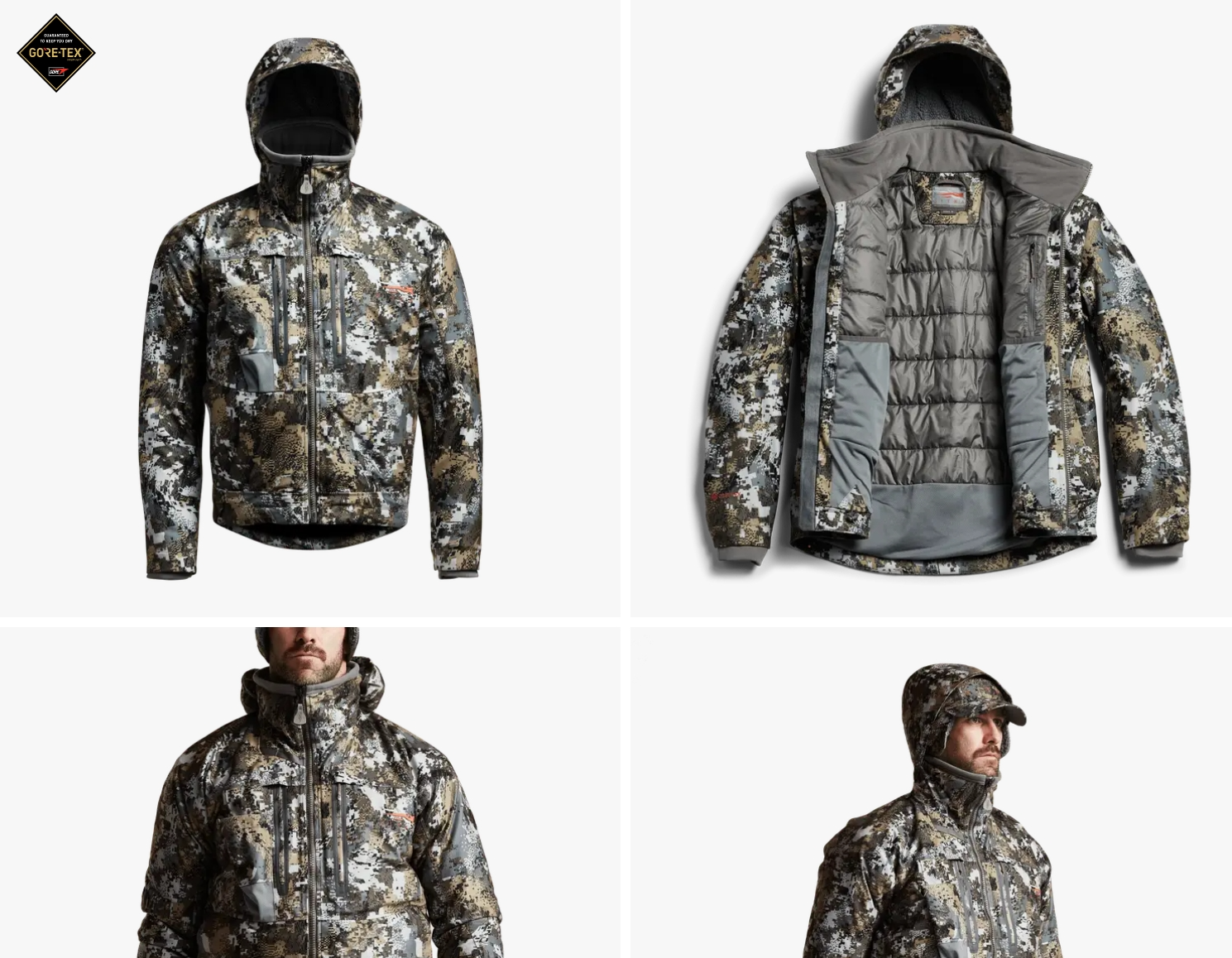
The thermometer read 103°F. I spotted the buck bedded under a mesquite thicket — three hours into a slow-still hunt through South Texas brush, soaked in sweat. The last thing I needed was my gear making it worse.
Here's what most hunting brands won't tell you: the wrong clothing in triple-digit heat doesn't just make you miserable. It gets dangerous fast. It will blow your hunt.Many high-performance hot-weather hunting shirts suppliers who focus on heat management fabrics and sun protection.
We've put in years of early archery seasons and summer hog hunts across the hottest parts of Texas and Arizona. From moisture-wicking hunting shirts to vented jackets and UPF sun protection gear — we've tested it all in the worst heat we could find.
What follows is the honest breakdown of what works when the mercury won' t quit — and what's just marketing copy dressed up in camo.
Our Top Pick for Hot-Weather Hunting Shirts: Long-Sleeve Sun Hoodies Put to the Test
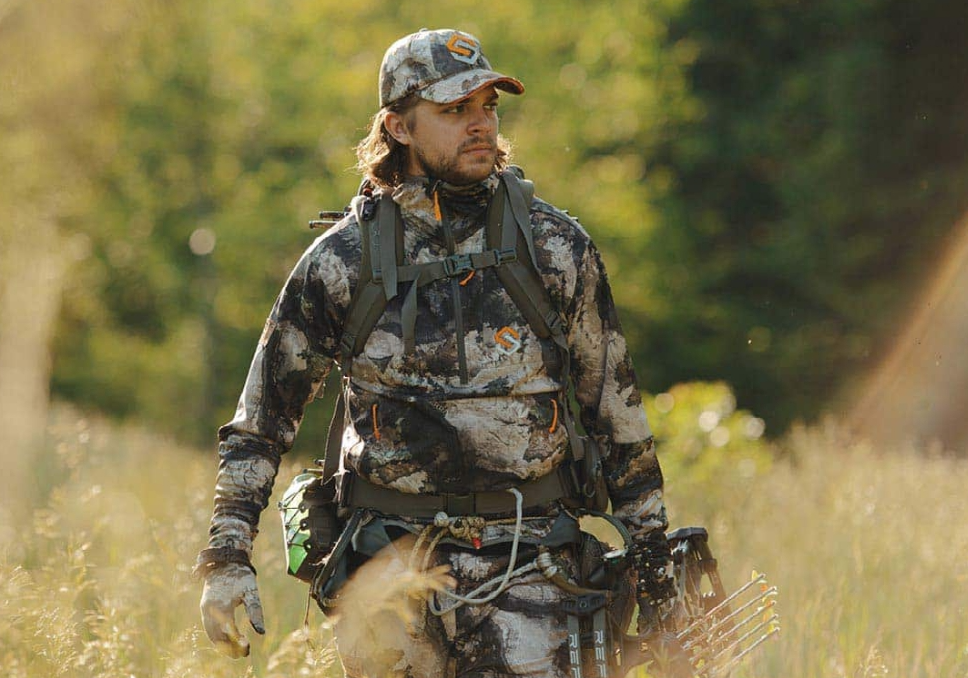
Long-sleeve shirts in 100°F heat sounds counterintuitive. It isn't. The right sun hoodie keeps you cooler than bare skin. It might also be the single most important piece of kit in your hot-weather hunting layering system.
The benchmark is non-negotiable: UPF 50+ . That rating blocks 98%+ of UVB radiation. This matters a lot when you're glassing an open hillside for three hours straight with zero shade. Anything rated below that is a compromise you'll feel by noon.Leading hot-weather hunting gear manufacturers optimize both fabric weight and venting to maintain comfort while blocking UV rays in extreme heat.
But UV protection is half the equation. Ventilation placement separates a good sun hoodie from a great one. The shirts that perform under load put mesh or laser-cut vents where your body runs hottest — underarms, upper back, and side torso panels . A shirt that vents across the chest alone feels stuffy the moment you start moving. Check the vent placement before you check the price tag.
The zip length matters more than most hunters realize. A deep half-zip isn't just a convenience feature — it's an active cooling tool. Pop it open on a steep approach. Dump the heat from your chest and neck. Seal it back once you close in on your quarry. Shallow zips give you light airflow at best.
Fabric choice comes down to your hunt type:
Merino wool — slower sits, bowhunting setups, multi-day wear where odor control is critical
Ultralight synthetic — aggressive tracking, long hikes, high-sweat output where fast-drying weight matters more than scent suppression
One overlooked variable: color . In direct 100°F sunlight, lighter earth tones run noticeably cooler on the surface than dark camo patterns. Concealment requirements permitting, go lighter. Your skin will thank you.
The best sun hoodies earn their top-pick status by nailing all of it at once — cooler under load, full UV coverage, fast venting, low odor retention, and a hood that stays stable through a bow draw without cutting your range of motion.
Lightweight Hunting Pants That Won't Cook Your Legs in 100°F Desert or Brush Country
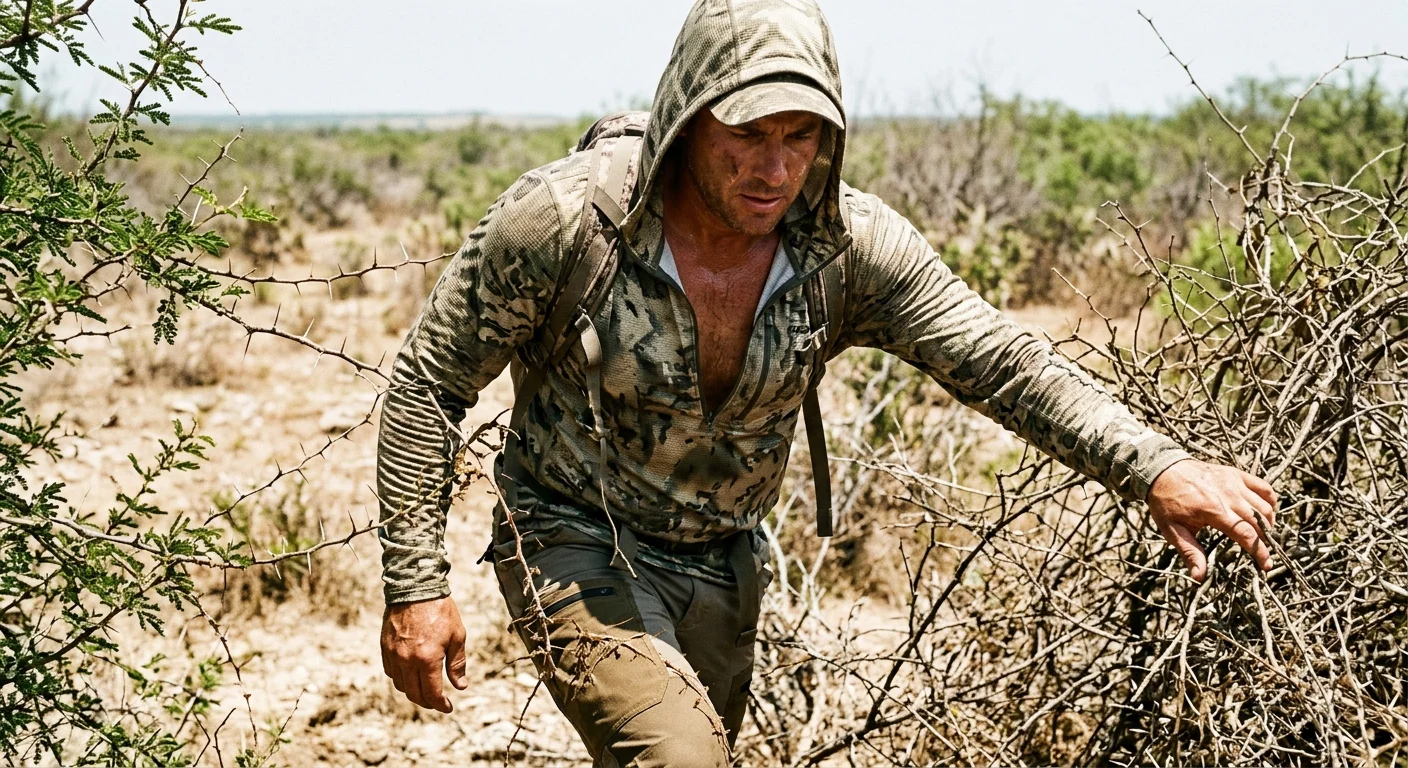
Pants are where most hunters get it wrong in extreme heat. They don't figure it out until they're two miles deep into South Texas brush — soaked, burning legs, thorn lacerations on each shin.
The instinct is to reach for shorts. Resist it. In 100°F desert and brush country, lightweight long pants run cooler than bare skin once the sun climbs overhead. Here's why: a thin, light-colored fabric layer reflects solar radiation instead of pulling it straight onto your skin. Your sweat evaporates from the fabric surface rather than baking off exposed legs. Hunters who test lightweight pants against bare legs in desert conditions report lower perceived heat across the board. That "being roasted alive" feeling disappears once you cut off direct radiation contact.
The fabric target is specific: look for 80–120 g/m² lightweight woven nylon or nylon/spandex blends. Many OEM/ODM Hot-Weather Hunting Gear partners produce these performance pants with four-way stretch and enhanced breathability tailored for extreme field conditions.That's thinner than standard softshell hunting pants, which run 150–220 g/m². The best hot-weather hunting pants use a 90–94% nylon, 6–10% spandex build — four-way stretch that moves with you on steep approaches without bunching or trapping heat against your legs.
That four-way stretch matters beyond comfort. Fabric that moves with your body creates a subtle pumping effect as you walk. It pulls humid air away from your skin with each step. Add side zip vents (20–30 cm openings) along the outer thigh seam, and you get an active airflow system you control:
On the uphill push: open both side zips and thigh pockets all the way — let convection pull heat upward from knee to waistband
On stand or ambush setup: close the vents to cut scent dispersion and block insects
Pushing through thick brush: close everything to shield zipper teeth and mesh panels from thorns
For Texas brush country , pure ultralight isn't always the right call. Catclaw acacia, prickly pear, and mesquite will shred fragile fabrics in one hard push. Go for pants in the 120–150 g/m² range with reinforced knee and lower-leg panels. The extra few grams are worth it — bleeding shins turn into odor sources at 20 yards from a whitetail, and that kills your hunt fast.
There's also the scent angle. Covered legs mean less exposed skin surface area. Fewer sweat gland contact points with open air. For close-range bowhunting in still conditions, that's not a small thing — your legs sit near ground level, right in the thermal layer that deer are reading.
Boots and Socks That Keep Your Feet From Becoming a Heat Trap
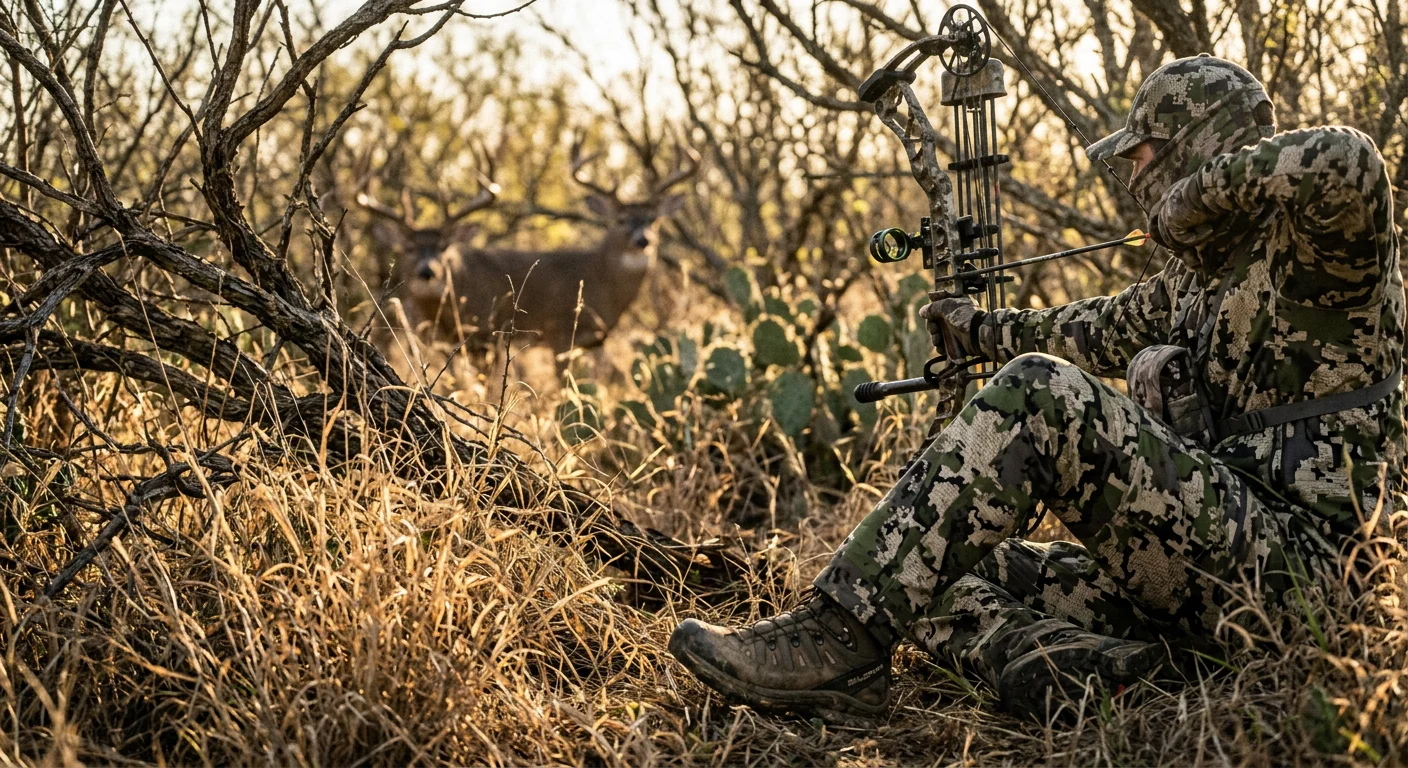
Feet are where most hunters give up on thermal discipline.
Everything from the waist up gets scrutinized — fabric weight, vent placement, UPF ratings. Then hunters lace up thick-insulated boots with cotton socks and wonder why they're limping back to the truck by noon.
Here's the core principle: your boot system's one job in 100°F heat is to move moisture out fast and keep insulation to an absolute minimum . Not cushion. Not insulate. Not "wick and retain." Move heat out.
The Boot: Zero Insulation, Maximum Airflow
Start with the insulation rating. A boot with Thinsulate, heavy foam lining, or any fleece interior? Put it back on the shelf. Those materials trap heat. In triple-digit temperatures, that's all they do.Custom hunting boot designs with open-mesh panels and minimal insulation help hunters maintain airflow and prevent overheating in 100°F conditions.
Look for boots labeled "uninsulated" or "0g insulation." Early-season hunting boots built for this purpose weigh 600–900g per boot (US size 9). Standard winter hunting boots run 1,100–1,500g — you'll feel the difference in your hand. That extra weight tells you what's packed inside.
Skip full-grain leather with a sealed waterproof membrane in dry-heat conditions. A sealed membrane blocks sweat from escaping. You've built a small sauna around your foot. Go for multi-panel construction — leather panels combined with large mesh or breathable synthetic sections , across the tongue and front third of the upper. A waterproof membrane is sometimes unavoidable. Check the vapor transmission rating. Above 10,000 g/m²/24h is workable. Below that, the boot performs like a plastic bag.
Insoles matter more than most hunters expect. Skip thick memory foam. It soaks up sweat at a crawl, dries even slower, and adds a heat barrier between your foot and the ground. A perforated EVA insole — removable is best — pushes air under your foot with each step. Pull it out during breaks and let it dry in the open air.
The Sock: Thin Merino Wins, Cotton Loses Every Time
Merino wool holds 30–35% of its own weight in moisture before it starts feeling wet. Cotton holds around 8–10% — then it just sits there. Wet cotton against your skin in 100°F heat doesn't cool you. It creates a warm, damp compress that shuts down evaporative cooling. That "hot soak" feeling around your feet by mid-morning? That's cotton doing what its fiber structure is built to do.
The target spec for a hot-weather hunting sock: merino content between 30–60% , blended with nylon for durability and 2–5% spandex for fit retention. COOLMAX® or similar multi-channel polyester in the blend is a real bonus. It pulls moisture off your skin faster and pushes it to the outer layer where it can evaporate.
Thickness is the variable most hunters get wrong. Thick cushioned socks feel great in the store. Out in the field at 103°F, that thick terry loop construction turns into an insulating layer and a sweat reservoir at the same time. Under the heel and forefoot — where pressure is highest — compressed wet cushioning raises friction. Blister rates climb fast. Field data confirms it: switching from thick cotton to thin merino blends cuts blister occurrence from 30–40% of users down to 5–10% . Average skin surface temperature runs 1–3°C lower due to faster sweat dispersal.
Go thin. Ultralight or light cushion, with targeted padding at the heel and ball of foot if you need it. Total sock thickness should stay under 1 . 2mm. A label that says "extra cushion," "winter weight," or "terry loop bottom" means that sock belongs in a different environment — not a hot hunt.
The Rest Break Protocol
Stop moving, and your feet stop pushing air through the boot system. Heat and moisture build up fast. The fix is simple. It takes four minutes:
Loosen the laces — two eyelets minimum, open the collar
Pull one boot and sock off , set the insole upright in the breeze; keep the other boot on so you can move if needed
Switch feet after 3–5 minutes — after 10–15 minutes of this rotation, interior humidity drops enough that the boot stops feeling like a warm glove on the way back in
Never set bare feet on sun-baked rock or soil. In direct sun, exposed ground in Texas or Arizona hits skin-burning temperatures — even with the air reading 100°F. Keep a thin layer between your foot and the ground during every swap.
Head, Face, and Neck Protection: The Most Overlooked Part of Your Hot-Weather Hunting Kit
Most hunters spend serious money on the right shirt and pants, then slap on a cheap baseball cap and call it done. That gap in thinking costs them — in sunburn, in scent exposure, in heat fatigue they can't trace back to a source.
Your HEAD, face, and neck are small in square footage but enormous in heat load. The head accounts for 7–10% of total body heat dissipation at rest. Under direct 100°F sun, sweat is streaming and UV is hammering every exposed surface.Top outdoor wholesalers stock a variety of sun hats, neck gaiters, and face shields engineered for heat management and UPF protection. That percentage hits well above its weight. Long sun exposure to the head and neck speeds up mental fatigue, causes decision errors, and increases hand tremor. None of that is acceptable at full draw.
The fix starts with understanding what your hat is and isn't doing.
Wide-Brim vs. Ball Cap + Neck Cape: Know the Coverage Math
A standard ball cap gives you 6–7 cm of front brim . At a summer sun angle of 60–75°, that covers 25–35% of your face . Your nose, jaw, chin, both ears, and the entire back of your neck stay exposed. That's not a hat — it's a visor.
A full-brim hat with 7–10 cm of circumferential coverage changes the geometry completely:
Face direct radiation reduced by 50–60%
Side face and ears: 70–80% shade coverage
Rear neck in upright posture: 60–70% shadow
A ball cap paired with a neck cape (legionnaire flap) drops 15–20 cm, covering from behind the ear to the shoulder line. That's a different trade-off:
Front face coverage: 40–50% (still leaves the lower face exposed)
Rear and side neck: 80–90% protection — better than a wide-brim alone
Sun hits you from behind on afternoon ambush setups and back-lit still hunts. The cape combo wins on neck protection in those situations. Walking open ridges or glassing from exposed positions? The wide brim does more for your face and ears.
The fabric must carry UPF 50+ either way. That rating blocks 98%+ of UV radiation. Ears and the back of the neck can show sunburn damage in as little as 10–20 minutes of unprotected summer exposure. A UPF 50+ hat pushes your safe exposure window out by 20–50x under the same conditions.
The Thin Gaiter Does More Work Than You Think
A lightweight neck gaiter — polyester, microfiber, or nylon blend, 100–150 g/m², UPF 30–50+ — is the most versatile piece in a hot-weather hunting kit. It costs next to nothing and most hunters never use it right.
It runs five jobs at once:
Sun protection. Pull it up over your lower face on open ground. Drop it to your neck in shade. You adjust coverage on the move without stopping to reapply sunscreen or swap hats.
Scent management. Your face and neck are high-output sweat zones — forehead, nasal folds, upper lip, jaw, nape. These surfaces sit at nose height for every whitetail you're closing in on. A gaiter works as a first-layer odor buffer. It absorbs sweat before that sweat releases into the air. Inside 200–300 meters of your target , pull it over your mouth and jaw. You're not cutting scent completely — you're slowing how fast it spreads. At 20 yards to a whitetail, that gap matters.
Bug exclusion. Pull the gaiter to your nose bridge, tuck the lower edge into your collar, add a cap and mesh face net. You've built a sealed system. Biting midge and mosquito contact drops by more than 80% across the highest-risk surfaces — jaw, neck, cheeks.
Dust and debris. In dry Texas or Arizona brush, a gaiter pulled halfway up cuts inhaled pollen and fine dust. The cough or sneeze you never had keeps a deer in range you never pushed out.
Moisture management. Fold it into a narrow headband. Wear it across your forehead on hard approaches. It pulls sweat away from your eyes and brow without adding heat load. Same piece, five functions — no extra weight.
The Three-Layer Head System for Maximum Coverage
Direct overhead sun, open ground, long approaches — these conditions are brutal. Stack the full system:
Cap or wide-brim hat — brim forward, controls light and forward face exposure
Neck gaiter — covers lower face, jaw, and neck
Hoodie attached hood — pulled over the cap, seals the rear head and top of neck
This combination shrinks the exposed skin on your head and neck to 10–20% of the original area — the eye zone and a strip of cheekbone, nothing more. In 35–40°C direct sun, that's the difference between arriving at your stand sharp and arriving half-cooked.
The weight penalty for all three layers combined is negligible. The performance gap is not.
Scent Control and Stealth in 100°F Heat: How We Manage Sweat Without Losing the Hunt
Sweat itself doesn't smell. That's the part most hunters miss.
The odor that blows your hunt isn't the sweat itself. It's the bacteria breaking that sweat down into compounds like ammonia, acetic acid, isovaleric acid, and nonenal. At 100°F, your body pumps out more sweat and skin oils. Bacteria work faster as a result. No active countermeasure in your clothing system means those odor molecules build up quick — and within 48–72 hours of field use, your gear becomes its own scent source.
This changes how you think about anti-odor hunting clothing. It's not about masking smell. It's about slowing the chemical reaction at its source.When buying for multiple hunters, considering wholesale price of hot-weather hunting gear can make outfitting a team with advanced hot-weather hunting gear more cost-effective.
Build a Three-Layer Scent Management System
In extreme heat, the right clothing combo works on two fronts — chemical suppression and physical moisture removal:
Layer 1 — Lightweight merino base (150–170 g/m²). Merino fiber absorbs up to 30% of its own weight in moisture before it feels wet on your skin. The keratin protein in wool also pulls in ammonia and fatty acid odor molecules and holds them. Field test data backs this up — odor ratings run 20–30% lower than untreated synthetic base layers under the same sweat load.
Layer 2 — Antimicrobial fast-dry synthetic mid or outer layer. Technologies like Microban Freshology — built for polyester, nylon, and spandex blends — hit all four key odor compound classes and meet ISO 17299 textile deodorization standards. Fast-dry synthetics also shrink the bacterial "wet window" by a wide margin. Quality fabrics hit 50–80% dry within 30–60 minutes. Less humid contact time means less odor production.
The Field Reapplication Schedule
Fabric technology buys you time. It doesn't buy you the whole day.
At 100°F, plan to reapply a scent-elimination spray every 4–6 hours — sooner if you've soaked through. Here's the protocol:
Before leaving: unscented shower, full kit spray (clothing, boots, pack), let it absorb
At the 3–4 hour mark: pull your outer layer, air it in shade for 10–20 minutes, reapply to armpits, back, and groin zones
Before your evening setup: one final cycle if you've sweated hard again
At 20 yards to a whitetail, that timing gap is the difference between a clean shot and a blown opportunity.
Silent Fabric Is Part of Scent Discipline
One variable hunters almost never link to scent control: noise . Stiff woven nylon produces 5–10 dB more sound than soft-knit fabrics through the same draw-and-twist sequence. That gap matters most inside 20–30 meters — the range where scent and sound both become threats. Bowhunting community data puts the "movement-sound spooked deer" rate 20–40% lower for hunters who switch from hard-shell to soft-knit outer layers.
For close-range archery setups in brush country, look for soft-knit lightweight construction at 120–180 g/m² with mesh or laser-perforated vent panels. You get the airflow for heat management and the quiet profile for stealth — no trade-off needed.
Hydration Systems and Pack Setup That Work With Your Hot-Weather Gear, Not Against It
Water weighs 2.2 pounds per liter. In 100°F South Texas brush, that math becomes strategy.
A 3L hydration bladder gets you through a 3–5 hour hunt without a refill stop. A 2L bladder covers 2–3 hours at moderate output. Push past those windows without a water source and you're rationing. Rationing water in triple-digit heat is how hunts turn into emergencies. The baseline plan: 2–3L bladder for your main supply, plus a 500ml soft flask loaded with electrolyte mix in an accessible hip or shoulder pocket. Drink from both on a rotation — not one to empty, then the other.
Most hunters skip one key detail: insulated tubing . Leave a standard hose exposed in 103°F direct sun and the water in that line heats up fast. Hot enough to be unpleasant within minutes. A foam-sleeved insulated hose (3–5mm EVA or PE wrap) keeps that line drinkable. Route the bite valve into chest shadow where you can. Take small pulls every 10–15 minutes — don't wait for thirst. By the time thirst hits in serious heat, you're already behind.
On electrolytes, timing matters as much as quantity. Every 45–60 minutes of active sweating, take in 300–600mg of sodium with your fluids. Salty snacks work alongside purpose-mixed drink tabs. Skip this and you can drink two liters of clean water and still feel terrible. Hyponatremia — low sodium from drinking plain water in heavy sweat conditions — is a real risk. It damages your decision-making before you even notice the problem.
Pack Architecture: Stop Building a Heat Trap on Your Back
The pack is part of your thermal system. A flat foam back panel pressed against your shirt creates a sealed sweat zone. No moisture-wicking hunting shirt can fix that. Suspended mesh back panels — trampoline-style frames that hold the pack body 1–3cm off your spine — reduce back contact by 30–40%. That air channel runs the full length of your torso. It's the single biggest feature difference between a true summer hunting pack and a three-season pack used in summer.
Shoulder straps work the same way. Narrow perforated straps (5–7cm wide, punched EVA or mesh construction) reduce skin contact and add airflow channels along their length. Pair them with a smooth, flat-seamed base layer at the shoulders. No thick zippers, no mounted accessories pushing the strap inward.
The hipbelt needs the same thought. A 7–10cm belt with a three-segment design — padded side sections around a central mesh or open channel — stops your core from becoming a sealed band of heat. Put a thick cotton waistband under that belt and you've broken the design. Keep your waistline layer thin and fast-drying.
The Heat Emergency Kit: 300–400g You Hope You Never Need
Pack this into 1.5–2L of pack volume and leave it there all season:
2–3 instant cold packs — place on the neck, armpits, and groin at the first signs of heat exhaustion. Those spots sit over major blood vessels and bring core temperature down faster than anywhere else.
3–4 packets of oral rehydration salts (ORS) for a 4-hour hunt, plus 2–3 backup packets. Standard hydration drink mixes are not the same thing. ORS is specifically formulated for serious fluid and electrolyte replacement.
One lightweight reflective emergency blanket (50–60g) — silver side out to reflect radiant heat, gold side in. It doubles as a shade structure or ground cloth.
A small digital thermometer — 40°C core body temperature is the point where heat stroke becomes life-threatening. At that level, cognitive impairment sets in and the person affected often can't judge their own condition.
Learn the field signs before you need them. A sudden stop in sweating during hard effort. A stumbling walk. Confused answers to simple questions. Complaints that seem out of proportion to the work being done. Any one of these means stop moving, get into shade, start cooling, and think about getting out. The hunting can wait.
Tactical Adjustments: How We Schedule and Adapt Hunts at 100°F+
Triple-digit heat punishes bad timing just as hard as bad gear choices — sometimes harder.
Past 100°F, deer, hogs, and desert game don't stop moving. They squeeze their movement into the coolest parts of the day. Then they vanish into thermal cover and stay there. Your schedule has to match that pattern. Miss it, and you're burning energy in open country while every animal in the area beds in shade 200 yards away — out of sight and out of reach.
Here's the daily structure:
90–60 minutes before sunrise: You're already moving in. Final approach done, boots on stand, bow or rifle ready. Pre-dawn is the one slot in a 100°F day where the air works in your favor.
Sunrise to two hours after: Primary activity window. This is your shot. Work it hard.
Late morning through mid-afternoon: Shade-lock. Stop moving. Find the densest timber, a north-facing draw, or a creek corridor — and hold there. Any midday push through open ground costs you scent discipline, physical reserves, and the attention of every animal bedded in cover nearby.
Final three hours before dark: The second window opens. Get on water or shade-to-water travel lanes and wait it out.
Hunt Short and Targeted — Not Long and Wide
Multi-mile exploratory hunts in summer heat drain you fast. They rarely pay off. Drop them. Go with short, targeted sits built around one solid pattern: a stock pond edge, a shaded brushy drainage, or a bedding-to-water travel corridor. One well-placed intercept point beats three miles of sweaty hillside — every time.
For Texas hogs, push the clock to near-dark or post-dark. Thermal optics and water-adjacent bait setups on night schedules are the standard summer play. For desert mule deer, first-light water ambushes are the move — then hold in shade for the rest of the day. Florida summer hunting shrinks down to short dawn sets near marsh edges. Pull out clean before the humidity shuts everything down.
Choosing between a water setup and a shade setup? At dawn and dusk, water wins. At midday, deep shade wins. The highest-value spot in any system is where the shortest concealed path between bedding shade and water crosses a natural pinch point. That's where your hours go.
The Complete 100°F Hot-Weather Hunting Gear Checklist (Field-Tested)
Forget everything above if you leave a critical item at home. This is the field-tested kit, broken down by body zone. Each item is ranked by what counts most in triple-digit heat.
Head: Go with a wide-brim hat — at least 7–8 cm of brim all the way around. UPF 50+ rated. Lightweight synthetic or vented nylon only. Pair it with a hoodie that covers the back of your neck. Add a lightweight gaiter on top. You need all three working together.
Upper Body: Pick a long-sleeve moisture-wicking base layer. Target 120–150 g/m² fabric weight. Look for underarm and back ventilation built in. Synthetic or merino both work. No cotton against your skin. Not once.
Lower Body: Lightweight nylon/spandex pants at 150–220 g/m² with side-zip vents. Pair with fast-dry synthetic underwear. Skip anything that holds heat or moisture.
Feet: Choose uninsulated breathable hunting boots under 800g per boot. Thin merino-blend socks only. Nothing thick. Nothing cotton. Both will wreck your feet in extreme heat.
Water System: Carry a 2–3L hydration bladder plus a 500ml electrolyte flask. Get insulated tubing — warm water kills your motivation to drink. This setup is not optional.
Pack: Use a pack with a suspended mesh back panel. Perforated shoulder straps help too. This is about managing body heat, not just staying comfortable on the trail.
Emergency Kit: Pack two cold packs, ORS packets, and one reflective blanket. Total weight runs around 300g. Keep it in your bag every single time.
One rule that holds across every budget: sort out the base layer, the boots, the hat, and the water system first. Everything else is secondary.
Conclusion
Here's the hard truth about hunting in 100°F heat: the guys who struggle aren't less tough — they're just less prepared.
I field-tested everything from moisture-wicking hunting shirts to vented packs and anti-odor base layers through a full pre-season. The pattern is clear. Heat management isn't one decision — it's a system. The right shirt buys you an hour. The right hat buys you another. Dial in the boots, the hydration rig, and the scent strategy. A brutal August morning goes from miserable to huntable. Maybe even enjoyable.
You already know the stakes: stay cool, stay downwind, stay in the field longer.
Now act on it. Head over to berunclothes.com and build your kit before the archery season opener. Stop letting the thermometer decide whether you hunt.
The deer don't take summers off. Neither should you.