You found the perfect hunting setup — boots laced, tag in pocket, season opening in two weeks. Then your new Sitka jacket arrives. It fits like a trash bag. Or worse, like a compression sleeve. Now you're back to square one. Return shipping costs money. The replacement might not land before opening day.
Here's the truth: hunting clothing sizing is inconsistent across brands. Nobody talks about it straight. Sitka runs athletic and trim. Kuiu cuts its own way. First Lite has its own logic. Budget brands like King's Camo? A whole other conversation.
This hunting clothing size guide breaks down how these brands fit against each other.For hunters who struggle with brand-to-brand fit differences, understanding custom hunting clothing size options can eliminate much of the guesswork before placing an order. You get real measurements, layering logic, and direct recommendations for different body types. Order once. Hunt confident.
Brand-by-Brand Fit Comparison Chart: Sitka vs. Kuiu vs. First Lite vs. Budget
Four brands. Four different ideas about what a hunting body looks like.
Check this before you touch a size chart: the number on the tag means almost nothing across brands. A Kuiu Large and a Sitka Large are not the same garment. One hugs your shoulders like a wetsuit. The other gives you room to breathe, layer, and move. Know the difference before you order — it saves you a frustrating return trip.Experienced hunting apparel supplier teams often recommend comparing garment measurements rather than relying solely on labeled sizes when switching between brands.
Here's the breakdown.
The Short Version: How Each Brand Runs
Kuiu — The most athletic cut of the group. Runs small. Size up one for tops and midlayers. Your everyday Medium becomes a Kuiu Large.
Sitka — Runs generous. Relaxed through the chest, built for an American fit. Tops are true-to-size or a touch big. Pants are a different story — waistbands run 1.5 to 2 inches larger than marked. Size down on the waist.
First Lite — The middle ground. Tops fit true-to-size with comfortable room. Pants are honest. Lean guys can size down one; everyone else lands on their normal size.
Budget Brands (Cabela's, UA Hunt, Drake, etc.) — Classic American relaxed cut. Tops run true-to-size; some guys size down for a cleaner fit. Pants measure within half an inch of the label, running a bit generous.
Men's Top Sizing: Chest Measurements by Brand (inches)
Brand | Size | Stated Chest Range | Real-World Fit Range | Adjustment from Everyday Size |
|---|---|---|---|---|
Sitka | M | 39–41 | 38–42 | TTS; trim guys can size down |
L | 42–45 | 41–46 | TTS | |
XL | 45–48 | 44–49 | TTS or down one unless heavy layering | |
Kuiu | M | 39–41 | 38–40 | Size up → go L |
L | 42–44 | 40–43 | Size up; add a base layer underneath and you'll need that extra room | |
XL | 45–47 | 43–46 | Size up → go XXL if broad-shouldered | |
First Lite | M | 39–41 | 38–41 | TTS |
L | 42–45 | 41–45 | TTS | |
XL | 46–49 | 45–49 | TTS; go up one for heavy insulation only | |
Budget | M | 38–40 | 38–42 | TTS; lean guys can go down one |
L | 42–44 | 42–46 | TTS | |
XL | 46–48 | 46–50 | TTS; stocky builds may size up for layering room |
Men's Pants Sizing: Waist Measurements by Brand (inches)
Sitka pants need extra attention. The waistband runs close to two full inches larger than labeled. That's not a typo — it holds true across the entire line.
Brand | Tagged Waist | Actual Measured Waist | Adjustment from Jeans Size |
|---|---|---|---|
Sitka | 32 | ~33.5–34 | Wear a 33–34" → order a 32 |
34 | ~35.5–36 | Wear a 36" → order a 34 | |
36 | ~37.5–38 | Wear a 38" → order a 36 | |
Kuiu | 32 | ~32 (honest) | TTS; thick base layer wearers go up one |
34 | ~34 | TTS | |
36 | ~36 | TTS | |
First Lite | 32 | 32–33 | TTS |
34 | 34–35 | TTS | |
36 | 36–37 | TTS; add one for heavy station hunting setups | |
Budget | 32 | Runs generous (~0.5–1") | TTS or down one depending on brand |
34 | Runs generous | TTS | |
36 | Runs generous | TTS |
Two Real-World Examples
Hunter A — 5'10", 176 lbs, 41" chest, 34" waist (typical everyday Large): - Sitka: Top l (TTS) / Pants waist 32 (down one) - Kuiu: Top XL (up one) / Pants 34 (TTS) - First Lite: Top L (TTS) / Pants 34 (TTS) - Budget: Top L, or M for a cleaner fit / Pants 34 (TTS)
Hunter B — 6'0", 198 lbs, 44" chest, 36" waist (bigger build, between L and XL):
- Sitka: Top L or XL depending on layers / Pants 34 (down one)
- Kuiu: Top XL or XXL (up one) / Pants 36 (TTS)
- First Lite: Top XL (TTS) / Pants 36 (TTS)
- Budget: Top XL (TTS) / Pants 36 (TTS)
Data pulled from brand official size charts and verified against field reviews. Chest and waist ranges cover typical fit zones for standard builds — athletic or atypical proportions may differ.
Budget Hunting Brands Sizing: King's Camo, Nomad, Cabela's, and More
Budget hunting brands don' t share a unified sizing philosophy. They share a price point. That difference matters — you're ordering pants online with no fitting room.
Most budget brands cut for a traditional American body. That means generous through the chest, roomy in the seat, and forgiving at the waist. That's the opposite of Kuiu's mountain-athletic trim. And each budget brand differs from the others in ways you won' t notice until the box shows up.
Here's how the major players fit in real life.
How Each Budget Brand Cuts Its Clothes
King's Camo runs a standard American relaxed fit. Not sloppy — but built for layering room, not a close athletic cut. The Ridge Pants use 4-way stretch polyester with a relaxed athletic shape. You get plenty of thigh room. Nothing feels glued to your leg. The Elevation Quarter Zip Hoodie is designed to wear loose — it layers over a base layer without pulling or binding. At $75 versus Sitka's $135 for a similar piece, you trade precision fit for a lower price. That's the deal.
Nomad runs a bit trimmer than King's or Cabela's. Think athletic hoodie fit, not mountain pant fit. Upper body cuts land somewhere between standard and relaxed. Lower body? You get enough seat and thigh room to move freely, with a small taper toward the ankle. Not tight. Not baggy. A solid middle ground for most hunters.
Cabela's and Bass Pro private label are the most traditional of the group. Boxy jackets. Straight-leg pants with generous knee and seat room. Built for stand hunting, truck rides, and cold mornings in a blind — not ridge runs. You also get Big & Tall sizing up to 4XL with multiple inseam lengths. That matters if premium brands have let you down by cutting off at XXL.
Under Armour Hunt and ScentLok are the exception here. Their fitted and compression lines come close to Kuiu and Sitka territory — close-to-body cuts, longer sleeves built for draw cycles, minimal bulk. Want budget gear that moves like premium athletic hunting clothing? Start with these two.
The Inconsistency Problem
Here's a caveat that doesn't hit Sitka or Kuiu: budget brands change their fit patterns without telling anyone. A King's Camo size 34 pant from 2020 may measure differently than the same tagged pant sold today. Multiple OEM hunting clothing factories, fabric batch swaps, and quiet fit updates can create 1–3 cm of variability within the same labeled size. Reviewers catch this all the time: "Same size, different color — fits completely different."
The fix is simple. Measure your chest, waist, and inseam before you order. Don't go by your jeans size alone. Check your measurements against the brand's current size chart — not last season's.
How to Size Hunting Clothing for Layering: Base, Mid, and Outer Layer Logic
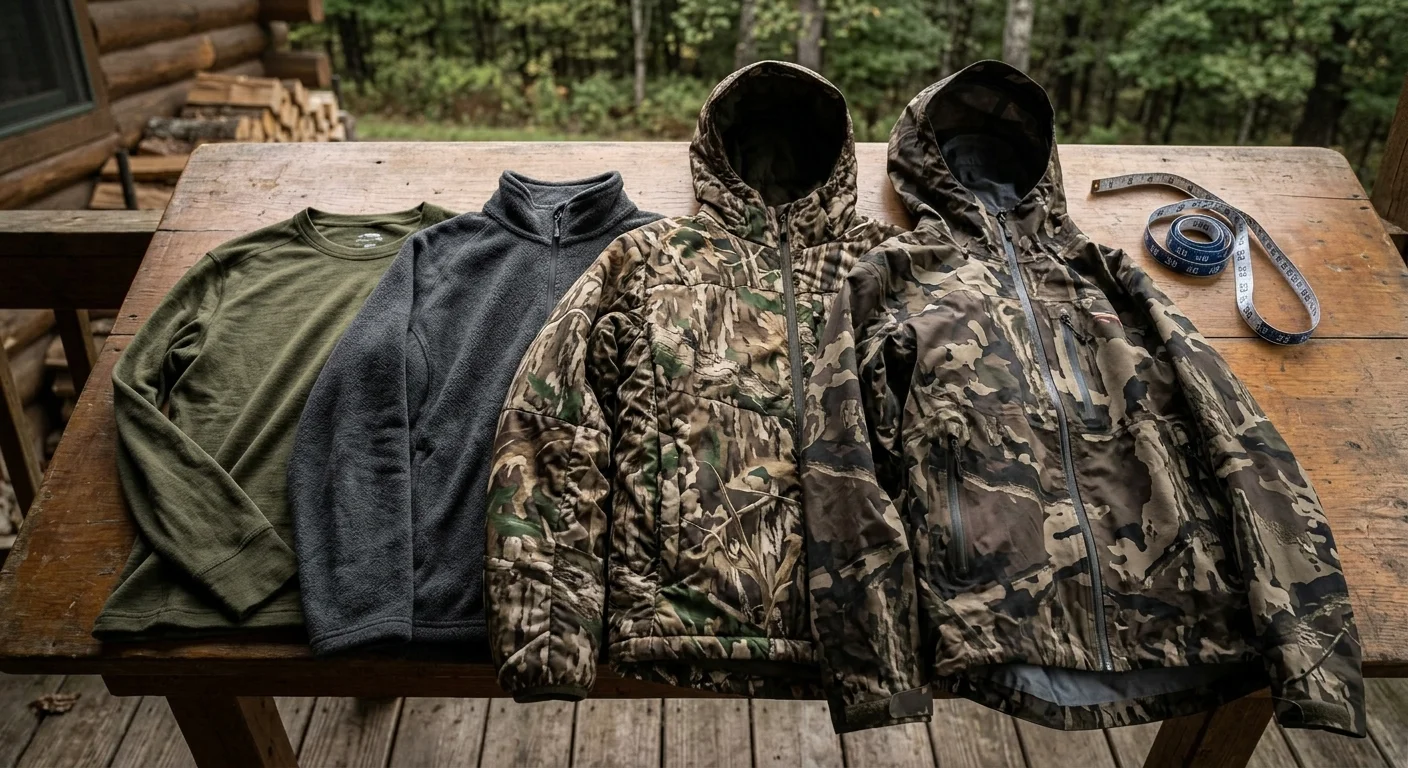
Layering hunting clothes isn't just a warmth strategy — it's a sizing strategy. Get the logic wrong and your shell won't zip over your insulation. Or your base layer bunches under your mid-layer like a wet paper bag.
Here's the rule most hunters never learn: each layer has its own sizing job to do. Base layer, mid layer, outer shell — each one answers a different question.
Base Layer: Size It to Your Body, Not Your Ego
Your base layer should feel like a gentle hug. Not tight enough to restrict, not loose enough to shift around. This isn't a fit preference — it's a performance requirement. A merino wool base layer that's too big loses moisture-wicking and heat transfer. The fabric can't work when it floats half an inch off your skin.
The rule: Go true-to-size using the brand's actual chest, waist, and hip measurements. Ignore your jeans size. Measure yourself.
For extreme cold — think late-season elk or early-morning mule deer in serious mountain temps — add a second base layer on top of the first at the same size . Prois recommends this for their Olann Merino line. Two base layers, same size, stacked. It works because both layers sit close to the body.
Mid Layer: Most of the Time, You Don't Need to Size Up
This is where hunters make the most expensive mistake. They grab a size up for every mid-layer without thinking. Most of the time, that's not needed.
Most mid-layers are cut to sit over a fitted base layer with no extra room required. Kuiu is the clearest example. They label each piece by its position in the system: base-layer fit , mid-layer fit , outer-layer fit . A Kuiu mid-layer fit garment is already cut to fit over what's underneath.
General mid-layer sizing rules:
Lightweight fleece or grid fleece (100–200 g/m²): Same size as your base layer. No adjustment needed.
Heavier insulated jacket or puffy (adding 4–6+ cm of bulk), stacked over a fleece: Stay in your size if the piece carries a mid-layer fit label. The cut already accounts for a layer underneath.
Wearing two mid-layers at once — say, a fleece plus a puffy — with a shell on top? Size up on the outermost mid-layer. Kuiu is clear on this: stacking multiple mid-layers inside a soft shell means the soft shell needs to go up one size.
Outer Shell: Let the Whole System Decide
The shell's size isn't about the shell. It's about everything underneath it.
Kuiu builds its outer shells around what they call outer-layer fit . That means the cut already expects a base layer, a fleece, and an insulation piece underneath. In Kuiu's full system, a four-piece cold-weather stack — base layer, fleece, insulated jacket, rain shell — can all be the same size . That's not a marketing claim. It's how the fit architecture actually works.
Sitka and First Lite follow similar principles, even if their labeling is less detailed. Real-world user feedback shows that Sitka's shells and hard-weather jackets handle a mid-weight insulation layer underneath at true-to-size. First Lite works the same way for standard cold setups.
Size up on the shell if:
You fall between sizes and sit near the top of your current size range
You're running a heavy stack: thick fleece + substantial puffy + shell, all at once
Your shoulders feel restricted during draw practice with your full layered system on
One key point from Kuiu: never stack two outer-layer fit garments on top of each other. An outer-layer insulated jacket worn under an outer-layer shell compresses the insulation fill and kills warmth. Your insulated piece should always carry a mid-layer fit — cut to sit inside the shell, not beside it.
The Practical Cold-Weather Example
Male hunter, 102 cm chest, 86 cm waist — fits a Medium across Kuiu, and a Large across Sitka and First Lite.
Layer | Kuiu | Sitka / First Lite |
|---|---|---|
Base layer (merino 145–200 g/m²) | M | L |
Mid layer fleece (200–300 g/m²) | M | L |
Insulated jacket (mid-layer fit) | M | L |
Rain shell / hard shell | M | L — go to XL only if stacking thick puffy + heavy fleece at the same time |
Same size. All the way through. That's the system doing exactly what it was built to do.
Sitka vs. Kuiu Sizing: If You Wear M in Sitka, What Size in Kuiu?
The short answer: same tag size — but the fit will feel different on your body.
That distinction matters more than it sounds. Sitka cuts its tops with generous room through the chest. Kuiu trims everything down to a close, athletic shape. Same tag, same chest measurement — two very different experiences in the field. Your Sitka M does not translate directly to a Kuiu M. You need to know where the numbers split and what that means for your build.
The Chest Measurement Gap
Kuiu runs one inch smaller in chest per size than Sitka. That's the core number. Here's what it looks like across the full size range:
Size | Sitka Chest (in) | Kuiu Chest (in) |
|---|---|---|
S | 36–38 | 35–37 |
M | 39–41 | 38–40 |
L | 42–44 | 41–43 |
XL | 45–47 | 44–46 |
2XL | 48–50 | 47–49 |
The overlap is real — both brands share chest territory at each size. But Kuiu sits at the lower end of that territory and cuts trimmer through the shoulders and torso. A Sitka M that feels comfortable but not loose? A Kuiu M will feel athletic and close. A Sitka M that already feels snug? A Kuiu M will feel tight.
How to Read Your Own Build Against These Numbers
Average build (chest sits in the lower two-thirds of Sitka's range):
Your measured chest is 39–40 inches and Sitka M fits with room to move. Kuiu M will work fine. The fit runs more athletic — sleeker through the chest and shoulders — but you won't need to go up a size.
Broad chest or wide shoulders (chest near the top of Sitka's range):
Your chest measures 40–41 inches and Sitka M already fits just-right in the shoulders. A Kuiu M will bind. That extra inch Sitka gives you is gone. Go to Kuiu L. The same logic runs up the range: Sitka L to Kuiu XL, Sitka XL to Kuiu 2XL — any broad build follows this pattern.
One forum exchange that nails this:
"I wear one size larger in Kuiu than Sitka — XL in Kuiu, L in Sitka."
That's a stocky, broader-shouldered build. It's the standard rule of thumb for that body type.
The Sleeve Factor
Most hunters overlook this: Kuiu sleeves run about half an inch shorter than Sitka across sizes. Your Sitka M sleeve hits right where you want it at the wrist. A Kuiu M may fall short. For long arms, this alone is reason to size up in Kuiu — not for chest room, but to get the sleeve length back.
Sitka vs. Kuiu Pants: A Very Different Sizing Problem
Tops are straightforward once you know the chest gap. Pants are where the real confusion starts.
Sitka pants run 1 . 5 to 2 inches larger than the tag. A tagged 34 waist on the Sitka Mountain Pant measures closer to 35.5–36 inches at the waistband. That's not a rumor — it's consistent across the line.
Kuiu pants run true. A tagged 34 waist on the Attack Pant measures right at 34 inches. No vanity sizing, no extra cushion.
That gap creates a cross-brand translation that trips people up:
Sitka Tagged Waist | Your Actual Waist | Kuiu Tagged Waist |
|---|---|---|
30 | ~31.5–32 | 32 |
32 | ~33.5–34 | 34 |
34 | ~35.5–36 | 36 |
36 | ~37.5–38 | 38 |
The rule: Sitka 34 fits you? Order Kuiu 36. Your real waist sits in the 35–36 inch range. Kuiu's tag reflects that number straight.
One more thing on pants: Kuiu inseams run two inches longer than Sitka's comparable sizes. Sitka's short/regular/tall system has been working for your shorter legs? Kuiu offers far less inseam flexibility. Extra fabric at the ankle is a real possibility.
The Step-by-Step Conversion
At the checkout page, run through this before you order:
Measure your chest at the widest point.
Find where you sit inside Sitka M's range (39–41 inches).
In the lower two-thirds (39–40 in)? → Order Kuiu M .
At the top of that range or broad through the shoulders (40–41 in)? → Order Kuiu L .
Long arms? → Size up in Kuiu regardless of chest measurement.
For pants: measure your actual waist and match it to Kuiu's chart straight. Size down one in Sitka to offset its built-in 1.5–2 inch vanity cushion.
The fit philosophies are different at a basic level. Sitka builds for an American body with room to move. Kuiu builds for the mountain athlete who wants every ounce and every inch accounted for. Neither is wrong. But ordering Kuiu with Sitka assumptions will cost you a return shipment.
FAQ: Hunting Clothing Sizing Questions Hunters Ask Most
Sizing questions don't stop at "what's my chest measurement." The real confusion is in the details — shrinkage, base layer tightness, whether to grab a size up before the season starts. These are the questions hunters type into search bars at 11pm the night before they order.
Here are direct answers.
Q: Will hunting clothes shrink after washing?
Some will. The risk sits in base layers and cotton-blend budget pieces. A garment that's machine-wash and tumble-dry approved still carries shrinkage risk — factor that in before you order. For outer shells and pants, keep one size of buffer if you're unsure how the fabric behaves. Premium synthetics and merino blends hold size well. Still, check the care label before you assume anything.
Q: How tight should a merino wool base layer fit?
Snug, not strangling. The fabric needs skin contact to wick moisture and transfer heat. Too loose and it floats — it can't do its job. Too tight and you lose range of motion. You also trap less air in your layering stack. The right fit: raise both arms, rotate your torso, and nothing pulls or bunches. Fabric gathering at your armpits or dragging across your back mid-draw means the size is wrong.
Q: Should I size up?
It depends on what you're doing in the field. Two clear rules:
Cold-weather, low-movement, heavy layering — yes, size up on your outer layer. You need room for a thick fleece and a puffy underneath.
High-movement hunting — archery, backcountry, long ridge walks — stay in your measured size. Excess fabric creates noise, traps wind, and slows you down.
For bibs: most brands recommend ordering an inseam two inches shorter than your regular pants. That keeps the hem off the ground as you move through wet terrain.
Q: How do I measure myself when I can't try it on?
Four numbers cover nearly every hunting garment decision:
Chest — tape around the widest point, just under the armpits
Waist — where you wear your pants day-to-day; tape relaxed, enough for one finger to slide underneath
Inseam — standing, from the crotch seam to where the hem should fall near the top of your boot
Sleeve — from the center back of your neck, over your shoulder, down to your wrist bone
Get these four right and you'll have everything you need to order with confidence.
Q: Between two sizes — which do I take?
Go larger. Every major hunting brand makes this call in their official size guide. A garment that's too small in the backcountry costs you more than a garment with a little extra room. Extra room is fixable. Too small is not.
Q: Which measurements matter most by garment type?
Jacket or top: chest first, sleeve second
Pants: waist and inseam together — one without the other creates problems
Bibs: match the waist to your jacket size, then shorten your inseam expectation by two inches
Gaiters: check shoe size, not clothing size — sizing runs S (US 7–8), M (8–10), L (10–12), XL (12–14)
Q: Do women's cuts follow the same sizing logic as men's?
No. Women's hunting cuts are built to a different structure at the shoulder, chest, and hip. They're not scaled-down versions of men's patterns. Browning describes their men's fit as "traditional, full-cut" and their women's fit as cut to a distinct shape. The same chest measurement does not mean the same garment. Women should size against the women's chart — the men's numbers won't give you an accurate fit.
Hunting Clothing Brand Sizing Verdict: Which Brand Fits Your Budget and Body
Four brands. Four different answers to the same question: what does a hunter's body look like?
Here's where each one lands.
Sitka cuts athletic and trim — tighter through the chest, more tapered at the waist than any other brand here. Shells and insulated jackets run USD 350–600 . Mid-layers sit at USD 150–300 . You're paying for precision engineering and real performance. But that engineering assumes a specific body type. Broader builds, thicker mid-layer stacks, and hunters who want room to move will hit the limits fast. Sizing reliability: 8/10. Overall value: 7/10.
Kuiu sits a touch more relaxed than Sitka — but don't let that fool you. It's still a mountain-athlete cut, not a deer-blind cut. Jackets land at USD 300–500 , pants at USD 200–300 . It works best for lean, high-movement backcountry hunters. You carry weight through the midsection or plan to stack heavy mid-layers? Size up. Sizing reliability: 7/10. Overall value: 7/10.
First Lite is the lowest-risk pick for most American hunters. The cut runs more relaxed — more forgiving at the shoulder, chest, and waist. Jackets run USD 250–450 , pants USD 180–260 . You want comfort and function without chasing extreme lightweight specs? This is where the math works out best. Sizing reliability: 8.5/10. Overall value: 8.5/10.
Budget brands — King's Camo, Nomad, Cabela's house label — cut wide and traditional. A size S from New View Hunting measures 44.5–46.5 inches at the chest. That's work-jacket sizing, not mountain-fit sizing. Price range: jackets at USD 60–150 , pants at USD 40–100 — about 25–40% of what Sitka charges for a comparable piece. The tradeoff is real. Sizing consistency drops across product lines. Quiet fit updates between seasons mean the same tagged size can measure differently year to year. Sizing reliability: 6/10. Overall value: 7.5/10 — high function-per-dollar if you measure before ordering.
The Simple Decision Framework
First-time buyer building a system from scratch: Start with First Lite. The relaxed cut gives you room while you learn what fit works in the field. Budget is tight? Use budget brands for outer shells and pants — a half-inch of extra room there hurts nothing. Spend more on base and mid-layers. Those sit against your body, so fit there matters most.
Upgrading from budget gear: Your budget brand most likely gave you 3–4 inches of extra chest room as standard. Moving to Sitka or Kuiu at the same tag size will feel like putting on a compression garment. So add one size on tops. Use your actual waist measurement — not your jeans size — for pants.
Adding one piece to an existing system: Your current kit runs athletic (Sitka, Kuiu) and you want a roomier mid-layer or soft shell to layer underneath a shell? First Lite fills that gap well. Your current kit runs relaxed and you want to add a lightweight Kuiu or Sitka piece on top? Measure your current garment's chest flat — double it — then compare against the premium brand's chart. Their same-size chest runs more than 1.5–2 inches smaller than your current piece? Size up.
One last point: Sitka, Kuiu, and First Lite all offer 14–60 day return windows through major retail channels, with some covering exchange shipping. That policy exists for a reason — use it as a backstop, not a primary strategy. Stuck between two sizes? It takes the risk out of committing to the wrong one.
Conclusion
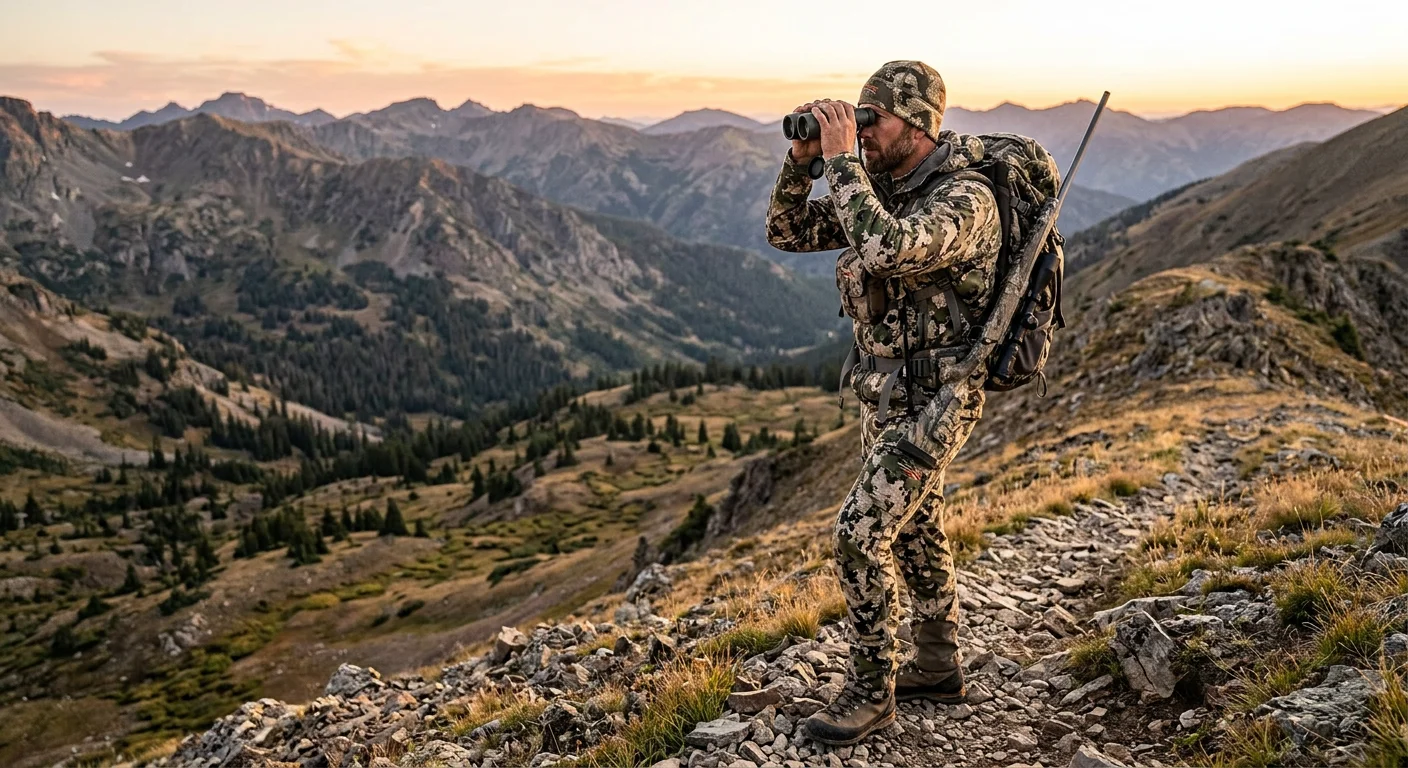
Good hunting clothes do more than keep you warm. They keep you in the field longer, moving better, and hunting harder.
Here's what the data shows across brands:
Sitka runs athletic and trim
Kuiu gives you a bit more room in the shoulders and chest
First Lite stays true to size with its merino builds
Budget brands can deliver real value — but only if you size them right
The takeaway is clear: size charts beat assumptions every time.
Measure yourself before you order. Know how your layers stack together. Don't guess on a $200 jacket.Whether you're buying individually or evaluating gear at a custom hunting apparel wholesale price level for clubs, outfitters, or retail programs, accurate sizing remains one of the biggest factors affecting satisfaction and returns.
Cross-brand sizing in hunting gear isn't a small problem. It's the gap between gear that performs on the mountain and gear that collects dust in your closet. Check the comparison data in this guide before you hit "add to cart."
Get measured. Pick your system. Spend less time on return shipping and more time glassing ridgelines.
The mountain doesn't care what size tag is in your jacket. But you will — the moment it fits right and the shot opens up.