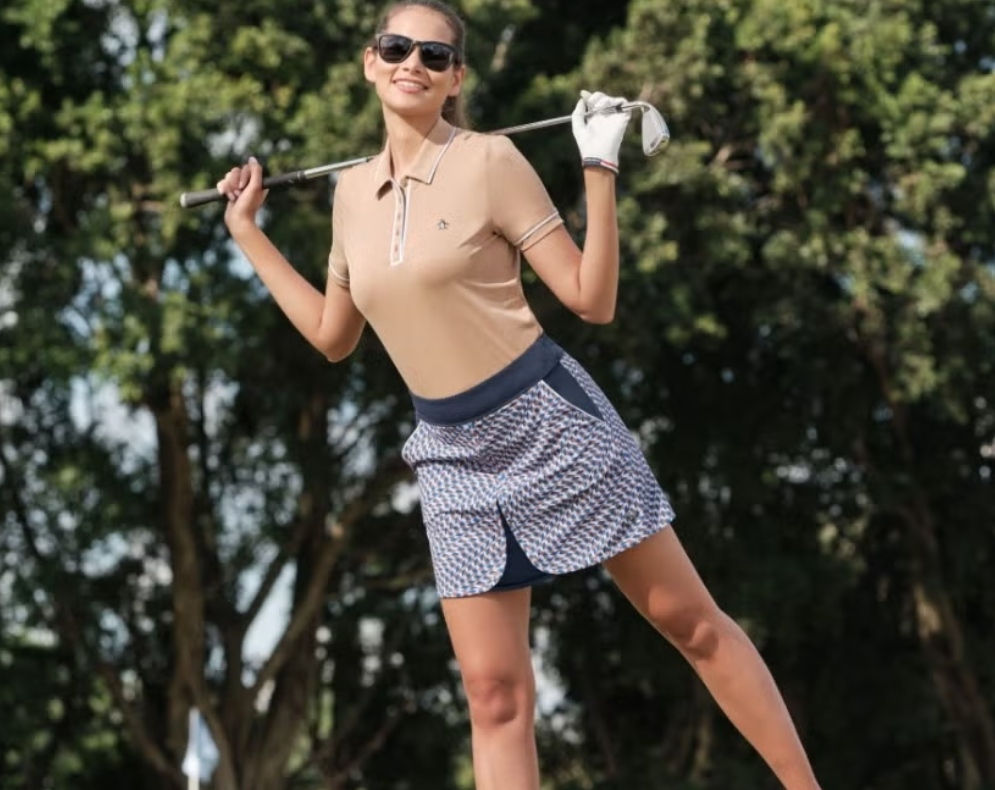
A golf shirt that gaps at the shoulders, rides up mid-swing, or bunches across the back isn't just uncomfortable — it's costing you strokes. Yet most women grab their usual size, cross their fingers, and wonder why something feels off the moment they address the ball.
Here's the truth: women's golf clothing comfort isn't about finding fabric that feels soft on the hanger. It's about knowing how each part of a shirt should move with your body through a full swing. Shoulder seam placement, sleeve length, collar feel, whether to tuck — every detail has a right answer.
This guide breaks it all down. Next time you shop, you'll know what to look for.
For brands building sizing systems around custom women's golf shirts fit, precision across shoulders, bust, and torso directly determines whether a performance design actually works on the course — or just looks good in product photos.
How to Measure Yourself for a Women's Golf Shirt (Before You Buy)
Sizing charts are only as useful as the numbers you bring to them. Take three minutes with a fabric tape measure before clicking "add to cart." It saves you the frustration of a return — and the letdown of a shirt that looked great on screen but fits wrong in person.
The Four Measurements That Matter
Grab a soft measuring tape, wear a thin layer, and stand straight. Ask a friend to help if you can. Self-measuring the bust tends to go off-level fast.
How to Read Brand Size Charts
Here's the part most people skip: different women's golf shirt brands size differently. Look at the bust range for a size Medium across four popular golf shirt brands:
Brand | Size M Bust (inches) |
|---|---|
Reebok | 37–38 |
Eastside Golf | 35.5–38 |
Pebble Beach | 36–37.5 |
Golf Apparel Shop | 41 (garment measurement) |
Golf Apparel Shop lists garment measurements — the actual shirt dimensions — not your body measurements. Add 2–3 inches to your bust measurement for ease before comparing to garment charts.
Between sizes? Size up for athletic movement. A golf swing demands more range of motion than almost any other sport. A shirt that fits great standing still can pull tight across the back the second you reach your backswing.
Shoulder Fit: The Most Critical Zone for Your Golf Swing

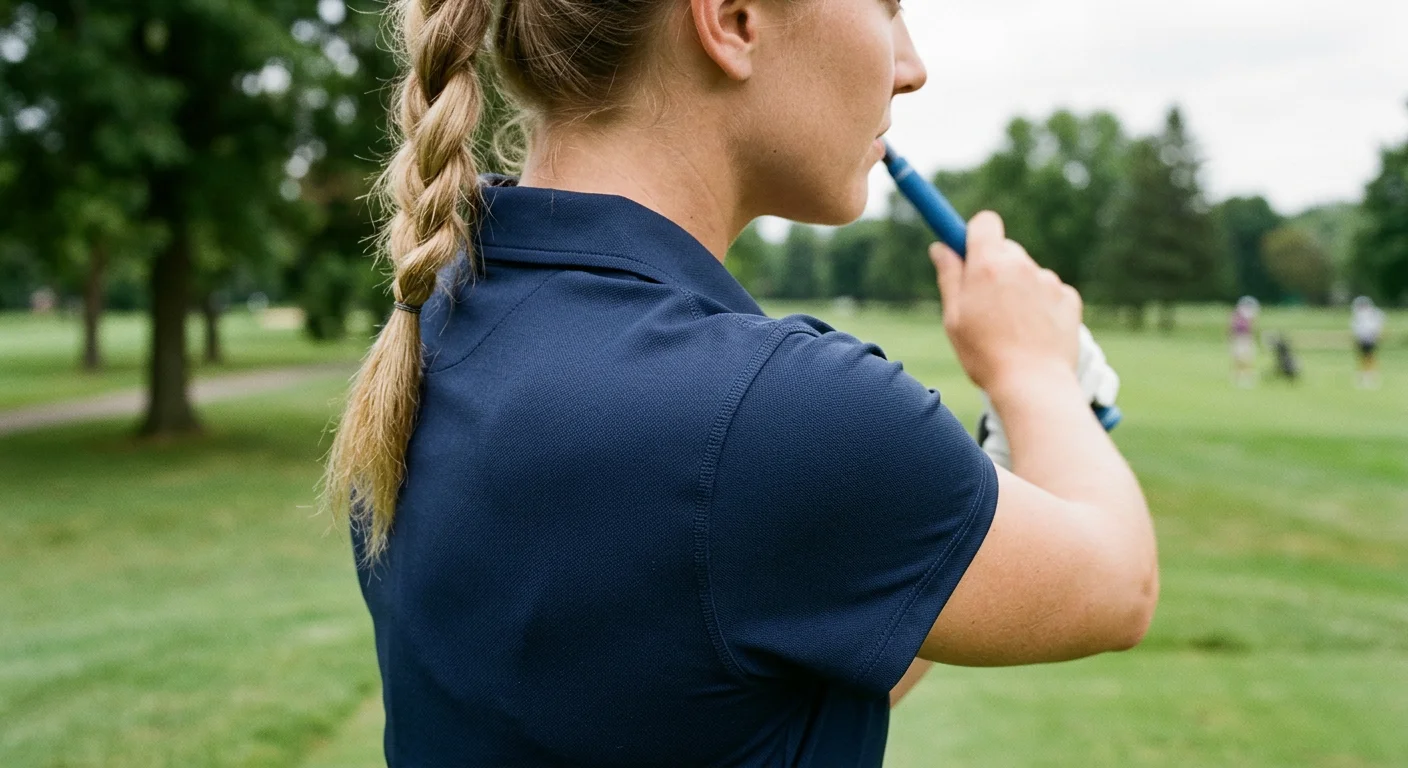
The shoulder seam sits right at the edge of your shoulder — not drooping toward your bicep, not creeping up toward your neck. That small strip of stitching controls more than you'd think.
Here's why it matters beyond comfort: research on golf biomechanics shows that shoulder rotation drives real power. The "X-factor" is the rotational gap between your shoulders and pelvis at the top of your backswing. In skilled players, that gap can reach 48–56 degrees — and it ties straight to club head speed. Your shirt has to move through that full arc without resistance. A misaligned shoulder seam creates friction and a subtle pull. Your body feels that restriction before your mind even catches it. The swing breaks down at the source.
When golf apparel factories develop custom golf shirts of shoulder fit for private-label programs, seam placement tolerances of even half an inch can determine whether rotational mobility is preserved or restricted during full extension.
What Correct Shoulder Fit Looks Like
Stand in front of a mirror with your arms relaxed at your sides.
The shoulder seam should sit at the edge of your shoulder bone — the point where your shoulder ends and your arm begins
No pulling, folding, or diagonal creasing across the upper back
Raise both arms overhead. The fabric should lie flat and smooth
Try your backswing: reach your right arm across your chest. The shirt should follow your movement, not resist it
Fit vs. Misfit: The Quick Test
What You See | What It Means |
|---|---|
Seam falls down your arm | Shirt is too large — shoulder will bunch during swing |
Seam pulls toward your neck | Shirt is too small — restricts backswing rotation |
Clean seam, smooth back | You've found your fit |
Between sizes? Pick the option where the shoulder seam sits in the right spot. You can fix length or hem later. A shoulder seam? That's not fixable.
Chest & Bust Fit: Comfort Without Restriction
The bust is where most sizing systems fail women — and golf shirts are no exception.
Standard size charts are built around a B-cup assumption. You're a C, D, or DD cup? That "medium" fitting your shoulders may pull tight across the chest the second you rotate into your backswing. The shirt isn't defective. The chart just wasn't designed with you in mind.
Apparel developers refining custom golf shirts of chest & bust fit often re-engineer front panel grading to account for cup-depth variation rather than relying on flat bust circumference alone.
How Much Room Do You Need?
A well-fitting golf shirt should skim the bust — not cling, not balloon. You're looking for two to three inches of ease beyond your actual bust measurement. That's the breathing room your swing demands.
Run this quick check: button the shirt, then cross your arms over your chest and rotate into a backswing position. Fabric pulling open or going taut across the fullest point? Too small. Hanging away from your body in a shapeless drape? Size down.
Cup Size Matters More Than You Think
Here's what most brands won't tell you: bust girth and cup size are not the same measurement. A 38″ bust on a B cup fits very differently than a 38″ bust on a D cup. The vertical distance from neckline to bust point shifts with cup size. So does the width across the front chest. A single number can't capture all of that.
Between sizes? Size up and look for shirts with stretch panels or side gussets. They handle cup-size variation far better than rigid wovens.
Bust (inches) | Suggested Size | Notes |
|---|---|---|
32–33 | XS | Slim through torso |
34–35 | S | Standard B-cup range |
36–37 | M | C-cup may prefer M here |
38–40 | L | D/DD cup: prioritize stretch |
42+ | XL / Plus | Check garment measurements, not just labeled size |
The goal is simple: a shirt that moves with you and stays put when you do. Nothing riding up. Nothing pulling open. Nothing making you think about fabric when your focus should be on the shot.
CTA SectionWaist & Torso Fit: Balancing Freedom and a Clean Silhouette
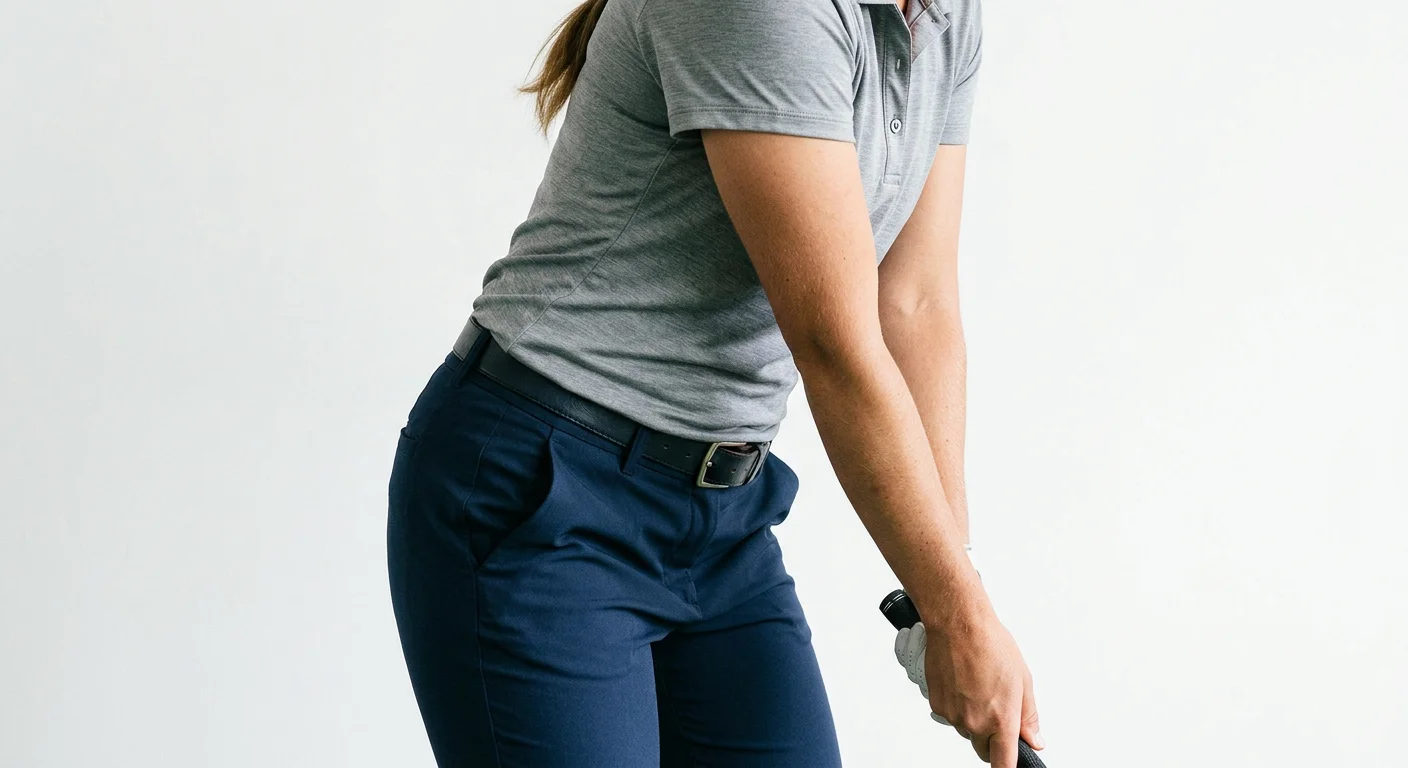
The waist is where a golf shirt either earns its place in your bag or ends up forgotten at the back of the closet.
Too tight through the torso, and every hip rotation feels like a wrestling match with your own clothes. Too loose, and the fabric billows out during your follow-through. It looks shapeless. It's distracting. The sweet spot is a shirt that skims your natural waist without gripping it.
For golf apparel suppliers producing custom golf shirts of waist & torso fit, contour shaping through side seams and subtle taper grading is what separates an athletic silhouette from a restrictive one.
Finding Your Natural Waist
Your natural waist sits at the narrowest point of your torso, just above the belly button. Bend sideways — the crease that forms? That's it. Measure there, tape snug but not squeezing, parallel to the floor.
Size | Waist (in) | Hip (in) |
|---|---|---|
S | 26–27 | 36–37 |
M | 28–30 | 38–40 |
L | 31–33 | 41–43 |
XL | 34–36 | 44–46 |
For a clean, athletic fit golf shirt, add 1–2 inches of ease beyond your actual waist measurement. That small buffer separates a shirt that moves with your swing from one that fights it.
Between sizes? Size up. A roomier torso is fixable with a tuck. Restricted rotation on the downswing is not.
Sleeve Length: Finding the Mid-Bicep Sweet Spot
Sleeve length does more than you'd expect — and most women don't think about it until something feels off mid-swing.
The standard for women's golf polo sleeves lands at mid-bicep : halfway between your shoulder and elbow. Too short, and you expose too much arm during the backswing — plus risk dress code issues. Too long, and the extra fabric adds bulk and cuts into your follow-through.
To find your sweet spot, measure around the midpoint of your upper arm while it's unflexed. Most women land between 12.4 and 12.9 inches — that's your baseline. A well-cut golf sleeve adds 2 inches of ease to that number. You get clean movement with no tight grip around your arm at full rotation.
The Quick Sleeve Test
Pinch the sleeve fabric between two fingers at the mid-bicep point. You should feel slight give — enough to pull a small fold. No give? The sleeve pulls during your backswing. Too much give? It shifts and bunches mid-swing.
What You Feel | What It Means |
|---|---|
Fabric moves with ease, lies flat | Correct ease — swing with full range |
Pulls taut when arm raises | Too narrow — restricts rotation |
Slides off shoulder mid-swing | Too wide — poor armhole fit |
The right sleeve doesn't get in your way. You stop noticing it's there — and that's the point.
Shirt Length & Tuck-In Fit: Stay in Place Through 18 Holes

Shirt length is the detail that separates a round you forget from one where you're reaching down to re-tuck on the fourth fairway.
Most golf clubs expect a tucked-in shirt — and your swing will test that tuck on every hole. A women's golf shirt needs to measure between 28 and 33 inches from collar base to hem to stay secure through a full round. That range isn't random. It sits long enough to hold through a deep hip rotation. It also stays short enough to avoid bunching above the waistband.
Here's a quick reference across common sizes:
Size | Rear Shirt Length (inches) |
|---|---|
S | 27.5 – 28.5 |
M | 28 – 29 |
L | 28.5 – 30.5 |
XL | 29 – 31.5 |
The Tuck-In Test
Before buying, bend forward from your hips — the way you'd address the ball. A well-fitted shirt stays put. The hem pulls free at your lower back? Size up in length. Or look for styles with a longer rear hem cut . Many performance golf brands now build this in as a standard feature.
One detail worth knowing: waist-to-hip ratio affects tuck stability just as much as shirt length. A shirt that fits your chest but gaps at the waist will ride up — no matter how long the hem is.
CTA SectionCollar Fit: Professional Look Without Chafing
A collar that rubs becomes all you think about by the back nine.
The fix is simple: measure your neck circumference pulled taut, then add ½ inch . That half-inch matters. A good fit sits comfortably against your neck. A bad one squeezes tighter with every hour on the course.
The two-finger rule is your quick on-course check. Slip two fingers flat between the collar and your neck at the front — right at the Adam's apple. Snug but not strangling. Turn your head left and right. The collar should hold its position without shifting.
Neck (inches) | Recommended Collar Size |
|---|---|
14 | 14½ |
14½ | 15 |
15 | 15½ |
15½ | 16 |
Between sizes? Size up. A looser collar looks polished and feels easy to wear. A too-tight one creases, chafes, and shows every time you address the ball.
Women's Golf Shirt Fit by Body Type: Real Recommendations
Body type changes everything. Most golf shirt guides treat every woman as if she's built from the same template. She isn't. Here's what works.
Athletic & Muscular Builds
Broader shoulders and a muscular torso need four-way stretch fabric . It moves in every direction without resistance. Look for a tapered cut that follows your shoulder line. This stops the shirt from ballooning at the waist during your swing. Rigid wovens will fight you. Stretch blends won't.
Curvy & Hourglass Figures
Your silhouette is already doing the work. Your shirt just needs to honor it. Waist-accentuating cuts with light shaping through the torso keep things elegant and performance-ready. Skip boxy or oversized styles. They hide your proportions and push excess fabric into your follow-through.
Petite Frames
Standard sizing wasn't built for you. Look for proportioned cuts with a shorter torso length. Sleeves should land at mid-bicep — not halfway down your forearm. The hem belongs at your hip, not your thigh. Get these details right, and the shirt looks intentional. Get them wrong, and it looks borrowed.
Plus-Size Fits
Extra room in the bust, waist, and hips matters — but so does structure. Flowing cuts in breathable fabrics give you full coverage. You get easy rotation without that stiff, restricted feeling. Longer body length also helps with tuck-in stability across a full 18 holes.
Apple Shapes
Open collars and V-neck styles create a longer visual line through the chest and neck. Go for smooth, drapey fabrics. They skim rather than cling. The silhouette stays clean without adding bulk.
Pear Shapes
Draw the eye upward. Bold colors, prints, or structured shoulder details on top balance wider hips well. A half-tuck adds casual polish. It works on and off the course.
Rectangle Figures
Waist-defining details do the heavy lifting here — a subtle seam, a gentle taper, or a fitted polo over slim-cut trousers. These create shape without fuss. Fitted styles in lightweight fabrics get the most done.
No matter your body type, one rule applies to every shirt: simulate your swing before you buy. Fabric that resists at the shoulder or pulls across the back will cost you on the course. For more outfit guidance, check our guide on what to wear for your first golf game.
Performance Fabric & Fit: Why Material Changes Everything
Fabric does more than look good — it either works with your body or works against it.
The global performance fabric market hit $79.44 billion in 2024 , and it keeps growing. Women in sport have stopped settling for shirts that look athletic but perform like cotton T-shirts. On a golf course, that gap becomes obvious fast. You're sweating through July heat and rotating through 100+ swings over four hours — the fabric you're wearing shows its true quality by hole three.
Here's what matters in that situation:
Moisture-wicking pulls sweat away from your skin before it soaks the fabric. A wet shirt gets heavy, clings to your body, and throws off the fit you dialed in before teeing off. Breathability holds your body temperature down so heat doesn't drain your focus. Four-way stretch — spandex blended into polyester or nylon — lets the fabric move through your full backswing arc. No tugging at the shoulder seams mid-swing.
Polyester dominates for good reason. It holds 35.5% of the performance fabric market . You get durability, shape retention, and wrinkle resistance — so the shirt still looks sharp on hole 18. Nylon adds stretch and softness. Spandex (5–10% of the blend) gives the shirt that forgiving flex at full extension.
Fabric also affects how a shirt fits over time — not just on day one. A polyester-spandex blend holds its shape after repeated washing. A shirt that fits well in the store can go boxy or tight after ten wash cycles if the fabric blend isn't built to hold up. Check the blend before you buy, not after.
Comparing options? Start with the fabric composition label — skip the brand's marketing language and go straight to the specs.
The "Swing Test": How to Confirm Your Golf Shirt Fits Before You Commit
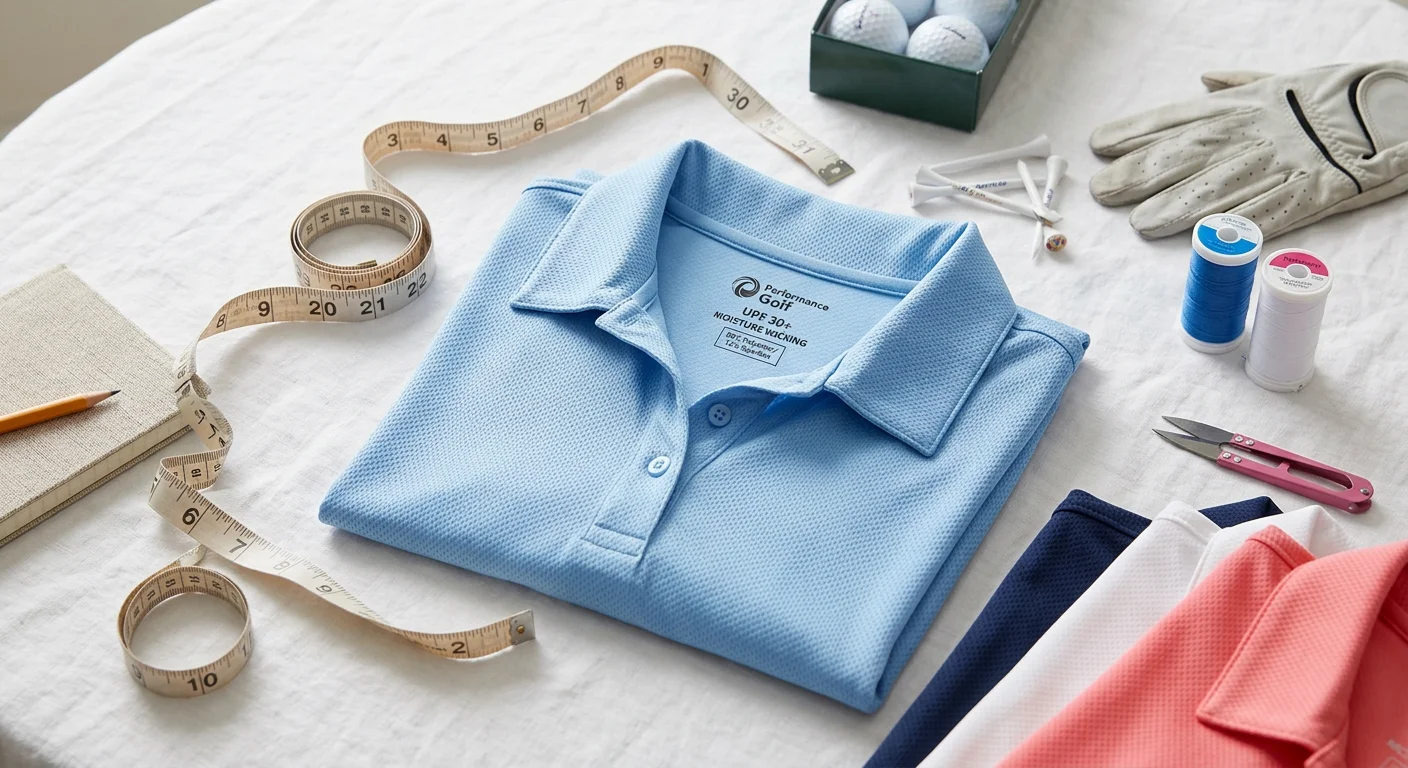
Every fitting room mirror lies a little. You look great standing still — but golf doesn't happen standing still.
Before you buy, run this test. It takes ninety seconds and saves you from a shirt that works great until hole one.
Here's what to do:
The shirt that passes all four? That's the one you buy.
The rule is simple: notice the fabric at any point during those movements — it doesn't fit. The right golf shirt disappears the moment you put it on. Your swing takes over, and the shirt just comes along for the ride.
Conclusion
The right golf shirt doesn't just hang on your body — it moves with you, hole after hole, swing after swing.
Know your measurements. Understand what proper shoulder alignment, bust ease, and sleeve length feel like. Sizing stops being a guessing game. No more shirts that gap at the chest or ride up mid-backswing. You show up to the first tee feeling like yourself — put-together, comfortable, and ready to play.
That's the quiet confidence a well-fitting women's golf polo shirt gives you. It's not about looking perfect. It's about never thinking about your shirt again once you're on the course.
Ready to find yours? At Berun Clothes , every moisture-wicking golf shirt for women is built with real swing mechanics in mind. Breathable, flexible, and made to fit bodies that move.
Go find the one that feels like it was made for you. Because it was.
CTA Section Video Section