Table of Contents
You've built a cycling brand from scratch. Now you face two very different choices.
Custom apparel gives you full creative control. Your brand stays aligned. But you'll pay more upfront and wait longer for production.
Ready-made options let you launch faster. Lower minimums mean less risk. The downside? You might look like every other cycling brand out there.
Here's the thing: there's no one-size-fits-all answer. That's why cycling entrepreneurs, club managers, and apparel retailers often feel stuck making this decision.
A boutique cycling studio has different needs than a growing online brand. What works for one can fail for the other.
You're either launching your first collection or scaling an existing line. Either way, you need to understand the real trade-offs between custom and ready-made cycling apparel.
Price tags tell part of the story. But costs, timelines, branding opportunities, and hidden factors matter just as much. These details can make or break your product line.
The right choice creates something cyclists want to wear. The wrong one leaves you with forgettable products.
We'll break down what matters for your specific business scenario.
What Is Custom Cycling Apparel? (Definition & Key Features)
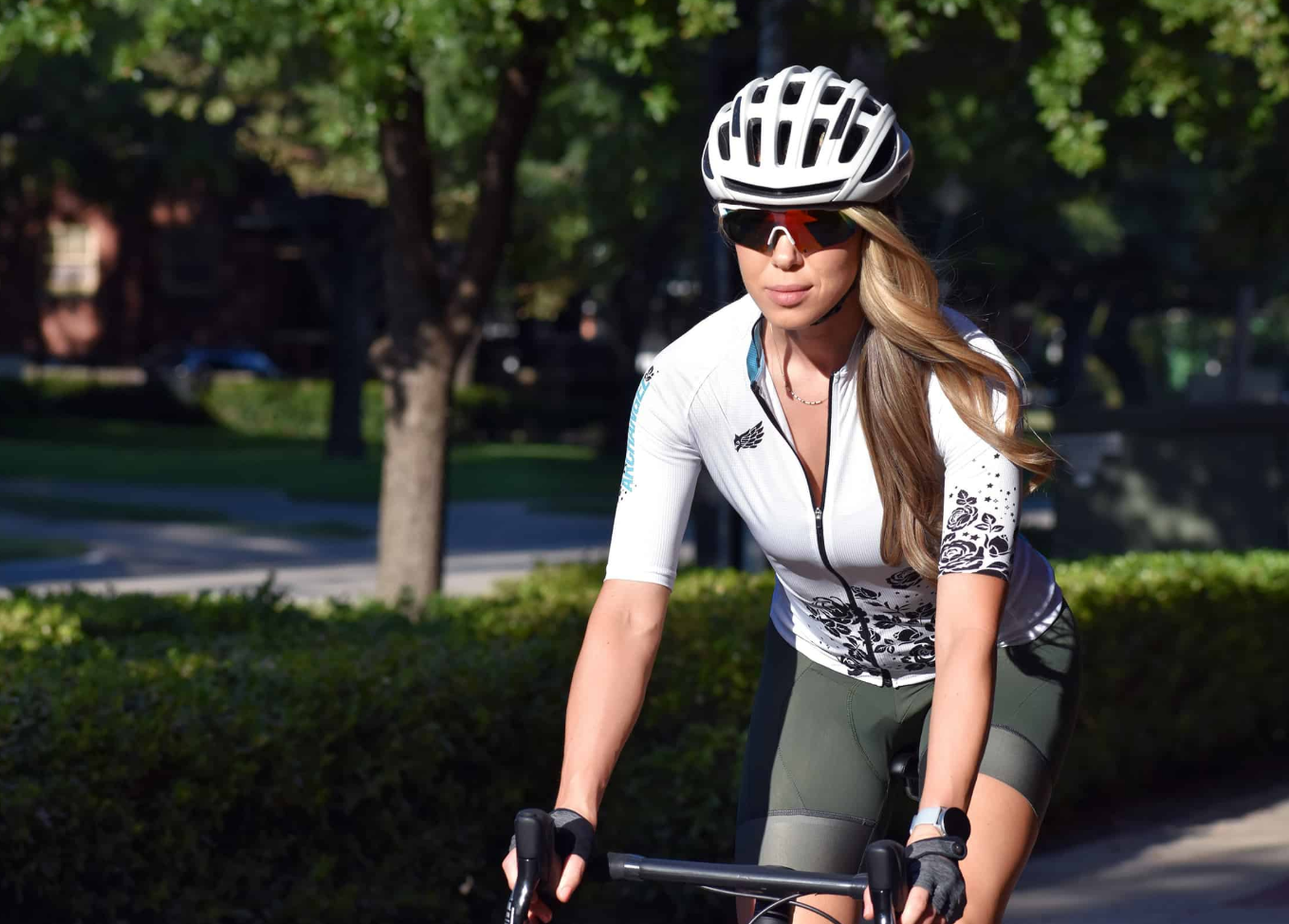
Custom cycling apparel is gear made for you—jerseys, bibs, shorts, gloves, and accessories that match your vision. You control every detail from scratch. Nothing gets grabbed off the shelf.
Custom gear gives you creative freedom. Ready-made cycling gear doesn't. With custom, you pick your color palette. You place your logo where you want it. You adjust graphics to match your brand. Ready-made options? You get what's already designed. No changes.
Here's what makes custom apparel unique:
Complete design control - Your brand colors, team logos, and graphics appear the way you picture them
Tailored fits - Different sizing options fit different body types. Your entire team stays comfortable.
Performance fabrics - Pick moisture-wicking, windproof, or high-visibility materials. Match them to your riding conditions.
Small production runs - Order what you need. Skip the massive inventory.
The customization process works like this: You design using online tools. You specify sizing. You select fabrics. You submit your order. You receive your unique pieces.
The market shows strong growth. Custom cycling wear grows at 5.8% each year through 2031. The broader cycling apparel market will jump from $6.04 billion to $8.24 billion in the same period. Amateur cyclists drive demand right now. They represent over 32% of the European market alone.
What fuels this growth? Teams and clubs want matching identities. Online design platforms make customization easy for everyone. You don't need special skills or large budgets to create professional gear anymore.
What Is Ready-Made Cycling Apparel? (Stock Products Overview)
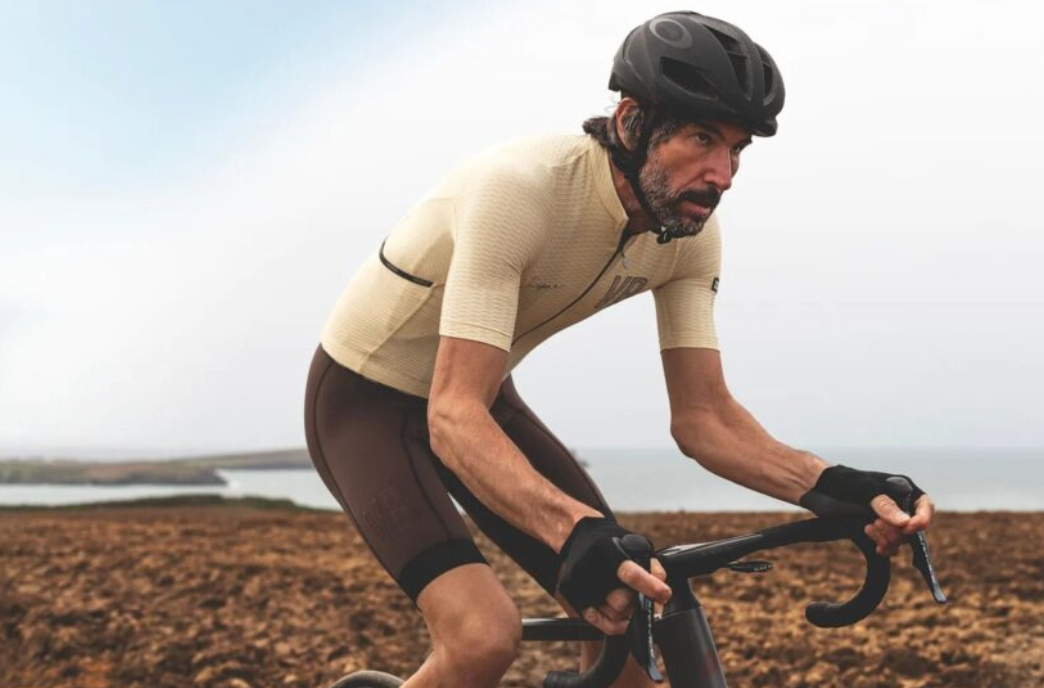
Ready-made cycling apparel comes off the production line in bulk. Factories make jerseys, bibs, and shorts in set designs. They keep them in stock. You order what's already made.
These products come in seasonal lines—spring/summer and fall/winter. Each piece gets a SKU number. Brands refill popular items all year. You're buying from stock, not ordering new designs.
The standard setup goes deep:
Common fabrics - Most pieces use polyester-spandex blends, Lycra, and breathable mesh. Top-end jackets use Gore-Tex for waterproofing.
Set designs - Road cycling gear fits tight and sleek. Mountain bike clothes are cut looser for easy movement. Colors and graphics stay the same across all batches.
Standard sizing - Men's sizes run XS to XXXL. Women's go XS to XXL. Most brands sell S-XL the most. Each size jumps 4-6 cm in chest and waist.
Speed counts. Stock products ship right away. No pattern work needed. No sample stages. Retailers refill stock each month based on sales. Teams that accept standard designs get orders in 3-7 days.
Fabric weights are easy to predict. Summer jerseys use 90-150 g/m² mesh fabrics. Winter pieces use 200-260 g/m² fleece-lined materials. Every piece has moisture-wicking polyester and 10-20% spandex for four-way stretch.
Performance & Fit Comparison: Custom vs Ready-Made
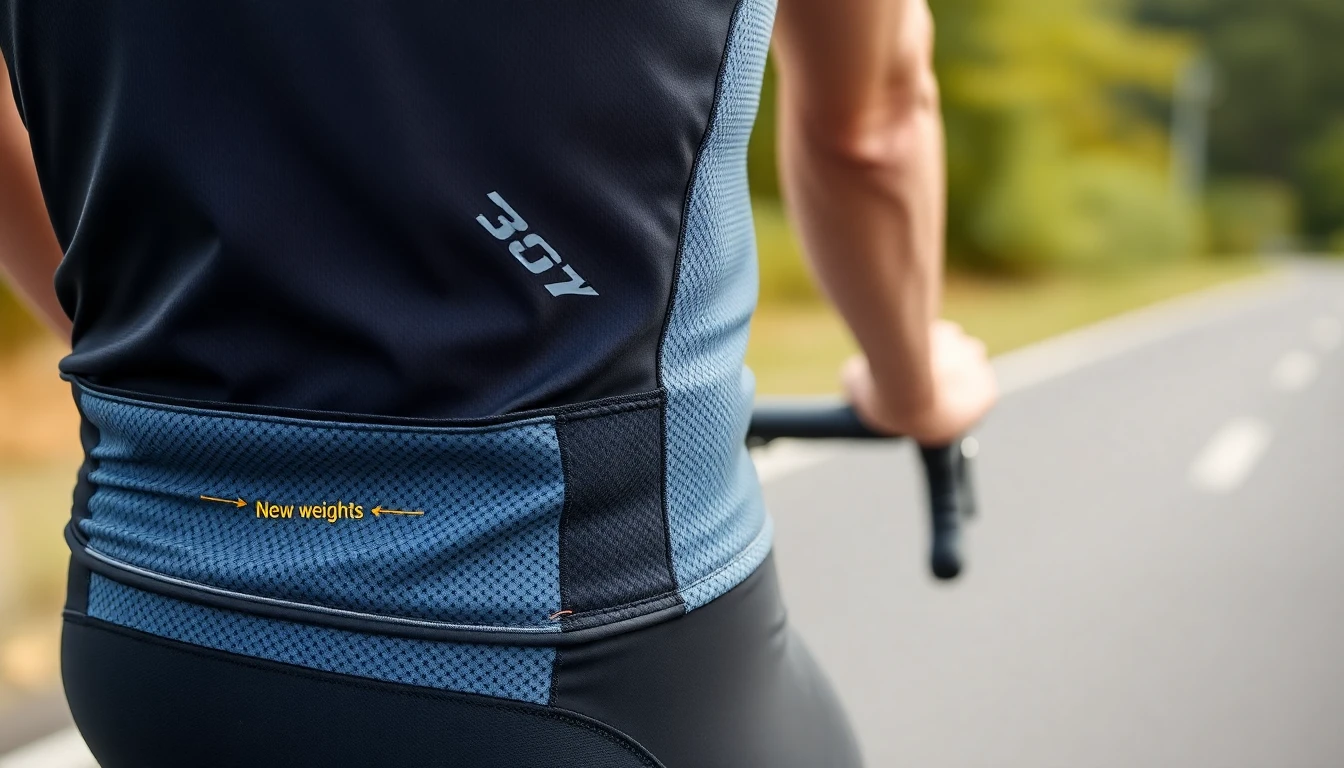
Fit drives performance. A jersey that bunches at your lower back kills speed. Shorts that dig into your thighs ruin comfort. Custom and ready-made cycling gear take two different paths to fit.
Custom cycling apparel molds to your body. You get individual measurements or 3D body scans. Designers adjust shoulder width, sleeve length, torso rise, and leg length to match your exact shape. This precision stops bunching—that fabric piling you get with poor-fitting material.
Custom cuts handle real body differences that standard sizes miss:
Left and right shoulder height differences
High muscle mass in thighs versus narrow waist proportions
Back extension in riding position
Movement range during pedaling, standing climbs, and cornering
Ready-made gear uses standard size brackets. Factories design for average body types across S/M/L/XL ranges. Each size covers broad ranges—4-6 cm jumps in chest and waist. Your body falls between sizes? Problems show up fast.
Stock gear has common fit problems. Fabric bunches behind knees. It rides up at the lower back. It pulls at shoulders. Extra material gathers around the waist. Manufacturers add fabric allowance in the waist, hips, and thighs to reduce returns. That extra material creates drag. It causes discomfort during rides.
Aerodynamics separate good from great. Pro teams choose body-hugging custom cuts with zone-specific fabrics. This reduces wind resistance. Studies show aerodynamic race fits cut power use by 3-8% at 40 km/h speeds versus loose training gear. In time trials, that means seconds saved.
Ready-made pieces use relaxed fits. They work across body types but sacrifice aero performance. Every visible wrinkle or fabric bulge increases your drag by 1-3%. Elite riders pay premium prices to eliminate that resistance. Standard sizing can't deliver the same precision.
Branding & Design Flexibility Analysis
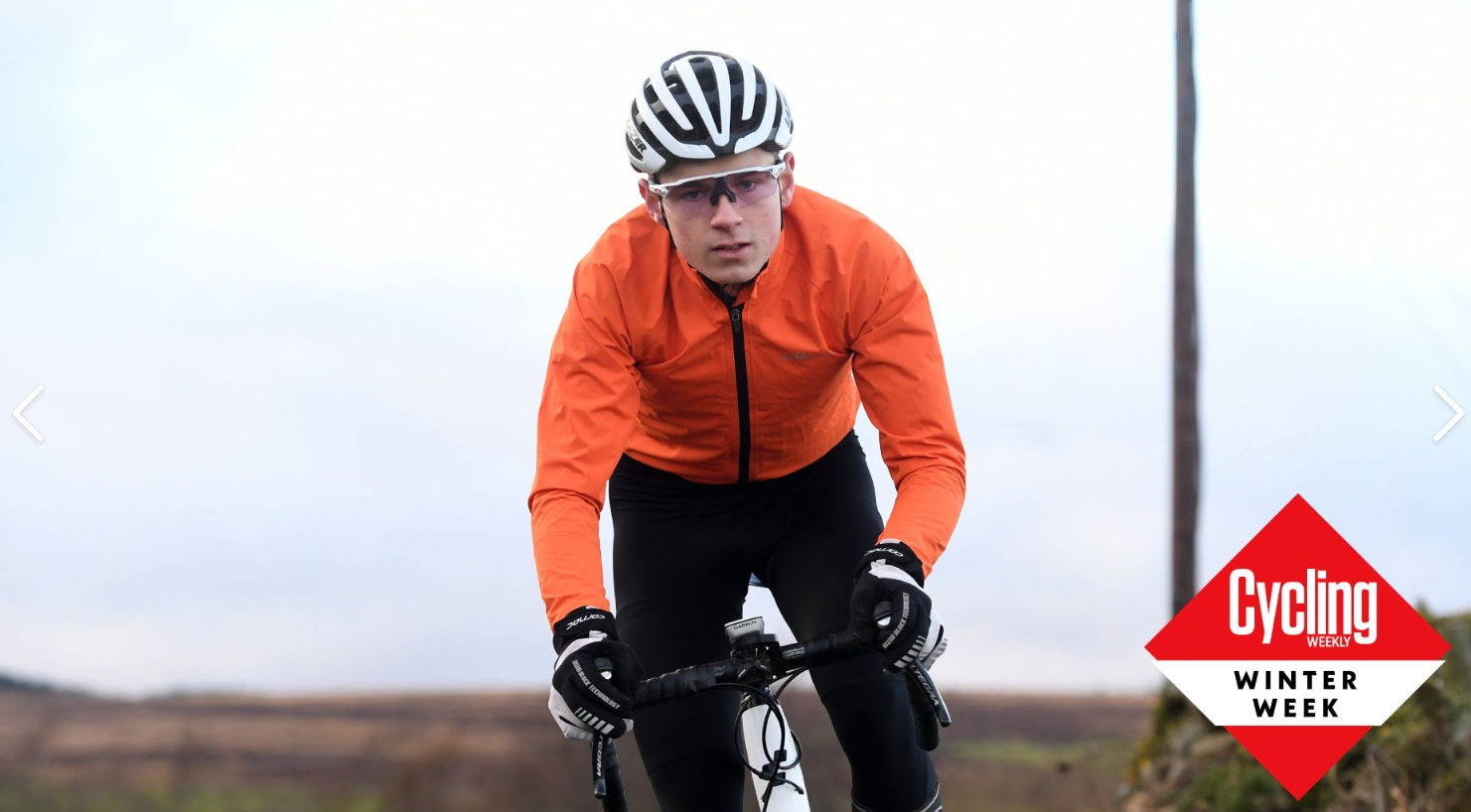
Your logo tells a story. Does it tell the same story everywhere, or does it adapt?
Custom cycling clothing gives you branding flexibility. Ready-made options of cycling apparel can't match this. You control every visual element. Logo placement. Color gradients. Typography. Graphic patterns. Your jersey becomes a moving billboard designed how you want it.
Here's what custom branding delivers:
Full creative control - Place your logo on the chest, sleeves, or back panel. Adjust size and orientation. Add sponsor logos where they make sense.
Unique color systems - Match your brand colors using Pantone specifications. Create gradient effects or color-blocking patterns that set you apart.
Dynamic design elements - Add geometric patterns, custom illustrations, or photographic backgrounds. Your gear won't look like anyone else's.
Storytelling through design - Weave brand narratives into fabric patterns. Google's doodle approach works for cycling gear too. Seasonal designs keep customers engaged and collecting pieces.
This flexibility operates on a scale. Static branding (rank 0) keeps everything identical. Same logo. Same colors. Zero variation. Dynamic branding (rank 3) adapts visual elements. Recognition stays intact. The City of Melbourne system shows this well. Their 'M' icon stays constant (rank 0 for recognition). But colors and geometric forms change (rank 3 for flexibility).
Ready-made apparel locks you into fixed designs. You're buying what's already printed. Stock jerseys come with pre-set graphics and color combinations. Want your brand colors? You'll need to compromise or skip it. Logo placement? It goes where the manufacturer decided. Period.
This rigidity creates branding risks. Your team looks identical to three other clubs using the same stock template. Customers can't tell your products from competitors. You're building someone else's brand, not yours.
The trade-off hits hard for growing brands. Stock options cost less upfront. $25-45 per jersey versus $60-120 for custom. But you lose differentiation. Generic designs fade into background noise in crowded markets.
Custom gear of cycling apparel requires brand strategy. Simple logos work better than complicated marks. They scale across jerseys, bottles, and social media without losing clarity. Stick to 2-3 core colors. They adapt across different fabric types and production methods.
Consistency matters even with flexibility. Brief brand guidelines keep your team aligned. They set parameters for logo use, color combinations, and graphic styles. Plus, they leave room for seasonal variations or special editions. This balance prevents confusion. It maintains fresh, current perception.
Your branding investment compounds over time. Custom pieces build recognition ride after ride. Ready-made gear disappears once the manufacturer discontinues that design next season. Which story do you want your brand to tell?
Cost Structure & ROI Breakdown
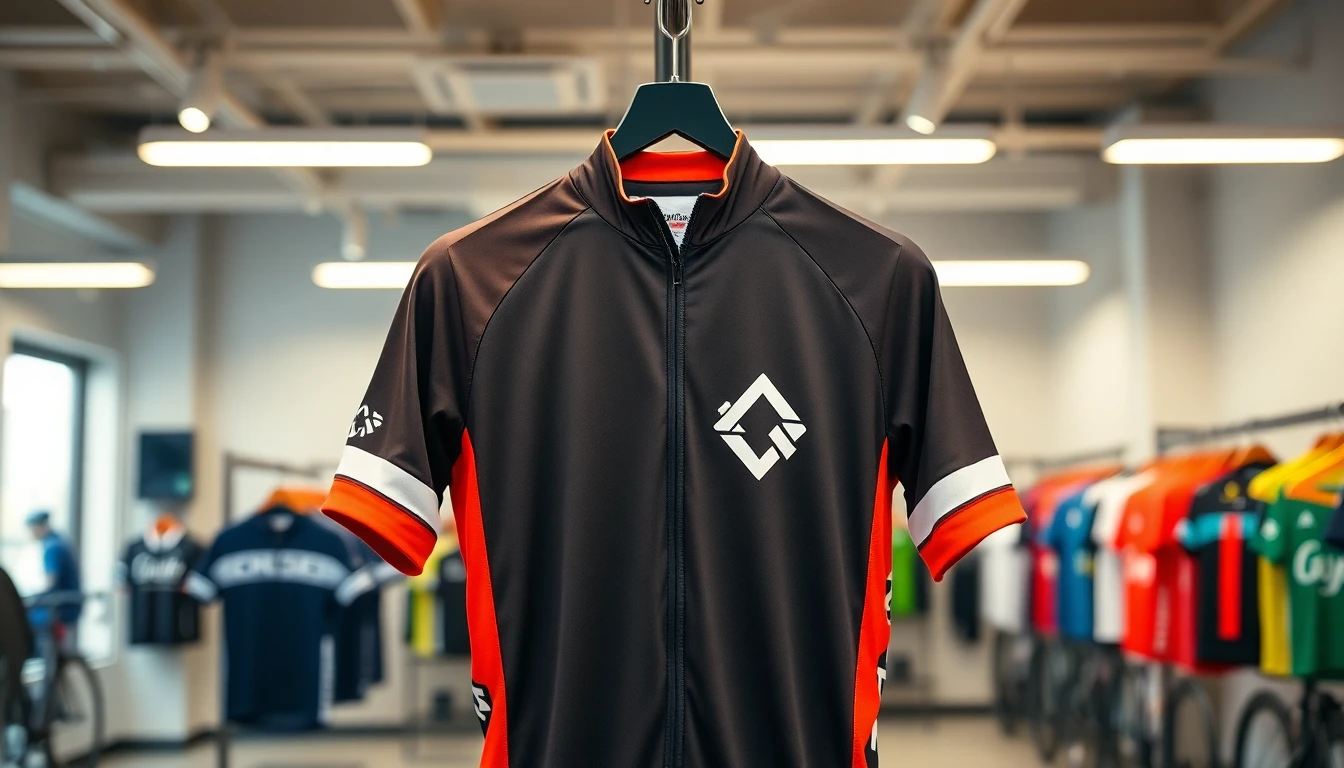
Numbers tell the real story. Custom and ready-made cycling apparel have different cost structures. These differences help you predict profits and avoid budget surprises.
Custom cycling apparel costs fall into three categories:
One-time setup costs - Design fees run $200-800 per collection. Pattern making adds $150-400. Sample production costs $80-150 per piece. Digital mockups range $50-200. Pay once, then you're done.
Fixed per-order costs - Small manufacturers need 25-50 pieces minimum. Larger ones need 100-300. Screen setup for printing costs $40-75 per color. Embroidery setup runs $100-200 per design spot.
Variable unit costs - Base jersey production costs $35-75 each. Premium fabrics add $8-15 per piece. Custom padding inserts cost $5-12 extra. Full sublimation printing adds $3-8 per garment.
Ready-made cycling apparel inventory is simpler. No design fees. No pattern costs. No sample rounds. You buy finished goods at wholesale rates.
Ready-made wholesale pricing has its own system:
Bulk pricing tiers - Order 10-24 pieces at $45-60 each. Order 25-49 pieces at $38-52 each. Order 50+ pieces at $32-48 each. Volume discounts kick in fast.
Inventory carrying costs - Storage runs 15-25% of product value per year. Unsold stock ties up capital. Seasonal items go on clearance at 30-50% markdowns.
Hidden costs - Generic designs need extra marketing spend to stand out. Stock-outs lose sales. Discontinued styles can't be reordered.
ROI calculations show the truth. Custom gear needs more money upfront but gives better margins. A 50-piece custom order costs about $4,500 total ($90 per unit including setup). Retail those jerseys at $140 each. Your gross margin hits 36%. Total profit reaches $2,500 on that first run.
Compare that to ready-made. Buy 50 stock jerseys at $42 wholesale. Sell them at $85 retail—the market rate for generic designs. Gross margin lands at 51%. Sounds better, right? But total profit reaches just $2,150. Plus, you compete with everyone selling identical products.
The break-even point shifts based on order size. Custom gets more profitable after your second or third run. Setup costs get absorbed. Unit costs drop as quantities increase. Ready-made stays profitable on small orders but caps your ceiling.
Track these metrics closely:
Cost per acquisition versus lifetime value per customer
Inventory turnover rate (custom moves faster due to exclusivity)
Gross margin percentage after all production costs
Customer retention rates (custom buyers show 40-65% higher repeat purchase rates)
Convert fixed costs to variable where you can. Print-on-demand services cut inventory risk but raise per-unit costs to $55-80. That works for testing designs. It doesn't work for established products.
Minimum Order Quantity (MOQ) Requirements Comparison
Your cash flow sets your first order size. Period.
Custom cycling apparel makers set minimums from 1 piece to 500 pieces.Ready-made wholesalers ? They ask for 10-50 pieces per style. These numbers reshape your whole business model.
Custom MOQ ranges by maker:
Ultra-flexible producers - BioRacer starts at 1 piece. Champion Systems does the same. You test designs without betting the farm.
Low-volume specialists - Castelli and Kalas need 5 pieces per style. Mix styles in one order. Minimums stay easy to handle.
Mid-volume factories - Most custom makers land at 25-50 pieces minimum. Economies of scale kick in here.
High-volume operations - Large factories want 100-300 pieces. Unit costs drop to $35-55. But your capital gets locked up fast.
Ready-made cycling apparel wholesalers pack in cartons. Standard boxes hold 50 units each. Want 75 jerseys? You'll order 100. The math forces your hand.
Your brand stage sets smart minimums:
Startups - Keep first orders under 50 pieces. Invest $2,500-4,500 total. Test the market before you scale. Low MOQ custom options of cycling apparel like BioRacer let you launch with $300-800.
Growth stage - Order 50-500 pieces. You need to balance unit cost savings against stock risk. Your brand recognition supports larger runs now.
Mature brands - Scale to 500+ pieces. Per-unit costs drop 30-40%. But you need proven demand and storage space.
Calculate your best order using Economic Order Quantity: √(2DS/H). D equals demand per year. S equals ordering cost per batch. H equals holding cost per unit per year. A cycling studio selling 200 jerseys per year with $150 ordering costs and $8 holding costs should order 87 pieces at once.
MOQ flexibility costs money. One-piece minimums add $15-25 per unit versus 100-piece runs. That extra cost buys you testing room and lower risk. Worth every dollar as a startup.
Production Timeline & Lead Time Analysis
Time kills momentum. A four-week wait for custom jerseys means your cycling club misses the season opener. A two-day ready-made turnaround gets riders on the road but locks you into generic designs.
Lead time = delivery date minus order date. Simple math. Big impact.
Custom cycling apparel follows a clear timeline:
Total custom timeline: 35-75 days from first sketch to delivered boxes.
Ready-made cycling apparel stock ships in 3-7 business days . Period. Warehouses hold stock. You order, they pack, carriers deliver. Zero production time.
Timing gets strategic here. Track your 85th percentile lead time—the point where 85% of orders arrive by. Custom makers of cycling apparel hitting 42 days at the 85th percentile beat those averaging 38 days but spiking to 65 days. Steady delivery beats raw speed.
Supplier variance tells the real story. One custom factory of cycling apparel promises 30 days but delivers in 34 (+4 variance, 78% on-time rate). Another promises 40 days and hits 39 (-1 variance, 94% on-time rate). That second supplier costs more per piece but protects your launch dates.
Think about downtime impacts. Machine breakdowns add 2-5 days per incident. Material shortages push timelines 7-14 days. Peak season congestion (March-May for summer gear) pushes everything back 10-20 days. Plan orders around these factors.
Smart brands speed up timelines without cutting quality. Real-time production tracking cuts lead time by 25%. You spot bottlenecks at the dyeing stage instead of finding delays at delivery. Analytics boost chain efficiency by 20%—order fabrics before your manufacturer runs low.
Ready-made removes production risks but creates new ones. Popular sizes sell out. Restocks take 2-4 weeks. Stopped styles can't be reordered mid-season. Your "fast" option slows down while you wait for the next container from overseas.
Test both models. Order 25 custom pieces for your core team (plan 50 days out). Stock 50 ready-made cycling jerseys for quick retail sales. This mix balances brand building with cash flow.
Quality Control & Material Standards
Fabric quality separates gear that lasts from gear that fails mid-ride. A jersey that pills after three washes destroys trust. Shorts with seams that split during climbs? Customer relationships end fast.
The Custom and ready-made cycling wear follow different quality control paths. These differences affect durability, comfort, and your brand reputation.
Custom production uses stricter oversight. You work with manufacturers face-to-face. This creates multiple inspection points:
Pre-production samples - Test fabrics for weight (90-260 g/m²), stretch recovery (10-20% spandex content), and colorfastness before bulk orders start
In-line checks - Inspect 10-15% of pieces during production runs. Catch stitching errors, print misalignment, or fabric defects before they spread
Final inspection - Review 100% of finished garments for measurement accuracy (±2cm tolerance), seam strength (minimum 3.5mm stitch density), and overall construction
Third-party testing - Labs verify moisture-wicking rates, UV protection ratings (UPF 50+), and fabric tear resistance per ISO standards
Ready-made stock skips most custom checkpoints. Factories produce thousands of identical pieces using set specifications. Quality control happens at batch level. Not individual garment level. You receive what passed the manufacturer's internal standards—typically sampling 2-5% of total production.
Material standards create the foundation. Custom orders of cycling apparel let you specify exact fabric compositions. Premium Italian Lycra versus standard Chinese polyester. Four-way stretch mesh versus two-way. Sublimation-grade versus screen-print fabrics. Each choice affects performance and longevity.
Stock products use pre-selected materials chosen for cost efficiency across mass production. Manufacturers blend 80-85% polyester with 15-20% spandex as the industry standard. You can't adjust ratios. You can't request specialty treatments like silver-ion antimicrobial finishes or ceramic-infused thermal regulation.
The data shows rising quality focus. Third-party control usage jumped to 49% in 2025, up from 43% in prior years. More brands verify materials on their own rather than trusting manufacturer claims alone. This shift reflects growing consumer expectations and the $5 billion annual cost of product defects across industries.
Custom apparel brands use detailed Standard Operating Procedures (SOPs). These cover fabric incoming inspection, cutting precision, stitching consistency, and finishing standards. These documented processes ensure every production run meets identical specs. Ready-made wholesalers operate under their own SOPs—which you don't control or modify.
Statistical process control (SPC) matters for repeat custom orders. Track defect rates across batches. Monitor stitch quality variations. Measure color consistency using spectrophotometer readings. This data approach cuts defects by 30% when paired with predictive analytics. You identify failure patterns before they scale.
Root cause analysis prevents recurring problems. A custom run with seam failures gets traced back. Was it thread tension settings? Operator training gaps? Fabric batch inconsistencies? Fix the source, not just symptoms. Ready-made stock offers no such visibility into production problems.
Smart brands verify claims on their own. Request fabric certifications: Oeko-Tex Standard 100 for chemical safety, bluesign® for environmental standards, or REACH compliance for EU markets. Custom manufacturers of cycling apparel provide these. Ready-made cycling apparel suppliers often can't—or won't—share detailed material documentation.
Quality costs money upfront but saves more long-term. Premium fabrics add $8-15 per custom piece. Rigorous inspections add 3-5 days to timelines. But warranty claims drop 60-70% compared to budget stock alternatives. Customer retention rates climb 40-65% when quality stays consistent across reorders.
Business Scenario Recommendations: Which Model Fits Your Brand?
Your annual sales volume determines your path forward. Aspirations don't matter. Five-year projections don't matter either.
A cycling club selling 30 jerseys per year faces different constraints than an online brand moving 800 pieces. The model that works for one crushes the other. Let's map your exact scenario to the right apparel strategy.
Startup Brands: Under 50 Members or Annual Units
Start with ready-made stock. Test demand before you commit capital to custom production.
Your first inventory order should look like this:
10-30 pieces per style - Keep total investment under $1,200-1,800
2-3 core styles maximum - One summer jersey, one bib short, maybe arm warmers
Standard color combinations - Black/white, navy/red, or gray/blue move fastest
Track conversion rates closely. You need 2-3% visitor-to-purchase conversion minimum. Watch return rates. Anything above 8-10% signals fit or quality problems. Calculate gross margin after all costs. Hit 50% minimum or you won't have room to scale into custom later.
Run this test for 4-8 weeks per SKU . Measure repeat purchase rates. Check review scores. A 30-day sellthrough rate of 70% or higher means you've found product-market fit.
Now transition into low-MOQ custom options. Producers like BioRacer and Champion Systems accept 10-30 pieces per color and size combination . Your first custom run should consume no more than 15-20% of monthly available cash flow .
Start with light customization elements:
Logo placement and hang tags cost just 3-8% of base unit price
Custom packaging adds professional perception for $0.80-2.50 per piece
Sample development runs $100-300 per style for most categories
Green-light larger custom orders after you hit these benchmarks: 70% sellthrough in 30 days, 25% repeat customer rate , and 4.5/5 star ratings minimum.
Growth-Stage Brands: 50-500 Annual Units
Custom manufacturing becomes your competitive advantage at this level. Generic stock products can't set your brand apart anymore.
Split your approach by sales volume. Brands selling 50-200 units per year should dedicate resources to 1-2 custom hero lines . Keep stock options for breadth. Scale past 200 units? Custom products need to represent 40-60% of total sales minimum.
Structure your custom orders this way:
Core collection pieces : 30-50 units per style
Seasonal or test designs : 10-20 units per style
Budget allocation : Limit experimental styles to 25-30% of purchasing budget
Plan 2-4 core styles plus 2-3 test styles per season . This keeps your lineup fresh. You won't overextend production capacity or warehouse space.
Target gross margins shift upward. Custom lines should deliver 60% margins minimum . Ready-made supplement products stay viable at 45-50% margins . Anything less means you're leaving money on the table. Or you're competing on price alone.
Vet low-MOQ suppliers using these criteria:
Minimum order quantity: 3-5 pieces per style and colorway
Sample turnaround: 5-10 days maximum
Production lead time: 15-30 days for bulk orders
Defect rate guarantees: Under 2-3%
Request tiered pricing at 5 / 10 / 30 / 50 piece breakpoints . Clarify what's included. Packaging, labels, and quality inspection often add 5-10% to base costs as a bundle.
Push differentiation metrics hard. New designs should make up 30-40% of each seasonal release . Maintain at least 50% proprietary construction or branding elements that competitors can't replicate. Drive brand repeat purchase rates toward 35-40% .
Established Brands: 500+ Annual Units
Private label manufacturing with factory-direct relationships becomes your operational core. The Verge Sport model sets the standard here. Vertical integration with rapid fulfillment is the goal.
Segment your strategy by volume tier. Brands moving 500-2,000 units per year work best with small factory partnerships and entry-level private labeling. Scale past 2,000 units? Lock in 1-3 dedicated factory relationships . Get exclusivity agreements and priority production slots.
Factory partnerships require structured vetting:
Production capacity checks through facility audits
Financial stability checks (request three years of records)
Quality management system certifications (ISO 9001 minimum)
IP protection agreements
Communication protocols and dedicated account management
Negotiate payment terms that protect cash flow. Standard 30% deposit, 70% on delivery terms shift to net-30 or net-60 . This happens once you prove consistent order volume.
Build inventory forecasting models using 12-month rolling data. Factor 15-20% safety stock for bestsellers. Cut slow-moving SKUs without mercy. Anything selling under 8 units per quarter ties up capital better deployed elsewhere.
Your operational advantage comes from speed and consistency. Customers expect 3-5 day fulfillment on standard orders. Custom requests should ship within 21-28 days maximum . Miss these windows? You're just another mid-sized brand with premium pricing.
Next Steps: Get Your Custom Cycling Apparel Quote from Berunclothes
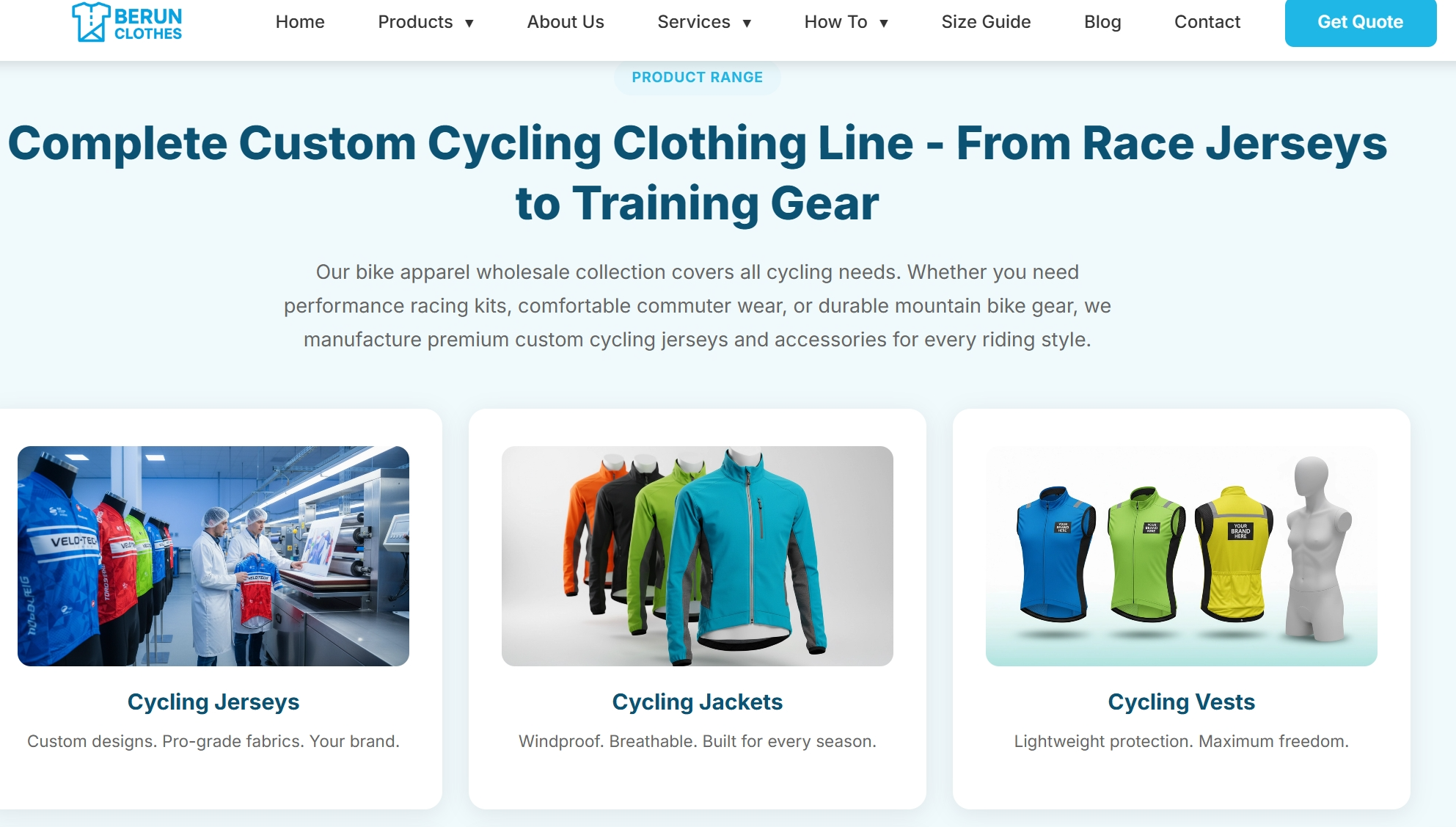
Berun Clothes makes custom cycling gear easy for brands at any stage. We've helped 500+ brands worldwide and 200+ cycling clubs with our simple team kit service.
Our quote process has five simple steps:
Low minimums make it easy. Our 50-unit minimum beats the usual 500+ requirements. Need a trial run under 50 pieces? We add just $2-5 per piece. Or a $150-300 flat fee.
Clear pricing means no surprises. Every quote breaks down design fees, setup costs, and processing (2-6% factoring). No hidden charges. Custom cycling apparel shirts cost $8-25 per piece for 50-200 unit orders.
Smart timing saves money. Bulk fabric orders drop unit costs 15-25%. Order ahead (November for March events) and get 10-15% off. Repeat blank inventory orders save 33%—$10 versus $15 per shirt.
Contact us:
- Phone : +86 138 0000 0000
- WhatsApp : Instant messaging for quick quotes
- Business hours : Monday-Friday, 9AM-6PM GMT+8
E-commerce brands launch products 40% faster with our system. Production takes 8-10 weeks after you approve samples.
Conclusion
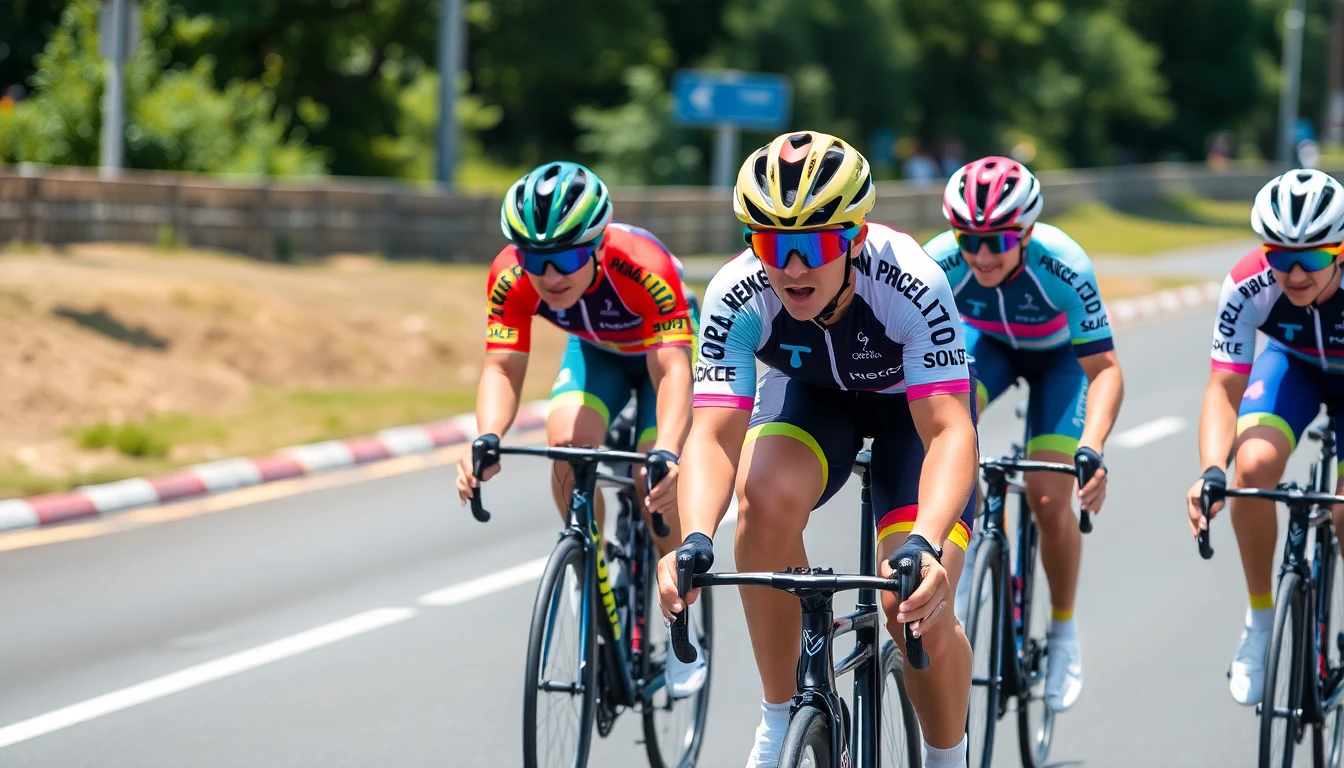
Custom vs ready-made cycling clothing - this choice defines your brand's future. Building a cycling team with specific performance needs? Launching a brand that needs unique market positioning? Personalized cycling gear gives you the edge and profit margins that stock products can't match. Starting small? Ready-made options let you test the market without big upfront costs.
Alignment matters most. Your cycling apparel strategy must match your business goals, budget, and timeline. A cycling club with 15 members needs different solutions than a retailer stocking 500 units. Both paths work - they just serve different purposes in the cycling apparel world.
Ready to move forward? Berunclothes offers custom design services (MOQ from 50 pieces) and white-label solutions to match where you are right now. Request your quote and we'll discuss which approach works best for your brand. The best decision? Make it today.