Most golfers obsess over equipment upgrades — a new driver, a premium shaft, a fitted iron set. They chase distance and accuracy through gear instead of through their own bodies. Working with performance golf apparel manufacturers for training can support movement efficiency, but here's the uncomfortable truth: your swing speed ceiling isn't set by your club. It's set by your fitness. The good news?Here's the uncomfortable truth: your swing speed ceiling isn't set by your club. It's set by your fitness. The good news? That ceiling is far more movable than you think.
The five golf fitness exercises in this guide target the exact physical qualities that separate a 90-mph swing from a 110-mph one:
These aren't generic gym movements dressed up with a golf label. Each one trains the biomechanical patterns your body runs through every time you step up to the tee. Put in the work, and you'll feel the difference — long before your scorecard has a chance to confirm it.
Exercise 1: Medicine Ball Rotational Throws — Build Explosive Swing Power

Throwing a ball against a wall is one of the oldest, simplest training methods around. It's also one of the most effective ways to add yards to your drive— especially when paired with gear from high-performance golf fitness clothing suppliers that allows full rotational freedom..
Medicine ball rotational throws train what sports scientists call the kinetic chain . This is the step-by-step firing of muscles from the ground up. It drives every powerful athletic movement you've seen. Your glutes ignite first. Force travels through your hips. Your obliques and core push it upward. Your shoulders follow. Your arms are just along for the ride. Sound familiar? It's your golf swing — almost to the letter.
A 6-week medicine ball program was tested on 69 high school athletes. The results showed real gains in power, speed, and agility compared to regular activity alone. The rotational pattern is the same one behind bat speed and throwing velocity — and clubhead speed.
How to Do It
Starting position: Feet shoulder-width apart, knees soft, weight balanced. For side throws, shift toward your front foot.
Grip: Hold the ball at chest or hip height with elbows bent. Don't white-knuckle it.
The throw: Start from your hips first . Then your core and obliques fire. Then your shoulders rotate through. Release the ball sideways against a solid wall with full speed and force. Your arms follow the rotation — they do not lead it.
Use a 4–6 lb ball. Heavier isn't better here. This is about explosive rotational power, not strength endurance.
Training Parameters
Variation | Sets | Reps | Focus |
|---|---|---|---|
Shuffle Scoop Toss (each side) | 3 | 8 | Speed; balance on front foot |
Step-Back Shot Put (each side) | 3 | 6 | Rate of force development |
General Rotational Throws | 3–5 | 3–8 | Technique + max velocity |
The Mistakes That Kill Your Power
Leading with your arms. The moment your arms take over, your core checks out — and so does your power transfer.
Lunging forward. A forward lunge breaks the stable base you need for explosive rotation.
Moving slow. Controlled medicine ball throws miss the point entirely. Throw every rep as fast and hard as you can.
Get the pattern down, then superset these throws with compound lifts — squats or deadlifts work well. That combo teaches your nervous system to produce force fast, then lock down under load. That's what your body needs to send a ball 280 yards down the fairway.
Exercise 2: Cable Woodchoppers — Strengthen the Rotational Control That Keeps Shots Accurate

Distance means nothing if the ball goes sideways. The golfer who splits the fairway at 260 yards beats the one launching 290 into the rough — every single time. Training in apparel developed by custom golf training apparel manufacturers can also help maintain consistency in movement and comfort during controlled rotations. Cable woodchoppers build the rotational control that keeps your shots on the line you intended.
Here's what sets this exercise apart from generic core work: the diagonal pulling path matches your actual swing arc. You're not just building a strong midsection. You're training it to produce force in the exact direction your swing needs.
How to Do It
Setup: Set the cable to the top pulley and attach a D-handle or rope. Pick a light weight — this is a control exercise, not a loading exercise. Stand side-on to the stack, about an arm's length away. Feet shoulder-width apart, outside foot a half-step forward, knees soft.
The pull: Grip the handle with palms facing in. Brace your core and keep your shoulders down. Exhale and pull the handle on a downward angle across your body toward the opposite hip. Your torso and hips rotate together. Your rear foot pivots to anchor the lower body. 80 to 90 percent of the power comes from your core — not your arms, not your legs.
The return: Pause at your hip. Inhale. Reverse back along the exact same path — slow and controlled. Resist the cable pulling you back. Don't let momentum do the work.
The muscles working hardest here are your obliques — both internal and external — along with your lats and rotator cuff. That combination drives swing direction stability and shoulder control on every shot.
No Cable Machine? No Problem
Anchor a resistance band at the top of a door frame. Follow the same diagonal path. Same stance, same rotation, same rear foot pivot. The muscle engagement is the same.
Training Parameters
Sets | Reps (Each Side) | Tempo |
|---|---|---|
3–4 | 10–12 | 1 sec pull / 2–3 sec return |
Start lighter than you think you need to. The moment you feel the pull happening in your arms instead of your core, the weight is too heavy.
Inline CTA 1Need Performance Golf Apparel for Your Team?
BeRun Sports manufactures custom golf training wear with 4-way stretch fabric, moisture-wicking technology, and full rotational freedom. MOQ from 200 pieces.
Explore Golf ApparelExercise 3: Squat Jumps — Develop the Leg Drive Behind Every Powerful Swing

Watch any Tour pro at impact in slow motion. What you'll notice first isn't the arms. It's the legs — driving hard into the ground— driving power. Training systems supported by OEM/ODM golf apparel for athletic performance are often designed to enhance lower-body explosiveness without restricting movement, pushing force up through the hips, into the torso, out through the club. The lower body isn't a passive platform. It's the engine.
Squat jumps train that engine.
This isn't a complicated exercise. But don't mistake simplicity for weakness.
In one 8-week study, inactive men who added progressive squat jump training improved vertical jump height by 25% — with real gains in peak power and speed. A separate protocol, run three times per week over the same 8-week window, improved sprint speed and explosive strength at the same time. That combination — raw power plus trained explosiveness — is what your downswing demands.
How to Do It
Starting position: Feet shoulder-width apart. Toes angled out a little. Drop into a squat — thighs parallel to the floor, chest up, weight spread through your heels and midfoot.
The jump: Drive through the floor. Extend your hips, knees, and ankles in one explosive sequence. Leave the ground full extension.
The landing: This is where most people lose the benefit. Land quiet — toe-to-heel, knees tracking over toes. Absorb the impact through bent knees and active hips. Go straight into the next rep without resetting.
Training Parameters
Level | Protocol | Sets | Reps |
|---|---|---|---|
Beginner | Bodyweight squat only | 3 | 10–12 |
Intermediate | Squat jump (bodyweight) | 3–4 | 8–10 |
Advanced | Back squat (5 reps) + squat jump (10 reps) | 3–4 | Superset |
The advanced power phase protocol — heavy squats followed right away by squat jumps — works well for a clear reason. The loaded squat primes your nervous system for max force output. The jumps then channel that force into explosive movement. That's the transfer pattern your swing is built on.
Primary Muscles Trained
Glutes and hamstrings — the main force generators behind the jump, and behind your hip drive at impact
Quadriceps — control the descent and anchor knee stability
Core and hip stabilizers — hold your posture through landing, matching the balance demands of a full swing finish
One note worth flagging: a history of joint issues or high fracture risk means the hard landing mechanics here need extra care. Form matters more than reps. A sloppy landing with knees caving inward does nothing for your golf game — and does real damage to your knees.
Get the landing right first. Then build the explosiveness on top of it.
Exercise 4: Plank with Arm Reach — Build the Core Stability That Stops Swing Breakdown

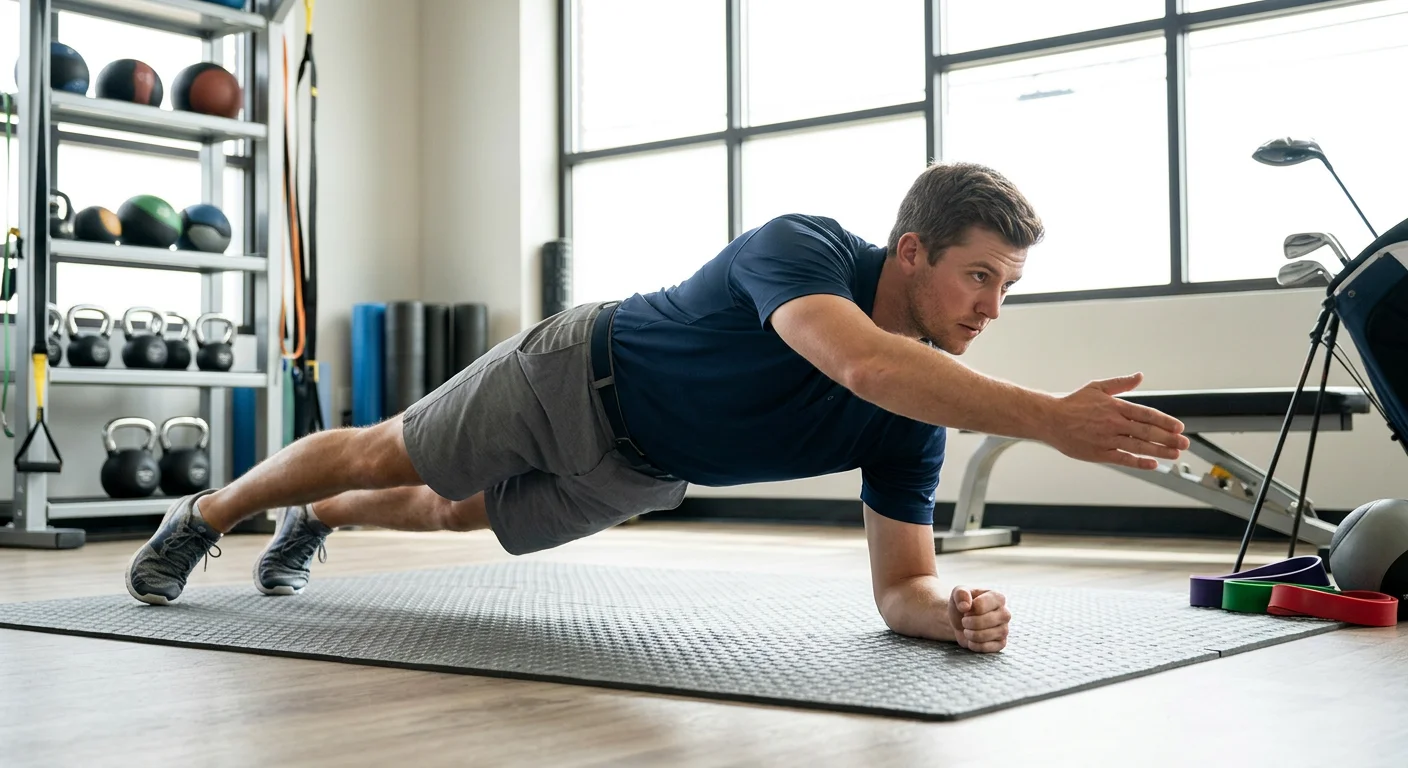
Technique gets blamed for a lot of things it didn't do. That late collapse in your follow-through — the one your instructor keeps flagging — isn't a technique problem.That late swing breakdown? Often not technique — it's stability. Training in gear from a breathable golf training wear factory can help maintain comfort and focus during longer core sessions. Research points to trunk stability deficiency as the cause of 80–90% of late swing breakdowns in amateur golfers. Your body can't hold the position your swing is trying to reach. That's the gap.
That's the problem the plank with arm reach solves.
How to Do It
Starting position: High plank — wrists under shoulders, legs straight, body forming a rigid line from heels to head. Squeeze your front thighs. Lock that core down.
The movement:
Brace your core tight. Keep your pelvis dead level — no rotation, no tilt.
Reach one arm forward to shoulder height. Move slow — take at least 2 seconds. Hold for 3 seconds . Your hips must not sway, dip, or rotate during this hold.
Return the arm to the ground. Re-brace. Repeat on the opposite side.
Alternate sides for 10 reps per side .
What you're training here is anti-rotation — your deep abdominals resisting the torque your downswing creates. That resistance is what keeps your pelvic position stable at the moment the club moves fastest. No stability, no control.
Training Parameters
Variation | Hold Time | Reps | Core Activation |
|---|---|---|---|
Arm Reach | 3 sec | 10/side | Anti-rotation ~90% max |
Leg + Arm | 3 breaths | 8/side | Full trunk ~100% |
Side Plank Reach | 3 sec | 10/side | Obliques ~85% |
Modifications
Forearm plank: Drop to elbows under shoulders, forearms parallel. Same rules apply.
Knee plank: Start here if the full position is too demanding. Build up from there.
The Faults That Undermine the Whole Thing
Three errors kill this exercise fast: hip rotation beyond 5 degrees , a sagging core mid-hold, and lifting the arm in less than 2 seconds. Film yourself from behind, or use a mirror. A wobbly hip during the reach tells you one thing — your core never engaged. You're just moving your arm around.
Golfers who stick with this kind of anti-rotation core training show a 15–25% improvement in fairway accuracy . That's a direct result of better pelvic stability in the late swing phase. The plank with arm reach won't feel athletic. But the discipline it builds shows up at the exact moment your swing needs it most.
Inline CTA 2Custom Sportswear Built for Athletic Performance
From breathable polos to elastic-fit pants, BeRun Sports delivers OEM/ODM golf apparel designed for unrestricted movement. Get a free quote today.
Get Free QuoteExercise 5: Lunges with Rotation — Combine Mobility and Power for a More Complete Swing
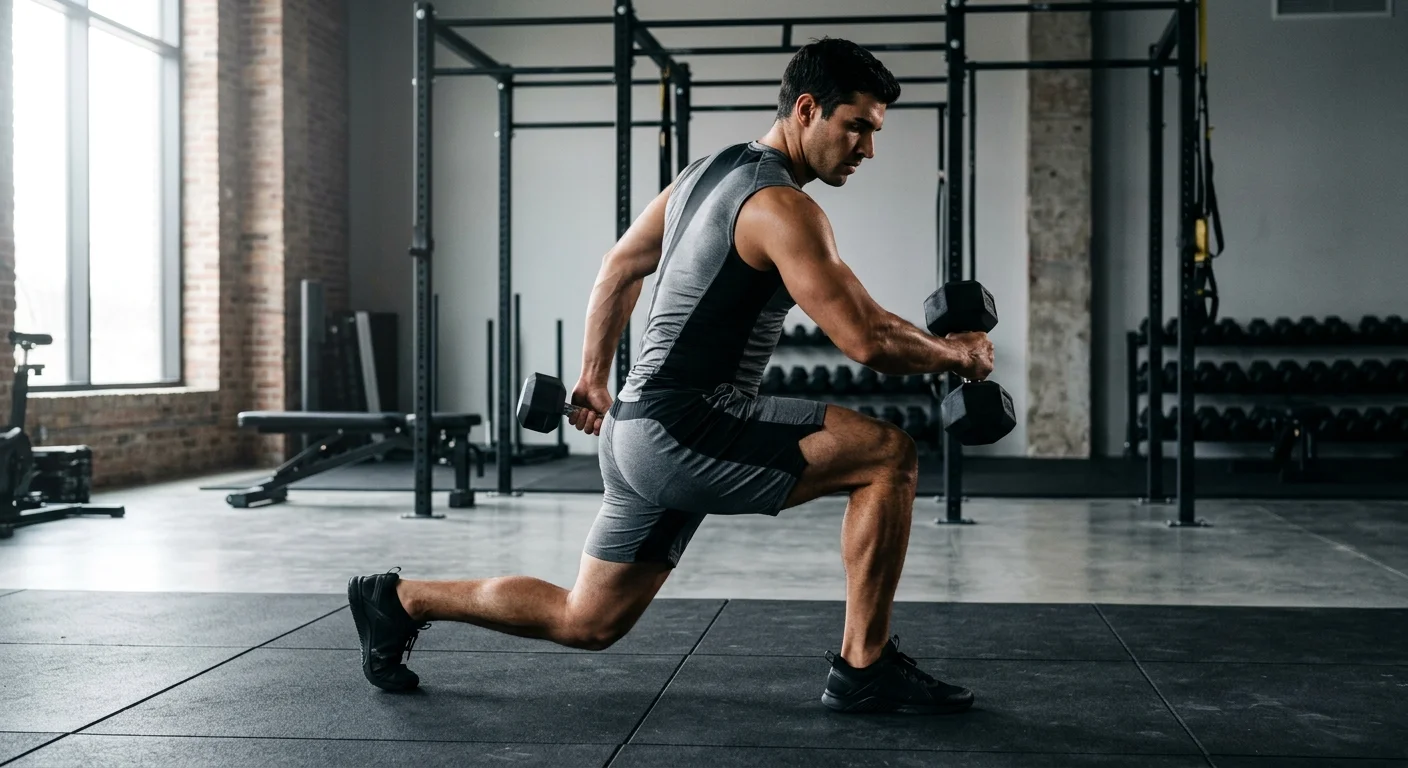
Hip-shoulder separation is the most overlooked factor in golf fitness. Most amateurs never train it on purpose — and most amateurs wonder why their swing plateaus where it does.
Lunges with rotation fix that. This exercise makes your lower body hold steady while your torso twists above it. Those two parts move at different times. That gap between hips and shoulders is where clubhead speed gets built. Train it with purpose, and your swing will open up in a way no equipment change can match.Hip-shoulder separation is where swing speed is built. Most golfers never train it directly. Consistent training with support from private label golf fitness clothing suppliers ensures athletes can move freely while reinforcing proper mechanics.
How to Do It
Step 1 — Lunge deep. Take a long stride forward. Let your knee travel over your first and second toe. Drive your hands — or light dumbbells — down toward the ground beside your lead foot. Tight hips? Reaching the ankle is fine. Heel stays planted.
Step 2 — Rotate on landing. Drop into the bottom of the lunge. Then rotate your trunk toward your lead side. Start with your hips square. Rotate after. Don't let your hips open too soon — that's the mistake that kills the separation you're building.
Step 3 — Push the ground away. Drive back through your heel. Return under control.
Training Parameters
Goal | Sets | Reps (Per Side) | Load |
|---|---|---|---|
Mobility | 1 | 5 | Bodyweight |
Power / Hypertrophy | 2–3 circuits | 6–8 | Light dumbbells |
Add the golf-club variation once the pattern feels solid. Hold your club in a normal grip stance and rotate through the descent. You're tracing the exact load path your swing follows at the top of your backswing.
Pause for one second at the bottom of each rep. That brief hold — hips loaded, trunk rotated — builds the body awareness that stops your swing from rushing past its own power.
Golf-Specific Workout Plan: How to Structure These 5 Exercises for Maximum Results
Five solid exercises done in isolation won't move the needle much. The order matters. So does the rest you take between sets. So does how you push things forward over time. That's where real training gains come from.
Here's how to put it all together.
Frequency: 2–3 sessions per week. Not every day. Your nervous system needs recovery time to lock in the power patterns you're building.
Default parameters: 3 sets of 8–10 reps per exercise, 60–90 seconds rest between sets. Stick to that as your baseline unless an exercise says otherwise.
Start with a 5–10 Minute Warm-Up
Don't skip this. The warm-up isn't filler. It gets your body ready for the rotational work ahead. Run through these in sequence:
Hip flexor stretch — 30 seconds per side, lunge position with a posterior pelvic tilt
Thoracic rotation — 10 reps per side, hands clasped, upper body rotating over a stable lower half
90/90 hip stretch — 30 seconds per side
Pelvic rotation — 5–10 reps per side, hips turning while the upper body stays quiet
Full body turn — 5–10 reps per side, club across your chest, working trail shoulder flexibility
Tour pros hit 45–50 degrees of hip-shoulder separation at the start of the downswing. That gap needs mobile hips and a loose thoracic spine. The warm-up builds both.
Run the 5 Exercises in This Sequence
There's a clear reason for this order. Start with lower body stability, move into rotation, then finish with full-power output:
Split stance thoracic rotation — 8 reps per side
Reverse lunge with knee drive — 8 reps per side
Goblet squat — 8–10 reps per side
Upper body push or row — 8–10 reps
Medicine ball rotational work — 8–10 reps per side
Follow the 8-Week Progression
Week | Volume | Intensity | Focus |
|---|---|---|---|
1–2 | 3×8 | Bodyweight | Form and stability |
3–4 | 3×10 | Light band or weight | Power development |
5–6 | 4×10 | Resistance up 20% | Speed — add overspeed swings post-workout |
7–8 | 4×12 | Max effort, 45s rest | Peak clubhead speed |
By week 7, you're pushing maximum effort with short rest periods. High volume, fast recovery, full output — that's the combo that drives clubhead speed gains. Realistic target: +5–10 mph over the 8-week block .
Finish with a Cool-Down
Close each session with a 30–60 second plank hold, hip controlled articular rotations (30 seconds per side), and five thoracic rotations per side. It's brief. But it seals in the stability work and stops your hips from stiffening up overnight.
Measure What Matters
Set your baseline clubhead speed with a radar launch monitor before week one. Most amateur drivers land in the 90–100 mph range. Track your numbers each week. Add 10–15 overspeed swings after each workout using a lighter club at 105–110% of your max effort. Strength training plus overspeed work together can push a 10–15% speed increase across the program. A golfer at 95 mph has a real path to 110 mph. The numbers check out. But the results only come with consistent effort.
What to Wear During Golf Fitness Training: Gear That Supports Your Full Range of Motion
What you wear to train isn't vanity — it's mechanics.
Take medicine ball rotational throws or cable woodchoppers. The wrong fabric works against you. Loose, unstructured clothing creates drag on 45-degree pulling angles. That costs you 15–20% of your power output before the movement finishes. Fitted, 4-way stretch materials let you hit 100% range of motion. Research backs this up — you get a measurable 10–15% boost in rotational speed.
The numbers are just as clear elsewhere. Stretch fabrics increase swing speed by 5–8 mph over non-stretch alternatives. In 90°F training sessions, good moisture-wicking technology cuts overheating risk by 25%.
Here's what matters in each category:
For training, the Berun 4-Way Stretch Training Polo handles cable woodchoppers with zero fabric drag. The Berun Elastic Fit Golf Pants support the full trunk rotation that medicine ball throws demand. Find both at berunclothes.com.
Dress like the training matters. Because it does.
Inline CTA 3Partner With a Trusted Golf Apparel Manufacturer
30 years of sportswear manufacturing expertise. BeRun Sports offers custom golf apparel with advanced fabric technology for brands worldwide.
View Golf CollectionConclusion
Your swing doesn't lie. Every weak rotation, every loss of control at impact — it all traces back to what your body can and can't do. The good news: that's fixable.
These five golf fitness exercises aren't filler. Medicine ball throws build explosive rotational power. Cable woodchoppers train the control that stops errant shots from costing you strokes. Squat jumps build leg drive. Planks strengthen your core. Lunges fix the balance gaps that break down your swing. Each one targets a real physical weakness standing between you and a stronger, more repeatable swing.
Start with the structured workout plan. Run it for six to eight weeks straight. Then step onto the first tee and trust what you've built.
One more thing — how you train matters as much as what you train. The right athletic gear keeps your range of motion free and your focus sharp. Restricted clothing slows you down mid-rep. It pulls your attention away from form. Berunclothes.com builds gear around that idea — freedom of movement, nothing holding you back.
Now stop reading. Go swing something.
Video Section