Every point lost to a slipping grip, a jarring vibration shooting up your arm, or sweat blurring your vision at match point — these aren't bad luck. They're equipment problems the pros solved years ago.As leading tennis accessories suppliers, the industry has long understood that performance lives in the smallest details.
Casual players obsess over racket frames and string tension. But the real edge lives in the details. It's the tennis racket accessories and tennis bag essentials that Tour players depend on every single match and every single practice session.
Alcaraz re-wraps his overgrip before a tiebreak. Nadal has trusted the same vibration dampener through thousands of topspin battles. These tools aren't luxury add-ons — they're core performance gear.
We dug into what ATP and WTA pros use and why. You'll find out how to bring the same setup to your own game — no matter your level or budget.
1. Overgrips & Grip Tape — The Foundation of Every Pro's Racket Setup
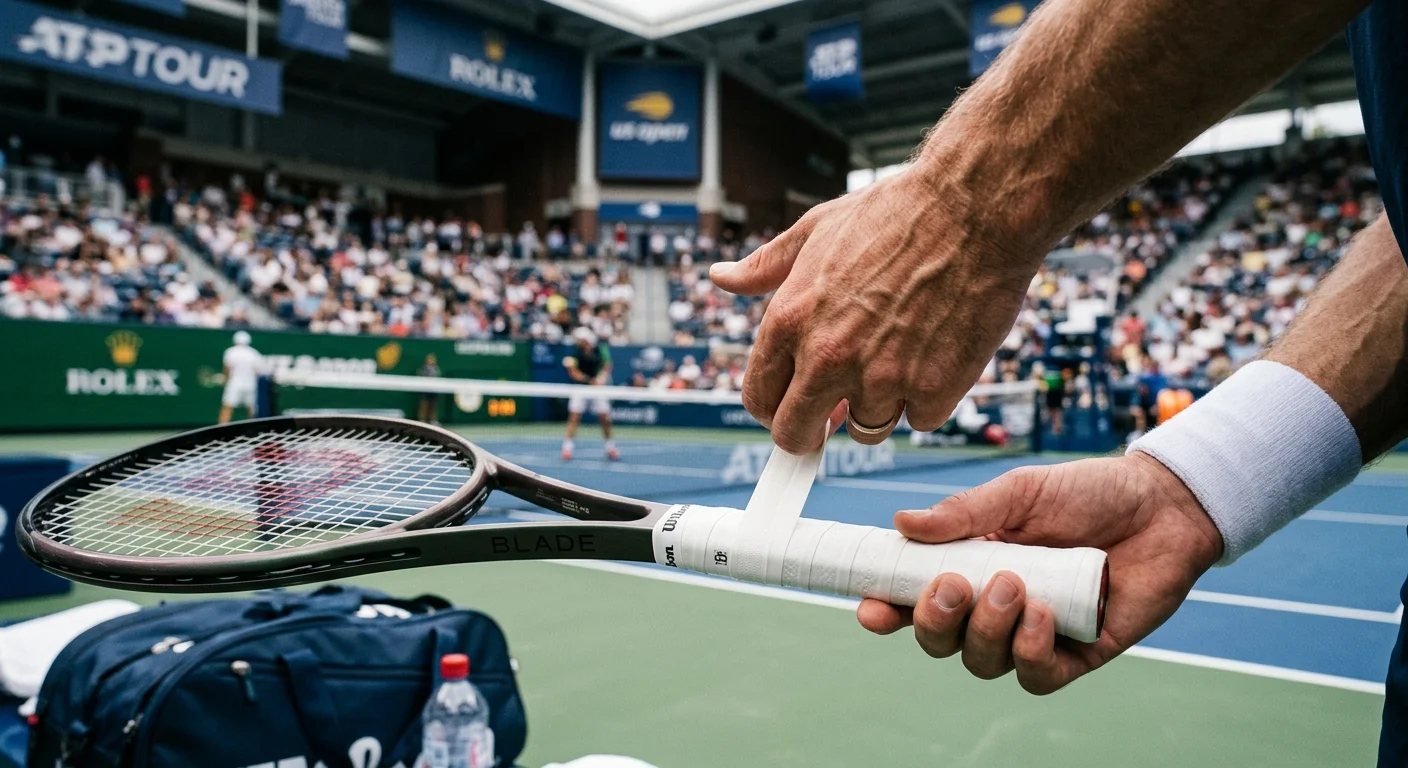
Used by professional tennis apparel wholesaler networks for bundled gear solutions.Watch any pro warm up. Before the first ball flies, there's a ritual — peeling off old grip tape, wrapping fresh overgrip with steady hands. It's not superstition. It's science.
Tennis overgrip and grip tape are the single most direct point of contact between you and your racket. Get it wrong, and nothing else saves you — not your $300 frame, not your custom string job.
What the Pros Use
Denis Shapovalov, Frances Tiafoe, Stan Wawrinka, and Nick Kyrgios all play with Yonex Super Grap (0.6mm, 6g). It offers high tack and strong moisture absorption. That's what you need in a third-set tiebreak, with sweat on your hands and everything on the line.
On the ATP and WTA circuits, Tourna MegaTac is another firm favorite. Why? It lasts. This grip holds up for 20–30 hours of play — longer than most options on the market.
Here's a quick breakdown of the top pro-level overgrips:
Overgrip | Thickness | Weight | Best For |
|---|---|---|---|
Yonex Super Grap | 0.6mm | 6g | Tack + moisture absorption |
Wilson Pro | 0.55mm | 5g | Durability |
Head Prestige Pro | 0.6mm | 6.5g | Maximum tack |
Volkl V-Dry | 0.5mm | 5g | Sweat absorption |
Tourna MegaTac | N/A | N/A | Long-lasting, pro circuit staple |
How Often Should You Change It?
Most recreational players get this wrong.
Pros and frequent players : Replace after every 1–2 sessions
Recreational players : Every 3–6 hours of play
Heavy sweaters : Change the moment it feels slippery — don't wait
A simple rule: change your overgrip as many times per month as you play per week. Play twice a week? Swap it out eight times a month.
The Right Way to Wrap
Technique matters more than most players think:
Start at the butt cap — anchor the end tight and flat
Overlap each layer by about 1/3 of the grip width
Keep steady tension — pulling too hard kills the cushioning
No wrinkles, no gaps — each flaw cuts your control on contact
The payoff? You get a sticky, non-slip surface. It stops the racket from twisting on fast serves, guards against blisters, and keeps your shots sharp under pressure.
Bottom line : A fresh overgrip costs less than $3. The improvement it gives you is worth far more than that.
2. Vibration Dampeners — How Nadal Protects His Arm During Heavy Topspin Rallies
Insights from the tennis racket accessories suppliers ecosystem.Nadal strings his Babolat Pure Aero at 55 lbs year-round . That's on the high end of the ATP Tour. Most pros keep polyester in the 40s. Higher tension creates a stiffer response. Stiffer strings send sharper vibrations straight up the frame and into your arm.
His solution? The Babolat Custom Damp . Small, simple, costs almost nothing.
What the Science Says
A 2006 ITF study found that dampeners don't cut vibration at the handle by much. A University of Birmingham study reached the same conclusion. Dampeners change the sound and frequency of vibration — not the raw intensity.
So why does Nadal use one? Frequency matters. A smoother vibration pattern puts less stress on your arm. Across thousands of topspin groundstrokes per season, that difference builds up. Over a 20-year career, it adds up fast.
Button vs. Worm Dampener
Nadal has used both:
Button dampener — his go-to for most matches, sits between the main strings
Worm dampener — used for specific match conditions
He's not alone. Agassi, Sampras, Serena, Djokovic, and Sharapova have all used dampeners on a regular basis.
The takeaway : Don't buy a dampener expecting injury prevention. Buy it for comfort, consistency, and the mental edge of a cleaner-feeling hit.
3. Smart Swing Sensors & Racket Analyzers — Data-Driven Training Like the Pros
Driven by innovation from the greatest tennis gear factory leaders.The smart tennis sensor market hit $145 million in 2024 . By 2028, analysts project it reaches $750 million . That kind of growth doesn't happen because a gadget looks cool. It happens because the data works.
What These Devices Measure
Clip a sensor onto your racket handle or string dampener. Here's what you get:
Swing speed and ball speed — measured to within 3.59 mph accuracy
Ball impact location — pinpointed to 3.03 cm on the string bed
Stroke type classification — 96.75% accuracy across six different shot types
Spin rate, racket angle, and shot power
Sweet spot contact frequency per session
One validated study tracked 21,477 strokes across 75 junior matches. It confirmed strong accuracy for forehand/backhand counts and ball speed detection. That's not marketing language — that's peer-reviewed performance.
Two Products Worth Knowing
Sony Smart Tennis Sensor attaches to your racket frame. It captures every stroke, then syncs via Bluetooth. From there, it generates filtered video clips — sorted by swing speed thresholds you set yourself.
SmartDampener takes a different approach. It's built into a standard vibration dampener. No extra hardware needed. Slide it into your strings, and it starts tracking string vibration patterns and racket motion at the same time.
Who's Buying These?
The market breakdown tells a clear story:
Amateur players: 20 million units
Professional players: 10 million units
Coaches: 5 million units
Amateurs are driving adoption at twice the rate of pros. Why? Pros have full coaching staff and video analysis. You don't. A $100 sensor gives you the same objective feedback that used to cost thousands in biomechanical lab time.
The honest trade-off : The upfront cost is high. There's also a short learning curve to read the analytics platform. But once you understand your data, you stop guessing. You start improving with a clear plan.
4. Wearable Performance Monitors — Recovery & Endurance Tracking Used by Top ATP Players
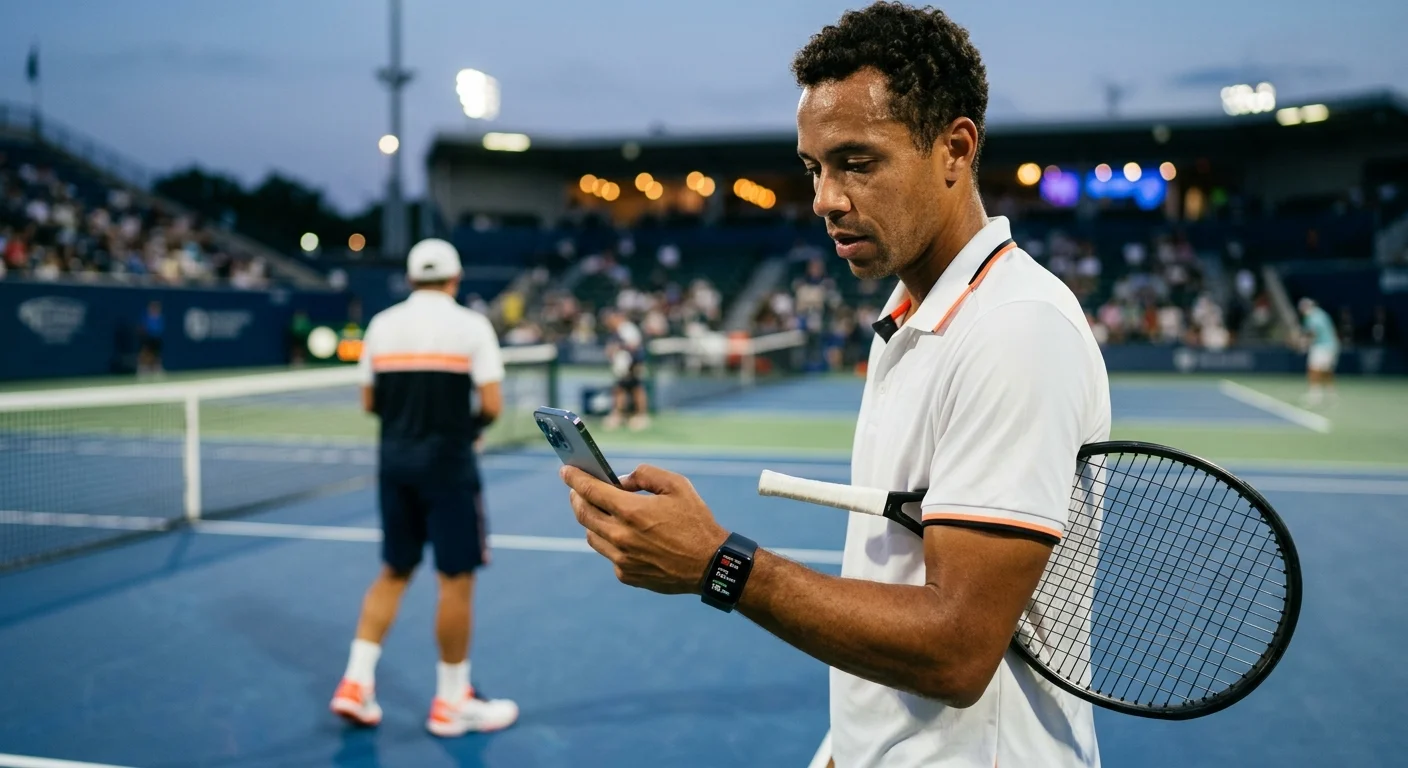
The ATP didn't approve wearables for in-competition use until July 15, 2024 . That date matters. This technology moved from "interesting experiment" to "serious performance tool" faster than most people expected—something any Custom tennis apparel & accessories services provider is now closely integrating into product development.
Two devices got the green light — STATSports and Catapult . Both feed data straight into the ATP Tennis IQ dashboard . That platform is locked to players and their support teams only. By 2025, the system grew to cover 2,000 players . It combines wearable data with scouting video and real-time physical performance metrics.
WHOOP: The Recovery Engine Behind the Numbers
WHOOP takes a different path. The WTA adopted it as their first official in-match fitness tracker in 2021. The ATP followed. Models 3.0, 4.0, 5.0, and MG are all approved.
WHOOP doesn't track swing speed. It tracks readiness . Each morning, it reads your heart rate variability, sleep data, and stress levels. Then it gives you two scores:
Recovery Score — shows how much your body has bounced back
Strain Score — tracks total exertion to stop overtraining
You get injury prevention sitting right on your wrist.
The Controversy Nobody Saw Coming
Here's the twist. By Australian Open 2026 , top players started pulling their WHOOP bands off before matches. Their argument? Live heart rate and recovery data gave opponents an unfair competitive advantage . Tennis Australia agreed. They banned wearables during play.
The data got too good. That's not a flaw. That's proof it works.
5. High-Performance Wristbands & Headbands — The Sweat Management Gear Alcaraz & Djokovic Never Skip
At the 2024 Australian Open, a chair umpire stopped Carlos Alcaraz minutes before a quarterfinal match. Not over conduct. Not over equipment. Over a wristband.
Under his standard tennis wristband sat a WHOOP fitness tracker . Alcaraz stayed calm: "It helps monitor recovery and training load — but tournament rules are rules. Take it off and keep going." He complied. Then he reached the quarterfinals anyway.
That moment highlighted a shift: wristbands are no longer just sweat accessories—they’re part of a broader performance system, something even a greatest tennis gear factory would now engineer with both function and data compatibility in mind.
What This Means for Your Game
For recreational players, the core job stays the same. A good tennis wristband keeps sweat off your palm and protects your grip. Still, the standard pros hold themselves to has moved way beyond that.
Here's what to look for:
Sweat absorption — thick terry cloth or microfiber pulls moisture away fast
Compression fit — stays locked in place through every serve and overhead
Wrist support — light compression cuts fatigue during long baseline rallies
Grand Slam officials banned wearables. Players lost some tools — but not all their performance data. Tournament systems like Bolt 6 filled the gap. These systems track distance covered, directional changes, acceleration events, and shot speed — no device on the wrist needed.
The bottom line : Pick wristbands and headbands built for real sweat volume, not looks. Your grip depends on it.
6. Resin Blocks & Grip Enhancers — The Secret Weapon in Humid Match Conditions
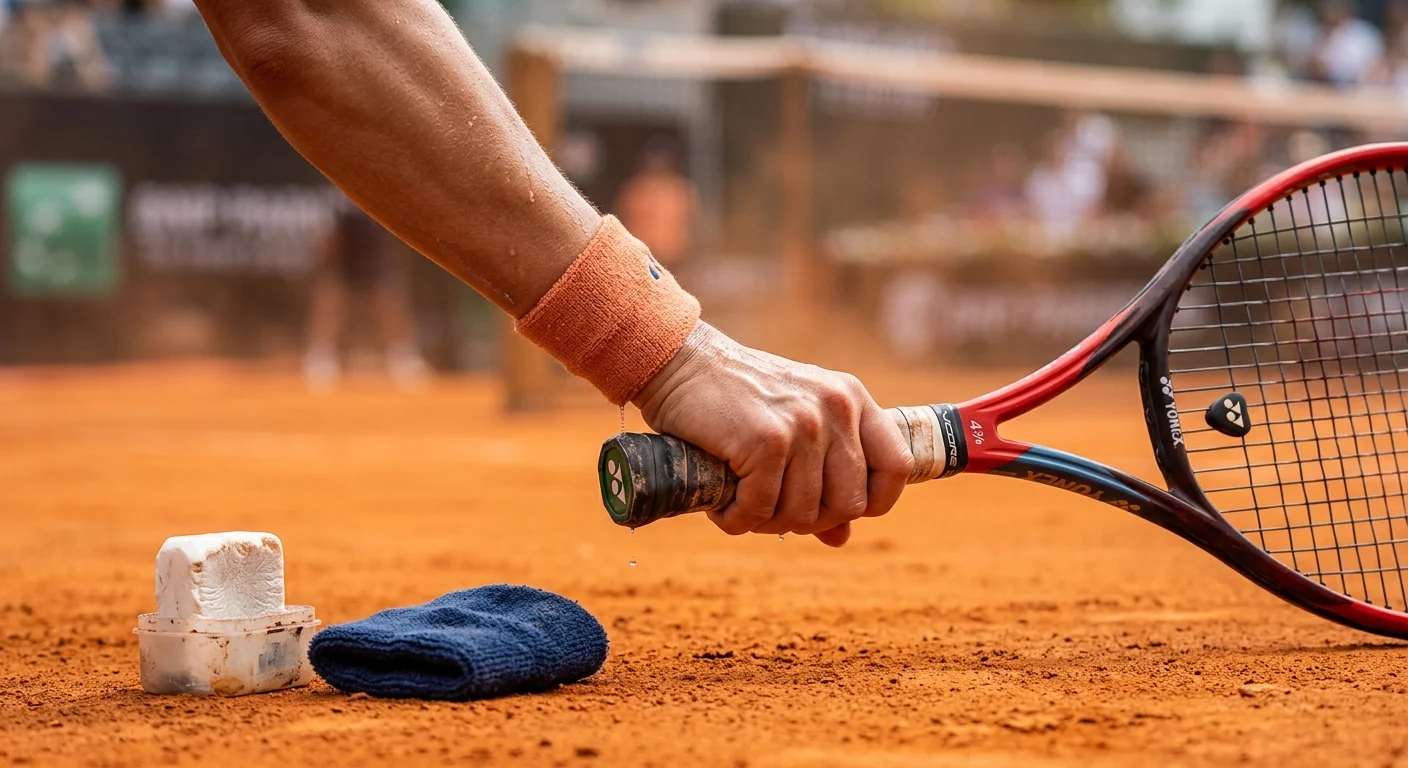
Humidity is a silent match-wrecker. No overgrip survives a brutal summer clay session with sweat pouring off your hands — that's where resin blocks and grip enhancers come in.
These aren't mainstream. Most recreational players have never touched one. But walk into any locker room at Roland Garros or the Miami Open. You'll find them tucked into almost every pro's tennis bag essentials kit.
Why Grip Traction Is a Physics Problem
Here's the core issue: a slipping racket doesn't just hurt your comfort — it kills your accuracy. Research on grip materials shows that worn or slick surfaces can almost double your accuracy loss on off-center strikes. Resin-based compounds — especially elastomer formulations — beat standard rubber grips by cutting torque at the moment of impact. So even mishits land closer to where you aimed.
Think about what that's worth in a third-set tiebreak.
What Grip Enhancers Do
Resin blocks put a thin, tacky layer onto your tennis overgrip or bare grip surface. Use it between games. A few quick rubs bring back the tackiness that humidity and sweat have stripped away. No re-wrapping needed.
The performance gains are real:
1.Accuracy — less torque keeps the racket face more stable through contact
2.Control — your grip pressure drops on its own once your hand feels secure, which eases tension in the forearm
3.Consistency — same feel from game one to game three, no matter the court conditions
Cost? Most resin blocks run under $10. For what they deliver in humid conditions, that's one of the best-value purchases in your whole tennis bag essentials lineup.
Play outdoors in summer? Compete in humid climates? This belongs in your bag. Full stop.
7. String Savers — How Spin-Heavy Players Like Ruud Extend String Life by 30%+
Casper Ruud's topspin numbers are brutal on strings. That aggressive snapback — the constant lateral friction from heavy RPMs — chews through a standard setup 30% faster than flat-hitting styles. That's not a minor inconvenience. That's a real cost problem.
Here's how spin-heavy players solve it.
The String Choice That Changes Everything
Polyester strings are the only real option for Ruud-level topspin. They produce 25% more spin than nylon . Plus, they last 2–3x longer under heavy friction. Coated co-poly blends push that even further — they cut internal string movement and hold up better over time.
Gauge selection is a direct trade-off:
1.16G (thicker) — better durability, strong playability balance for recreational spin players
2.17G–18G (thinner) — maximum spin output, but expect 30–50% shorter string life
Ruud plays the thin-gauge game. His trade-off: restring every 5–10 hours of play.
Four Ways to Extend String Life by 30%+
1.Use coated co-poly strings (like Solinco Outlast 18) — less internal friction, better snapback durability
2.Drop tension 5–10% from your baseline — lower tension cuts breakage risk and extends life by 20–30%
3.Hybrid thicker mains (16G poly) — adds durability without sacrificing spin
4.Play indoors where you can — indoor conditions alone add 20% more string life compared to outdoor heat and humidity
Bottom line : Strings are a recurring cost. Pick the right gauge, set your tension lower, and choose the right string type. You keep that cost under control — without giving up the spin that wins you points.
8. Electronic Stringing Machines & Portable Tensioners — Precision Tension Control Like Tour Stringers
Tour stringers don't guess. They calibrate.
Every racket in a pro's hands before a Grand Slam match gets strung on an electronic machine with ±1% tension consistency — sometimes tighter. That's not a luxury detail. It's the gap between a racket that performs the way you expect and one that costs you points without you knowing.
Constant Pull vs. Lock-Out: Why It Matters
Most players never hear about this mechanic. Strings stretch after you pull tension. A lock-out machine sets the value and stops there. A constant pull system keeps adjusting — it holds the target tension as the string relaxes. The result? Final tension runs 5–10% more accurate than lock-out machines.
Electronic machines like the Yonex Precision 9.0 push this even further:
Dual sensors calibrate to 1/1,000,000th of a meter
Tension adjustments down to 0.1 lb increments
Nine pull speeds
Pre-stretch settings from 1–20%
Built in Japan
Nothing gets left to chance.
The Siboasi S6 delivers similar precision at a lower price point. You get microcomputer control, four pre-stretch sets, four tension memory slots, and an auto-start linear gripper. Set your tension profile once. The machine recalls it every session.
What This Means for Your Game
You don't need a tour stringer. But restringing on a regular basis — or caring about consistent string tension — means the right machine pays for itself fast. Precision stringing protects your tennis string accessories investment. Plus, every session feels the way it should, without surprises.
9. Pro-Level Tennis Bags with Tech Features — Carry Your Gear Like a Tour Player
Tour players treat their bag like a mobile equipment station — not a duffel.
Everything has a place. Rackets stay shielded from heat and cold. Sweaty shoes never touch clean clothes. Drinks stay cold through a three-hour match. That kind of organization is built in on purpose. It's designed from the ground up.
What Separates a Pro Bag from a Regular One
The ADV Pro V3 is a solid starting point. It holds up to 10 rackets in a 62L frame that weighs just 3.8 lbs. You get YKK zippers and a weatherproof Korda nylon shell. There's a built-in cooler pocket too. A separate toiletry pocket keeps sunscreen away from the rest of your gear.
The compartment layout matters just as much as the size:
Ventilated shoe section — isolates sweat and prevents mold
Side panel — fits a laptop, tablet, or match journal
Quick-access pocket — phone, keys, wallet, done
Thermo-lined racket compartments — shield strings from heat and cold
Top-tier bags also work in multiple ways. Detachable straps let you switch from backpack to duffel in seconds. Travel versions roll into airplane overhead bins. Lockable zippers and a rigid frame keep everything secure on the road.
The hardware matters too. Reinforced stitching and heavy-duty zippers hold up under real weight. You're hauling 12 rackets, six water bottles, and a full kit change. Cheap zippers won't last the season.
10. Training Aids & Grip Strength Tools — The Off-Court Conditioning Secret of Sinner, Pros
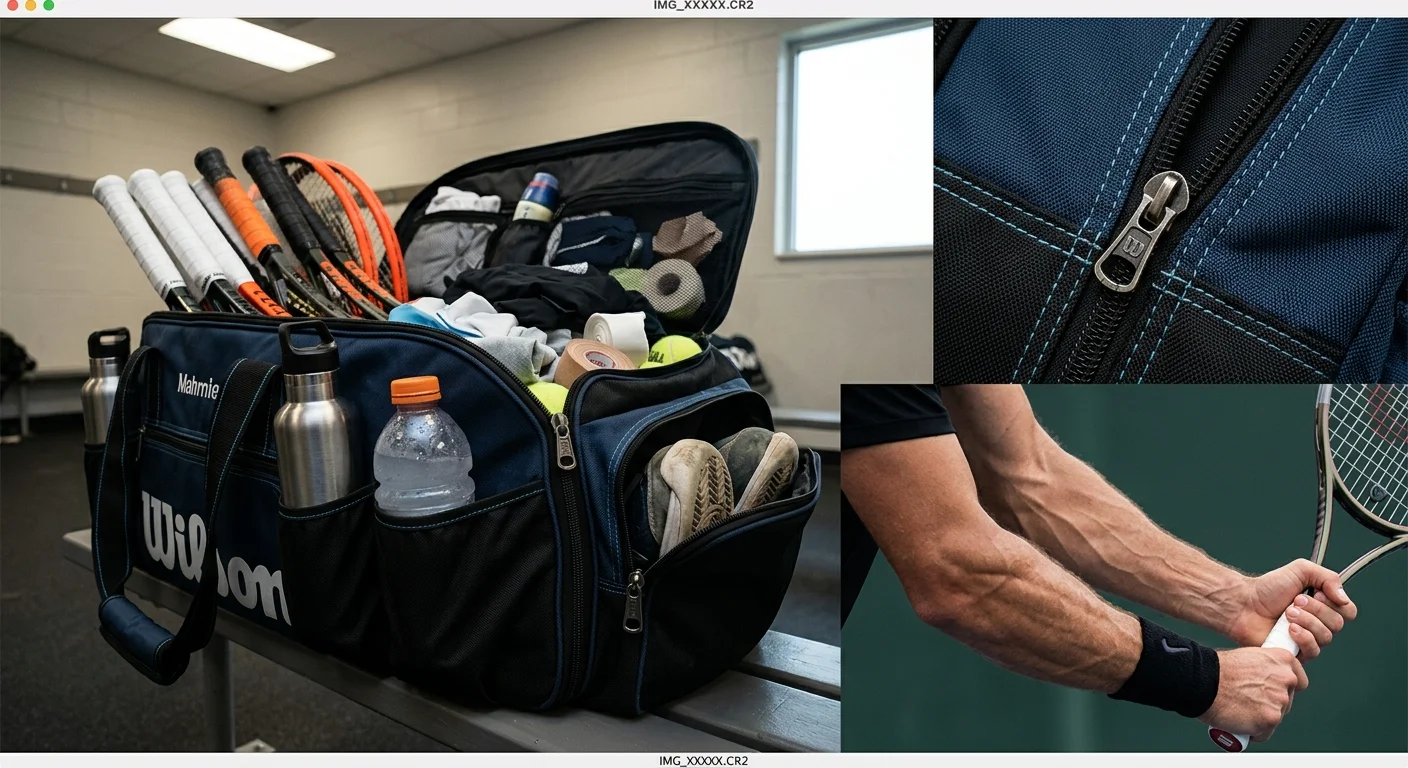
Jannik Sinner's forearm volume grew 10% in a single training cycle . That didn't happen from hitting more forehands.
Since 2020, Sinner has worked with Dr. Riccardo Ceccarelli on "mental economy training." It pairs a physical trainer with a psychologist. The physical side focuses on fast, precise movements with relaxed muscles. Not brute force. Controlled tension. Think 10–15 second holds at 80% max grip — not white-knuckle squeezing.
The result? ATP top-10 players average 120–150 kg isometric grip strength . Sinner hit 140 kg after his 2024 training block.
The Three Tools Behind the Numbers
1.IronMind Captains of Crush — progressive resistance from 60 lbs to 280 lbs; the gold standard for crushing grip
2.Theraband FlexBar — targets forearm extensors head-on; the tennis-specific tool most players skip
3.Fat Gripz — adds 2–2.5 inches to any bar, increasing grip demand by 50–100% on every lift
The Sinner-Inspired Weekly Routine
1.Captains of Crush No. 1.5 (140 lbs) — 3 sets × 5–8 reps, 45s rest
2.FlexBar twists at green level (15 lbs) — 3 × 10 per arm
3.Fat Gripz dead hangs — 3 × 30–45 seconds
4.Relaxed pinch grip drill (10–20 lbs) — 10 reps at 1s explosive/3s hold
Eight weeks of steady work builds 15–20% better grip endurance . It also cuts late-match fatigue by 25% in five-set conditions.
That's the off-court edge most players leave on the table.
How to Build Your Pro-Inspired Tennis Gear Setup on Any Budget
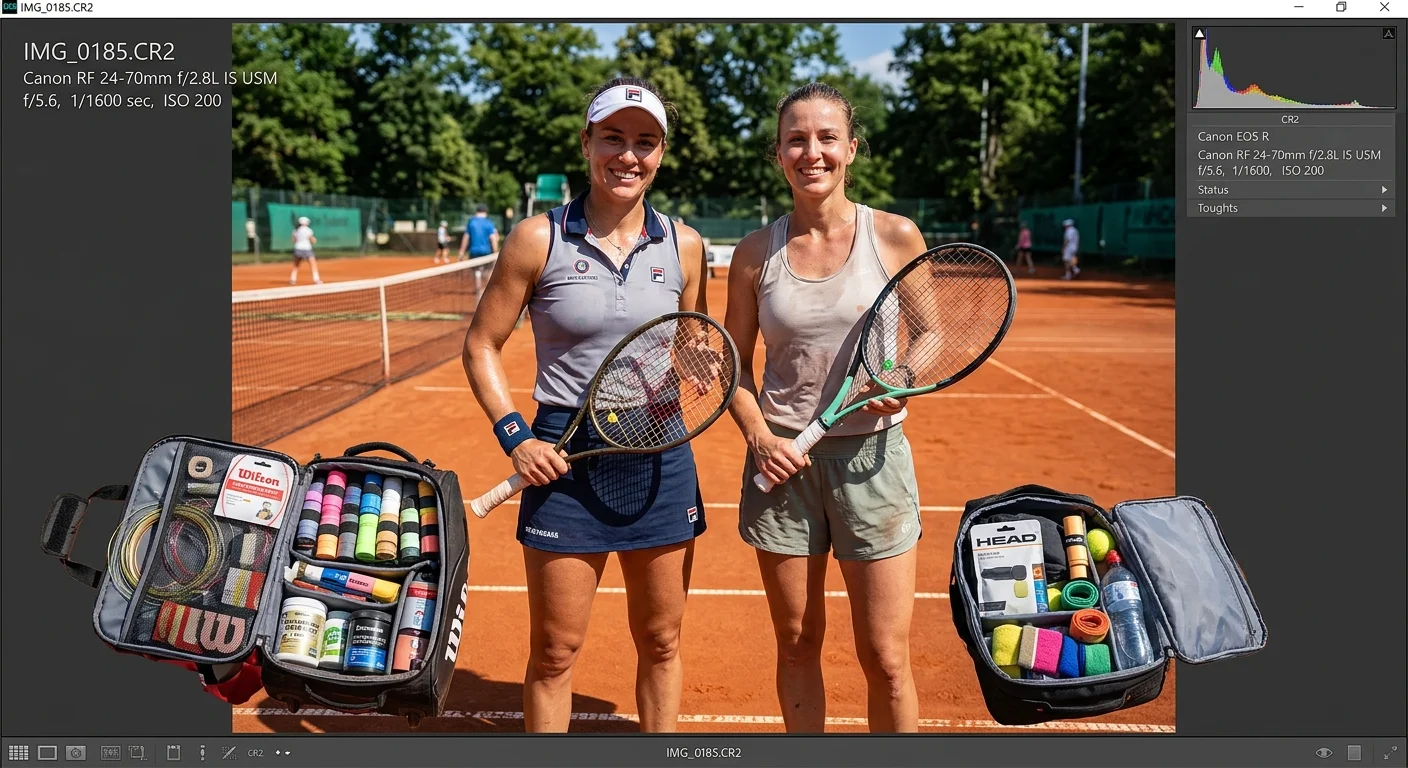
The gear gap between pros and recreational players is smaller than you think — and cheaper to close.
You don't need to spend $500 to get the same functional setup Tour players use. Spend smart instead. Here's how to do it at two price points.
The $168 Starter Setup
This covers every essential without waste:
Racket : Dunlop CX 200 LS (~$100) — lighter frame, forgiving for developing players
Strings : Head Synthetic Gut 3-pack (~$8) — reliable, affordable, gets the job done
Overgrip : Wilson Pro Overgrip — the same grip tape pros trust, under $5
One pro tip: demo rackets before buying. Most pro shops let you borrow frames for free. Major brands often put discontinued models on clearance for under $100 . That's a Tour-pedigree frame at a beginner price.
The $234 Upgrade Path
As your game develops, here's the next step up:
Racket : Head Boom MP — better control, tour-level feel
Strings : Head Velocity — more pop, longer playability
Overgrip : Yonex Moist Super Grip — the same overgrip Shapovalov trusts
The Non-Negotiables at Any Budget
Whatever you spend, never skip these:
Fresh tennis balls — dead balls kill your feel and feedback
Breathable athletic clothing — performance apparel shapes how you move and feel on court. Good clothing reduces friction and keeps you cool during long rallies.
Proper footwear — go with tennis-specific or non-marking athletic shoes. Cross-trainers work fine to start.
Build the foundation first. Add the accessories as your game grows.
FAQ: What Tennis Accessories Do Pro Players Use Every Match?
You've read the full breakdown. Here are the questions players ask most — answered straight.
Q: Do pros really change their overgrip every single match?
Most do. Many change mid-match — especially in a tiebreak. A fresh tennis overgrip costs under $3. A slipped racket in a fifth set costs far more.
Q: Is a tennis vibration dampener worth it?
It won't save your arm. Science is clear on that. But it changes the feel of every hit — smoother contact, less mental distraction. Nadal has used one for 20+ years. That's not nothing.
Q: What tennis bag essentials do pros carry courtside?
Every match bag covers the basics:
Fresh tennis grip tape
Spare overgrips
A tennis towel
A tennis wristband (sometimes double-stacked)
A tennis elbow support if needed
At least two pre-strung rackets
No guessing mid-match.
Q: Do pros use tennis ball hoppers during warm-up?
Every time. A tennis ball hopper keeps practice moving — no chasing balls, no breaks in rhythm. You'll find it as standard kit from junior academies all the way to Grand Slam practice courts.
Q: Which brands do pros trust?
Wilson, Babolat, Head, Yonex, and Tecnifibre dominate the Tour. But the accessory — not the logo — wins points.
Conclusion
The difference between a club player and a pro isn't just talent — it's the details hiding in their bag.
Your overgrip stops the racket from flying out on a pressure point. Your vibration dampener protects your elbow through a 3-hour grind. Every tennis racket accessory on this list exists for one reason: it solves a real problem that real players face.
You don't need to spend like Djokovic to play smarter. Pick two or three upgrades that fix your biggest weaknesses on court — better grip, less fatigue, cleaner swings. Build from there.
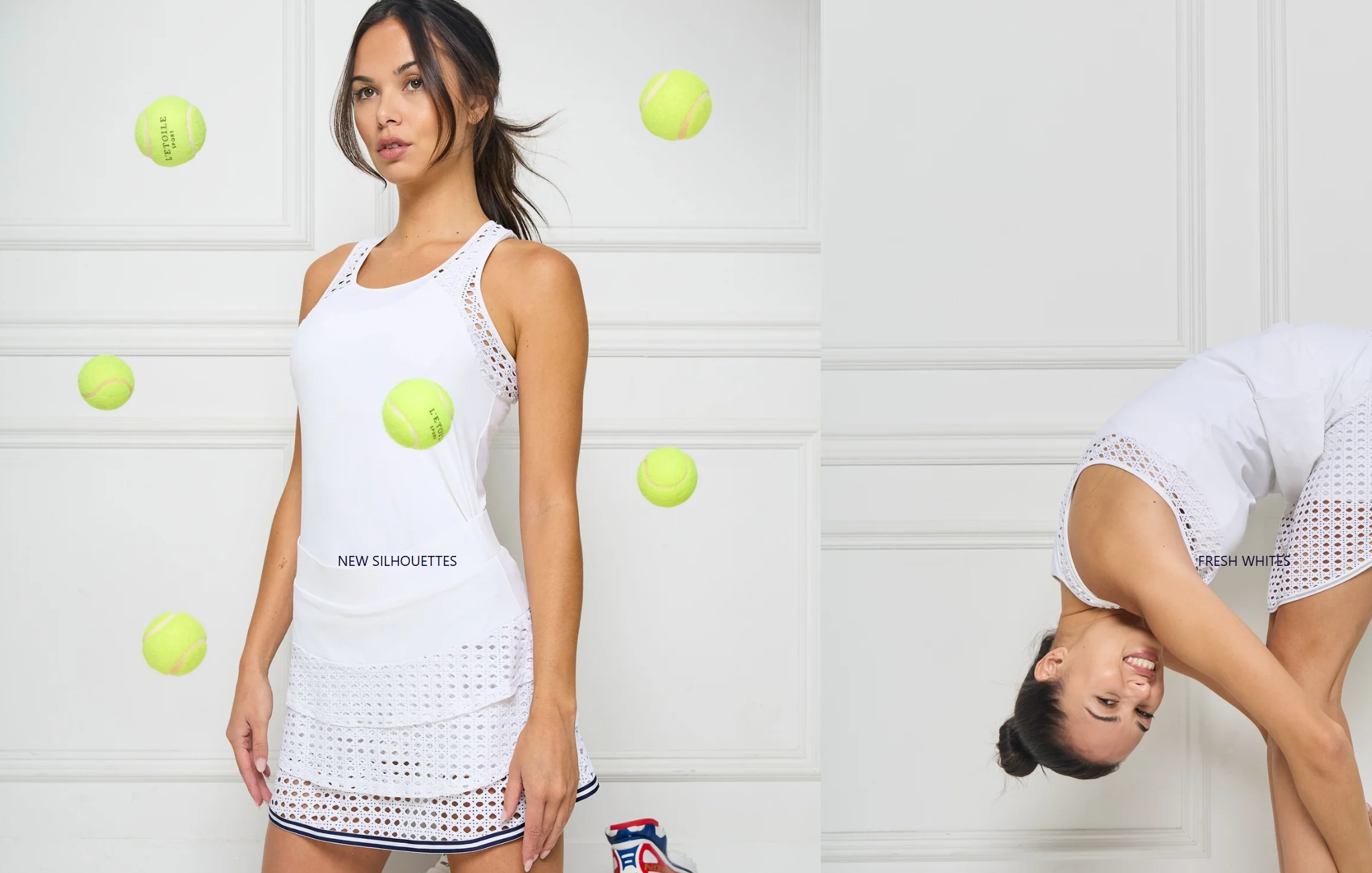
Also, don't overlook what you're wearing while you dial in your gear. The right tennis apparel moves with you, not against you. Check out Berunclothes's performance tennis collection to complete your pro-inspired setup from the ground up.
Get every detail right, and confidence walks onto the court before you do.