Some days, stress skips the warning signs. It sneaks into your shoulders. Your chest feels tight. Everything seems heavier than normal.
You might carry the weight of a rough week. Or maybe that constant anxiety won't stop. Either way, your body knows exactly what it needs. It needs to slow down .
Good news. You don't need a gym membership. You don't even need a whole hour of free time or years of practice.
These six calming yoga poses act as a quick reset. You get a gentle routine backed by science. Do them right now in your living room. You can even stay in your pajamas. I do recommend better activewear once this becomes a regular habit. High-quality, breathable clothes from professional yoga apparel suppliers change the experience. Good gear lets your body move freely. Your deep stretches feel much easier. This upgrades your whole routine.
Here is what each pose does:
Some release deep tension in your hips.
Others tell your nervous system to calm down.
Each move handles a specific job.
Finish all six poses. You might finally feel like yourself again.
Pose 1: Child's Pose (Balasana) — Your First Line of Defense Against Anxiety
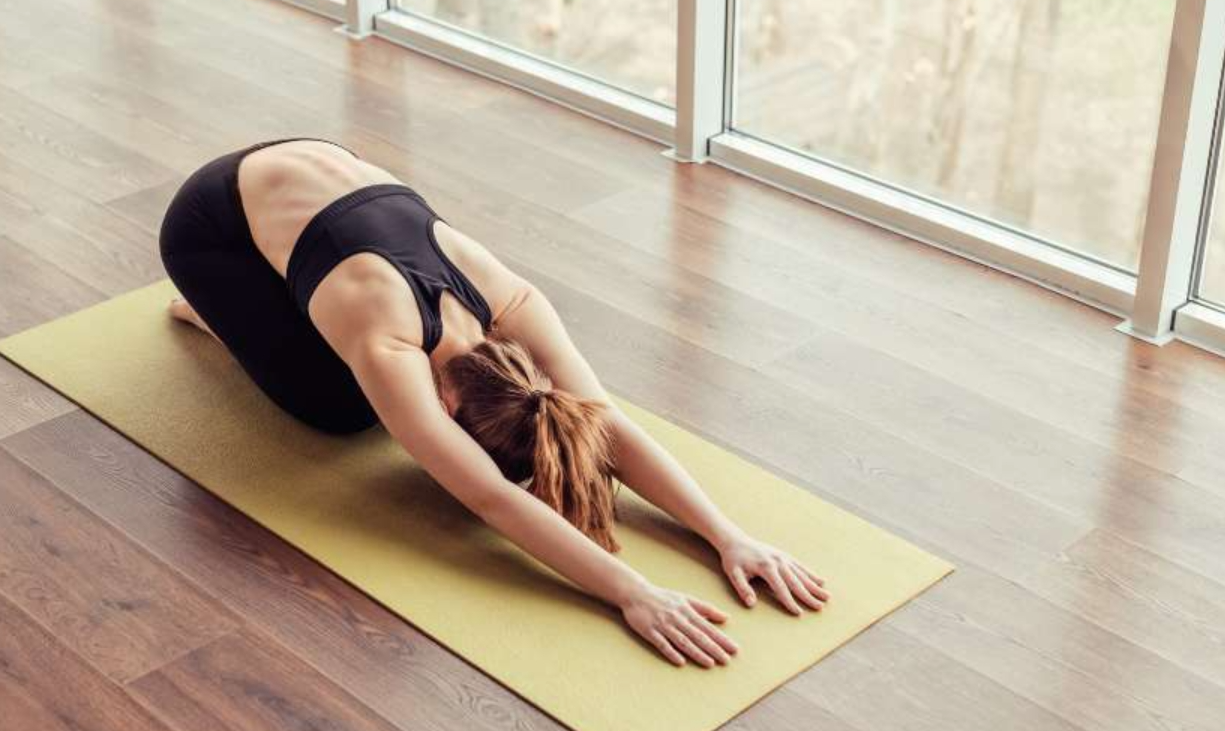
Yoga teachers always come back to this one. There's a good reason for that. Child's Pose isn't a rest stop between harder things — it's a full neurological reset, hiding in plain sight.
How to do it:
- Kneel on your mat, big toes touching, knees hip-width apart
- Sit back onto your heels
- Fold your torso forward, letting your forehead rest on the mat
- Extend your arms in front of you, or lay them beside your body
- Breathe slow and steady, and hold for at least 60 seconds
Looks simple? It is. But what's happening inside your body is far from ordinary.
Why This Pose Works (The Science Is Fascinating)
Your forehead touches the floor. Right away, something called the oculocardiac reflex kicks in — your heart rate starts to drop. The slight chin tuck from the forward fold also triggers the vagus nerve . This activates what researchers call the "vagal brake" — your body's built-in brake on the stress response.
Your chest presses against your thighs. That makes normal belly breathing impossible. So your body switches to slow, deep rib and back expansion instead. That's not a flaw in the pose. That's the pose doing its job. It pulls your focus inward, ties you to your breath, and gives you back a sense of control.
The benefits build over time. A 2017 study tracking 100 medical students found that five minutes of Balasana daily for 90 days led to measurable drops in both blood pressure and resting heart rate. Research also connects regular practice to higher GABA levels in the brain — the neurotransmitter that actively calms anxiety signals.
Modifications Worth Knowing
Anxiety or claustrophobia making this feel like too much:
- Keep your eyes open
- Lift your forehead a little off the mat
- Stretch your arms forward to feel more open and less closed in
Knees giving you trouble: Tuck a folded blanket or bolster between your thighs and calves. Comfort is not a compromise here — it's part of the practice.
Child's Pose meets you right where you are. That's why it's always the right place to start.
Pose 2: Cat-Cow Pose (Marjaryasana-Bitilasana) — Reset Your Nervous System with Breath
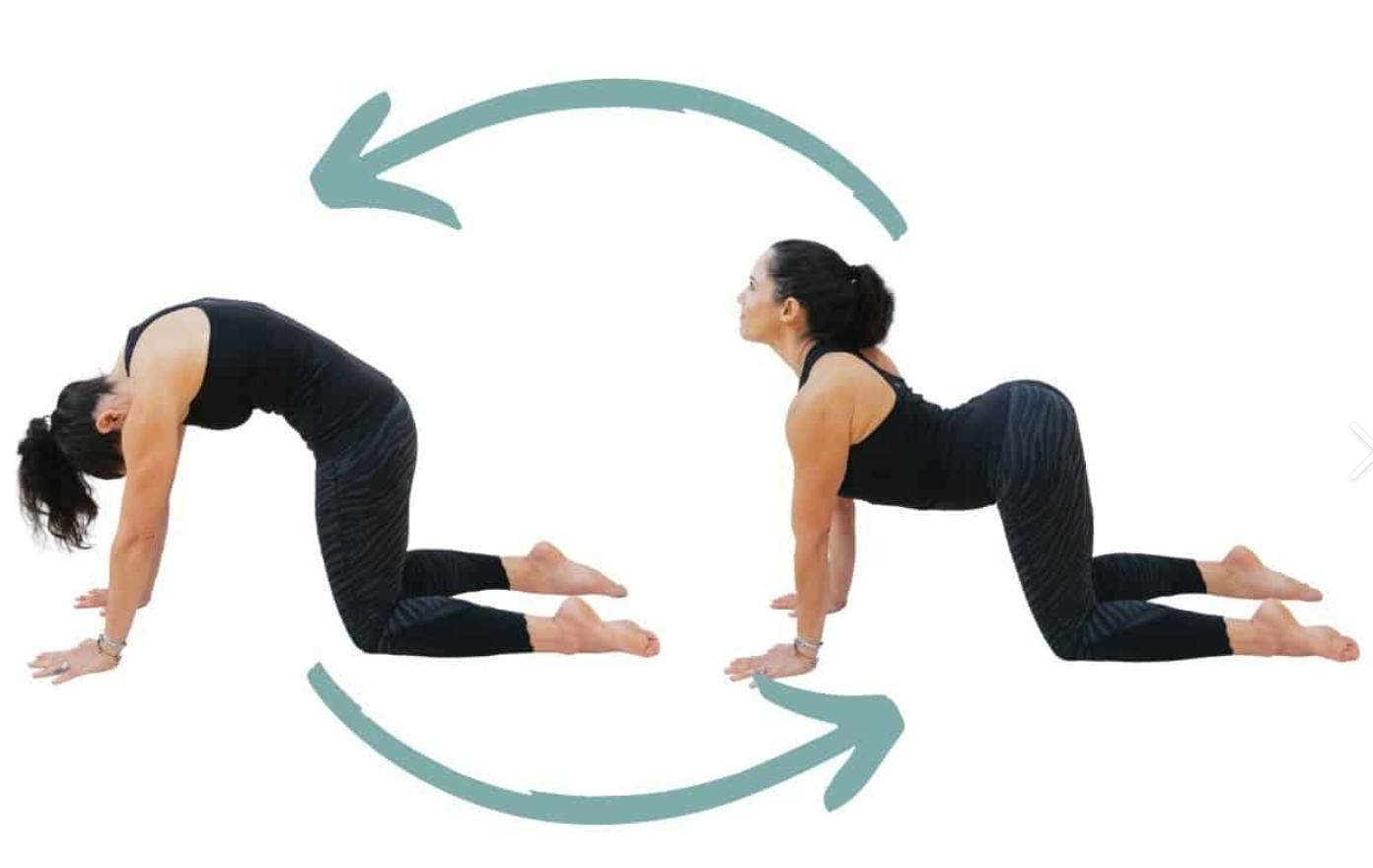
There's something almost meditative about movement that breathes with you.
Cat-Cow is that — a rhythmic, flowing conversation between your spine and your breath. Most people overlook it in a stress relief yoga sequence. Once you feel it working, though, you'll get why it belongs in every calming yoga practice.
How to do it:
- Come to all fours — hands shoulder-width apart, knees under your hips
- Inhale into Cow Pose: Let your belly drop toward the floor, arch your spine with care, lift your head and tailbone — hold for 10 seconds
- Exhale into Cat Pose: Round your spine upward toward the ceiling, tuck your chin to your chest, draw inward — hold for 10 seconds
- Flow through 5–6 full cycles, letting the breath lead the movement, not the other way around
Why the Breath-Movement Sync Is Everything
This isn't stretching for the sake of stretching. Each inhale-exhale cycle moves your full spine — cervical, thoracic, lumbar. At the same time, the steady rhythm settles your nervous system through repeated, mindful motion and body awareness.
The effect builds up fast, and it's real:
| Benefit | What Happens |
|---|---|
| Spine | Full mobilization through every vertebral region |
| Back Tension | Erector spinae release — low back pain eases |
| Core | Transverse abdominis and pelvic floor engage |
| Digestion | Abdominal organs receive a light internal massage |
| Mind | Breath-sync quiets anxiety and mental agitation |
One to two minutes of this flow — about 5–6 slow cycles — is enough to break a stress spiral during peak work hours. It also works as a counter-pose after long sitting sessions. Your rounded spine gets realigned. The lumbar tension that builds up all day starts to release.
The breath does the heavy lifting here. Let it.
Pose 3: Downward-Facing Dog (Adho Mukha Svanasana) — Flip Your Perspective on Stress
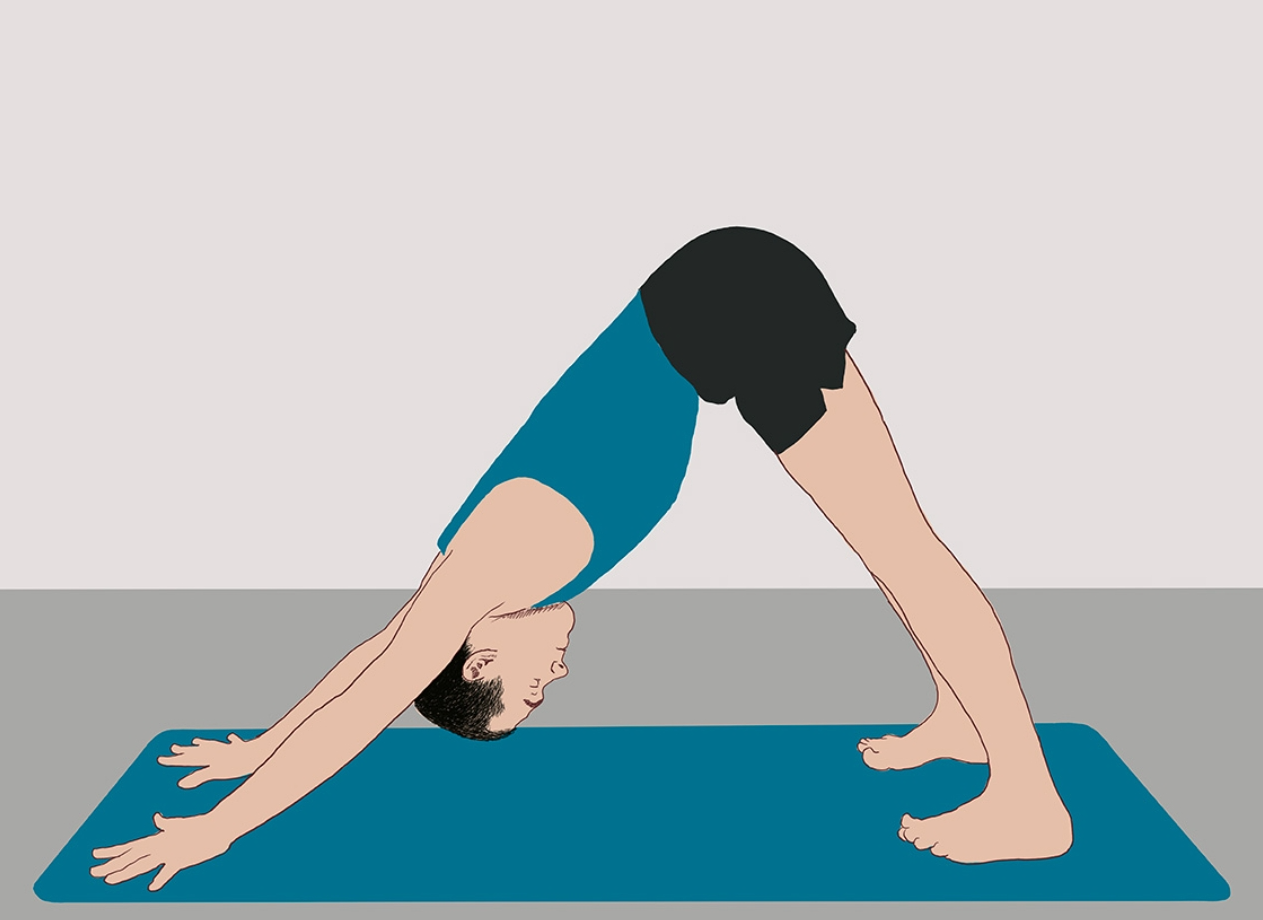
Downward-Facing Dog is the pose everyone recognizes — and almost everyone underestimates.
It looks like a transition. A pause between things. Hold it for a full minute, though. You'll feel it doing something real: it flips your entire relationship with gravity — and with stress.
How to do it:
- From all fours, tuck your toes and press your hips up and back toward the ceiling
- Form a clean inverted V-shape — hands shoulder-width apart, fingers spread wide
- Push your heels toward the floor (they don't have to touch — that's not the goal)
- Let your head hang loose between your arms, gaze drifting toward your navel
- Hold for 1–3 minutes, breathing slow and intentional
What the Inversion Does to Your Body
This pose stands apart from other calming yoga poses for one clear reason: your hips sit higher than your heart, and your heart sits higher than your head. That shift sends a fresh surge of oxygenated blood to the brain. Mental clarity improves. Cortisol levels drop.
Slow, deep breaths in this position wake up the parasympathetic nervous system — the relaxation response most people chase but struggle to reach. Your nervous system starts to settle. The mental noise fades.
Beyond stress relief, this pose builds real strength. Your arms, shoulders, hamstrings, glutes, and core all work at once — without it feeling like a workout.
Modifications That Make It Accessible
Tight hamstrings? Soften a generous bend in your knees. A flat back matters far more than straight legs.
Wrist discomfort? Place your hands on blocks, or press through your fingertips to spread the weight more evenly.
Discomfort here is feedback, not failure. Ease into it, and let the pose open on its own terms.
Pose 4: Seated Forward Bend (Paschimottanasana) — Turn Inward to Find Calm
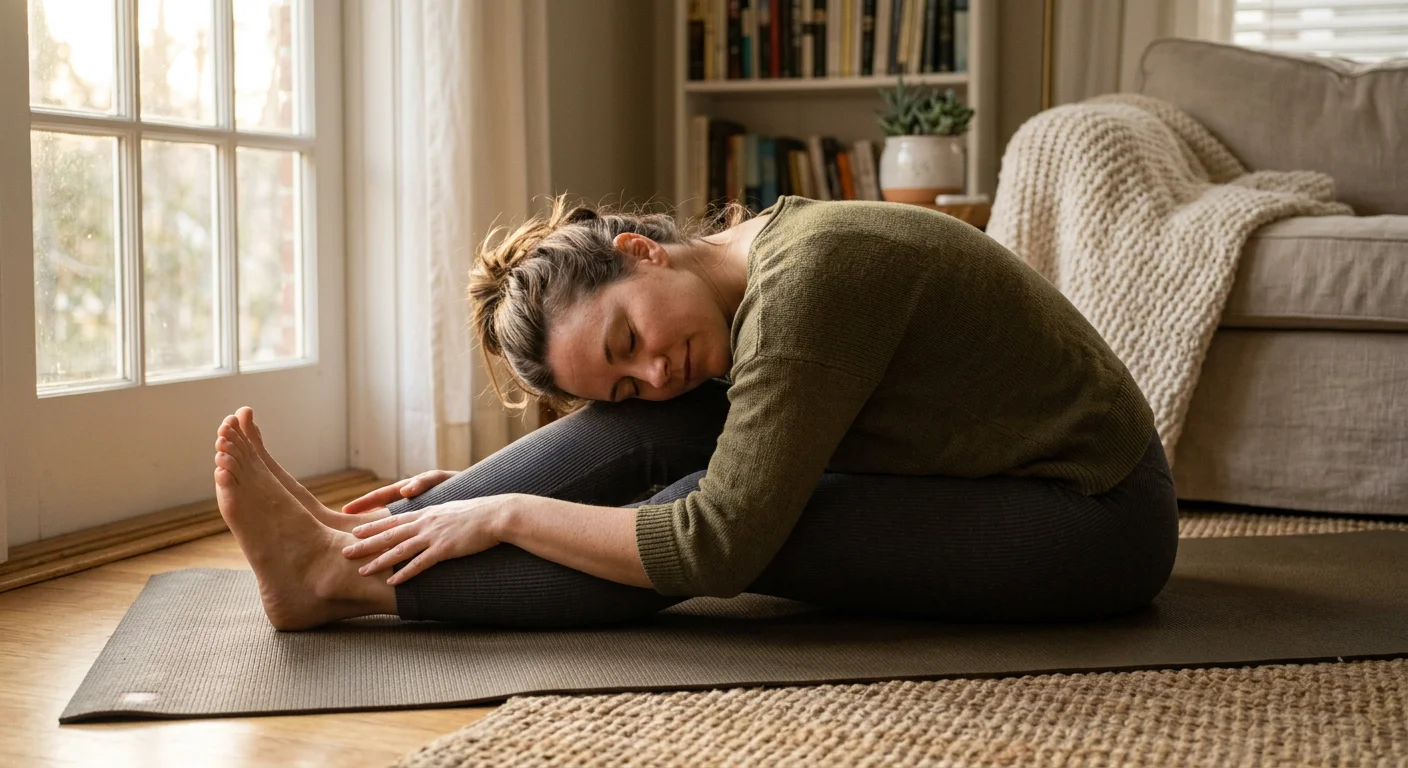
Tension doesn't just live in your mind. It settles into your hamstrings, your hips, the long muscles running either side of your spine. It waits there, silent, until something invites it to release.
Paschimottanasana is that invitation.
How to do it:
- Sit tall on your mat, legs extended straight in front of you, toes flexed upward
- Inhale — lengthen your spine and hinge forward from your hips , not your waist
- Exhale and fold forward. Reach for your feet, shins, or wherever your body lands today
- Soften your chest toward your thighs. Let your forehead follow
- Hold for 5–10 full breaths. With each exhale, let the fold go a little deeper
The Hip Fold That Changes Everything
Most people miss this distinction. It makes a big difference for both safety and benefit.
Folding from the hips keeps the spine long and neutral. The stretch spreads across your hamstrings, glutes, and lower back. Rounding from the lumbar spine compresses the L4-L5 vertebrae and can raise disc pressure by up to 50%. The cue is simple: think chest forward , not head down .
Why Going Inward Feels So Good
The forward fold does something real to your stress levels. Studies show forward-bending poses can reduce cortisol by 20-30%.
The gentle pressure on your abdomen also stimulates your liver, kidneys, and digestive organs. This helps your body produce more serotonin.
The pose also opens space for self-compassion. Deep, rhythmic breathing releases tension stored in the hips and pelvis. These are areas where the body tends to hold unprocessed stress over time.
Modifications by Flexibility Level
| Level | What to Do |
|---|---|
| Beginner | Loop a yoga strap around your feet, soften your knees a little, hinge from the hip |
| Intermediate | Sit on a folded blanket (1-2 inches) to tilt your pelvis forward and ease hamstring tension |
| Advanced | Hold your heels, draw your chest to your thighs, hold 1-3 minutes |
Stay here. Breathe slow and steady. Let the pose do what stillness does best — bring you back to yourself.
Pose 5: Legs-Up-the-Wall Pose (Viparita Karani) — The Cortisol Killer You Need Before Bed
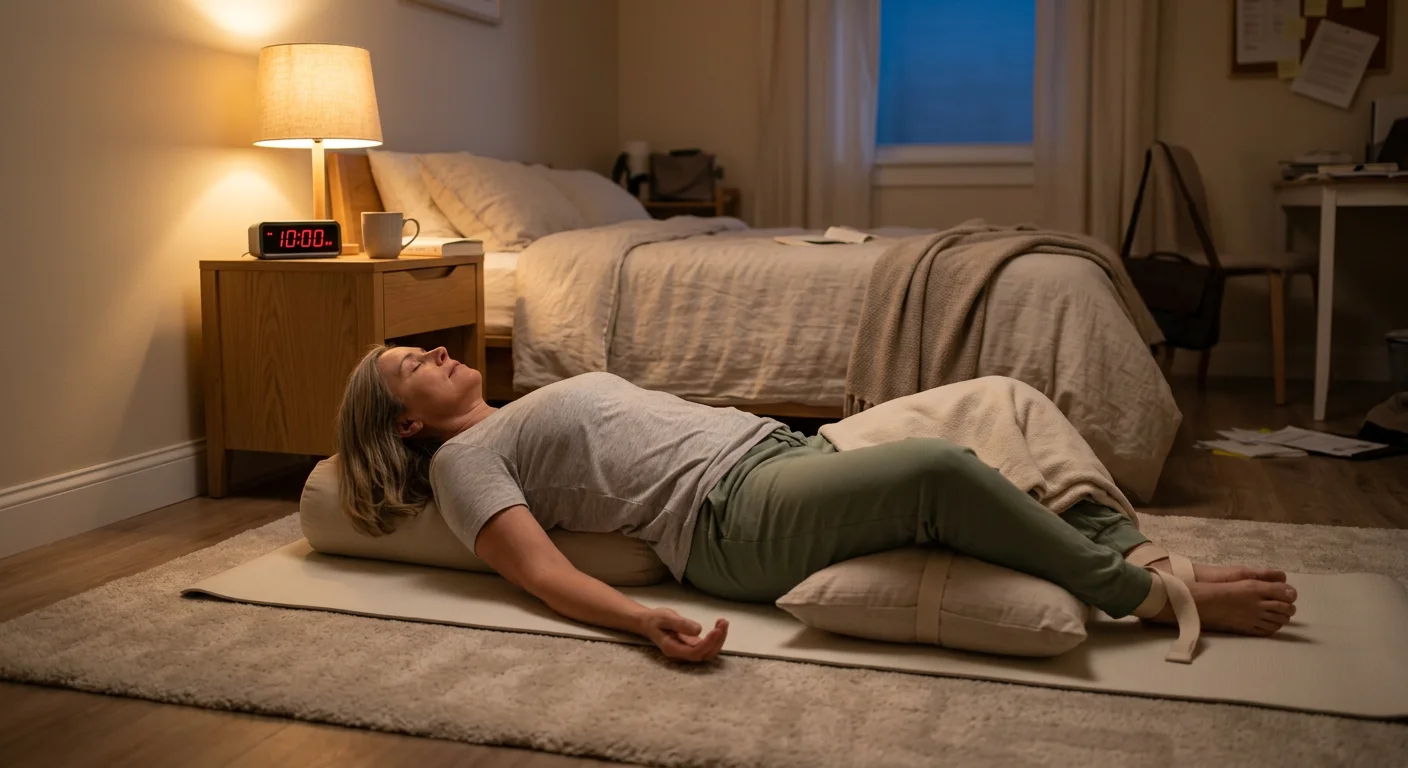
Here's something worth knowing: cortisol doesn't just spike during stressful moments. It stays in your bloodstream long after the moment has passed. That 3 p.m. work crisis? Your body may still be processing it at 10 p.m. That's why what you do before bed matters more than most people realize.
Legs-Up-the-Wall looks almost too easy to be effective. You lie on your back, scoot your hips close to a wall, and let your legs rest straight up against it. No balance required. No flexibility needed. Just you, a wall, and gravity doing the work in reverse.
How to do it:
- Sit sideways with one hip close to the wall
- Swing your legs up as you lower your back to the floor
- Let your arms rest open at your sides, palms facing up
- Close your eyes and breathe — hold for 5–15 minutes
Why Evening Is the Right Time for This
Cortisol follows a natural rhythm. It peaks in the morning, dips after lunch, and keeps falling as bedtime gets closer. Stress breaks that pattern. It keeps cortisol levels high at the exact time your body needs them to drop.
Evening yoga fits that natural decline well. Wondering whether morning or evening yoga is right for you? The answer depends on your goals. Research on depressed patients receiving yoga treatment showed cortisol levels dropped — from 111.9 ng/ml down to 91.7 ng/ml. Women over 40 who practiced yoga on a consistent basis showed a 15% reduction in salivary cortisol compared to their baseline levels. That's not a small shift.
The pose itself inverts the flow. Blood that's pooled in your legs all day starts moving again. Your nervous system reads the stillness as safety. The exhale deepens. The body — at last — begins to let go.
This is the restorative yoga pose your pre-sleep routine has been missing.
Pose 6: Corpse Pose (Savasana) — Do Nothing, Gain Everything
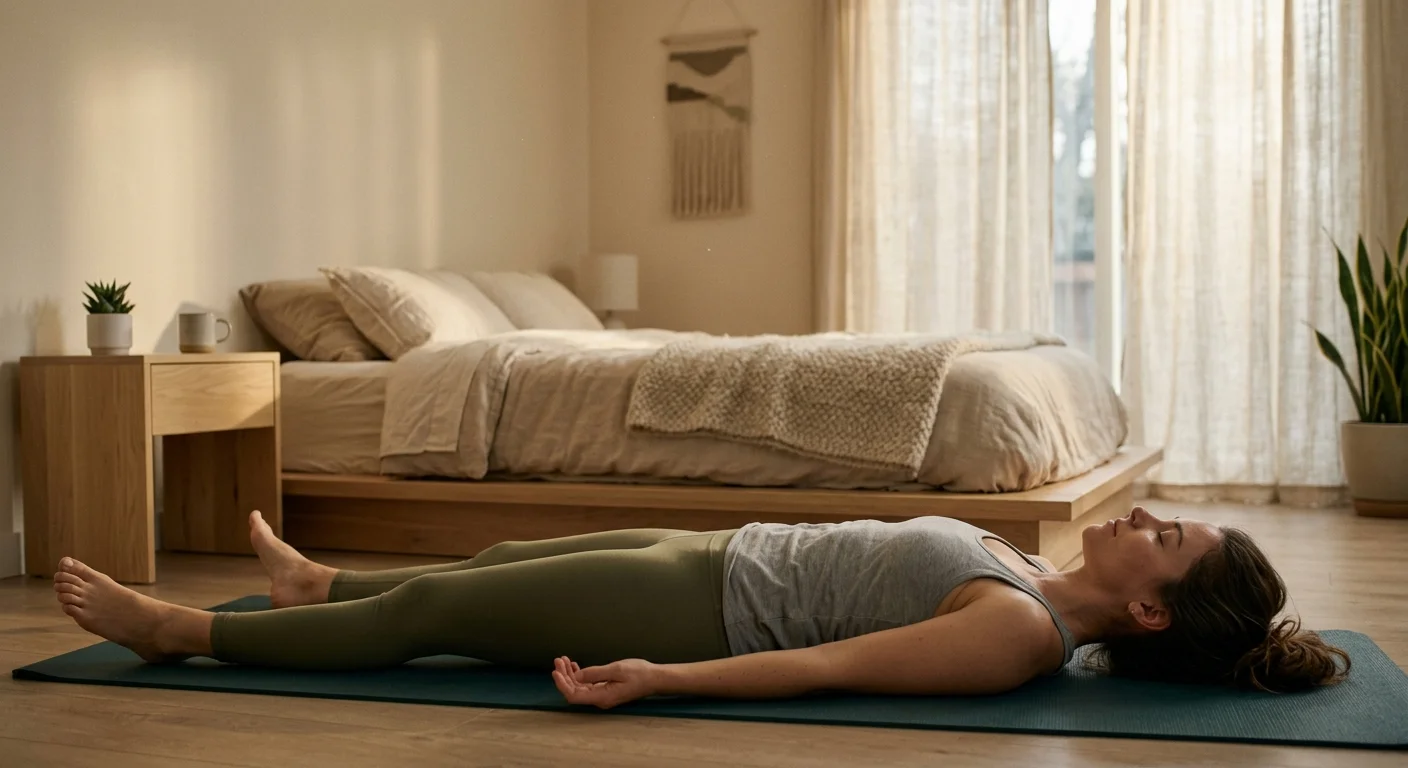
Savasana is the pose people skip. It's also the one that does the most.
After five poses of active release, your body is ready. Your nervous system is calmer. Muscles are softer. Breath is slower. Savasana is where all of that lands — where the work settles in. You lie still, and your body does something remarkable: it restores itself.
How to do it:
- Lie flat on your back, legs a little apart, arms resting at your sides with palms facing up
- Close your eyes and let your feet fall open on their own
- Start a slow body scan — forehead, eyes, jaw, neck, shoulders, arms, torso, hips, legs, feet — release tension in each area as you reach it
- Breathe at a steady rhythm: inhale for 4 counts, hold for 4, exhale for 6
- Stay here for at least 5 minutes. Ten is better
This Is Not Sleep — And That Distinction Matters
What happens in Savasana is called pratyahara — a conscious turning inward of the senses. You're not drifting off. You block out external noise on purpose, while staying aware of what your body feels. That awareness is what shuts down the sympathetic nervous system and brings the parasympathetic system online.
The research backs this up. Studies show state anxiety drops 22.4% in practices that include Savasana — compared to just 5.6% from passive rest alone. Memory scores improve by 16-33% right after. Depression markers fall too. A six-month study of hypertension patients found that regular Savasana practice lowered blood pressure, blood glucose, and cholesterol levels.
This is the pose that seals everything. The sequence brings you to the edge of calm — Savasana takes you the rest of the way.
Don't skip it.
Building Your Daily Stress-Relief Yoga Routine (Putting It All Together)
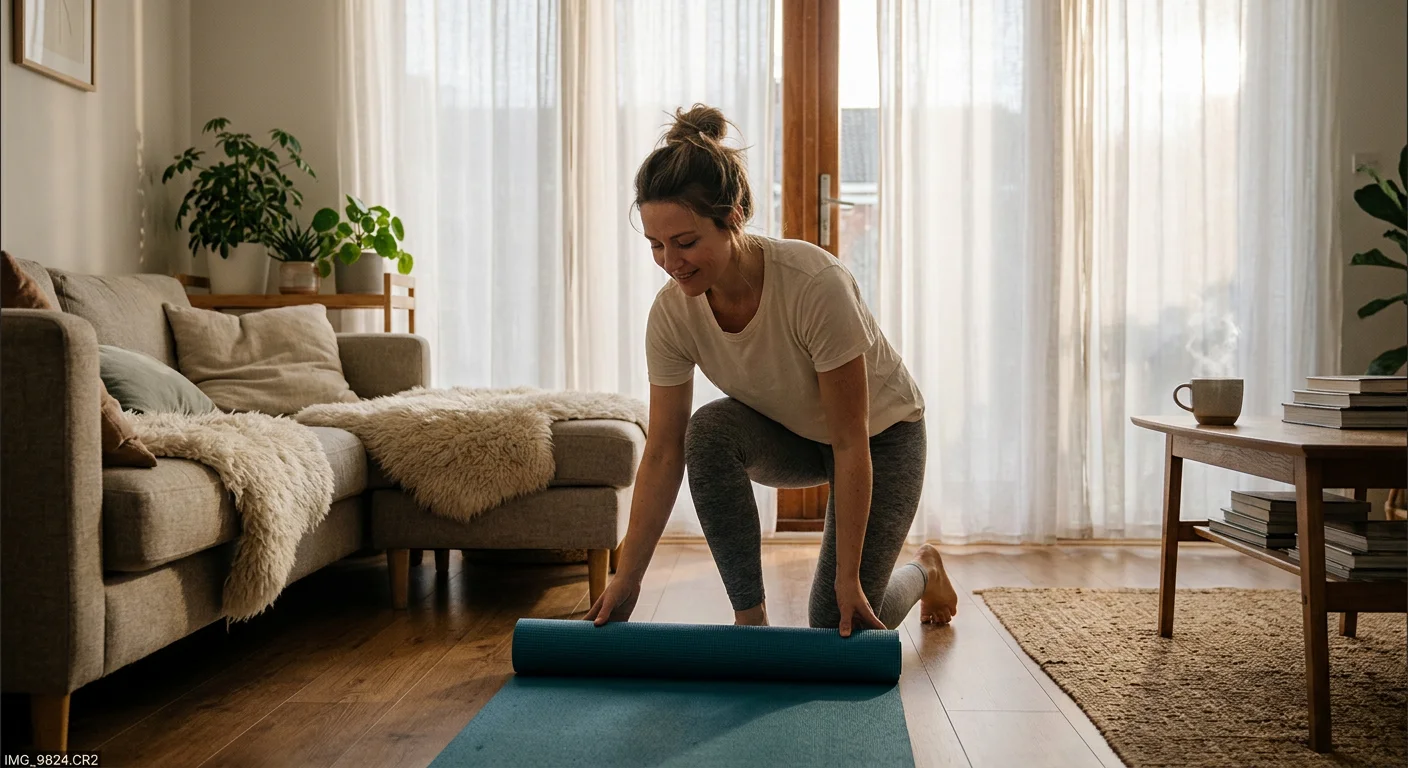
Ten minutes. That's all it takes to start changing how your body handles stress — and the research backs this up. One month of 10-minute daily practice cut musculoskeletal complaints in home-office workers by more than 80%. Eight yoga sessions produced measurable well-being improvements in teenagers. The barrier to entry is lower than most people think. If you are just starting out, our guide on the best yoga poses for beginners is a great companion resource.
Now you have six poses. The real question is what to do with them.
Make the Sequence Work for Your Life
You don't need all six poses every single day. Think of them as a toolkit, not a fixed prescription.
Move through all six in order -- Child's Pose through Savasana. This is your Sunday evening ritual. Your post-hard-week recovery. Your complete stress-relief sequence from start to finish.
Cat-Cow into Downward Dog, then finish with Legs-Up-the-Wall. This breaks a cortisol spiral without pulling you too far from your day.
Seated Forward Bend, Legs-Up-the-Wall, Savasana. These three poses support the evening cortisol drop your body is already working toward.
Consistency Beats Intensity, Every Time
Science keeps confirming the same thing: frequency matters more than duration. Regular practice slowly rebalances your autonomic nervous system. It builds up the parasympathetic side. It softens the chronic stress load that most people carry day after day. Depression markers drop. Sleep gets better. Serotonin rises while cortisol pulls back.
More than 8 in 10 U.S. adults report prolonged stress. Most are waiting for the perfect moment to do something about it. If you are also debating between yoga and gym workouts, know that yoga offers unique long-term benefits for stress management.
There is no perfect moment. There's just your mat, your breath, and the next ten minutes. Start there. Come back tomorrow. That's the whole practice.
What to Wear for Your Stress-Relief Yoga Practice
Your yoga outfit matters more than you might think. Research backs this up. Well-fitting clothes help about 90% of practitioners stay mindful. This is not about looks. Focus management is the real priority.
Think about it. A tight waistband during a Seated Forward Bend ruins your focus. A bunching top in Downward Dog causes similar issues. Your brain spots these tiny annoyances fast. They disrupt your practice. That calm state slips away.
The proper gear handles these problems. Specialized yoga clothing manufacturers spend countless hours optimizing seam placements. They also perfect fabric stretch. Eliminating physical friction unlocks your mental focus.
What to Look For
For active sequences (like Cat-Cow, Downward Dog, and Child's Pose):
For restorative poses (like Legs-Up-the-Wall and Savasana):
Soft bamboo or cotton blends. These feel like a second skin.
Looser fits give you room for deep breathing. Those deep breaths trigger your parasympathetic response. You worked through six poses to reach this calm state.
What to Skip
Cotton holds about 27 times its weight in moisture. Skip it for active flows. Stiff fabrics cut your range of motion by 30–50%. This defeats your goals on the mat.
The goal is simple. You want an outfit that fades into the background. True practice starts there.
Conclusion
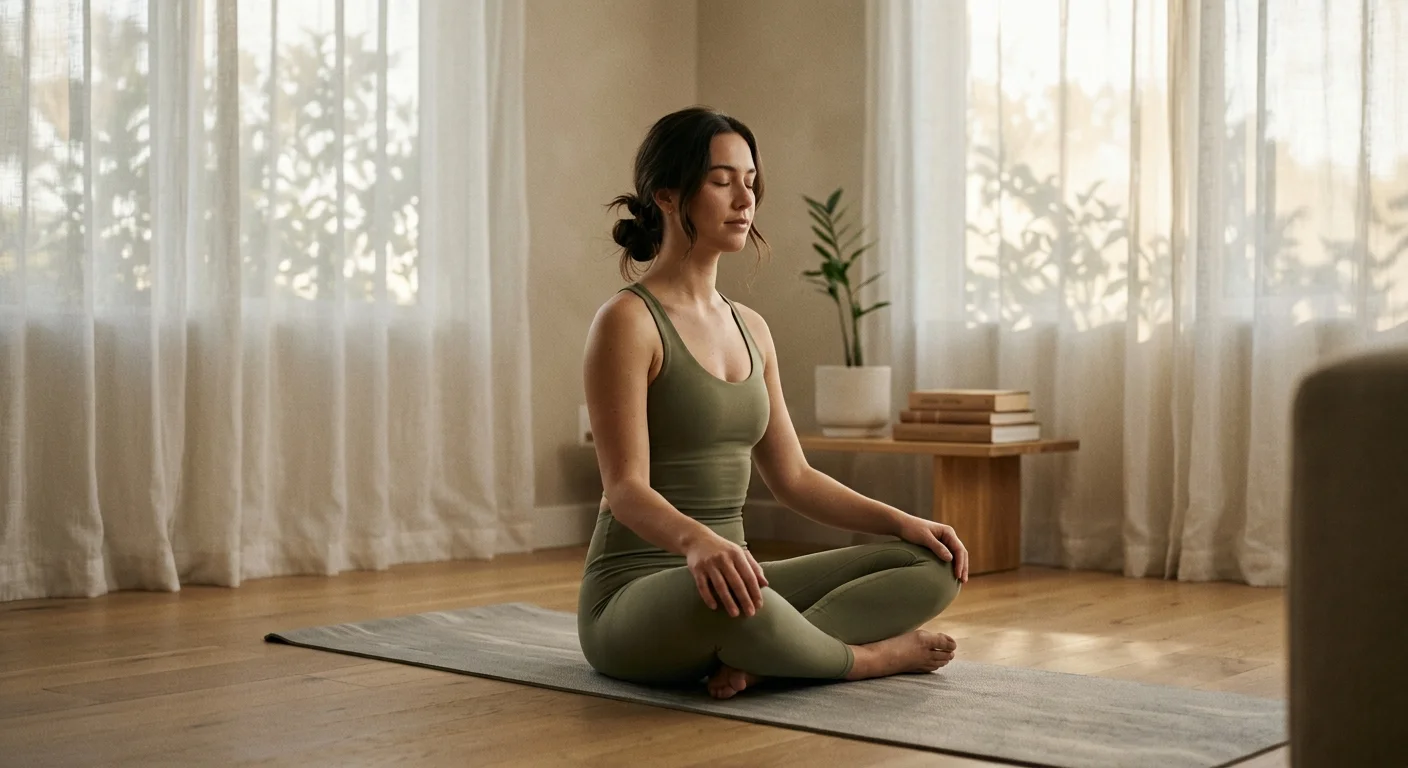
Your mat is ready. Your breath is with you. You now have six proven poses to meet stress wherever it shows up — a Sunday evening spiral or a Wednesday afternoon slump.
The real secret these poses share? They don't ask you to eliminate stress. They train you to move through it with more grace and more awareness. Your body learns how to find its way back to calm. That's not just a yoga practice — that's a life skill.
Start small. Roll out your mat tonight and try Legs-Up-the-Wall for five minutes before bed. Let Savasana remind you that stillness is productive. Build your stress relief yoga sequence one breath at a time. Over time, consistency changes the way you handle everything else.
The most powerful thing you can do for your mental wellness isn't dramatic. It's showing up, again and again, with the right intention and the right outfit.
👉 Ready to practice in comfort? Explore Berunclothes's yoga collection — made to move with you, not against you.