You're watching a Grand Slam final — but something feels off. And just like how top-tier gear is developed by Pro-level tennis apparel manufacturers, the differences between ATP and WTA aren’t accidental — they’re built into the system.The men just walked out for a fifth set. The women's match wrapped up two sets ago. Same tournament, same courts, same prestige… yet the rules are different. That's one of the striking contrasts you notice when comparing the WTA vs ATP.
The differences go deeper than men's and women's tennis. Ranking systems, prize money battles, playing styles, and even what players wear on court — all of it sets these two tours apart.
A casual fan trying to read a scoreboard? Someone stepping onto the court for the first time? Either way, knowing these distinctions changes how you watch and appreciate the game.
The Biggest Rule Difference: Why Men Play Best-of-5 Sets Grand Slams But Women Play Best-of-3

Most casual tennis fans don't realize this: men and women at the same Grand Slam are playing by different rules.At the structural level—much like how a Competition-grade tennis apparel factory designs gear for endurance vs agility—match format defines everything.
At all four Grand Slams — the Australian Open, French Open, Wimbledon, and US Open — men compete in best-of-5 sets , while women play best-of-3 . A men's match runs a minimum of 25 games in a clean sweep. Women's matches run 15. More sets. More games. More pressure on every single point.
So what does that format gap actually do to match results? The numbers tell a clear story.
What the Data Tells Us About Format and Match Outcomes
The format gap isn't just about stamina. It shapes who wins.
Research covering Grand Slam results from 2006 to 2019 shows a clear pattern:
Men's higher-seeded players won 78.9% of their matches
Women's higher-seeded players won 75.3% of theirs
That's a 17% higher upset rate on the women's side — and the best-of-3 format is a primary driver
One bad set in a shorter format ends your tournament. There's no safety net. No third or fourth set to claw back momentum. That's why women's tennis produces more upsets — and more drama — match for match.
Surface plays a role too. The upset gap between men and women was widest at the Australian Open (28.8% more upsets for women) and narrowest at the US Open (10.8%) . Wimbledon stands out — it produced the most upsets for both genders across all four surfaces.
The Dominance Effect: Why Best-of-5 Favors the Elite
From a supply-chain perspective—similar to how Custom tennis clothing manufacturers scale consistency—best-of-5 rewards players who can sustain elite performance longer.Check the title distribution from 2006 to 2019 and the contrast is stark:
Men's Grand Slams: Federer, Nadal, and Djokovic combined to win 48 of 56 titles
Women's Grand Slams: 14 different players shared 32 titles
Best-of-5 gives elite players more time — more sets, more games, more chances — to take control. Best-of-3 cuts that window short. Upsets become easier.
Serve stats reinforce this gap. Men win around 80% of their serve games at Grand Slams. Women win around 65% . That 15-point gap means serve breaks happen far more often in women's matches. Games swing faster. Sets shift quicker. Results are harder to predict.
The bottom line? Best-of-5 rewards consistency. Best-of-3 rewards peak performance in critical moments. Neither format is better. They produce different kinds of tennis — with different stats, different patterns, and different stories playing out across the net.
Game Speed, Power, and Playing Style: How Men's and Women's Tennis Look Different on Court

The numbers don't lie. In tennis, the physical gap between men's and women's play shows up all over the data.
Just like product segmentation between Men's tennis apparel suppliers and performance-focused categories, the on-court differences come down to power vs construction. Start with serve speed.Across Grand Slams from 2002 to 2013, men averaged 184.1 km/h on first serves. Women averaged 158.5 km/h . That's a 25.6 km/h difference on the opening shot alone. On second serves, the gap gets smaller — men at 150.4 km/h , women at 133.4 km/h — but it never closes.
Look at the full ATP and WTA Tour averages and the story stays the same. Men serve between 190–200 km/h . Women clock in at 170–180 km/h . Among the top 20 players in 2013, men's peak serve averages reached 218.6 km/h . Women's peak averages hit 185.6 km/h . That's a 33 km/h gap at the elite level.
Raw Power Doesn't Tell the Whole Story
Here's where it gets interesting.
Women aren't just hitting slower — they're playing smarter. Aryna Sabalenka's average forehand speed at the US Open clocked in at 80 mph . That topped both Carlos Alcaraz (79 mph) and Jannik Sinner (78 mph) on the same shot. Power in women's tennis is very real. The difference is in how often that power gets used across a full match.
Men produce more explosive strength across serves and groundstrokes. Biological factors drive this. The result: more winners, fewer unforced errors, and more pressure on opponents. Women's tennis leans into construction and consistency instead. Points get built step by step, not ended with raw force.
How Far Do Players Run?
The physical demands show up in movement data too. Australian Open HawkEye tracking from 2021–2022 found that male players covered 2,400 meters per match in best-of-5 competition. Women covered around 1,400 meters in best-of-3 play. That's a gap of 809 meters per match .
The per-shot distance was close to identical for both: 4.2–4.5 meters . Also, 80% of all shots needed six meters or less of movement.
The difference isn't in how they move. It's in how many times they have to do it . Format drives physical load. Physical load then shapes every tactical decision that follows.
Consistency vs. Parity: Which Tour Has More Upsets and Why
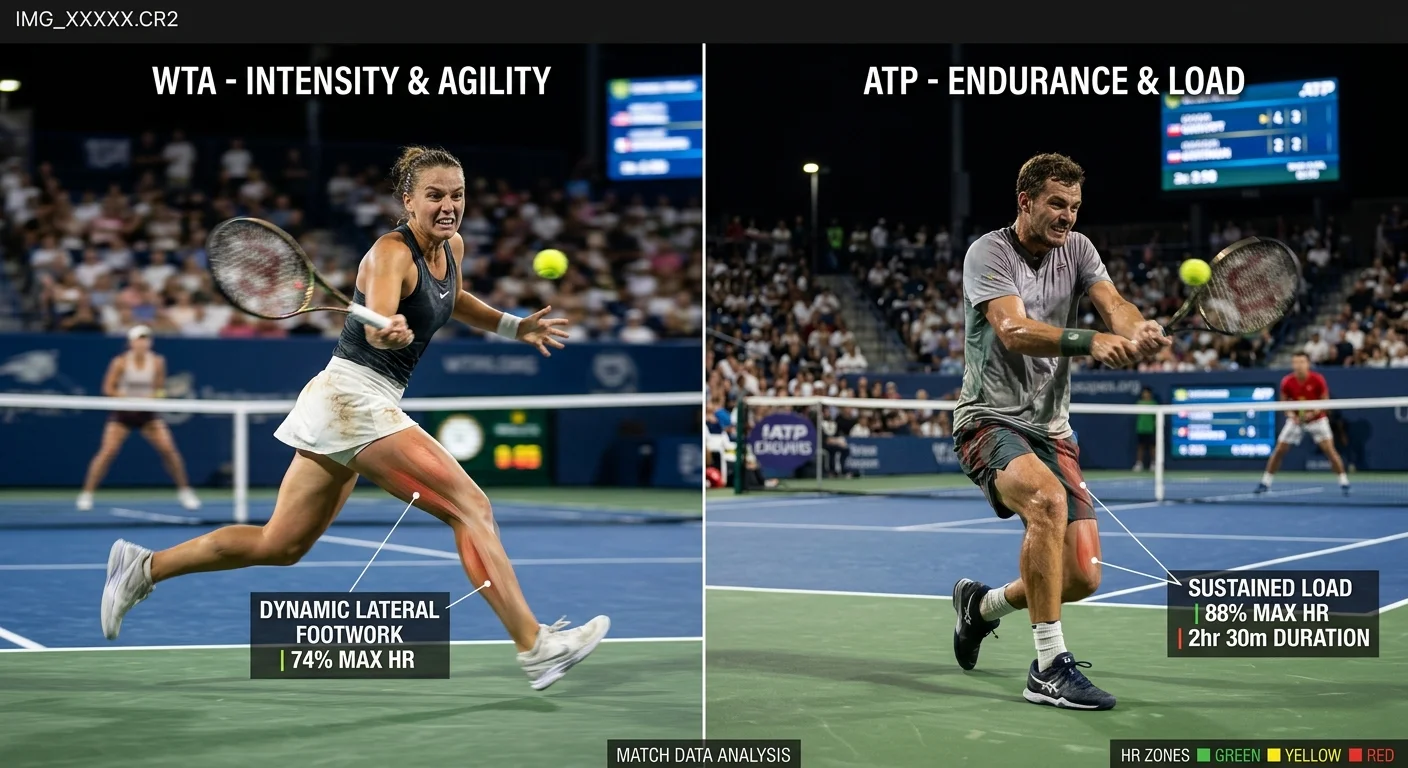
The numbers already told you that women's tennis produces more upsets. Here's the deeper story behind why — and what it means for how you watch the game.
From a market dynamics lens—similar to how Women's tennis apparel manufacturers adapt to trend-driven demand—the WTA ecosystem is built for variation.The ATP upset rate sits around 29.6% . The WTA's lands at 31.5% . That gap looks small on paper. On court, it plays out in a very different way.
Why the WTA Produces More Chaos
ATP dominance isn't luck. The top men deliver at a steady, stable level — consistent serve percentages, controlled return games, predictable output across surfaces. That stability acts like a ceiling on upsets. Elite players almost never hand their opponents a path through.
The WTA doesn't work that way. The parity isn't some romantic storyline about competitive spirit — it's structural. Serve and return consistency shifts more on the women's tour. A player's second serve can waver. Her return game can dip mid-match. A lower-ranked outsider steps in and takes control fast. In best-of-3, there's no time to recover.
The post-Serena era made this worse. Over the past decade, no single WTA player has dominated the way the Big Three locked down ATP results. That gap created room for non-top players to go deep in draws — and they did.
What This Means If You're Watching (or Betting)
WTA upsets create a different kind of tension for viewers. Momentum shifts happen faster. Tactical adjustments matter more per game. You're watching a match that can flip in a single service game — that's not common on the ATP side.
For anyone tracking match predictions, a few metrics cut through the noise:
Rally length : Longer average rallies favor the more consistent player. A 5-shot average versus a 3-shot average changes the entire odds structure.
Pressure points : Watch 0-30 and 30-40 games. WTA matches swing heavily on these moments — more so than ATP matches at the same scoreline.
Indoor events : Across both tours, indoor surfaces produce the most predictable results. The bounce is true, the conditions are controlled, and top seeds hold their ground.
The pattern holds: one more ball in court wins most matches. On the WTA, getting that extra ball back is the difference between a quarterfinal run and a first-round exit.
ATP vs WTA Rankings: How the Points Systems Work and Where They Differ

Tennis rankings are more than a scoreboard. They decide who gets seeded, who skips early-round matches, and who lands a seven-figure endorsement deal. Both the ATP and WTA run a 52-week rolling points system — but the details split in ways that matter.
The Core Structure: What Counts Toward Your Ranking
Even ranking systems reflect structural differences—just like how brands adjust custom tennis apparel size standards across regions and markets.On the ATP side , a player's ranking comes from his best 19 results over 52 weeks. Twelve of those are mandatory: 4 Grand Slams plus 8 ATP Masters 1000 events. The remaining 7 slots come from ATP 500s, 250s, Challenger events, and the ATP Cup. The ATP Finals — reserved for the top 8 — counts as a bonus 20th event.
The WTA system counts a player's best 18 singles results (or 12 for doubles). The mandatory base works a bit differently. It includes 4 Grand Slams plus 6 WTA 1000 events. One extra non-mandatory WTA 1000 — like Doha — fills out the core calendar.
Points Distribution: Where the Numbers Split
At the top, both tours give identical points for Grand Slam wins — 2,000 points for the champion, 1,300 for the finalist . Go deeper into the draw, and the gaps show up:
Round | ATP Grand Slam | WTA Grand Slam |
|---|---|---|
R16 | 200 pts | 240 pts |
R32 | 100 pts | 130 pts |
Qualifier | 25 pts | 2 pts |
That qualifier gap stands out. ATP qualifiers earn 25 points just for getting through. WTA qualifiers earn 2. For a lower-ranked player fighting through qualifying draws, that gap can push their ranking up or down by dozens of spots across a full season.
The Year-End #1 Tiebreaker: Where WTA Gets Complicated
Both tours use total points to settle the year-end world number one. The WTA adds a tiebreaker step when two players finish level: Finals performance comes first , then fewest tournaments played. The ATP stays clean — highest total points wins, full stop.
So why does this matter? A player who peaks at the WTA Finals in November can jump past a rival who led all season. The WTA rewards players who save their best tennis for the biggest stage. That creates late-season drama the ATP's straight points count never produces.
The Real-World Impact of Where You Rank
Rankings control more than your draw position — your seed drives your commercial value . Players inside the top 10 can earn 5–10 times more in sponsorship revenue than players ranked in the top 50. Endorsement deals tie straight to seeding visibility and broadcast exposure. Every point you win at a Masters 1000 or WTA 1000 isn't just a ranking bump. It compounds into real market value.
Both tours reward consistency. The WTA's higher early-round points and its Finals-weighted tiebreaker make the road to number one look quite different from the ATP path. Same goal, different rules getting there.
Prize Money and Pay Equity: The Ongoing Debate Between Men's and Women's Tennis
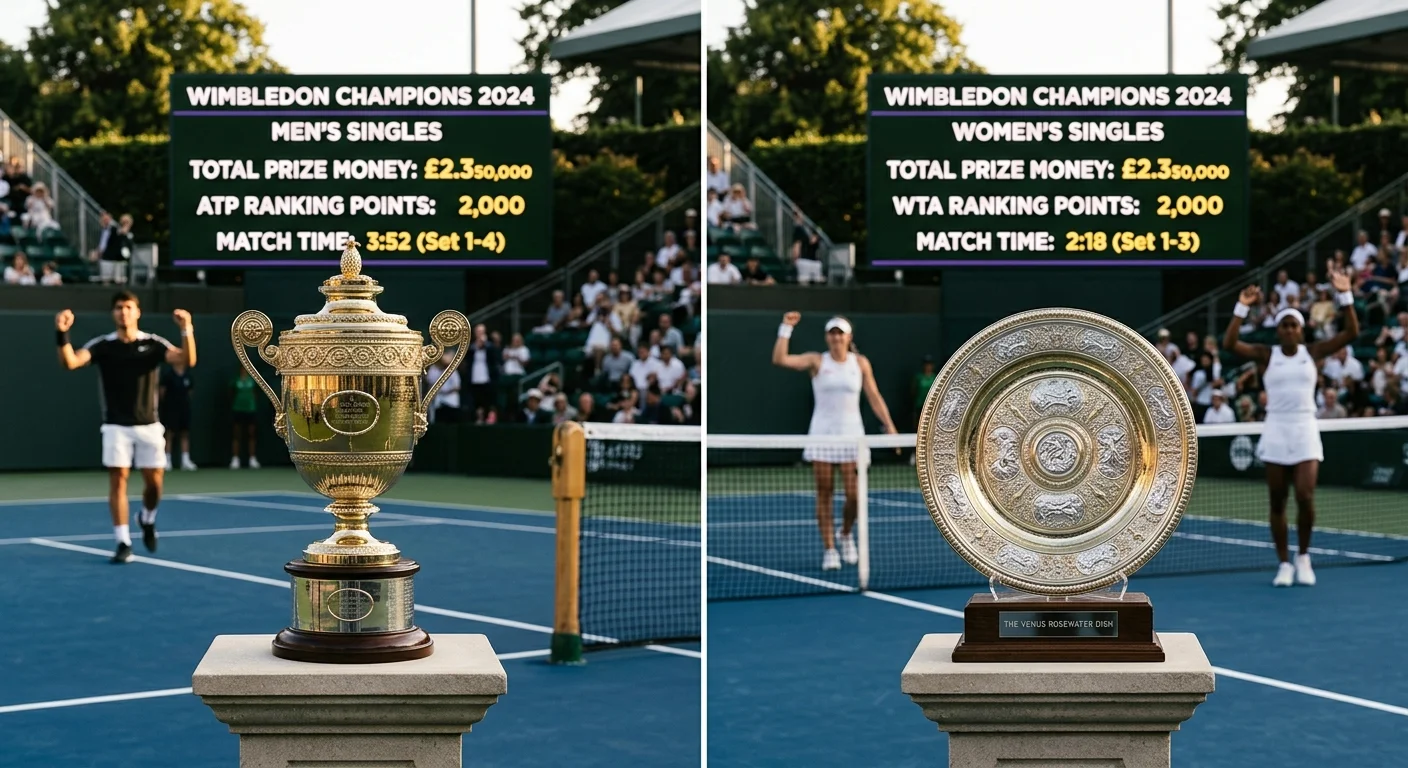
Equal pay in tennis sounds simple. It isn't.
The US Open made history in 1973 by becoming the first Grand Slam to offer equal prize money to men and women. Wimbledon and the French Open didn't follow until 2007 — more than three decades later. Before that, the 1968 Wimbledon paid the men's champion 62.5% more than the women's champion. That gap didn't shrink to 10% until 1977. It stayed there until outside pressure forced change.
Grand Slams are now equal on paper. But step outside those four marquee events, and the gap tears wide open again.
The Non-Grand-Slam Money Gap Is Still Real
Look at what happened in 2015. Novak Djokovic — men's world number one — earned $21.65 million in total prize money that year. Serena Williams — women's world number one, and the most dominant player in the sport at the time — earned $10.58 million . Less than half.
That gap isn't a coincidence. ATP 500 events offer purses above $2 million . The 2025 Charleston Open — a WTA 500 event — offered just $1.06 million . The 2026 Charleston Open was the first standalone WTA 500 event to match an ATP 500 purse. It pushed past $2 million. That's still ahead of the WTA's 2033 equalization goal for all 1000 and 500 events.
That timeline says everything. Full prize money parity across tour-level events is still seven years away .
The Argument Doesn't Have a Clean Answer
Here's where it gets complicated — and where both sides have real points:
Viewership cuts both ways. The 2015 US Open women's final sold out before the men's. But the 2015 Wimbledon men's final drew 9.2 million BBC viewers against 4.3 million for the women's.
Match length is the loudest counterargument. Men play best-of-5 at Slams. Outside Slams? Both tours play best-of-3. The format argument applies to just four events per year.
Revenue reality is hard to ignore. Men's TV rights deals are worth far more than women's. Prize money has tracked revenue closely throughout the sport's history.
The strongest case for equal pay isn't about sets played or crowd size. It's about equal achievement at equal levels . A Grand Slam title is a Grand Slam title. Tying a champion's paycheck to broadcast ratings sets a dangerous precedent. It punishes top performers based on gender, not results.
The debate isn't settled. The gap is closing — but it's slow, uneven, and facing real resistance.
Tennis Apparel Differences: What Men and Women Wear on the Professional Court

Step into any professional tennis venue. The clothing gap between tours hits you right away — and it's no accident.
Men wear shorts, polos, or collared shirts. Women wear skirts, dresses, shorts, or leggings. No rule forces a crossover. Wimbledon tightens things for everyone — its "almost entirely white" rule has held since 1995, and accessories got pulled in by 2014. Outside the All England Club, each tour dresses around its own practical needs.
Function Drives Every Design Decision
Most people miss this: apparel rules aren't just about looks. Each piece is built around what the match actually puts players through.
Men at Grand Slams play best-of-5. That means 5+ hours on court in summer heat. Sweat rates can top 2.0–2.5 liters per hour . Frances Tiafoe packs 20+ shirts per match and changes up to six times — because a soaked shirt picks up 20–30% of its dry weight in moisture, which kills grip and comfort. The body takes a serious beating. Shirts need to breathe, dry fast, and hold up for hours. Rafael Nadal's capri shorts and sleeveless tees weren't a style choice. They were built for clay-court movement.
Women play best-of-3. Less time on court means different design priorities. Shorter skirts and stretch fabrics focus on sharp lateral movement — not five-hour endurance runs.
Both tours use the same base materials: polyester and nylon blends for moisture-wicking, light weight, and water resistance. The real difference is where each design puts its focus.
The Market Data Tells a Surprising Story
Women's tennis apparel beats men's in revenue — and it's not close.
Segment | 2022 Revenue | 2028 Projected | Market Share |
|---|---|---|---|
Women | $870M | $939M | 43.9% |
Men | $658M | $718M | 33% |
Total | $1,983M | $2,167M | — |
US tennis skirts and dresses alone jumped 24% in 2022 — double their 2019 numbers. The women's segment pulls the whole category forward.
How the Rules Changed Everything
Before 1972, professional tennis stuck to a strict all-white dress code. Men wore trousers and dress shirts. Women wore long skirts and long-sleeve tops. The 1972 US Open broke that open. Color came into the game. Men shifted to above-knee shorts and polos. Designer Ted Tinling brought shorter, bolder silhouettes to women's tennis.
The 1980s pushed further. Men's court fashion leaned into terrycloth stripes and short shorts — think Borg and McEnroe. Women's apparel moved toward colorful dresses and fitted unitards. Pro tennis eventually landed on polyester-nylon performance wear for both sides. Women's designs, though, kept far more style range.
The bottom line for buyers:
- Men's tennis apparel focuses on tough breathability for long matches
- Women's focuses on stretch and design range
- Nike, Adidas, and Under Armour together hold 22% of combined tour revenue
- Both tours grow fastest through online channels (CAGR: 1.89%)
WTA vs ATP: Quick Comparison Table (Key Differences at a Glance)
All the key differences between the ATP and WTA are right here. Sets played, prize money, ranking points, tour structure — one table covers it all.
Category | ATP (Men's) | WTA (Women's) |
|---|---|---|
Grand Slam Format | Best-of-5 sets | Best-of-3 sets |
Grand Slam Prize Money | $43.25M (equal) | $43.25M (equal) |
500-Level Prize Pool | $2.76M+ | $1.21M–$2.3M |
250-Level Prize Pool | $680K | $275K |
Top 2025 Earner | Alcaraz: $21.3M | Rybakina: $2.72M |
Players Earning $1M+ | 88 players | Limited data |
Guaranteed Base Pay | Yes (top 250 players) | No equivalent |
Ranking Count | Best 19 results | Best 18 results |
Upset Rate | ~29.6% | ~31.5% |
Grand Slam prize money is equal on both sides. Drop below that level, though, and the gap grows fast. The ATP leads by 2–3x at both the 500 and 250 tiers.
Frequently Asked Questions About WTA vs ATP Differences
Still have questions? Good. Here are the ones that come up most often.
Why do men play 5 sets and women play 3?
Two reasons: tradition and physical demand. ATP Grand Slams have used best-of-5 since the sport's professional era began. WTA matches run best-of-3 at all levels — Grand Slams included. The format is different, but both tours award the same ranking points. Win a Grand Slam on either tour and you walk away with 2,000 points .
How does the WTA ranking system work?
WTA rankings count a player's best 18 singles results across a rolling 52-week window. That number goes up to 19 if you include the WTA Finals.
Here's how the breakdown works:
Mandatory base: 4 Grand Slams + your best 6 WTA 1000 results from events like Indian Wells, Miami, Madrid, Rome, and Cincinnati
One non-mandatory WTA 1000: Doha, Dubai, or Wuhan — pick your best result
Remaining slots: Fill with your next best results from WTA 500s, 250s, 125s, or ITF events
Rankings update every Monday.
Do men and women earn equal prize money?
At Grand Slams — yes. The US Open hands the same check to both tour winners. Outside Grand Slams, the gap is real. ATP Masters 1000 winners take home $1M+ . WTA 1000 winners land between $500K and $1M . Total annual ATP prize pools run about 20–30% higher than WTA pools.
Conclusion
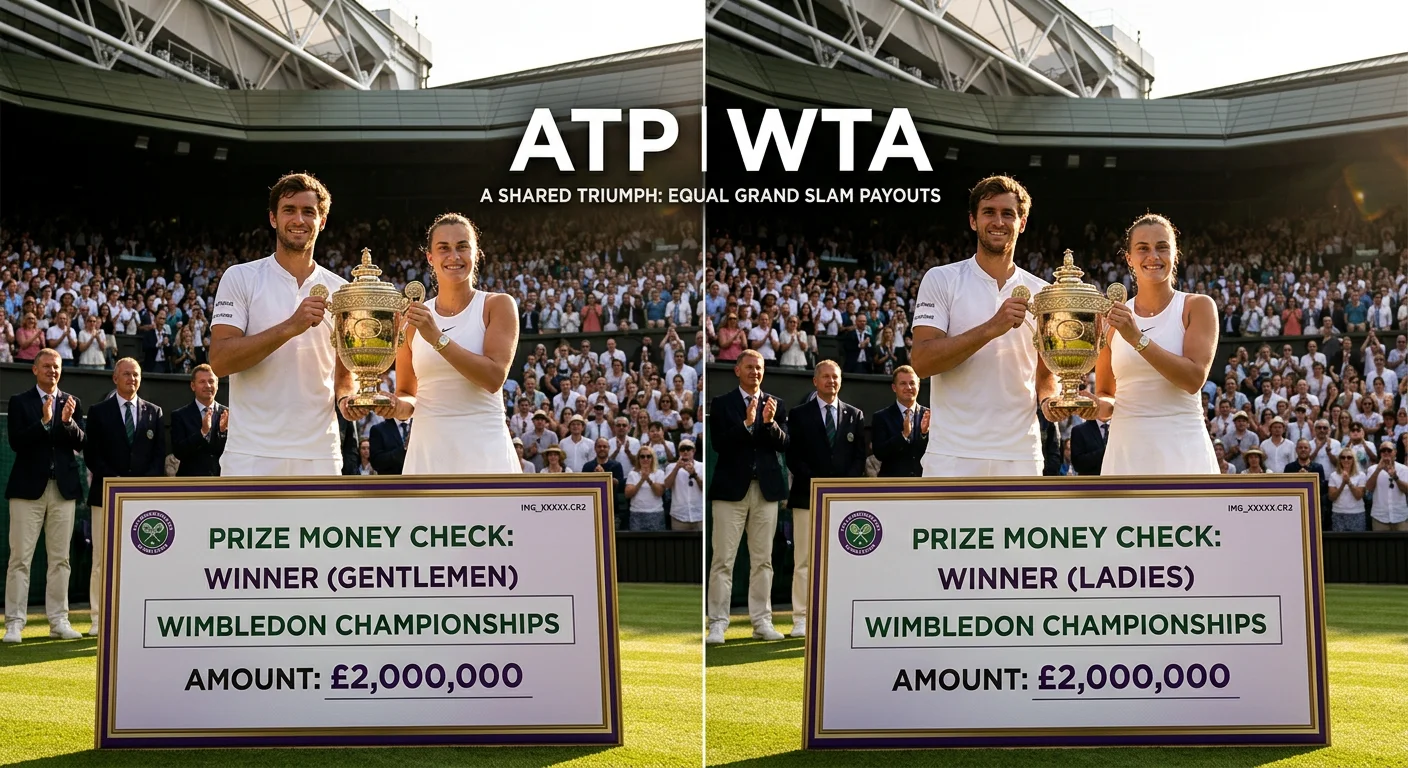
Watching a five-set Wimbledon thriller hits different from a lightning-fast WTA final. Once you know the difference between men's and women's tennis, the whole game opens up in a new way.
Here's what matters most: the WTA vs ATP gap isn't just about sets played. It's about two separate competitive worlds. Each one has its own ranking logic, prize money structure, playing style, and dress code culture. Women's tennis brings constant parity and shocking upsets. Men's tennis rewards endurance and raw power. Both deserve your attention.
You now know how to watch smarter and argue better. Every serve, break point, and tiebreak carries real meaning — and you can see it clearly now.
One more thing — the right gear matters as much as the knowledge. Inspired by WTA speed or ATP strength? berunclothes.com offers performance tennis apparel built for how you play.
The court's waiting. Are you ready?
 YouTubeYouTube video player