Most of us grab a swimsuit off the rack without ever asking — who made this thing, and where? With Speedo, that question has a fascinating answer.
The brand feels Australian (it is, sort of). Britain manages it entirely. And the Speedo swimwear factories behind it might catch you off guard.
Curious whether your next swimsuit clears your ethical shopping bar? Or maybe you're just the kind of person who reads tags — hello, fellow tag-readers. Either way, Speedo's real manufacturing story tells you far more about swimwear quality and brand integrity than any glossy ad ever will.
The Brand Behind the Suit: Speedo's Australian Origins and British Ownership
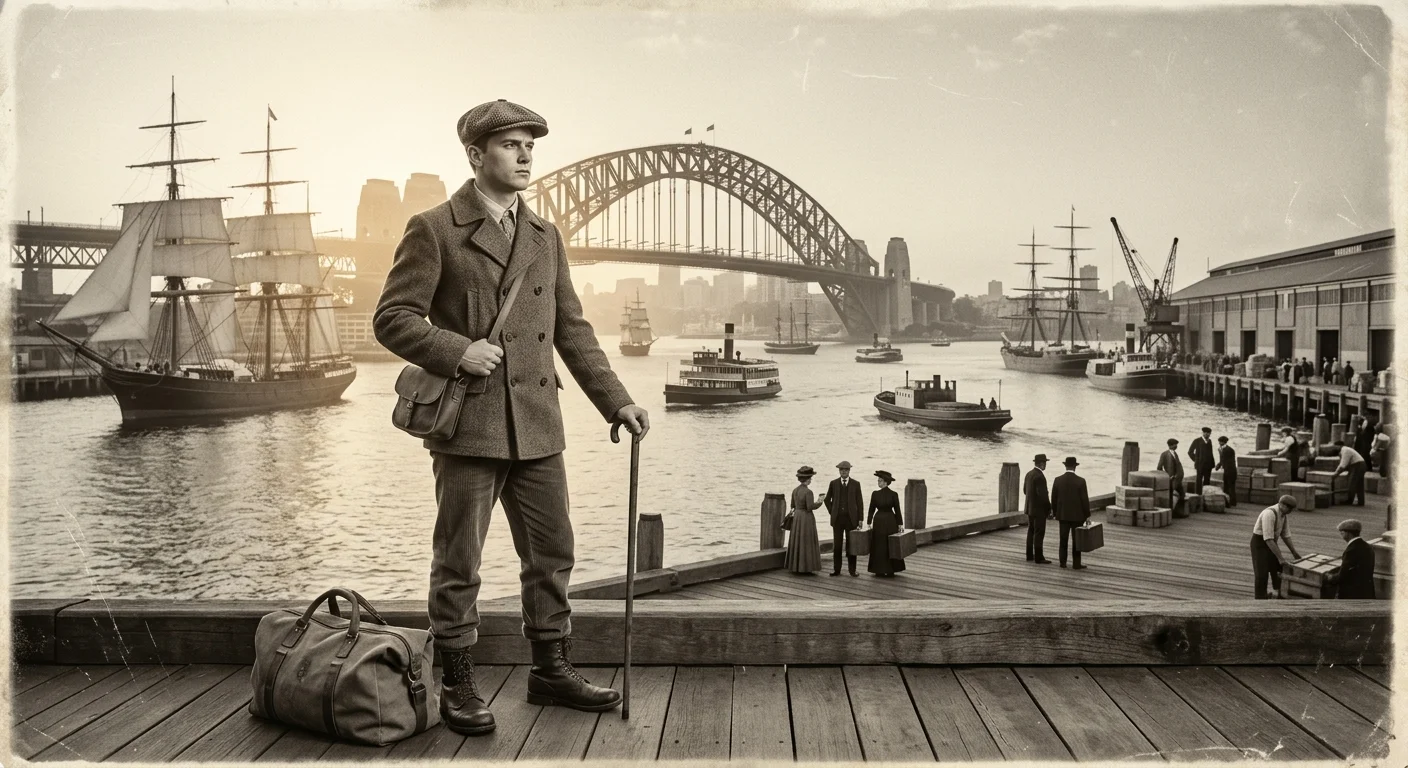
A Scottish immigrant stepped off a boat in Sydney in 1910. He brought almost nothing — just ambition and a solid background in hosiery. That man was Alexander MacRae, from Loch Kishorn in the West Highlands — a place that sounds made up, but isn't. By 1914, he had founded MacRae Hosiery Manufacturers. His first brand name? Fortitude. Taken from the MacRae clan crest. Of course it was.
Then World War I hit. The Australian Army needed socks. MacRae's small underwear company found itself flooded with more orders than it could handle.
The real turning point came in 1928. MacRae launched a non-wool swimsuit unlike anything before it — the Racerback . It was the first of its kind in the world. The open shoulder and exposed back gave swimmers real freedom of movement. Some beaches banned it. Competitive swimmers grabbed it straight away. That's how you know something works.
The name "Speedo" came from a staff contest that same year. Captain Parsonson submitted "Speed on in your Speedos" and won £5 . Five pounds. For naming one of the most recognized sportswear brands on earth.
The brand grew fast. Licensing deals spread across Italy, Spain, Sweden, and 112 countries total. Then the ownership story takes a sharp, surprising turn. Speedo has clear Australian roots — yet Speedo is now owned by the British Pentland Group. Not Australian. British. The brand listed on the Sydney Stock Exchange in 1951. It earned global fame after the Speedo-sponsored Australian team took 8 gold medals at the 1956 Melbourne Olympics . From there, control passed into British corporate hands.
The latest ownership move? In 2020, Pentland bought back the North American licensing rights from PVH Corp for $170 million cash. A far cry from sock money.
So: Australian soul, British ownership, global reach. The brand's identity is layered and complicated. That complexity is part of what makes where Speedo swimwear is made a far more interesting question than the label ever suggests.
Where Is Speedo Swimwear Actually Made? A Country-by-Country Breakdown
You're standing in the swimwear aisle. The tag is pinched between your fingers. That little label is doing a lot of work — more than most people realize.
Speedo's manufacturing footprint spans the globe. The numbers tell the story better than any marketing copy, so let's go straight to the data.
The Big Three: Where Speedo Swimwear Actually Gets Made
Speedo's North American headquarters sit in Cypress, California . Their recent trade data shows 2,683 import shipments . That's not a typo — two thousand, six hundred and eighty-three. Compare that to just six export shipments in the same period. That gap tells you everything about how modern swimwear manufacturing flows.
The top sourcing countries break down like this:
Sri Lanka — the single largest import source at $9.86M in 2025 trade data
China — second at $6.33M , with a strong focus on woven shorts, woven swimwear, and woven polyester products
Vietnam — a growing third-tier sourcing country that rounds out Speedo's Asian manufacturing base
The companies doing the hands-on production work include Unique Sea Products Co Ltd , Aqua Trading Global Pvt Ltd , and Stallion Sport Ltd . You've probably never heard of them. But one of them made the suit on your back at the community pool.
Bangladesh also plays a key role — not as a production source, but as a major export destination. Speedo shipped $10.09M worth of product there in 2025. These are finished goods moving through the broader network, not sitting idle in a California warehouse.
What This Means for Quality
Global athletic brands all source from Asia. That's standard practice. "Made in Asia" stopped meaning "lower quality" about two decades ago. Sri Lanka, specifically, has earned a strong reputation for technical apparel manufacturing . That means precision stitching — the kind competitive swimwear needs to perform at a high level.
Speedo has also set a clear sustainability target: 100% sustainable swimwear materials by 2024 . Already, 65% of all swimwear carries PFC-free DWR treatment. That's durable water repellency without the harmful forever-chemicals. The supply chain is complex, yes. But the direction it's heading looks deliberate.
Asia: The Volume Powerhouse Behind Most Speedo Labels
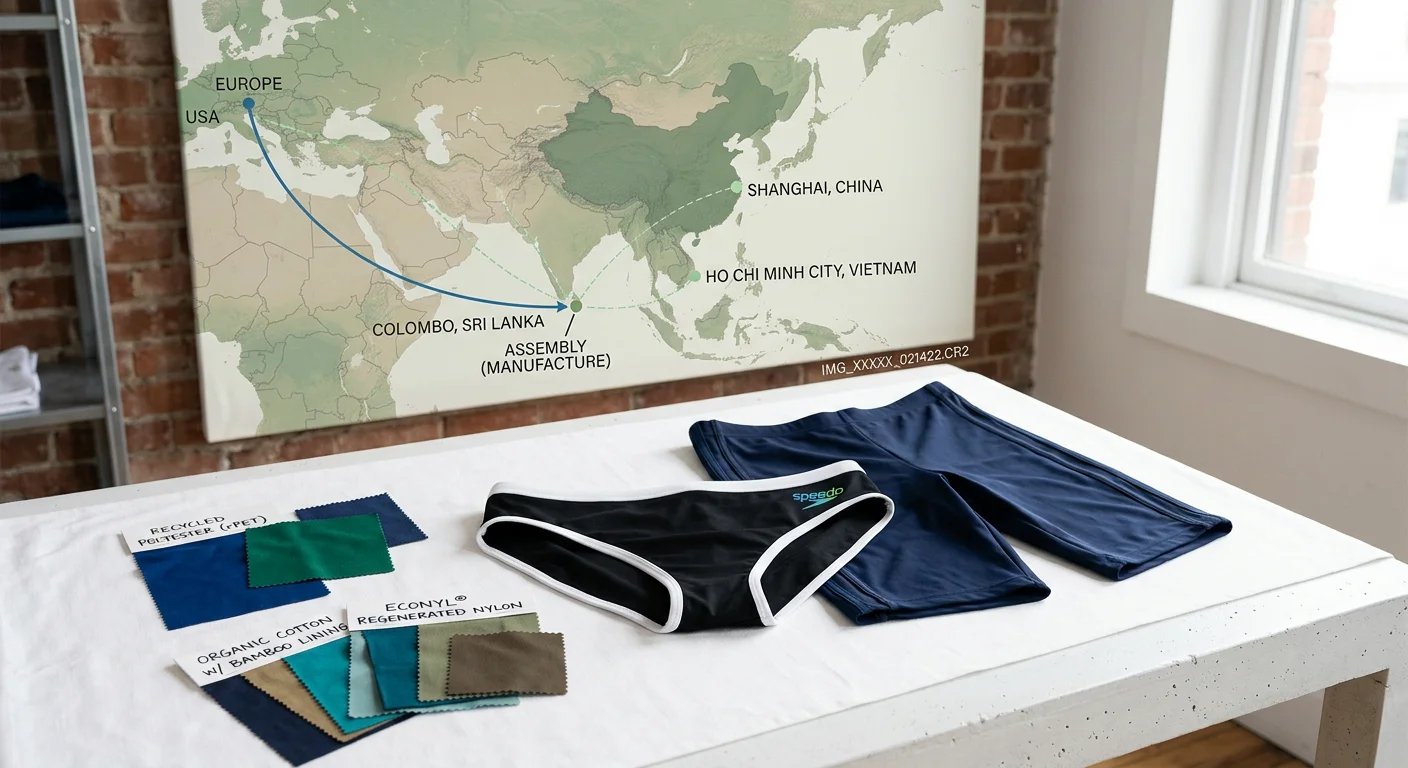
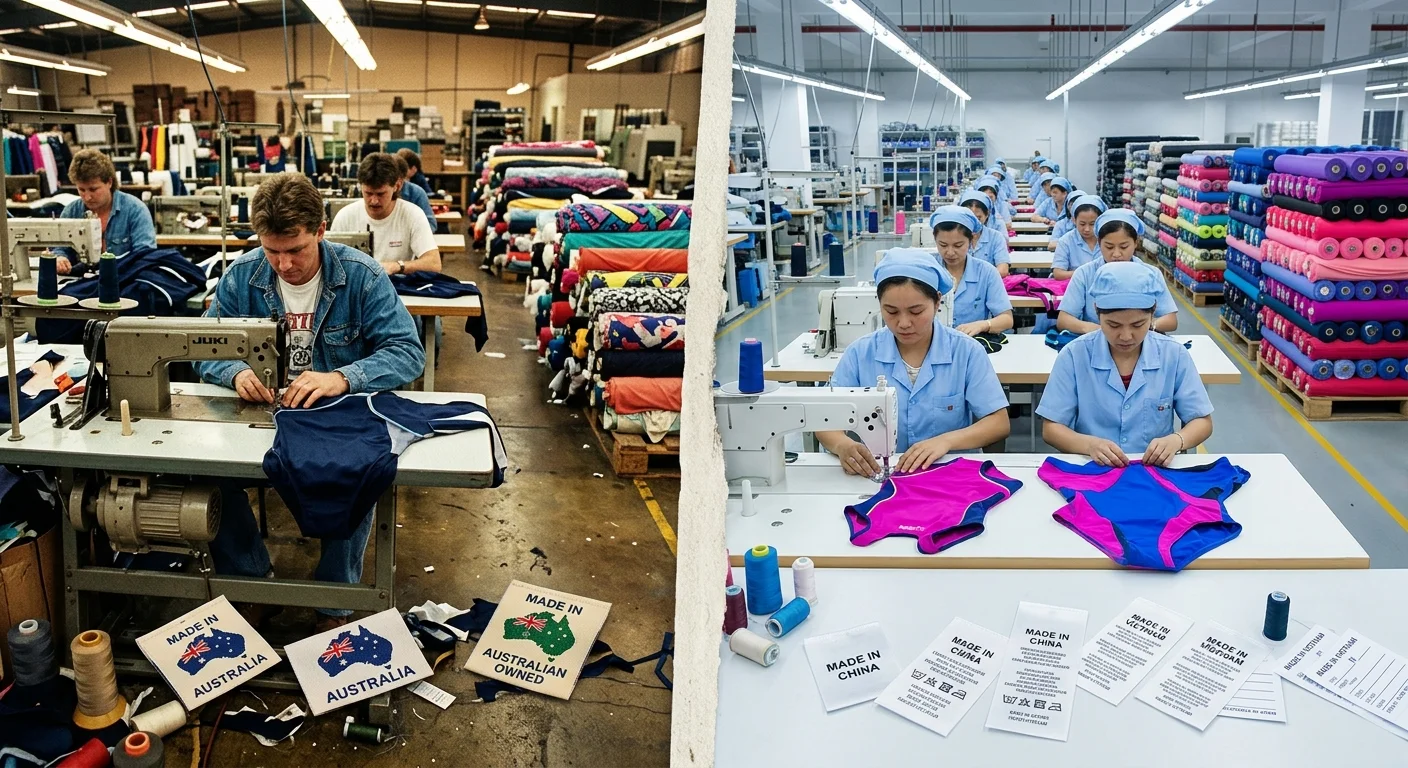
Speedo didn't stumble into Asia. Back in 1992 , the brand made a clear, calculated move — pulling production out of continental Europe and building its manufacturing base across the region. Thirty-plus years on, that decision looks less like a cost-cutting call and more like a smart read on where global swimwear was heading.
Here's the scale you're looking at: the Asia-Pacific swimwear market sits at USD 9.08 billion in 2026 . By 2031, analysts project it reaches USD 12.42 billion — a CAGR of 6.47%. This isn't a small regional market growing at a slow pace. It's the core of the entire global swimwear industry. In 2025, Asia-Pacific holds 31.65% of the global swimwear market share . One region. Close to a third of all swimwear sold on the planet.
China alone accounts for 32.16% of that Asia-Pacific share. Run the numbers on where Speedo's fabrics get cut, sewn, and finished — China is not a minor detail. It's the main story.
Why Asia, and Why It Stuck
Three forces keep Speedo's manufacturing rooted in Asia. None of them come down to "it's cheaper":
Technological fabric advancement — Japan and South Korea push a +1.2% CAGR boost through advanced material innovation. The precision needed for competitive swimwear isn't just possible here. In many cases, it's sharper and more refined here than anywhere else.
Rising health and fitness culture — China's fast-growing fitness market adds another +1.1% CAGR tailwind . Speedo isn't just manufacturing in a region. It's producing products right inside its fastest-growing consumer base.
Athleisure and multifunctional demand — China contributes another +0.9% as swimmers want suits that perform in the pool and look good outside it.
It's not all clean water, though. Raw material price swings across China, India, Vietnam, and Thailand drag regional CAGR down by -0.9% . Counterfeit products moving through Southeast Asian markets pull off another -0.5% . Any real look at Speedo's supply chain has to put those friction points on the table alongside the gains.
The Sustainability Thread Running Through It All
The 1992 production shift also laid the groundwork for something Speedo's marketing team takes clear pride in. In April 2025 , the brand launched the Eco Fastskin — built from 100% recycled nylon and polyester . The Speedo swimwear manufacturers & factories producing Speedo suits at scale now process materials that started life as something else — post-consumer waste turned into high-performance swimwear.
Speedo runs on $47.4 million in annual revenue with 789 employees spread across six continents , Asia central among them. That global footprint isn't random. It reflects where swimwear gets made, where it gets worn, and where brands are now expected to build products designed to last .
Europe: Where Speedo's Premium and Competition Swimwear Is Born
Europe handles about 20% of Speedo's total production volume . Yet it generates 40% of the brand's revenue . That gap tells the whole story.
This is where the expensive suits come from. The ones competitive swimmers argue about at the edge of the pool. The ones with technical specs printed so small you need reading glasses to catch them.
Four European swimwear manufacturers carry that responsibility. Each one owns a distinct piece of the puzzle.
The Four Factories Doing the Real Work
Carvico in Italy holds the largest share — 40% of Speedo's European competition swimwear production . Their swimsuits factories sit in Lombardy and the Veneto region. It sounds scenic, but these are precision textile facilities. They run nylon/elastane fabric work at industrial scale. Carvico fabrics deliver strong chlorine resistance. The drag reduction is strong too. Olympic swimmers shave hundredths of seconds off their times. The fabric making that possible starts here.
Petratex in Portugal covers 30% of European volume with a different focus: seamless construction. No seams means no resistance points. No resistance points means faster times. Petratex pushes lightweight synthetic fiber innovation. Their suits target competitive swimmers where fractions of a second matter most.
Sanko in Turkey accounts for 20% , and their specialty is sustainability. They operate within EU/Turkey material frameworks and produce Speedo's eco-range lines. Fast turnaround, solid quality, and close proximity to European supply chains make Sanko a key partner. Speedo is pushing toward a 100% sustainable fabric target by 2030 . Right now, 35% of Speedo's European fabrics meet eco-standards — Sanko is a big reason that number keeps climbing.
Antex in Spain covers the remaining 10% with a sharp focus on chlorine-resistant technical fabrics. Spain's swimwear import sector grows at 5.3% per year . Antex builds suits for serious recreational and professional swimmers — durable gear that outlasts casual pool use by a wide margin.
Why Europe Commands a Premium
The numbers look odd at first. Lower production volume, higher revenue share. But it makes sense once you break it down. European manufacturing costs more. The nylon/elastane precision work, seamless bonding technology, and sustainable material sourcing all add up. Competitive swimmers pay that price without hesitation. The alternative is a slower suit.
Import value for European technical swimwear grew 8.2% per year even as physical volume dropped 1.77% . Buyers pay more for less fabric. The reason is simple — the fabric performs. That's the core value of Speedo's European manufacturing base.
Speedo's international headquarters sits in Nottingham, England . European operations launched in the 1960s , and Pentland Group took full control through the 1990s . The roots run deep. The German Swimming Federation (DSV) named Speedo its official swimwear supplier for 2023–2025 , covering swimming, diving, and water polo. That's not a marketing badge. That's a technical endorsement from people who count laps for a living.
Is Speedo Made in the USA? The Honest Answer
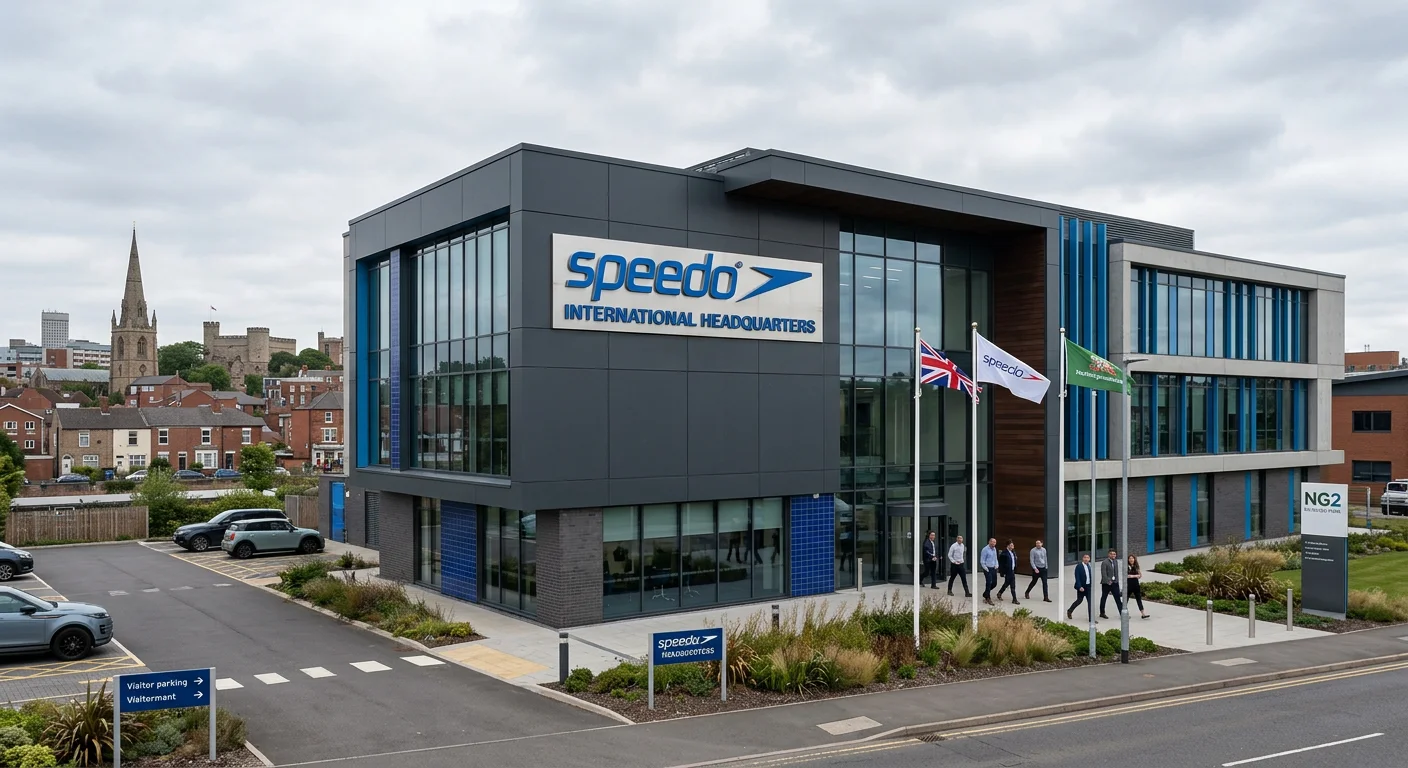
Short answer: no. Longer answer: also no, but with a few interesting detours.
Speedo's North American headquarters sits in Cypress, California — which sounds very American, very sun-drenched, very we-make-things-here . It doesn't. In 2026, those offices move to a new 25,000-square-foot facility in Long Beach. The timing lines up with the Olympics. Over 130 employees work there — and they're very good at selling swimwear that gets made somewhere else.
Here's what US production looks like:
Los Angeles and New York facilities handle 20% of Americas capacity — and that's being generous
A limited run of higher-end SKUs came through American Apparel — emphasis on limited
The rest? Brazil (through Cia. Hering) and Mexico (through Grupo Moda) fill out the Americas picture
Pentland paid $170 million to reclaim North American licensing rights from PVH in 2020. That deal pulled global operations under one British roof. No one broke ground on a swimwear wholesale factory in Ohio.
So "Made in USA" is your non-negotiable? Check individual SKU labels. Those American Apparel California runs do exist. They're just not the default — not even close.
Speedo's Quality Standards: What the Manufacturing Labels Don't Tell You
Labels lie. Not out of malice — more like a friend who says "it's fine" when it's not. The tag tells you where the swimsuit was made . It says nothing about what's in it, what it can do , or whether the company knows what goes into its own supply chain.
The transparency problem is worth looking at first. It's stranger than you'd expect.
The Green Supply Chain CITI Index scores brands on how openly they share supply chain information with the public. Speedo scored 47% as of February 2026. The industry average sits at 26% . The highest scorer hits 83% . So Speedo beats the average — by a solid margin in some cases — but a real gap still exists between Speedo and the most transparent brands out there.
Cotton sourcing is a specific sore spot. Zero percent of Speedo's cotton comes from certified sources. The brand ranks 78th overall for cotton versus synthetics use. The average score in this category is 18% , and the sector high is 75% . Speedo leans on performance synthetics, so cotton sourcing isn't the main story here. But the gap is still worth calling out.
The Fastskin Performance Reality Check
Here's the part that will stick with competitive swimmers. Speedo marketed its Fastskin suits with bold claims: 7.5% drag reduction and 1–1.5 seconds improvement per 100 meters . Independent testing told a different story. Results showed 2% drag reduction — with a p-value of 0.31. That's not statistically significant. The suit may still give you some edge. The data just doesn't back up the headline number.
The LZR Racer uses polycarbonate, polyether, and polyester resins. These are genuinely advanced materials, especially compared to traditional polyester-cotton blends. Speedo also runs a Restricted Substances List (RSL) through Pentland Brands. This caps harmful chemical limits across both consumer products and factory environments.
The quality is real. The marketing sometimes gets ahead of the data. Both of those things are true at the same time.
FAQ: Your Top Questions About Speedo's Origin Answered
Real people ask these. All the time. And the answers are stranger and more interesting than the questions deserve.
Is Speedo an Australian brand?
Yes — and also no. That fits a company that started with socks . Alexander MacRae founded MacRae Hosiery in Sydney in 1914. The "Speedo" name didn't show up until 1928. It came from a staff slogan contest. The winning author took home £5. Australian soul. Scottish immigrant roots. British ownership since the 1990s. This brand carries a lot of history.
Who owns Speedo now?
The British Pentland Group . They picked up the European rights around 1990–1991. Then they absorbed the Australian and international operations not long after. In January 2020, they paid $170 million to buy back North American rights from PVH. Today, Speedo sits headquartered in Nottingham, England. A British conglomerate runs it. Australian at heart — just not on paper.
Is Speedo swimwear made in China?
Some of it, yes. Trade data shows $6.33M in China-sourced imports for Speedo's North American operations. China isn't the whole picture, though. Sri Lanka leads the sourcing at $9.86M . Vietnam rounds out the top three.
Is Speedo still made in Australia?
Not in any real production volume. The original Speedo Knitting Mills ran in Australia for decades. Then manufacturing moved to Asia, starting in 1992 . Check your individual labels — just don't expect to find a Sydney factory stamp.
Conclusion
Here's what nobody tells you in the swimwear aisle: where something is made and how well it's made are two different conversations.
Speedo's story is messy — born in Australia, owned by Britain, made across Asia and Europe, and still the name serious swimmers trust most. That's not an accident. Decades of strict quality control kept that trust alive, even as the brand changed hands and swimming apparel factories shifted around the globe.
So you came here worried your next swimsuit might let you down. Don't be. Now you know what you're buying and why it costs what it costs.
Ready to find your perfect fit? Browse our swimwear collection at berunclothes.com. We break down what you're getting before you spend a dollar. Informed swimmers swim better. That's just a fact.
Video Section