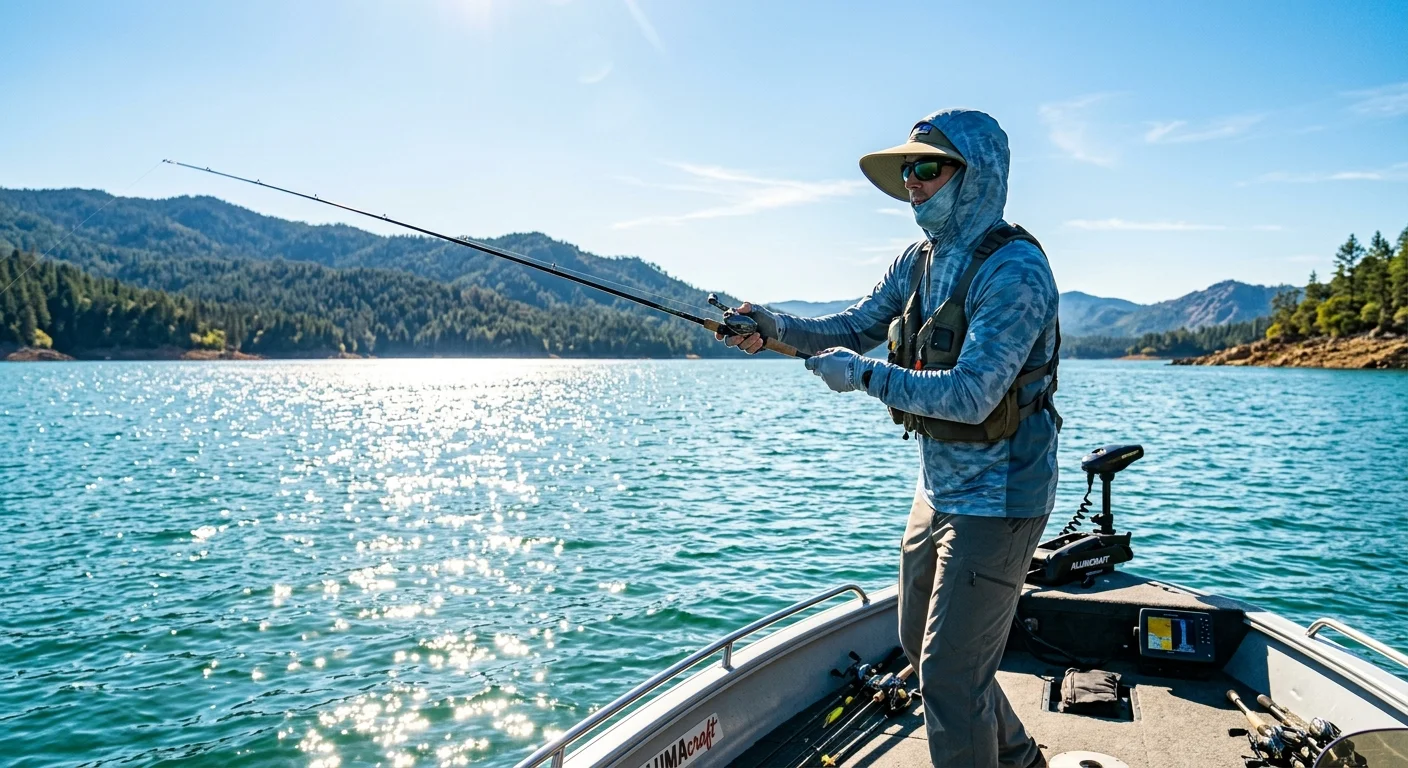
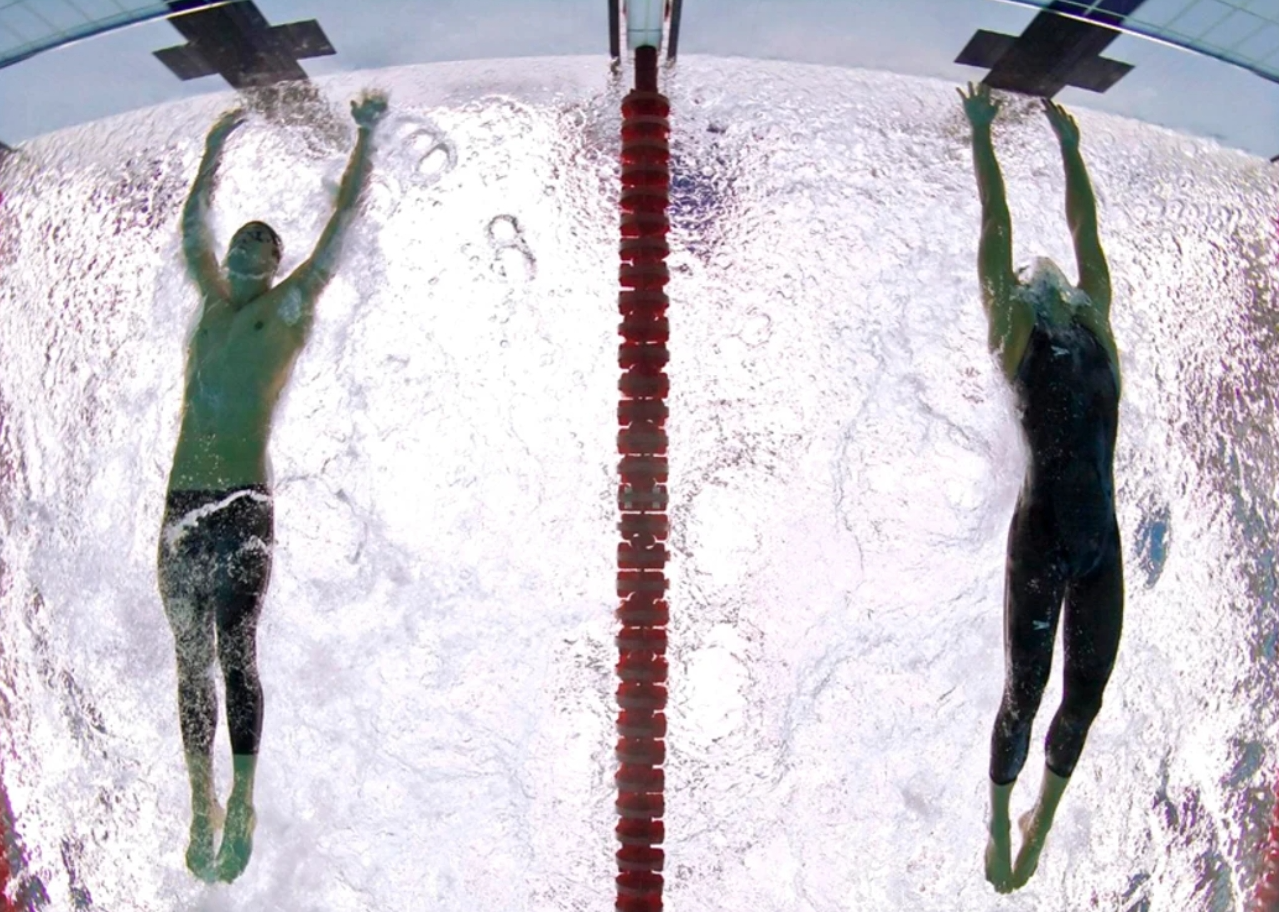
Picking between a wetsuit and a drysuit can feel overwhelming — but it doesn't have to be. Get it wrong, and you'll spend a session shivering in water that needs far more thermal protection. Or you'll wrestle with heavy gear on a warm summer paddle where a slim neoprene wetsuit would have done the job. Across the industry, from neoprene wetsuit manufacturers for watersports performance to thermal water sportswear factory for extreme environments, gear is engineered for very specific water conditions — but choosing correctly still depends on you, not just the product label.Both suits exist for good reason. The right one comes down to your water temperature, your sport, and how your body handles the cold. This guide breaks it all down — insulation basics, mobility trade-offs, real costs, and sport-by-sport picks — so you leave knowing which suit belongs in your kit bag.
Wetsuit vs Drysuit: 6 Key Differences Side-by-Side
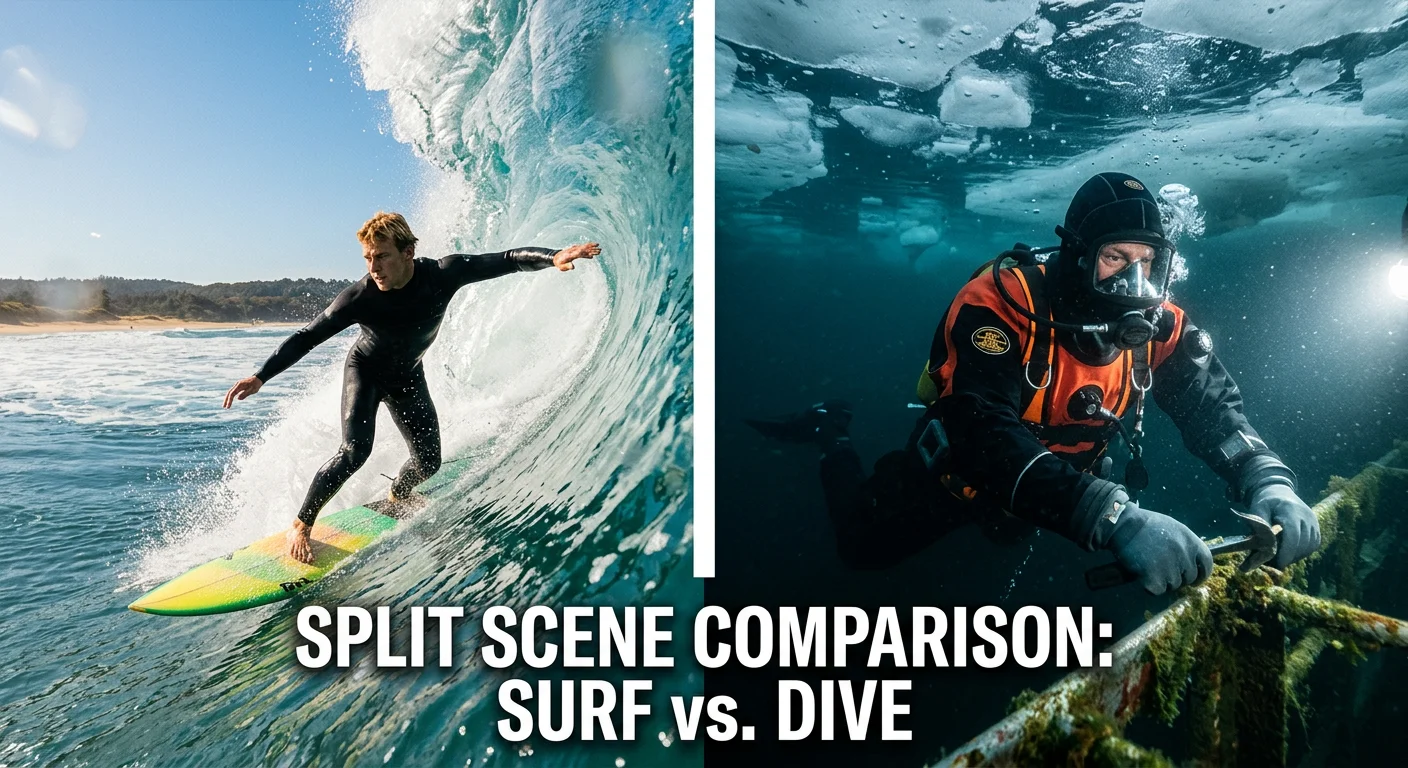
Six differences. That's all it takes to pick the right suit — or end up with an expensive regret.
The table below covers the key gaps — insulation, temperature ranges, price, and more.Behind these designs, professional watersports apparel suppliers for diving and surfing constantly refine materials and construction techniques to balance warmth, flexibility, and durability. Scan it first, then read the breakdown below for the details that shape your final call.
Difference | Wetsuit | Drysuit | Winner |
|---|---|---|---|
Insulation Principle | Traps a thin water layer inside neoprene foam — your body heat warms it | Keeps a dry air layer next to your skin + lets you add undergarments; no water contact | Drysuit (cold extremes) |
Water Temperature Range | Best above 10°C (50°F); 3–7mm thickness covers most conditions | Built for below 10°C (50°F); add or remove layers to adjust warmth | Drysuit (colder limits) |
Mobility & Flexibility | Skin-tight neoprene stretches with you — great for surfing and swimming | Looser, bulkier fit adds drag and limits range of motion | Wetsuit (dynamic sport) |
Ease of Getting On/Off | Snug but simple — no underlayers, no fuss | Bulkier seals, zippers, and valves slow the process down | Wetsuit (simpler) |
Price Range | $100–$500 | $800 and up | Wetsuit (budget-friendly) |
Maintenance | Neoprene wears down over time — expect more frequent replacement | Seals, zippers, and valves need regular checks — but the suit lasts longer | Drysuit (longevity) |
What the numbers mean
At the manufacturing level, custom wetsuit production services for aquatic sports brands focus heavily on neoprene density and stretch ratios to optimize warmth vs mobility.
Insulation is a physics problem first. Water pulls heat away from your body about 20 times faster than air does. A wetsuit slows that loss by holding a thin water layer against your skin. Your body warms it. The neoprene keeps it in place. A drysuit cuts out water contact. It locks in a dry air pocket instead. You can stack thermal undergarment layers on top as the cold gets worse. In serious cold-water conditions, that gap isn't small. It's the line between staying functional and facing hypothermia risk.
Thickness sets your temperature limit. A 3mm neoprene wetsuit works well for warm tropical sessions or summer surfing. Move into moderate cold and you'll need 5–7mm . Drop below 10°C — ice diving, winter kayaking, open-water cold swims — and a wetsuit hits its ceiling. It can't keep up.
Buoyancy works differently between the two. Neoprene floats on its own. That's a plus for surfers and snorkelers who want natural lift in the water. A drysuit sits closer to neutral buoyancy. You'll use air valves or a BCD to control your position underwater. That's worth knowing before you make a scuba diving suit choice.
Price hurts upfront — but lifespan matters. A quality drysuit built from trilaminate or rubber holds up far longer than neoprene. The $800+ starting price is a real barrier. But spread that cost across ten years of cold-water use, and it often makes financial sense.
Water Temperature Guide: Which Suit Fits Which Conditions
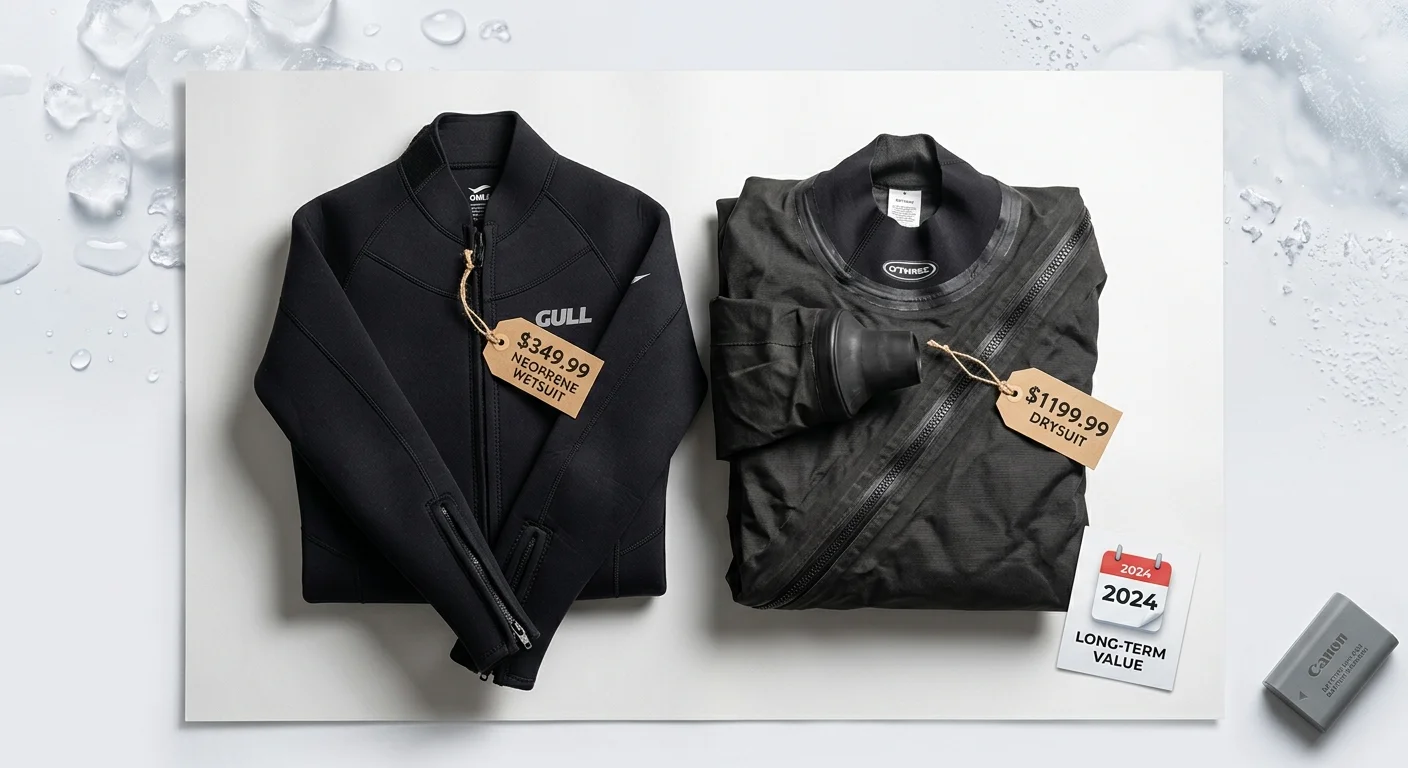
Water temperature is the one variable that makes every other decision easier. Nail it, and everything else — thickness, accessories, suit type — falls into place.Many OEM/ODM diving suit manufacturers for cold water conditions design suits specifically around these thermal thresholds to match real-world diving environments.
Here's the breakdown:
Water Temp | Short Sessions (<1 hr) | Long Sessions (>1–2 hrs) | Accessories Needed |
|---|---|---|---|
>70°F (21°C+) | Rashguard or 0.5–2mm shorty | 2–3mm full suit | None |
60–70°F (15–21°C) | 2–3mm full or spring suit | 3–4mm full suit | Optional 2–3mm booties |
50–60°F (10–15°C) | 4–5mm hooded full suit | 5mm full + hood + booties | 3–5mm booties/gloves |
<50°F (<10°C) | 5–6mm hooded full | 6.5–7mm+ or drysuit | 5–7mm booties/gloves/hood — required |
The 50°F Line Changes Everything
At 50°F (10°C) , your choice of wetsuit starts to matter a lot more. A wetsuit can still do the job — but you need to pick the right one.
Surfing or active paddling at 50°F: a 4/3mm neoprene wetsuit handles it. Your body generates heat. The suit locks it in.
Slow drift diving at the same temperature: go straight to a 7mm semi-dry — or give a drysuit real thought. Staying still drains warmth fast.
Two factors push your thickness up or down:
Cold acclimatization — experienced cold-water regulars can go 0.5–1mm thinner without issue. Beginners should add 1mm as a buffer.
Session length — anything past two hours brings wind chill into play. Step up 0.5–1mm to stay ahead of it.
Real-World Examples
Northern California, December–January (45–55°F): 5/4mm hooded full + 5mm booties and gloves. No exceptions.
Red Sea, July–August (70–75°F): A 2–3mm shorty is all you need.
UK waters, October (55–65°F): 3/2–4/3mm with reinforced core thickness. Add a millimeter on the limbs for low-intensity swims.
Australia, March–April (60–70°F): 3/2mm full suit, optional booties.
Here's a rule worth keeping: hoods are essential below 50°F, and booties become a smart call below 55°F. Skip them, and no amount of neoprene thickness makes up for the heat you lose through your hands, feet, and head.
Best Suit for Each Watersport: Sport-by-Sport Recommendations
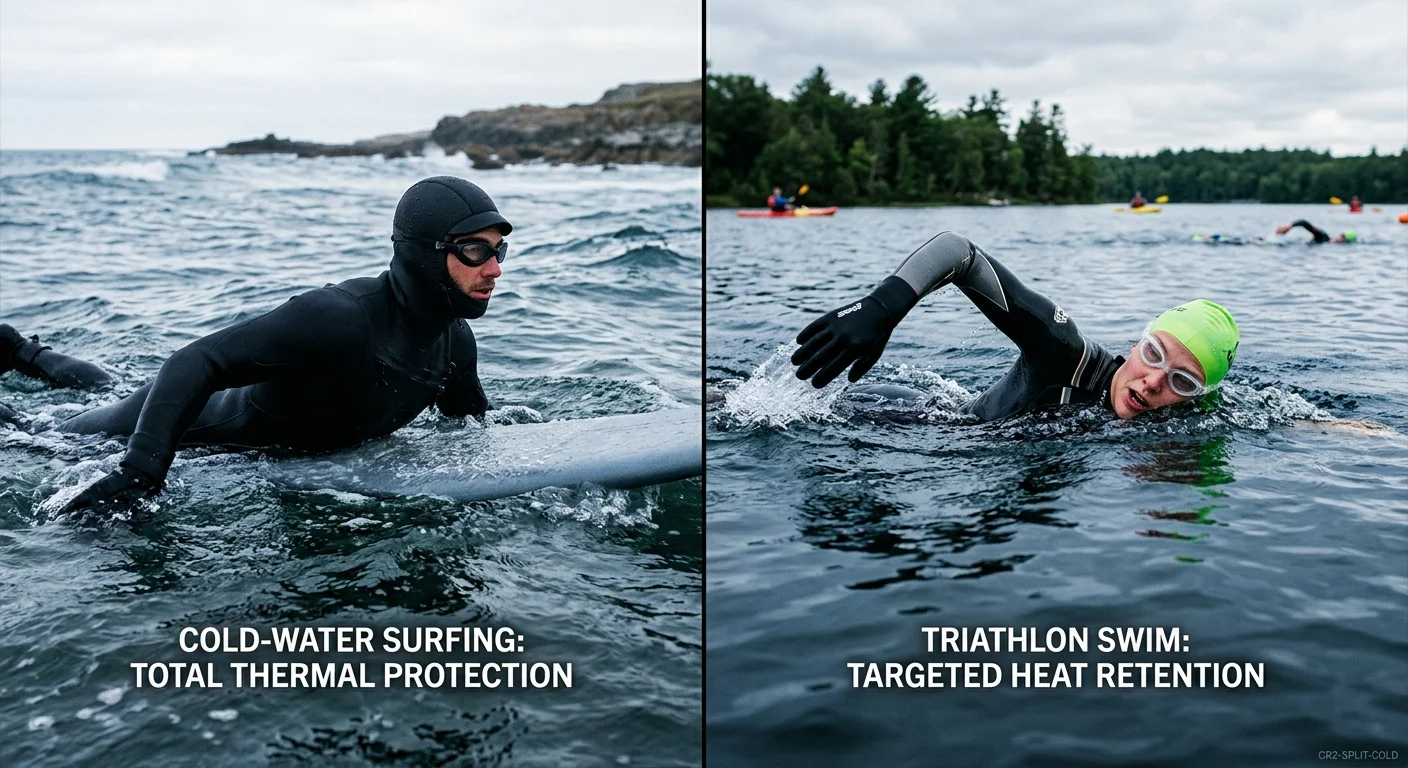
In fact, private label wetsuit suppliers for surf and dive brands often design separate product lines for surfing, diving, and paddling because no single wetsuit performs optimally across all activities.
Every sport puts different demands on your body — and on your suit. A triathlete needs buoyancy and a fast T1 exit. A winter sailor needs wind-blocking warmth without ever going underwater. Pick the wrong suit, and it works against you.
Here's the sport-by-sport breakdown.
Surfing
Surfing is a flexibility sport first. Your shoulders rotate non-stop. Your arms paddle hard. Your torso twists through every bottom turn.
A 5–7mm full wetsuit is the standard choice for cold-water surfing. But thickness alone isn't the whole story. Look for high-stretch neoprene — Yamamoto limestone rubber gives you 20% more flex than standard foam. That extra stretch matters most in the shoulder and arm panels. A zipperless chest-entry design takes pressure off your lower back and opens up your rotation.
Fit matters more than most surfers think. A loose wetsuit lets cold water flush through the collar and cuffs over and over. Each flush strips warmth. Every gap costs you 5–10% of your thermal protection. Snug at the neck, snug at the wrists — no exceptions.
Open Water Swimming & Triathlon
Competitive open-water swimmers and triathletes use wetsuits for a different reason than surfers. Buoyancy is the main benefit — warmth comes second.
A 2–4mm triathlon wetsuit uses buoyancy panels across the chest and thighs. These lift your hips into a flat position and cut drag. The speed gain is real: a well-fitted tri wetsuit improves swim speed by 4–7% and drops energy output by 10–20%. That matters with a 40km bike leg waiting after T1.
Shoulder panels stay thin on purpose — 1.5–2mm in the arm zones — so your stroke doesn't suffer. Quick-release back zippers let you strip the suit in under 30 seconds at T1.
Drop below 10°C (50°F) and step up to a 6–7mm full suit . You keep the buoyancy benefit. You also get much better warmth.
Scuba Diving
Water temperature drives this choice.
Warm water diving (above 22°C / 72°F): A 1–3mm shorty wetsuit does the job. Flexibility is the priority — your BCD, regulator, and tank already add bulk. You don't need extra layers.
Cold water diving (10–16°C / 50–60°F): Move to a 5–7mm full wetsuit with reinforced knees and elbows. Welded seams stop water from getting in at pressure points. The abrasion zones on a good cold-water suit hold up against 500+ contact cycles on rocks and reef.
Below 10°C: Go with a drysuit . It keeps water off your skin. The trade-off is buoyancy control — trapped air inside the suit creates significant lift. Plan to carry an extra 5–10kg of weight to hit neutral buoyancy and hold it. That's a skill you'll need to develop, not just a gear upgrade.
Paddle Boarding (SUP)
SUP is low-impact and upright. You won't go underwater often — but you will fall, and heavy neoprene will make you overheat fast.
A 3–5mm wetsuit works for most conditions. In warmer water, pair a rashguard with board shorts or a high-waist bottom. You get full paddling range and UV protection without the bulk. Put unrestricted shoulder movement above insulation every time.
Kayaking & Canoeing
Kayakers deal with spray — not full immersion — but a capsize is always on the table. That shifts how you think about warmth.
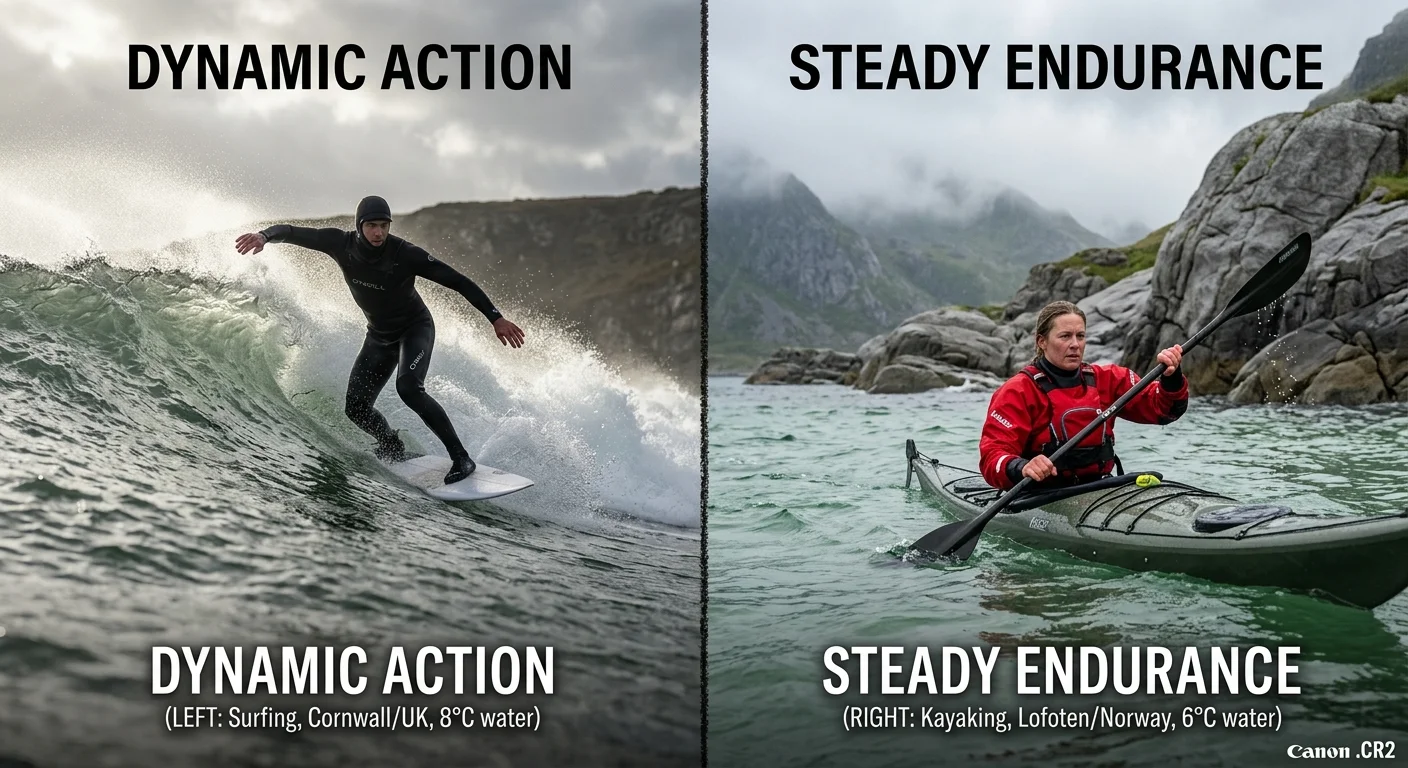
A 4–6mm wetsuit covers most river and coastal paddling. In cold, windy conditions — sea kayaking in late autumn, for example — a drysuit is the better pick . It blocks wind chill from spray and stays 100% dry with no full submersion needed. Add a thermal base layer underneath, and it holds warmth through long, steady sessions where a wetsuit would gradually fall short.
Sailing & Surf Fishing
Both sports follow the same pattern: long cold exposure with no full submersion .
Sailors stand on deck in cold wind and spray for hours. Surf anglers wade in cold shallows and face wind-driven evaporative cooling the whole time. In both cases, the real threat isn't water depth — it's steady surface chilling.
A drysuit is the clear winner here . Below 16°C (60°F) , its sealed build blocks wind chill and stops the evaporative heat loss that drains warmth from a neoprene wetsuit over time. Add a thermal undergarment underneath, and you can adjust warmth up or down without swapping suits.
Here, thermal water sportswear factory for extreme environments designs gear specifically to resist prolonged evaporative heat loss.
Quick Reference: Sport-to-Suit Match
Sport | Best Suit | Thickness | Priority |
|---|---|---|---|
Surfing | Wetsuit | 5–7mm | Flexibility + fit |
Open Water Swim / Tri | Wetsuit | 2–4mm (6–7mm winter) | Buoyancy + speed |
Warm Scuba (>22°C) | Wetsuit | 1–3mm shorty | Mobility |
Cold Scuba (<10°C) | Drysuit | — | Thermal protection |
SUP | Wetsuit | 3–5mm | Unrestricted paddling |
Kayaking / Canoeing | Wetsuit or Drysuit | 4–6mm / drysuit in cold | Splash + wind protection |
Sailing / Surf Fishing | Drysuit | — | Wind + evaporative chill |
Mobility, Comfort & Fit: Wetsuit vs Drysuit in Real Use
Here's what most gear guides skip: the warmest suit isn't always the best-performing suit.
Fit and freedom of movement shape your time on the water far more than insulation specs. The two suits handle this trade-off in opposite ways.
The Mobility Trade-Off
A wetsuit wraps tight — that's the point. Neoprene stretches, which helps in dynamic sports. But the compression adds up. After 60–90 minutes of paddling, your shoulders start to feel it. The suit doesn't fight you hard all at once. It wears you down rep by rep, hour by hour.
A drysuit runs looser by design. That extra room fits thermal undergarment layers underneath. Your paddle stroke stays clean and unrestricted. The trade-off: that baggy profile adds drag in the water. You'll notice a bulkier feel at speed underwater.
For seated paddling — kayaking, canoeing, long touring — the drysuit takes the mobility win. The wetsuit's joint restriction builds into real fatigue over a 4+ hour session. Your arms feel it before your mind does.
Comfort Over Time
Aspect | Wetsuit | Drysuit |
|---|---|---|
First hour on water | Comfortable once warmed up | Dry and comfortable from the start |
After 2+ hours | Tight fit fatigues shoulders; damp feel sets in | Loose fit holds up well; stays dry inside |
Out of the water | Cold, clingy neoprene chills fast | No evaporative chill — dry skin, dry layers |
The wetsuit's weak point isn't insulation — it's the post-immersion chill. Out of the water, wet neoprene clings to your skin. Evaporation kicks in fast. You cool down quicker than you'd expect.
Getting In and Out
Pulling on a wetsuit is simple. The snug neoprene creates a suction-cup effect that slows you down. A little talc or wetsuit lube fixes that. Nothing complicated about it.
Drysuits are a different story. Entry systems vary — back-entry zippers, front zippers, or hinged designs like the Typhoon Hinge that let you step in solo. You'll also deal with neck gaskets and wrist seals. Those need real attention. Ill-fitted seals start chafing after 2–4 hours. Proper sizing and a short break-in period fix most of that. Still, it's not a zero-learning-curve piece of gear.
What Sport Decides It
Surfing and kiteboarding: Wetsuit every time. A drysuit can't match the agility a 3/2–6/4mm neoprene suit delivers.
Kayaking and canoeing: Drysuit for anything beyond two hours. The loose fit keeps your stroke efficient. The wetsuit works against it over time.
Paddleboarding: Drysuit earns its place here. Fall risk runs high, and dry layering keeps you regulated across long sessions.
Scuba diving below 50°F (10°C): Drysuit for extended bottom time. Wetsuit for faster movement on shorter dives.
The short version: wetsuits perform better in high-action sports. Drysuits stay comfortable longer in slow, sustained activities — especially where cold exposure builds up over time and getting out of the water isn't always an option.
Cost, Durability & Maintenance: Long-Term Value Comparison
The price tag on a drysuit isn't the real number to focus on.
Cost-per-use is what matters — and that changes everything.
Entry-level wetsuits start at $50–$150. Mid-range models run $150–$300. High-end options push to $600. Drysuits open at $500–$1,000 and climb to $3,000+ for premium builds. That gap looks brutal on a spreadsheet. Run the math over a decade of cold-water use, though, and the picture flips.
A quality wetsuit — say, a $400 model — lasts 3–5 years under regular use. Saltwater, sun, and friction eat through neoprene faster than most divers expect. At 50 dives per year, you're replacing it every 60–100 dives. Your annualized cost lands around $60–$100 .
A drysuit at $1,200 lasts 15+ years with proper care. Same dive frequency. Annualized cost: $50–$100 — before repairs. Yes, seals and zippers need attention ($100–$300 every 1–3 years). Professional servicing adds another $200–$500 per year. Even so, your per-dive cost drops from $5–$8 on a wetsuit to $1–$3 on a drysuit across its full lifespan. Drysuits also hold resale value. Neoprene does not.
Maintenance: Two Very Different Routines
Wetsuit post-use (5 minutes):
- Rinse inside and out with fresh water
- Hang on a wide hanger, away from direct sunlight
- Store flat to prevent compression creasing and odor buildup
Drysuit post-use (10–15 minutes):
- Rinse the exterior; inspect seals and zippers for damage
- Lubricate latex/silicone seals and waterproof zippers after every session
- Pressure-test for leaks — inflate the suit, submerge wrists and neck seal
- Make sure it's fully dry before storage; book professional servicing once a year
Ready to Upgrade from Wetsuit to Drysuit?
Three clear thresholds tell you it's time:
Condition | Upgrade Makes Sense? |
|---|---|
>30–50 dives per year in cold water | Yes — cost spreads over 15+ years |
Regular exposure below 15–18°C (59–64°F) | Yes — a wetsuit can't keep up |
Frequent deep or technical dives | Yes — air valves give buoyancy control |
Warm/moderate water, <30 dives/year | No — wetsuit is cheaper and simpler |
Rough or harsh dive conditions | Yes — drysuits handle abuse far better |
The upgrade isn't about luxury. It's about hitting a crossover point. Past that point, a drysuit stops costing more — and starts costing less. Per dive. Per year. Per decade.
Wetsuit vs Drysuit for Beginners: Which Should You Start With
Start with a wetsuit. Full stop.
Not because drysuits are bad — they're exceptional pieces of kit. But a drysuit needs certification, technical knowledge, and a budget most beginners don't have yet. A wetsuit needs none of that. You buy it, you wear it, you get in the water.
The Beginner's Default: Wetsuit First
A 3/2mm neoprene wetsuit in the $100–$300 range gets most beginners through their first season. It covers surfing, open-water swimming, snorkeling, and light paddling. No PADI Drysuit Specialty course. No learning curve around air valves or buoyancy trim. Just a snug second-skin fit and you're moving.
The one thing beginners get wrong most often: fit . A loose wetsuit flushes cold water the whole time you're in. Instead of 45+ minutes of comfortable warmth, you're shivering in 15–20. That's not a wetsuit problem — it's a fit problem. Try it on wet. Check the neck, wrists, and chest. No gaps.
Ready to Move Up?
After 10–20 sessions, patterns start to show. You find yourself paddling or diving in water below 15°C (59°F) for long stretches. The wetsuit starts hitting its limits. That's the point to take a serious look at a drysuit — not before.
The progression works like this:
New to watersports → 3/2mm wetsuit
Building experience, moderate cold → 5/4mm or 6/5mm wetsuit with hood
Regular cold-water sessions below 15°C → drysuit with thermal undergarment layers
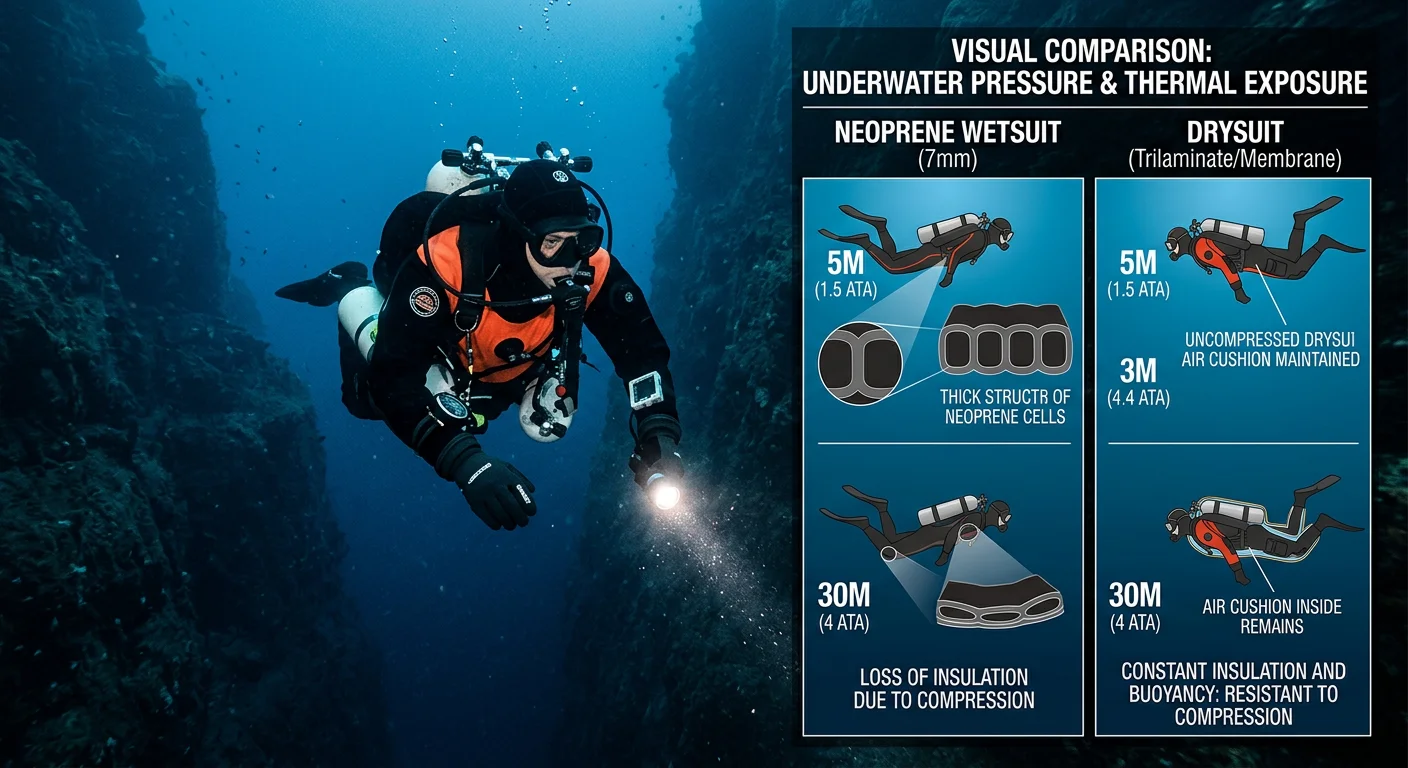
One number to hold onto: a wetsuit loses 20–50% of its insulation and buoyancy below 10 meters depth as neoprene compresses under pressure. A drysuit doesn't compress. So, scuba diving in cold, deep water? That compression gap grows the deeper you go. It matters.
Starter Checklist Before You Buy
Measure your body — chest, waist, height, and weight; size charts vary by brand
Match thickness to temperature — 3/2mm works above 15°C; add a hood and vest between 10–15°C
Budget under $400? — wetsuit only, no exceptions
Track your sessions — 10–20 dives or paddles gives you real data on whether a drysuit upgrade makes sense
Exit rule — shivering within 30 minutes means your suit, fit, or thickness is off; don't push through it
FAQ: Wetsuit vs Drysuit Common Questions Answered
These questions come up all the time — and a wrong answer costs you warmth, money, or worse, your safety.
Is a drysuit necessary for winter surfing?
Yes. Water temperatures below 15°C (59°F) are too cold for a wetsuit to handle. A drysuit keeps you dry and fully functional. A wetsuit just leaves you battling the chill.
At what water temperature do I need a drysuit?
The hard threshold is 10°C (50°F) . Below that, a wetsuit becomes a liability. Water pulls heat from your body 20 times faster than air . A drysuit traps a dry air pocket to stop that heat loss. Below 10°C , this isn't a preference. It's a safety decision.
Does drysuit diving require special training?
It does. You need to learn three core skills:
Air valve management for buoyancy control
Proper seal maintenance
How to layer your thermal undergarments correctly
Skip the training and an over-inflated suit can send you shooting toward the surface fast.
Can I just use my 5mm wetsuit for winter kayaking?
Below 15°C , a 5mm wetsuit won't give you enough protection during a capsize. Switch to a drysuit paired with a Farmer John thermal base layer . You get real immersion protection and stay dry across multiple sessions.
My 3/2mm wetsuit feels fine on the beach. Is it safe for winter surfing?
No. Winter water often sits below 10°C . A 3/2mm suit gives you maybe 20–30 minutes before shivering takes over. For longer sessions in those conditions, a drysuit is the right call.
Quick Comparison Snapshot
Parameter | Wetsuit | Drysuit |
|---|---|---|
Best water temp | Above 21°C (70°F) | Below 15°C (60°F) |
Insulation method | Body-warmed water layer | Trapped air + thermal layers |
Training required | None | Yes |
Cost | Budget-friendly | 2–3× more expensive |
Pack size | 50% less bulk | Heavier, bulkier |
Conclusion
The right suit doesn't just keep you warm — it keeps you in the water longer, safer, and with more confidence.
Here's the simple breakdown. For warm to moderate waters, a neoprene wetsuit is your natural starting point. It gives you freedom of movement and comfort. For cold water below 10°C, a drysuit with proper undergarment layers is no longer optional — it's a must.
Your sport matters. Your water temperature matters. Your experience level matters. These decisions don't need to feel overwhelming. Understanding the basics makes everything clearer — and that's what this guide set out to do.
Ready to find the suit that fits your adventure? Browse berunclothes.com for a curated range of wetsuits and drysuits. You'll find options matched to every watersport, every temperature, and every budget.
The water's waiting. Choose well — then get out there.