No country in history has dominated a single Olympic sport the way the United States has dominated swimming. Think about it — from Mark Spitz's seven gold medals in Munich to Michael Phelps rewriting record books across five Olympic Games, USA swimming dominance is no accident. It comes from a hard-driving system built on elite college programs, top-tier coaching, and a federation that treats excellence as the bare minimum.For brands and teams building performance-driven lines, working with experienced American team-style swimwear manufacturers helps translate that same competitive standard into product design.
So what makes American swimmers this good, year after year? Talent is part of it. But the answer goes much deeper than that.
Here, you'll find the training philosophies, institutional structures, and legendary athletes that made the United States the top force in competitive swimming — plus what any serious swimmer can pull from that playbook.
How the NCAA College Swimming System Creates World-Class Athletes
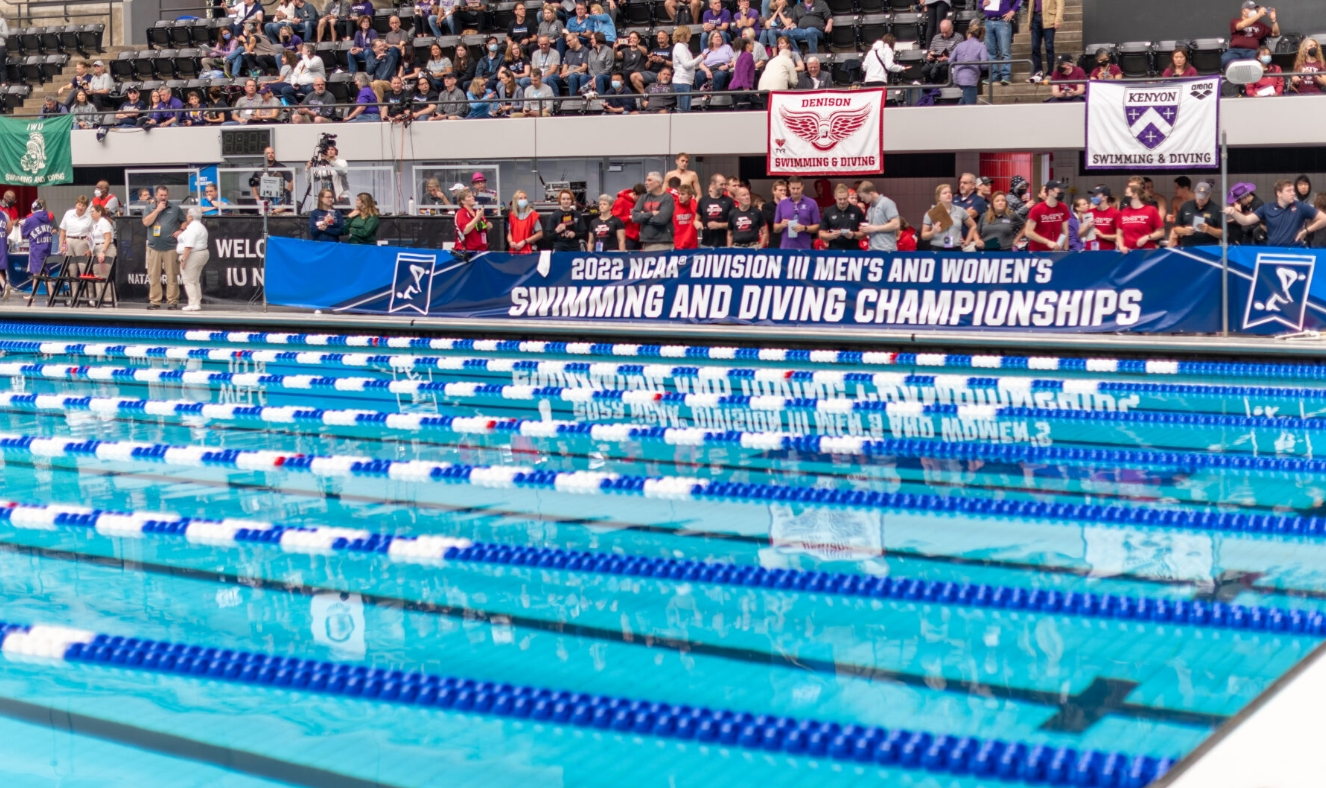
Forty-seven swimmers walked into Rio 2016 representing Team USA. Thirty-nine of them walked out with medals. That's not a team — that's a machine.
The engine behind those numbers? The NCAA college swimming system. Olympic coaching staff didn't mince words: they called it "the best minor league system in the world." The data backs that up.
Built for Pressure, Not Just Performance
Here's what separates NCAA swimming from every other national development model. It doesn't just train athletes — it stress-tests them.
The NCAA meet format mirrors an Olympic schedule almost exactly. Preliminary rounds. Finals. High-stakes elimination under fatigue. The U.S. Olympic staff prepared for Rio by simulating the NCAA grind — training late, eating dinner at 11 PM, sleeping at 2:30 AM. Assistant Olympic coach Ray Looze (Indiana University) said it straight: "Even me, as a rookie coach, this is just like a long NCAA meet. There's no margin for error."
Other national programs — including Australia — collapsed under those same conditions at Rio. NCAA-trained Americans didn't blink.This level of consistency is also reflected off the pool, where custom USA-Style competitive swimwear is designed to meet the same repeat-performance demands.
The Katie Ledecky Blueprint
Katie Ledecky enrolled at Stanford in 2016. She already had five Olympic golds, fifteen world titles, and three world records. She didn't need college swimming. She chose it anyway.
Stanford gave her something elite club training couldn't match: two tracks running at once — serious academic growth alongside elite competition. She competed at the Tokyo 2021 Trials and finished her Psychology degree at the same time. Stanford's coaching staff and training environment pushed her competitive maturity even further after Rio.
That's not a scholarship story. That's a blueprint.Behind many elite programs, an American team-style swimwear factory supports teams with consistent, competition-ready gear across seasons.
A System With Global Reach — and a Growing Tension
Look at the non-American stars from Rio who trained in NCAA programs. They tell their own story:
Katinka Hosszu (Hungary) — 3 golds, 1 silver; trained at USC
Joseph Schooling (Singapore) — Olympic butterfly champion; University of Texas
Lilly King — Indiana University → Olympic gold, breaststroke
Ryan Murphy — UC Berkeley → Olympic gold, backstroke
Simone Manuel — Stanford → Olympic gold, freestyle
The NCAA's yards-based, short-course training builds strong stroke efficiency and aerobic capacity. Division I scholarships cut through financial barriers. They fund four full years of professional-level development. Three major competition peaks per year — dual meets, conference championships, NCAAs — build a competitive depth that single-championship national programs can't match.
But there's a real tension here. International competition runs in 50-meter long-course pools. NCAA trains mostly in short-course yards pools. U.S. performance dipped across the 2023 Worlds, 2024 Olympics, and 2025 Worlds — and the debate is getting louder. Are American swimmers being shaped for a format that doesn't carry over?
At the same time, foreign NCAA alumni keep collecting international medals. The system the U.S. built may be lifting everyone else's ceiling too.
The NCAA pipeline drove USA swimming dominance for decades. Whether it holds that edge — or becomes a shared global tool — is the most interesting question in competitive swimming right now.For international teams adapting to this system, sourcing through USA-Style competitive swimwear wholesalers offers more flexibility in aligning with U.S.-style training demands.
USA Swimming Federation: The Institutional Engine Behind the Success
Behind every dominant athletic culture, there's a backbone most people never see. In American swimming, that backbone has a name, a budget, and a membership roll that tells you almost everything.
USA Swimming is the official National Governing Body for competitive swimming in the United States. By 2024, it counted 376,479 individual members — swimmers, coaches, officials, volunteers — spread across 2,740 club teams in all four geographic zones. The Western Zone leads with 25.6% of athletes. The Southern, Eastern, and Central zones each hold 24-25%. The spread is close to even across all regions. That's not coincidence. That's infrastructure.
The Money Behind the Medals
Numbers don't lie. USA Swimming reported $51 million in total revenue in 2024. $24.31 million of that came from member dues alone. Total assets sit at $74.60 million , backed by $50.50 million in net reserves . This is not a volunteer operation running on enthusiasm and bake sales. It's a well-run institution with the financial strength to invest in athlete development at every level — from youth programs to elite competition.For clubs scaling participation, understanding USA-Style competitive swimwear wholesale prices becomes part of managing growth without sacrificing performance standards.
A Membership Base That Keeps Growing
The federation's bounce-back story is worth noting. COVID-19 hit hard — membership dropped from 411,672 in 2019 to 363,093 in 2020 . But USA Swimming fought back fast. By 2024, membership climbed back to 376,500 , with 63 new club teams added in a single year. That kind of recovery takes more than luck. It takes a solid structure.
The largest age group? Children 8 and under — 41,777 members. The pipeline starts young and runs deep. A federation that feeds talent from the bottom up doesn't just dominate one generation. It sets up the next three.At this level, many programs also explore custom American team-style swimwear services to build identity and consistency from youth squads to elite teams.
Legendary Athletes Who Defined American Swimming Supremacy
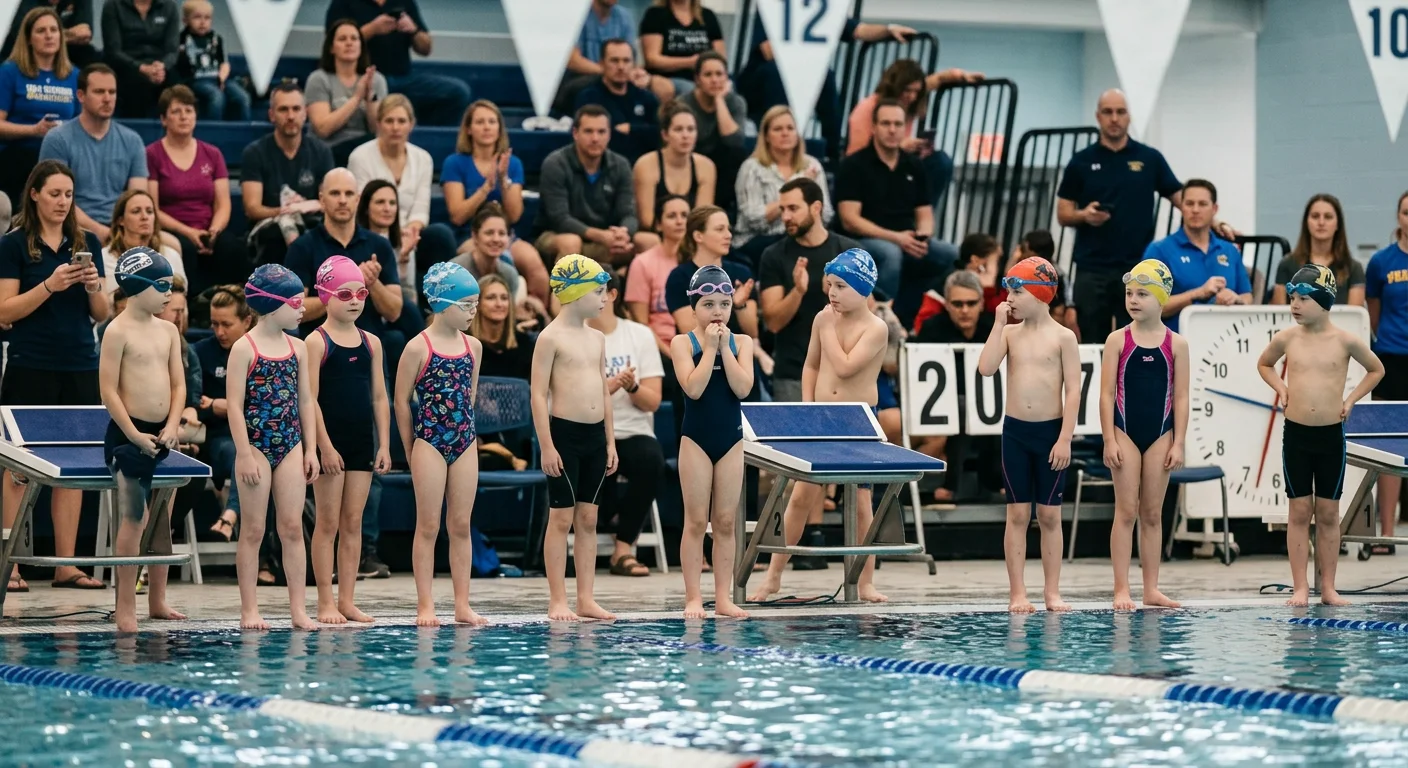
Records exist to be broken. A few athletes exist to make that statement look foolish.
American swimming didn't build its global reputation through systems alone. It built through individuals — people who showed up on the world's biggest stages and did things no one had done before. Some did it once. The remarkable ones did it across decades.
Michael Phelps: The Number That Ends the Argument
28 Olympic medals. 23 of them gold.
That's the number. Everything else is just context.
At the 2008 Beijing Games, Phelps won 8 gold medals — every single one in world-record time. He didn't just beat Mark Spitz's single-Games record. He buried it. His career total stands at 83 major international medals — 66 gold across the Olympics, Worlds, and Pan Pacs. That makes him the most decorated swimmer and the most decorated Olympian in history. He earned World Swimmer of the Year seven times. American Swimmer of the Year nine times.
No career in aquatic sport comes close. One probably never will.
Katie Ledecky: Distance, Dominance, and Duration
Ledecky made her Olympic debut at age 15 in London 2012. She walked away with gold in the 800m freestyle. Four years later in Rio, she won the 200m, 400m, and 800m freestyle. She was the first woman to sweep those three events since 1968.
Her résumé now reads: 14 Olympic medals, 9 gold . She holds 13 world records in distance freestyle. She has won 21 World Championship golds . She is the most decorated U.S. female Olympian ever — tying Larisa Latynina for the most Olympic golds won by any female athlete in history.
The Legacy Tier: Spitz, Biondi, Lochte, and Beyond
Before Phelps, there was Mark Spitz — 7 golds at Munich 1972. Every single one a world record. That performance defined a generation. Matt Biondi added 11 Olympic medals across three Games (1984–1992), including 5 golds at Seoul 1988. Ryan Lochte collected 12 Olympic medals and 90 major international medals — second to Phelps alone in U.S. men's swimming history.
Natalie Coughlin won 12 Olympic medals across three Games. She became the first woman ever to win back-to-back Olympic golds in the 100m backstroke. Simone Manuel made history at Rio 2016. She was the first Black American woman to win an individual Olympic swimming gold — a moment that went far beyond sport.
Dara Torres made five Olympic teams spanning 1984 to 2008. Five. That kind of staying power speaks for itself.
So what connects these athletes across different eras and different strokes? None of them peaked and disappeared. They kept showing up — at the next Games, the next Worlds, the next moment where ordinary wasn't enough. That pattern is no accident. It reflects what the American swimming system is built to produce: athletes who don't just reach the top, but hold their ground there.
Training Methods and Techniques That Keep US Swimmers Ahead
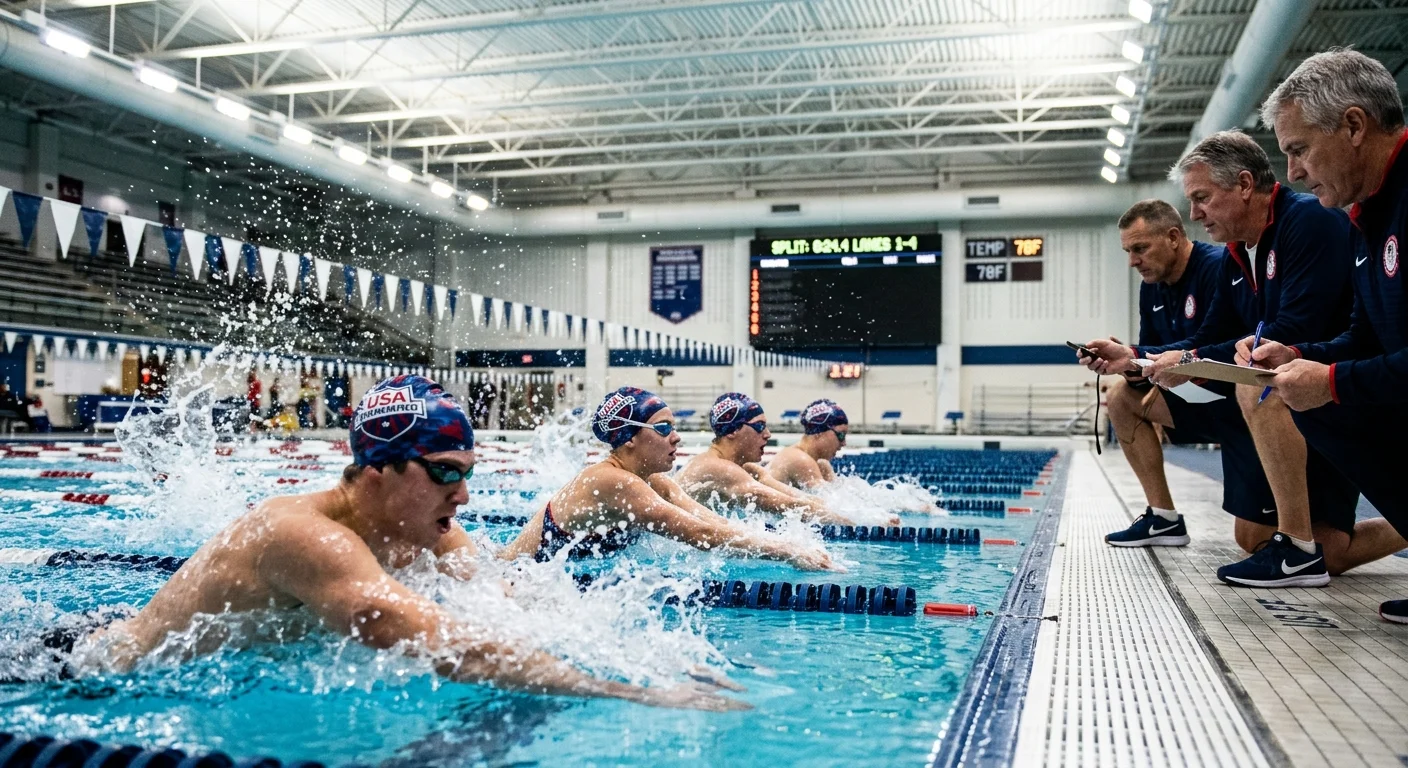
Elite American swimmers don't just train harder — they train with a precision that feels almost scientific.
The numbers behind a typical U.S. elite training cycle show what most outsiders never see. 86–90% of total training volume sits at or below the lactate threshold of 4 mmol⋅L⁻¹. About 40–44% is pure aerobic base work — slow, deliberate, foundational. Another 44–46% targets the threshold zone. High-intensity efforts above 6 mmol⋅L⁻¹ make up less than 5% of total load. This isn't a program built on suffering. It's built on smart accumulation — stress applied right where adaptation happens.
The backbone of that approach is the 14–15 week macrocycle . Two of these blocks fit into each Olympic quadrennial. Each block adds load step by step. Together, they produce peak performances at the moments that matter most. Getting the calendar right is itself a competitive edge.
Strength Training as a Technical Tool
Most people picture dryland training as generic gym work. For competitive swimming in the United States , it's far more focused than that.
Hypertrophy cycles run four sessions per week, built on Built Strong principles . Strong Endurance protocols run three times per week and include:
- Kettlebell swings
- Dumbbell rows
- Medicine ball slams
- Pushups
Rest periods get shorter as work time grows. This keeps the body from settling into a comfort zone. Most swimmers complete 15–20 repetitions at 85% of their one-rep max . Coaches adjust loads for each athlete based on assessment data.
That personal calibration matters a lot. Every athlete goes through a Functional Movement Screen (FMS) and PRO FTS assessment. Corrective exercises come directly from those results. Nothing gets a one-size-fits-all treatment.
When Data Breaks Records
Kate Douglass didn't break a 12-year-old American record in the 200-meter breaststroke through effort alone. She used accelerometer-based stroke analysis — devices worn at the waist that map acceleration and deceleration across every phase of every stroke. The data caught something her coach's eye missed. She fixed it. The record fell.
That's what modern American swimming training programs look like at the top level.
In the final three weeks before major competitions, the whole system shifts. Volume drops. Mobility work and strength maintenance take over. Athletes move off the group protocol and onto their own peaking plans. The results from the Tokyo 2021 Olympic cycle back this up — half the training group hit personal records . One athlete took bronze in the 200-meter medley, setting both a personal best and a national record in the same race.
The method rotation strategy adds another layer. Isometrics, hypertrophy phases, and glycolytic peaking rotate through two-week micro-cycles. Each method comes back later in the cycle for a second round. The second exposure drives faster gains — same idea as compound interest. You've already adapted once. The next round builds on top of that.
That's the system. Strict in structure, sharp in specificity — and directly responsible for some of the most dominant performances in USA swimming history.
USA vs. Australia: The World's Greatest Swimming Rivalry
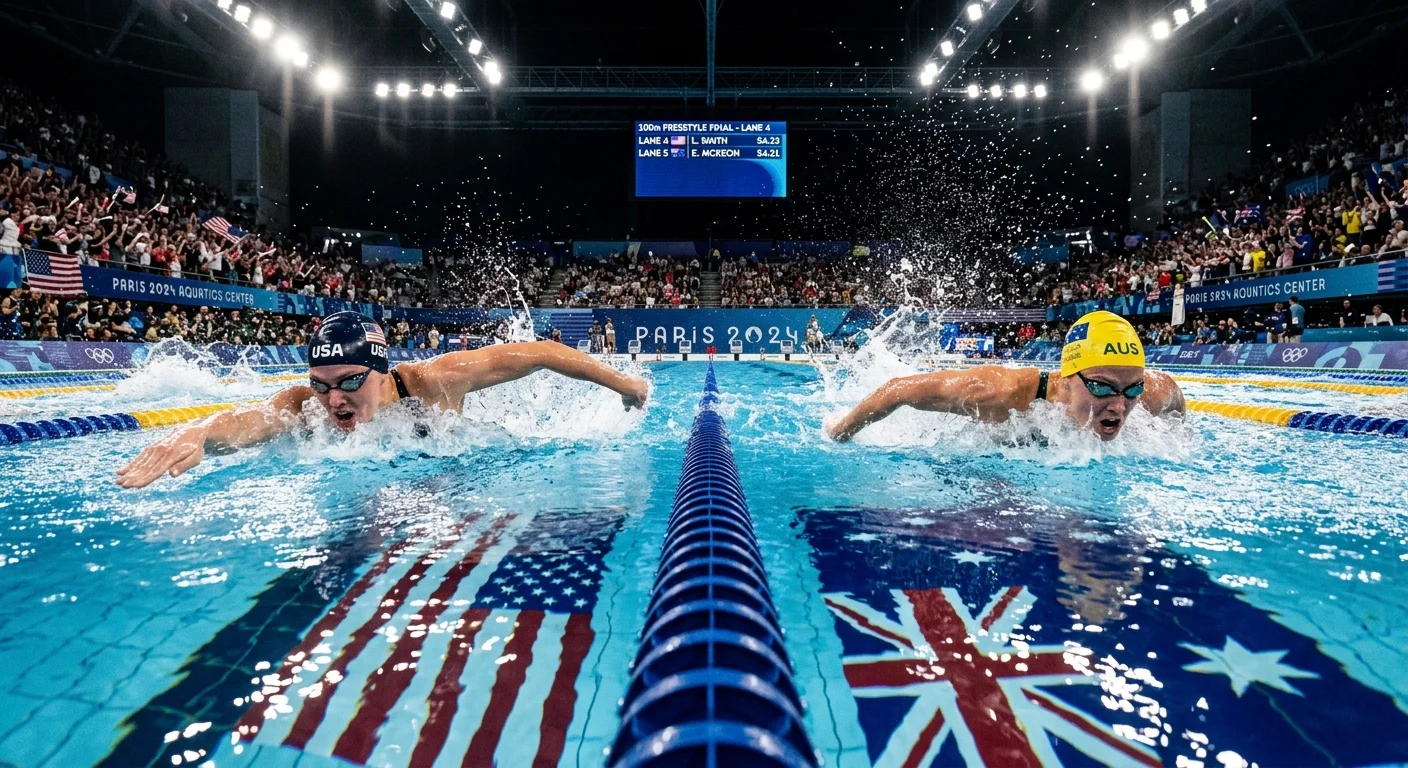
For close to seven decades, one rivalry has set the ceiling for competitive swimming. Not USA versus the world — USA versus Australia. Two countries. Two systems. One pool.
The numbers tell a clear story. Since the 1956 Melbourne Olympics, Australia has never topped the United States on the Olympic swimming medal table. That's 68 years of American dominance — broken just twice, by East German state-backed programs in 1980 and 1988. No other nation has kept pace over the long run. Australia has come the closest.
The Moment Everything Changed
Sydney 2000 is where things got real.
Australia snapped a seven-straight-Olympics winning streak by the U.S. in the men's 4×100m freestyle relay. It happened on home soil, in front of a crowd that had been waiting years for that exact moment. Ian Thorpe led the charge. Michael Klim played air guitar on the pool deck right after. It wasn't subtle. It wasn't supposed to be.
That win sent a clear message. Australia wasn't chasing the U.S. anymore. They were coming for it.
The Duel in the Pool — Direct Head-to-Head
The Duel in the Pool series put the rivalry under a spotlight:
Year | Winner | Score | Venue |
|---|---|---|---|
2003 | USA | 196–74 | Indianapolis |
2005 | USA | 190–102 | Irvine |
2007 | USA | 181.5–129.5 | Sydney |
2022 | USA | 309–284 | Sydney |
USA took every edition. But look hard at that 2022 margin — 309 to 284. On Australian soil, in a format built for direct comparison, the gap had shrunk to just 25 points.
Paris 2024: The Shift Becomes Undeniable
The first four days of the Paris 2024 Olympics rewrote the rivalry's recent story. Australia posted 4 golds from 8 total medals — a 50% gold conversion rate. The U.S. grabbed 15 medals but just 2 golds , including two back-to-back gold-less days. Ariarne Titmus won the 400m freestyle and made it look like a training swim.
That came right after Australia's breakthrough at the 2023 World Championships. They claimed 13 gold medals — more than any other nation — while the U.S. finished with 7 golds despite leading the total medal count. It was the first time in over 20 years that Australia beat America in gold medals at a major international meet.
The U.S. still holds real structural advantages. 2024 U.S. Trials swimmers posted faster times than their Australian counterparts in 18 of 28 events. Depth, roster size, and institutional experience are still American strengths.
But Australian swimmers have been saying it out loud. The shift isn't on the way. It's already done.
How US Swimming Dominates Relay Events
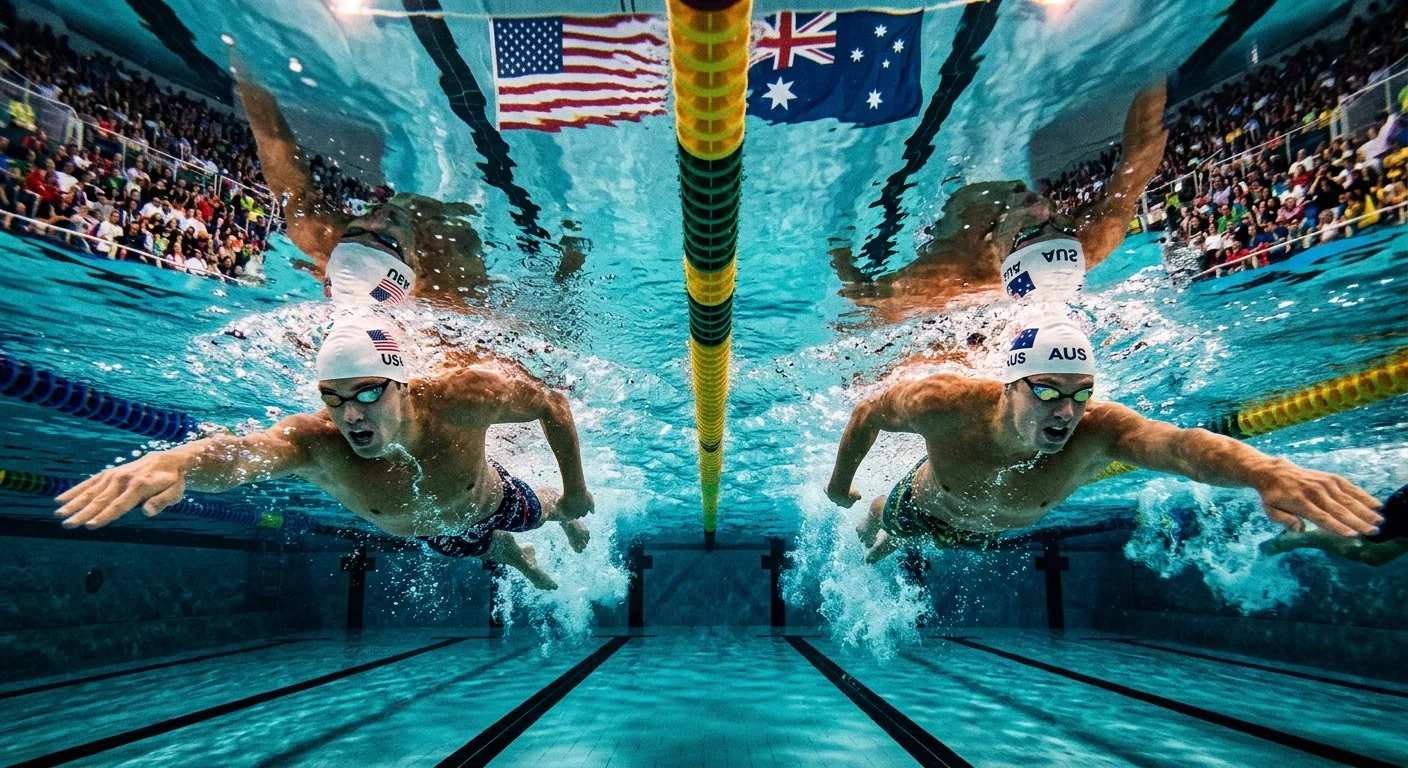
Relay swimming is where American depth stops being a talking point and starts being a weapon.
In the men's 4×100m freestyle relay, the U.S. claimed gold in 15 of 18 events since 1968 . The 4×200m freestyle tells a similar story: 14 of 18 golds . These aren't flukes building into a trend. This is structure producing results — across generations of different athletes.
The World Records That Tell the Real Story
The U.S. doesn't just win relay events — it owns the benchmark times.
Event | World Record | Key Splits |
|---|---|---|
Men's 4×200m Free (LC) | 6:58.55 | Phelps 1:44.49, Berens 1:44.13 |
Men's 4×100m Medley (LC) | 3:26.78 | Dressel 49.03 fly, Apple 46.95 free |
Women's 4×100m Medley (LC) | 3:49.34 | Set at 2025 Worlds, Singapore |
Women's 4×200m Free (LC) | 7:30.13 | Weinstein closing in 1:50.31 |
Look at those anchor splits from Caeleb Dressel and Jack Apple. Those numbers don't just win races — they break opponents before the final wall.
Depth Is the Real Advantage
At the 2024 short-course Worlds, the U.S. men's 4×200m relay clocked 6:40.51 — a world record. All four swimmers averaged sub-1:40.13 per leg . The lead-off alone, Kieran Hobson's 1:39.37 , set an individual world record on its own. This wasn't the Phelps era carrying the team. This was depth doing the work.
That's the real relay formula. Other countries build around one superstar and hope the rest holds. USA relay swimming teams build four lanes deep. And the bench behind those four? Just as dangerous.
What Competitive Swimmers Can Learn From the US Training Model
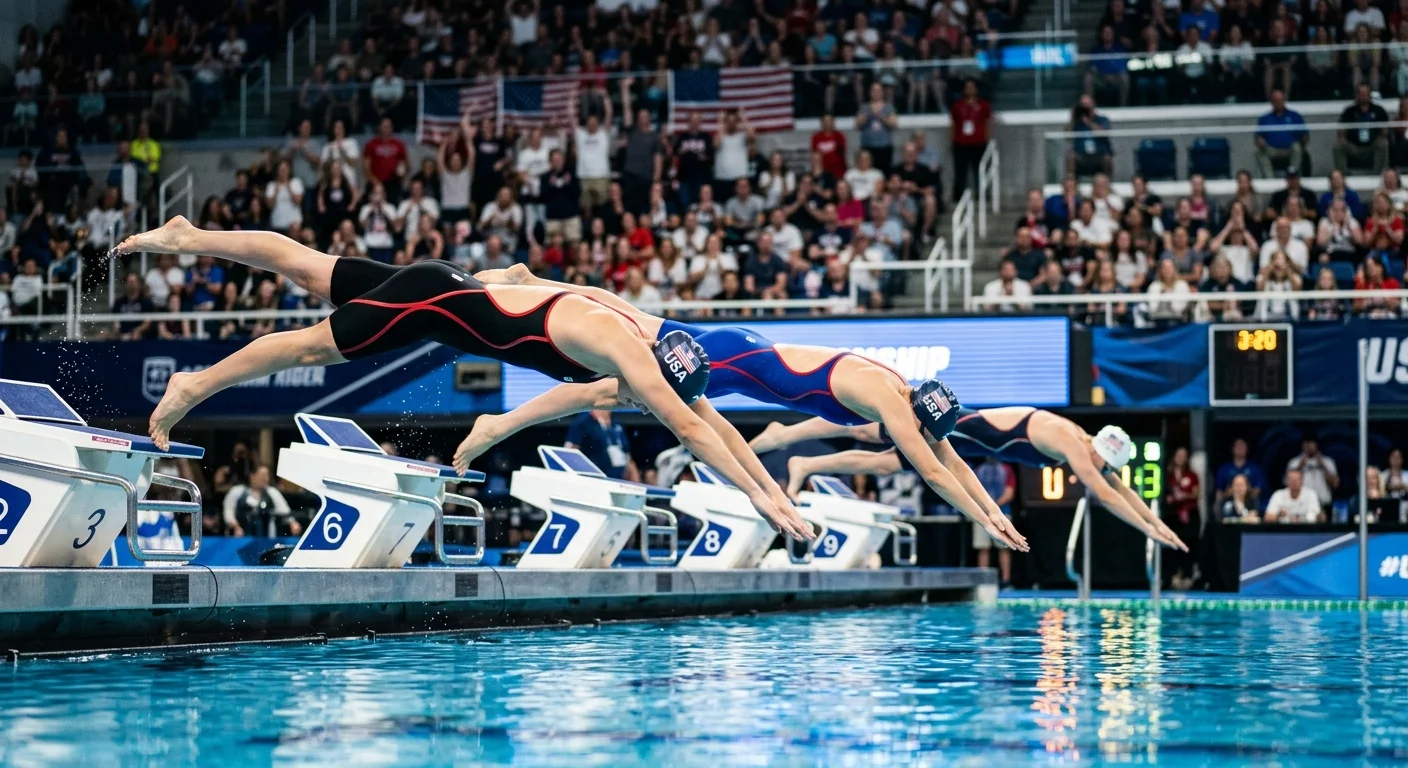
The US model isn't a secret. It's a system — and systems can be copied.
Not every part of it requires an NCAA scholarship or a Bob Bowman on deck. The core principles work for any serious swimmer willing to put in the discipline.
Structure Your Season Like an American
US elite swimmers build around 14–15 week macrocycles — two per Olympic quadrennial. Each block adds load in stages, then tapers into a peak. The intensity split is clear: 70% of volume stays at or below 4 mmol·L⁻¹ (aerobic base). The other 30% pushes above 6 mmol·L⁻¹ (high-intensity work). That ratio isn't a preference. It's the foundation behind world-record performances.
Technique First, Volume Second
US performance progression studies show the biggest time drops happen young — up to -12.99% per year in 100m events for 9–10 year olds . After that, gains shrink fast. By age 20–21, you're looking at under 1% per year. The takeaway is simple: lock in technical efficiency early. It protects your long-term ceiling. Coaches chasing -3–5% annual gains between ages 15–18 use technique drilling as the main tool — not added yardage.
Add Dryland. Full Stop.
A meta-analysis of 844 swimmers across 36 randomized controlled trials found that combined pool-plus-dryland training beat pool-only training across every major performance measure. The gap wasn't small — SMD favored combined training by more than 0.5 . In the US model, two to three dryland sessions per week isn't a suggestion. It's a requirement.
Gear That Matches the Work
High-volume aerobic sessions need low-drag training suits . These reduce resistance enough to make technical feedback cleaner and repeat efforts easier to track. US pros reach for drag-reducing fabrics in about 80% of their training sessions. On race day, polyurethane-blend competition suits cut 2–4% off race times in controlled trials — that's a real, measurable edge. Your gear should match the intensity of your training. berunclothes.com carries drag-reducing training suits built for high-intensity volume work — the exact format the US model runs on.
The blueprint is already written. What's left is execution.
Conclusion
The American swimming machine doesn't run on talent alone — it runs on systems . The NCAA pipeline turns raw potential into world-class competitors. USA Swimming backs that up with strong institutional support. Relay teams take individual brilliance and turn it into collective dominance. Every piece of this puzzle was built with purpose.
Michael Phelps didn't happen by accident. Neither did the US Olympic swimming team's decades-long grip on the medal table.
So what does that mean for you? Maybe you're chasing your first lap record. Maybe you're drawn to the discipline behind elite aquatics. Either way, the principles of American swimming dominance are learnable. They're adaptable. And they're worth pursuing.
The next step? Train like you mean it — then gear up for it. At berunclothes.com , you'll find performance apparel built for swimmers who take the sport seriously.
The water doesn't care about excuses. Neither do champions.
Video Section