Both are classics. Both burn calories, strengthen your heart, and leave you feeling alive after a hard session.
But if you've ever stood between the pool and the pavement, unsure which one is worth your time, your joints, and your energy — you're not alone.
Swimming and running deliver very different results for very different bodies. The "better" option comes down to your goals, your health history, and what you'll stick with long-term.
This guide covers calorie comparisons, muscle activation, joint impact, and weight loss efficiency. Read it, pick your direction, and start moving.For fitness brands and retailers, partnering with reliable Swimwear and runing apparel manufacturers can also help align product offerings with these distinct training needs — from chlorine-resistant swimwear to high-performance running gear.
Swimming vs Running: Calories Burned Head-to-Head
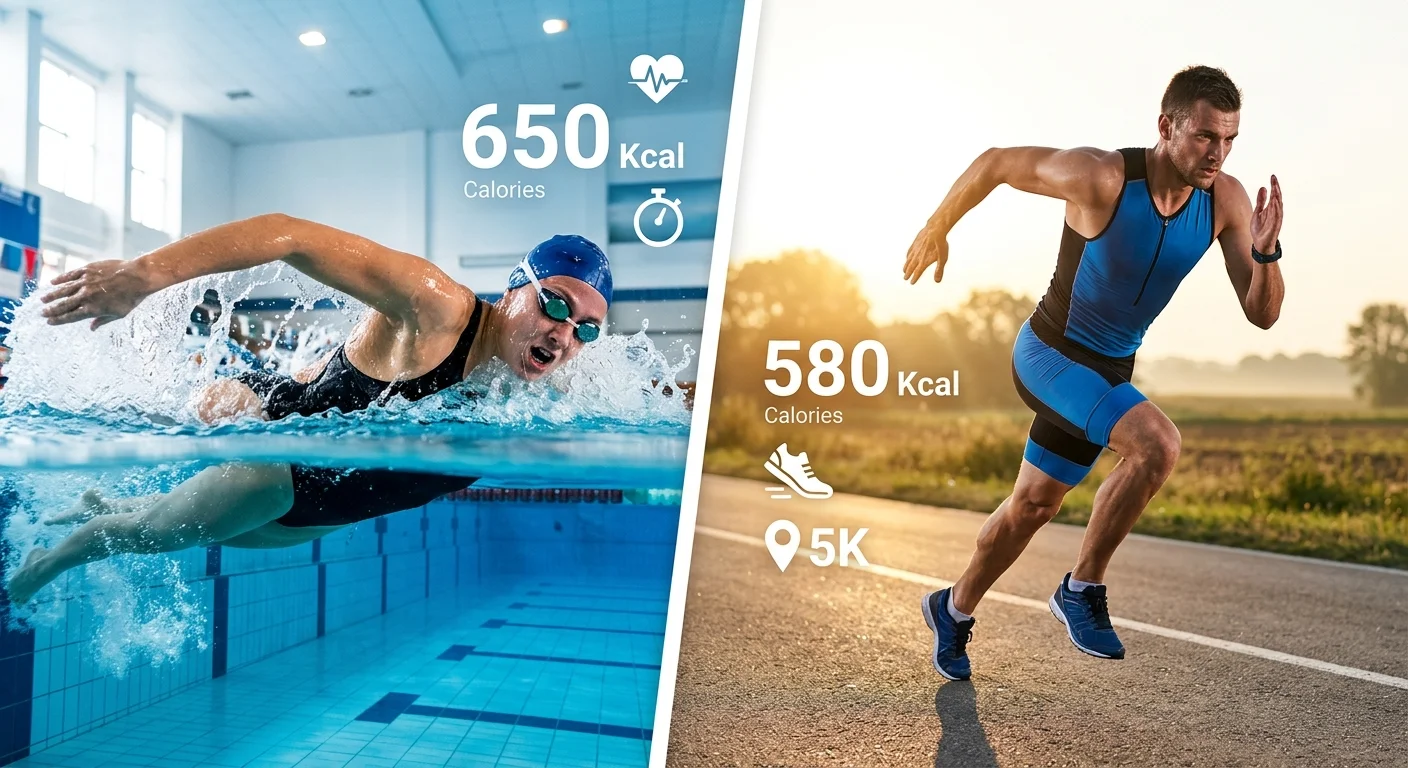
The numbers here are more surprising than most people expect. And the story they tell isn't as simple as "running burns more."
Harvard Medical School data shows a 155-pound person running at 7.5 mph for 30 minutes burns around 465 calories . That same person swimming hard for 30 minutes? 372 calories . Running wins that round. But look at the bigger picture, and things shift.
What the Data Shows
Activity (30 mins) | 125 lbs | 155 lbs | 185 lbs |
|---|---|---|---|
Swimming, leisurely | 180 | 223 | 266 |
Swimming, vigorous | 300 | 372 | 444 |
Running, 5 mph | 240 | 298 | 355 |
Running, 7.5 mph | 375 | 465 | 555 |
At a comfortable pace, running edges ahead. Push the intensity in the pool, though — butterfly stroke, for instance — and the calorie burn climbs to 872 calories per hour . Breaststroke hits 750 . Backstroke hits 778 . Those aren't small numbers.
The Water Resistance Factor
Water creates 12 to 14 times more resistance than air. That's what makes swimming stand out from a physical standpoint. Your body works harder with every stroke, even when it doesn't feel that way. Your heart rate holds steady at 70–85% of maximum , pushed up by hydrostatic pressure — and your legs take none of the pounding that running delivers.
The result? Swimmers can hold intensity longer. They burn an estimated 25% more calories over extended sessions , compared to runners who slow down as fatigue sets in.
Zone-based testing with athletes backs this up. The gap closes at higher efforts — running burns 12–17% more in Zone 4. At easy Zone 1 paces, that number jumps to 29–43% more .
The honest takeaway : running burns more calories at matched intensities. But hard swimming — stroke-specific training in particular — comes very close. Plus, it tends to feel easier on the body while you're doing it.For brands developing performance swim gear, investing in custom Swimwear services can help optimize fabric resistance, fit, and durability to better support these high-efficiency water workouts.
Full-Body Muscle Activation: What Each Exercise Works
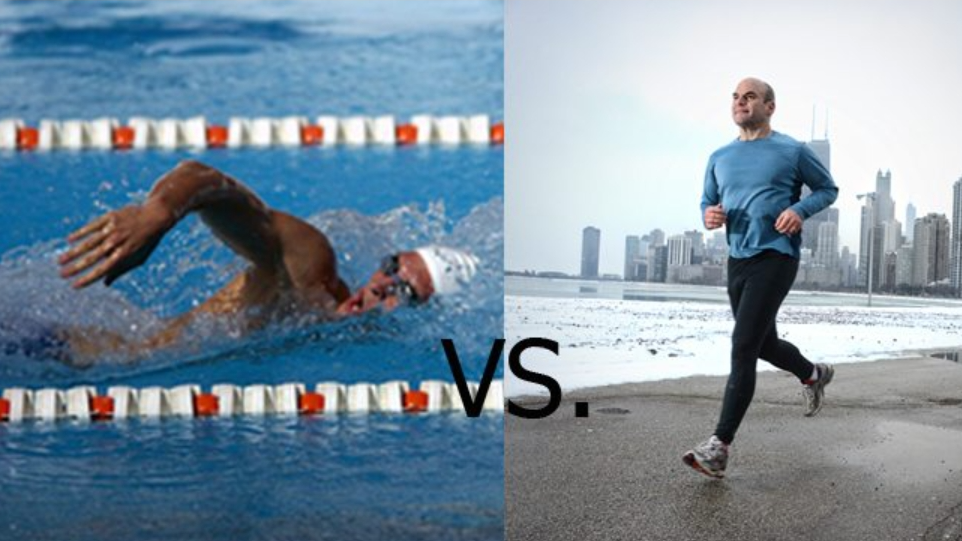
Most people get this wrong. They assume running is the full-body workout and swimming is an arm thing. The reality is close to the opposite.
Swimming pulls from every major muscle group at once — and in a way running cannot replicate. Your lats, shoulders, core, glutes, and legs all fire together. Water pushes back against every move you make, and your body has to fight that resistance the whole time.
What Swimming Activates
The stroke determines the muscle. That's the key distinction.
Freestyle loads the latissimus dorsi, anterior deltoids, and hip flexors
Breaststroke puts heavy demand on the inner thighs, glutes, and pectoral muscles
Butterfly — the most demanding stroke — drives the core at near-maximum effort, with a powerful drive through the lower back and hamstrings
Backstroke targets the posterior shoulder chain and upper trapezius in ways most gym exercises never reach
The water itself matters here. Water creates 12 to 14 times more resistance than air . So your stabilizer muscles — the small ones around your joints and spine that most people ignore — stay active the entire time just to keep you balanced and streamlined.
What Running Activates
Running is more targeted than people think. It's a lower-body and cardiovascular workout, not a full-body one.
The main movers are your quadriceps, hamstrings, calves, and glutes. Your core kicks in to stabilize your pelvis and posture, but it's reacting — not carrying load.
Your upper body? Along for the ride.
That's not a knock on running. It builds solid lower-limb strength and endurance . The repetitive stride pattern also sharpens neuromuscular efficiency in ways swimming doesn't touch. For retailers, sourcing from reliable Swimwear and runing apparel wholesalers can help balance both product categories efficiently.But for overall muscle coverage, the pool works more of your body per session.
The straight comparison : swimming trains more muscles per session. Running trains fewer muscles, but hits them harder.For teams and clubs, custom swimwear team & wholesale running team apparel is often the next step to align performance with identity.
Cardiovascular Benefits: Heart Health & VO₂ Max Comparison

Your heart doesn't care how you challenge it — only that you do. Both swimming and running deliver real results. And both can add years to your life.
The research is striking. Each MET increase in cardiorespiratory fitness (CRF) cuts your all-cause mortality risk by 10% . Raise your VO₂ max by just 3 ml/kg/min, and that risk drops by 30% . Men with high CRF show 47% lower cardiovascular mortality than less-fit peers. For women, that number reaches 70% . The Copenhagen Male Study followed 5,107 men over 46 years. The fittest group lived five years longer on average.
Where Running Pulls Ahead
For raw VO₂ max gains, running — especially HIIT — has a clear edge. The weight-bearing effort pushes your peak heart rate higher. It forces faster oxygen delivery adaptations. It also triggers nitric oxide release, which makes your arteries more elastic.
A solid running HIIT plan looks like this:
- Four-minute intervals at 90–95% max heart rate
- Three sessions per week
- Result: +10–15% VO₂ max gains within 8–12 weeks
Swimming works differently. The constant water resistance keeps your heart rate steady. Over time, this builds capillary density and improves how well your cells use oxygen. VO₂ max gains land at +5–10% over the same 8–12 week period.
The Honest Bottom Line
Both activities lower resting heart rate by 5–15 bpm after 12 weeks of steady training. Both cut long-term hypertension risk by 20–30% . So neither is a bad choice — it comes down to what fits your life.
Speed of cardiovascular improvement matters to you? Go with running intervals. Joint comfort and long-term consistency matter more? Swimming still builds a very strong heart. It just gets there on a gentler timeline.
Joint Impact & Injury Risk: The Low-Impact Advantage of Swimming
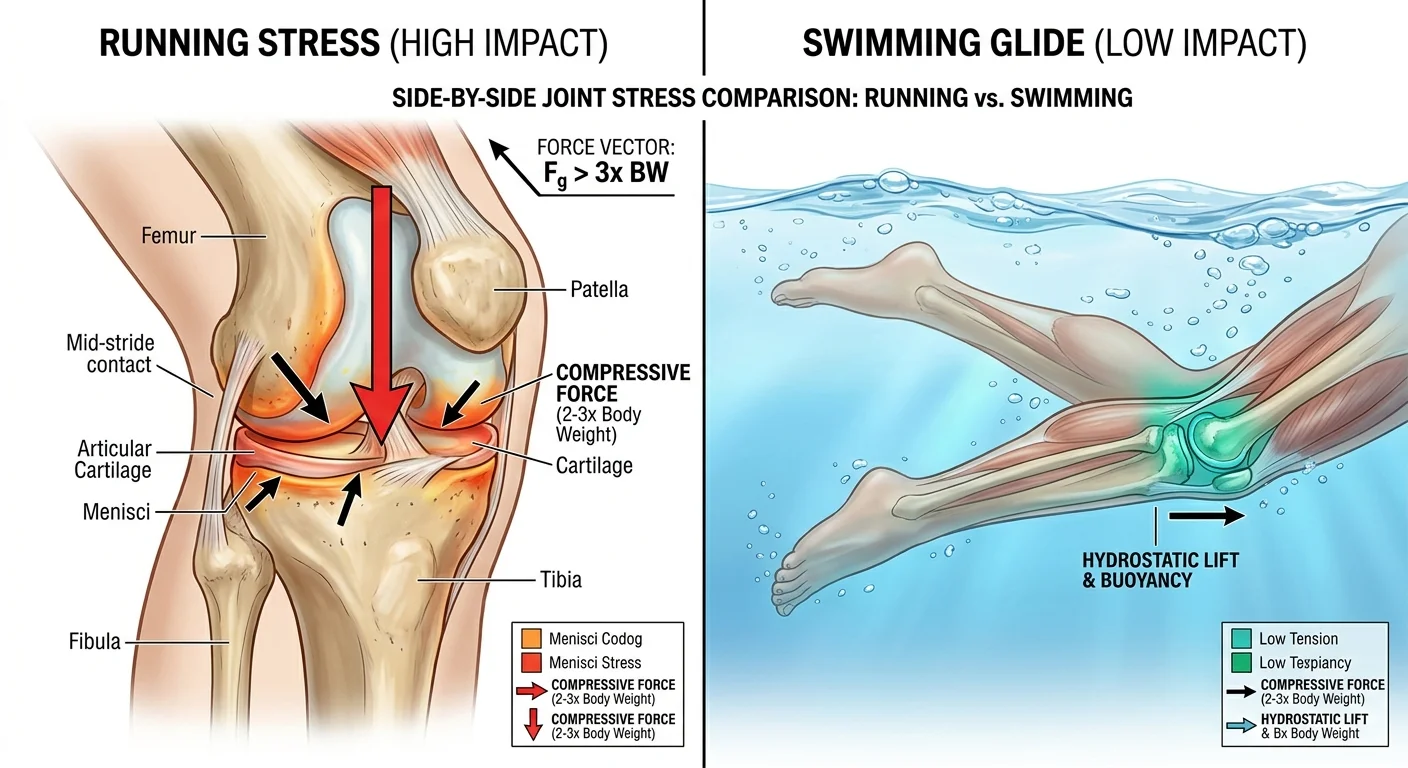
Here's a fact worth knowing before your next workout: every running stride sends a force equal to 2–3 times your body weight through your knees and ankles. Do that 10,000 times on a Sunday long run, and the cumulative load is massive. That's why knee osteoarthritis, stress fractures, and ankle sprains top every runner's injury list.
Swimming runs on a completely different logic.
Water buoyancy offsets more than 90% of your body weight . This drops the compressive force on your joints to near zero. Your knees take no impact. Your ankles absorb nothing. Got arthritis? Recovering from a lower-limb injury? Carrying extra weight that makes running painful? This difference is real and it matters.
The Injury Numbers Tell a Nuanced Story
Swimming isn't risk-free. It carries a different kind of risk.
Injury Type | Swimming Rate | Running Comparison |
|---|---|---|
Overall injuries | 1.56 per 1,000 athlete exposures | ~3–5x higher in running sports |
Knee injuries | 0.17 per 1,000 hours | 20–50% annual knee injury rate in runners |
Shoulder injuries | 27% of all swim injuries | Lower overuse rate than weight-bearing sports |
Overuse proportion | 42.6% of swimming injuries | 50–70% in running |
The pattern is clear. Swimming swaps ground-impact injuries for overuse injuries — mainly shoulder and knee. Most come from high-volume training with poor technique.
Breaststroke swimmers face the biggest risk: 86% report knee pain at some point . 47% deal with it weekly . Push breaststroke beyond four sessions a week, and your knee risk doubles. Your shoulder risk quadruples.
Keeping the Low-Impact Advantage Intact
The pool's gentle reputation is real — but it's not guaranteed. Four habits keep it that way:
Rotate your strokes. Breaststroke hits knees hardest. Freestyle and backstroke spread the load across more muscle groups.
Cap breaststroke sessions at twice a week max. Your knees will feel the difference fast.
Watch your shoulders. They account for 50% of competition time-loss injuries in swimmers. Good technique protects them far better than cutting volume.
Build in recovery. Over 42% of swimming injuries are overuse-related. Rest days prevent most of them.
The bottom line : swimming is kinder to your joints than running — full stop. But "low-impact" isn't the same as "no risk." Train smart, and the pool stays one of the safest places to build cardiovascular fitness. That's especially true for anyone coming back from injury or dealing with chronic joint conditions.
Which Is Better for Weight Loss: Swimming or Running?
Weight loss is not about finding the "best" exercise. It's about finding the one you'll show up for — then pairing it with a diet that supports the work you're doing.
That said, the data does point in a direction.
Running burns calories faster. A 175-pound person running at 7 mph for 30 minutes burns around 456 calories . The same person swimming hard for the same duration? Closer to 396 . At matched intensities, running burns about 25% more calories per minute . Your goal is maximum burn in a short window — say, a 20-minute lunch break session. Running is the more efficient tool.
But the Story Doesn't End There
Swimming has a quiet advantage that shows up over weeks, not workouts.
Water supports your body weight. Your joints stay fresh. That means fewer rest days, fewer skipped sessions, and fewer "my knee is killing me" mornings that derail a routine. Consistency builds over time. A swimmer who trains four days a week will outperform a runner who trains two — no matter which sport burns more per session.
There's also the intensity ceiling. Push hard in the pool — butterfly stroke above all — and you're looking at up to 872 calories per hour . Breaststroke hits 750 . Backstroke 778 . Those numbers close the gap by a wide margin.
The One Catch With Swimming
Some people find they're hungrier after pool sessions. The cold water and full-body effort can spike appetite in a way that quietly wipes out the calorie burn. Sound familiar? Track your intake on swim days — not with obsession, just with honesty.
The Practical Verdict
Running wins for short, high-intensity sessions and faster short-term fat loss
Swimming wins for sustainable long-term weight management, above all if joints are a concern
Both require a calorie deficit to move the scale
The smartest approach? Run on your high-energy days for a hard, efficient burn. Swim on days your body needs movement without the pounding. Let the two work together rather than compete for the top spot.
Best Choice by Personal Goal: A Decision-Based Breakdown
No single answer fits everyone. Your body, your schedule, and what you're trying to build — these three things point you toward the right choice.
Use this as your guide.
If your goal is fat loss:
Run. You burn more calories per minute than almost any other workout. Short, intense sessions get results fast. Joints bothering you? Alternate — swim three days, run two. Consistency beats method every time.
If you're rebuilding after injury or managing joint pain:
The pool is your place. Joint compression is close to zero. That means you train harder and more often — without the setbacks that slow you down on pavement.
If you want a stronger, more balanced body:
Swimming covers more muscles in one session — lats, core, shoulders, glutes, all firing at once. Running builds powerful legs and solid endurance. That's where it stops.
If you're a complete beginner:
Start in the pool. The low-impact water lets your body build cardiovascular fitness without the soreness and injury risk. Most new runners quit by week two for exactly this reason.
If cardiovascular performance is the priority:
Running HIIT builds VO₂ max faster than most training styles. Push hard for four minutes. Rest. Repeat three times a week. The gains show up on schedule.
The honest truth? Most people benefit from both.
Can You Combine Both? The Case for Cross-Training

The best athletes in the world don't stick to just one thing. Triathletes swim, cycle, and run — not because they can't choose, but because variety builds a stronger, more resilient body than any single sport can.
Cross-training with swimming and running isn't a compromise. It's a strategy.
Alternate between the two, and your body gains something neither sport gives you on its own. Running builds bone density and lower-limb power. Swimming lets those same legs recover while keeping your heart rate up and your fitness on track. Your rest day turns into a training day — with none of the damage.
How to Structure It
Each session needs a clear purpose. Treat them as different tools, not swappable options:
Run on high-energy days — your legs feel fresh, your drive is high, and you want real intensity
Swim after hard run sessions — water pulls the load off sore joints and speeds up muscle recovery
Use swimming as active rest — 30 minutes of easy freestyle moves blood through tired muscles, clears out soreness, and keeps your total training volume up without extra stress
Who Benefits Most
This setup works well for a few key groups:
Runners dealing with knee pain who need to stay active without making it worse
Beginners building an aerobic base without piling on injury risk
Anyone whose training falls apart after a few tough weeks on pavement
More movement. Less damage. Stronger results across both.
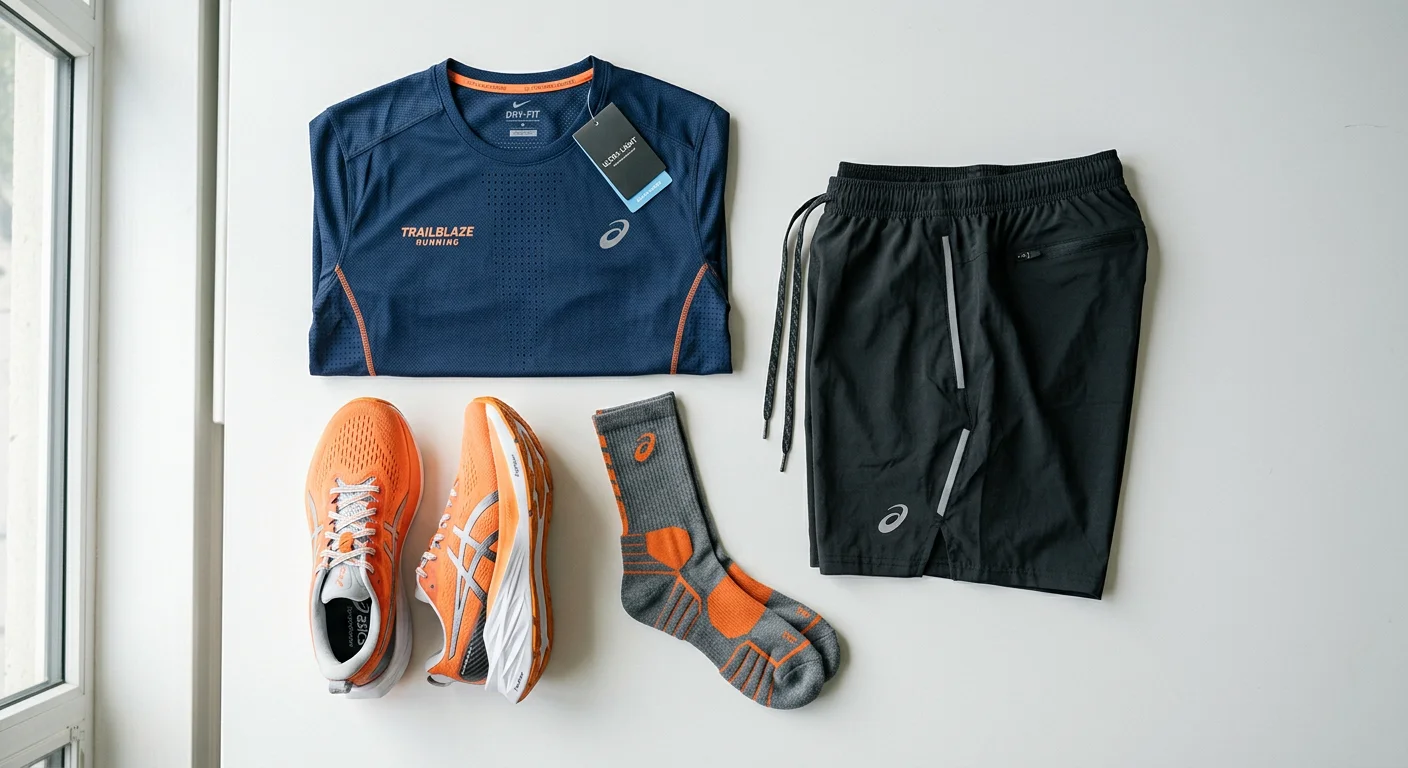
What to Wear: Gear Essentials for Running (And Why It Matters)
Gear isn't glamorous. But a blister at mile three will stop you cold. Soaked cotton clinging to your chest in the rain will make you quit early. What you wear shapes how long you last. Full stop.
Start with shoes. Shoes make up 50.3% of all running gear purchases. That's not because runners are obsessive. It's because the right shoe prevents injury — and the wrong one causes it. Road shoes, trail shoes, and racing flats each serve a different purpose. Match yours to your terrain.
Layer in moisture-wicking clothing. Cotton traps sweat against your skin. Technical moisture-wicking running fabrics pull it away. On long runs, that difference is huge. Chafing and heat build up slowly, and by the time you notice them, they've already become a real problem.
Add a GPS watch. 21% of Americans already track their movement this way. Data turns vague effort into measurable progress. You can see how fast you ran, how far you went, and where you can push harder next time.
At berunclothes.com , you'll find running apparel built around these principles — functional, breathable, and designed for the kind of running this guide covers.
Frequently Asked Questions
Straight answers to the questions that come up most. No fluff.
Does running burn more calories than swimming?
Yes — but the gap is smaller than most people think. A 155-pound person running at 6 mph for 30 minutes burns around 372 calories. Vigorous swimming? The same 372. The gap grows at higher speeds. Push to 8 mph and you hit 465 calories, versus 372 for hard swimming. Match your intensity in the pool, and the two sports come out even.
Is swimming better for bad knees?
Yes, without a doubt. Running sends a force equal to 2–3 times your body weight through your joints with every stride. Swimming removes that impact. The Arthritis Foundation backs this up: swimming laps cuts pain and improves joint function in people with arthritis.
Which is better for belly fat?
Neither one targets belly fat on its own — spot reduction isn't real. Both sports reduce overall body fat through steady calorie burn. High-intensity intervals in either sport trigger EPOC. That keeps your metabolism running for up to 14 hours after you stop.
Which costs less to start?
Running wins here. Shoes cost $40–$120. That's your entry cost. Swimming needs pool access, which means paying for a membership. Budget is tight? Stick to the pavement.
Can swimming match running's calorie burn?
Yes — but you have to push hard. Swim at full effort, and a 155-pound person burns around 446 calories in 30 minutes. That beats moderate running output. The effort level is what makes the difference.
Conclusion
There's no universal winner here — and that's good news.
Both swimming and running deliver real, science-backed cardiovascular benefits. It doesn't matter whether the water pulls you in or the pavement calls your name. The best aerobic workout is the one that fits your body, your goals, and your life right now.
1.Struggling with joint pain? Swim.
2.Want to burn calories outdoors? Run.
3.Can't choose? Do both — your heart, lungs, and muscles will thank you.
What matters most is that you show up — with purpose, and ready to move.
Starting with the right gear makes every mile feel better. Check out BeRun's performance running collection — built for the way real people run.
Your next workout starts with one decision. Make it today.
Video Section