You've stood in a tackle shop — or stared at an Amazon listing — looking at rod lengths and wondering if that extra foot matters . It does. A lot.
For anglers and retailers sourcing complete setups, partnering with reliable fishing gear suppliers ensures you’re matching the right rod length with the right environment from day one.A 5'6" rod and a 7'6" rod aren't just different numbers on a spec sheet. One threads a cast through overhanging branches on a tight creek bend. The other launches bait clean across an open lake. Those are two completely different tools.
Pick the wrong length, and you fight your equipment every trip. Pick the right one, and everything clicks — casting distance, hook sets, fish control. All of it falls into place.
This guide breaks down how to match rod length for bass fishing and every other scenario you'll face. Stop guessing. Start catching.
Short Fishing Rods (Under 7 Feet): Strengths, Weaknesses & Best Use Cases
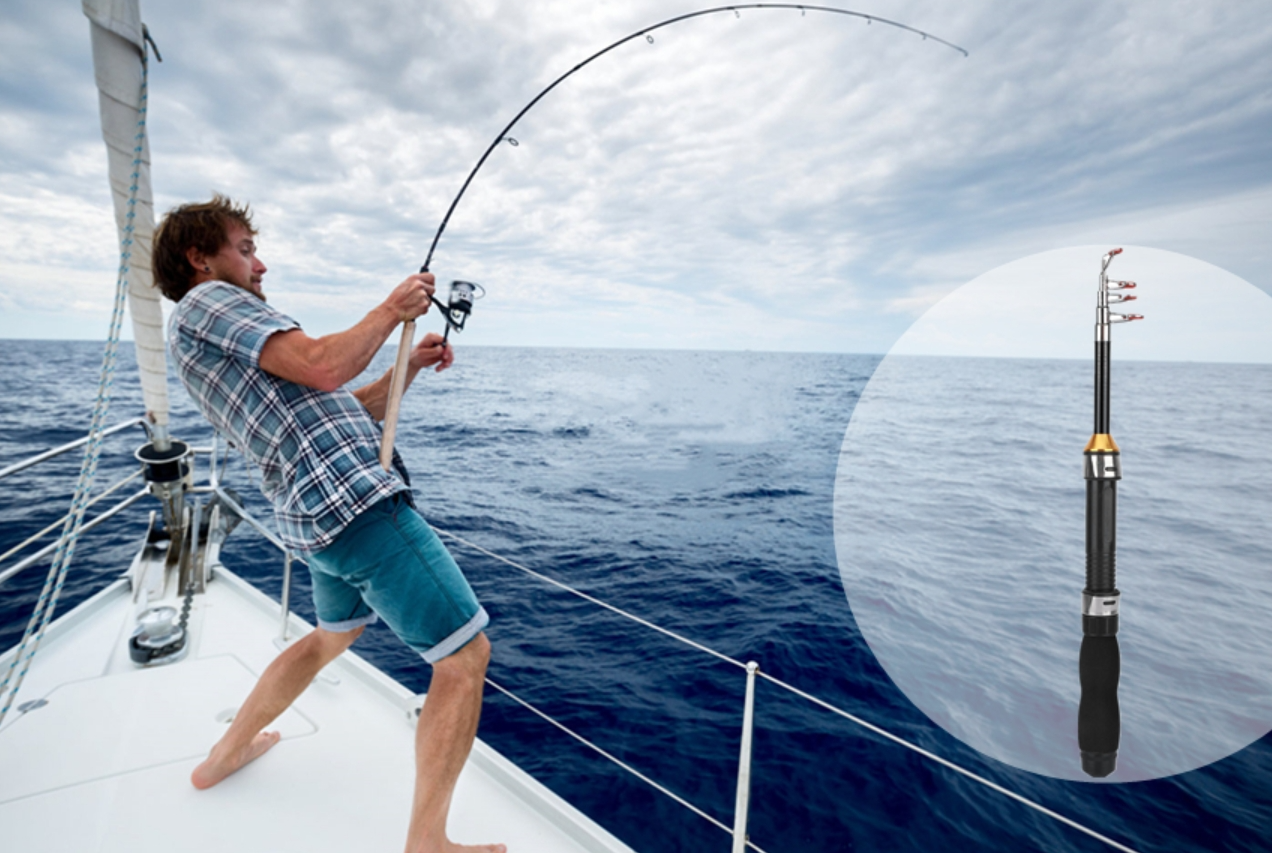
Short rods are specialist tools. Full stop.
Anything under 7 feet — under 6 feet in particular — trades versatility for precision. That's not a flaw. That's a design philosophy. Fish the right environment, and a compact rod outperforms everything else on the water.
Here's what you're getting.
What Short Rods Do Best
Precision in tight spaces is where short rods dominate.
Overhanging trees. Brush-lined creek bends. Docks layered with heavy cover. A long rod becomes a liability in these spots. A 5'6" to 6'6" rod lets you throw roll casts, bow-and-arrow casts, and wrist-flick skips. A longer blank simply can't do that.
Key advantages:
Pinpoint accuracy under structure — skip baits beneath docks and overhanging vegetation with a snap of the wrist
Superior sensitivity — ultralight setups rated 0–4 weight transmit every subtle take, tick, and bump straight to your hand
Portability — many models break down into 4–6 piece travel configurations, great for hiking remote streams or kayak fishing tight river sections
Fast hook sets — less distance between you and the fish means quicker, cleaner hookups in close-quarters situations
For dock fishing and shallow wading, pair a 5–6 foot spinning rod with a 6.4:1+ speed reel. Run 12-pound monofilament or lighter. Work Ned rigs, small Senkos, or 1/4-ounce tungsten-weighted craws. That setup is proven in confined water.
Gear Note: Many performance-focused brands working with fishing apparel manufacturers also design ultralight-friendly apparel that enhances mobility and casting control in tight environments.
Where Short Rods Let You Down
The trade-off is real. Know it before you buy.
Casting distance tops out around 30–40 feet. On wide rivers, open lakes, or water that needs distance accuracy, a short rod puts fish out of reach.
Not enough backbone for bigger fish. Anything above 16 inches — brown trout, largemouth bass in heavy cover — will overpower a short ultralight setup. You risk fighting fish too long, which raises release mortality.
Wind kills performance. Light line gets pushed around hard. Punching through a headwind with a 5-foot ultralight is a punishing experience.
Poor line mending ability. Short reach makes managing tricky currents much harder. Your effective drift length on moving water drops fast.
Best Use Cases at a Glance
Scenario | Recommended Length | Why It Works |
|---|---|---|
Mountain streams & blue-lining | 6–6.5 ft | Tight canopy, short casts |
Dock fishing with cover | 5–6 ft | Skipping accuracy |
Creek wading | 6–6.5 ft | Maneuverability |
Kayak river fishing | 6–7 ft | Compact cockpit space |
Panfish & small trout | 5.5–6.5 ft | Sensitivity, light line |
Bottom line: Short rods pay off for anglers fishing confined, technical spots. Brush, overhead obstructions, close-range presentations — this length gives you a real edge there. Cast across open water or fight larger species, and you'll hit the limit of what a short rod can do pretty fast.
Long Fishing Rods (7 Feet and Above): Strengths, Weaknesses & Best Use Cases
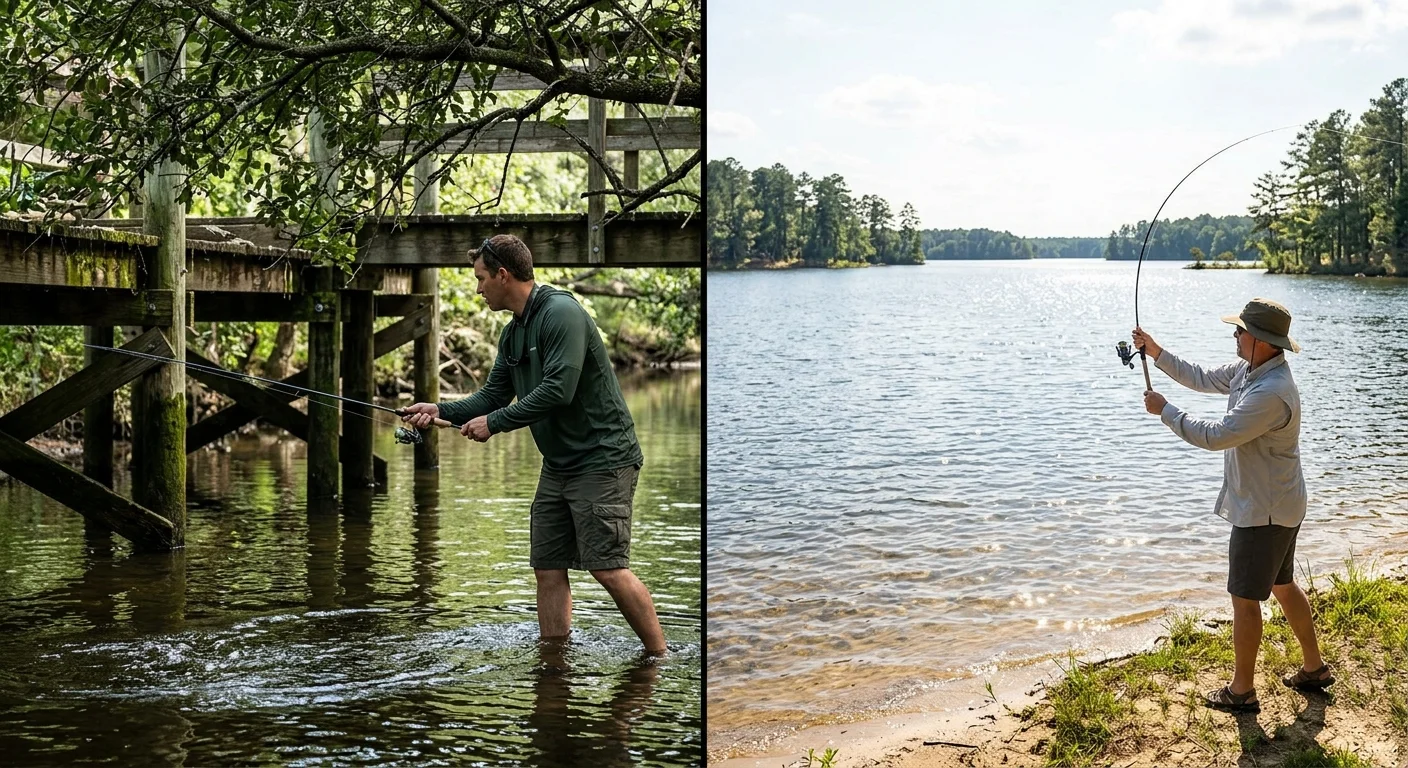
Seven feet is where physics starts working for you instead of against you.
More blank means more arc. More arc means more energy loaded into each cast. A 7'6" rod launching a 1/2 oz swimbait outperforms a 6'6" rod on that same cast by 15–25% in distance — not marginal, measurable. On open water, that gap puts your bait in front of fish that shorter rods can't reach.
What Long Rods Do Best
Distance and deep-water performance are the headline advantages — but they're not the whole story.
Casting distance : 7'3"–7'6" rods store more energy during the cast. That reduces mid-flight roll on heavier rigs — think 3/8–1 oz chatterbaits, spinnerbaits, and swimbaits. Step up to a 7'7"–8' spinning rod and you pick up 20–30% more distance over a 6'6" in open water. That's not a rounding error.
Deep-water hook sets : Extra length moves far more line per sweep. A 7'1"–7'6" MH/Fast rod handles deep jigs and Carolina rigs in 20–30 ft of water. That matters because fluorocarbon stretch kills sensitivity at depth. A 7'5" heavy extra-fast model pulls double the line volume on a 30 ft sweep compared to a 6'10" blank.
Leverage on big fish : 7'–8' rods give you real winch leverage for frog fishing and punching heavy mats on 50–65 lb braid. Go longer — 9'6" to 13' for steelhead float rigs — and you can mend current and control drift in ways no shorter rod can match.
Surf and shore reach : A 12 ft surf rod slings heavy weights 50–100 yards past breaking waves. A 9 ft rod on the same beach falls well short.
Gear Note: Expedition anglers often rely on custom fishing clothing services to match long-session offshore fishing with breathable, sun-protective gear
Where Long Rods Work Against You
Extra length costs you in tight situations.
Tight cover becomes a hazard. A 7'7"–8' rod snags branches, clips rocks, and risks tip breakage anywhere the casting lane tightens. Dock skipping and jerkbait work in heavy structure are off the table.
Maneuverability drops fast. In close quarters, the blank slaps water. Rods above 7'9" often won't fit standard rod lockers — a real problem for boat anglers.
Accuracy is the trade-off. Long rods prioritize distance over precision. In wind or sheltered water, that imbalance shows up quickly. A rod built to launch 1/2 oz swimbaits is flat-out overpowered for 1/16 oz finesse rigs.
Best Use Cases by Length
Length | Best Scenarios | Power/Action | Key Lures & Line |
|---|---|---|---|
7' | Ned/dropshot, walleye jigging, all-around bank bass | ML–M / XF–F | 1/8–1/4 oz, braid + fluoro |
7'1"–7'3" | Texas rigs, chatterbaits, open flats bass | MH / F–MF | 3/8 oz blades, fluoro/braid |
7'3"–7'6" | Frogs, punching mats, deep Carolina rigs, beach casting | H / F | 1 oz rigs, 50–65 lb braid |
7'7"–8' | Big-water bass, long finesse casts, stream dry flies | M–MH / F | Dropshot, thin braid + leader |
9'–12'+ | Surf, steelhead floats, centerpin drift | ML–M / MF–M | Heavy surf weights, float rigs |
Bottom line: Long rods pay off on big, open water — lakes, surf beaches, deep structure, and heavy cover where distance and leverage define success. Push one into tight, technical terrain and that same length becomes a liability. Know your water first. Then pick your length.
Long Rod vs. Short Rod: Head-to-Head Comparison Across 6 Key Dimensions
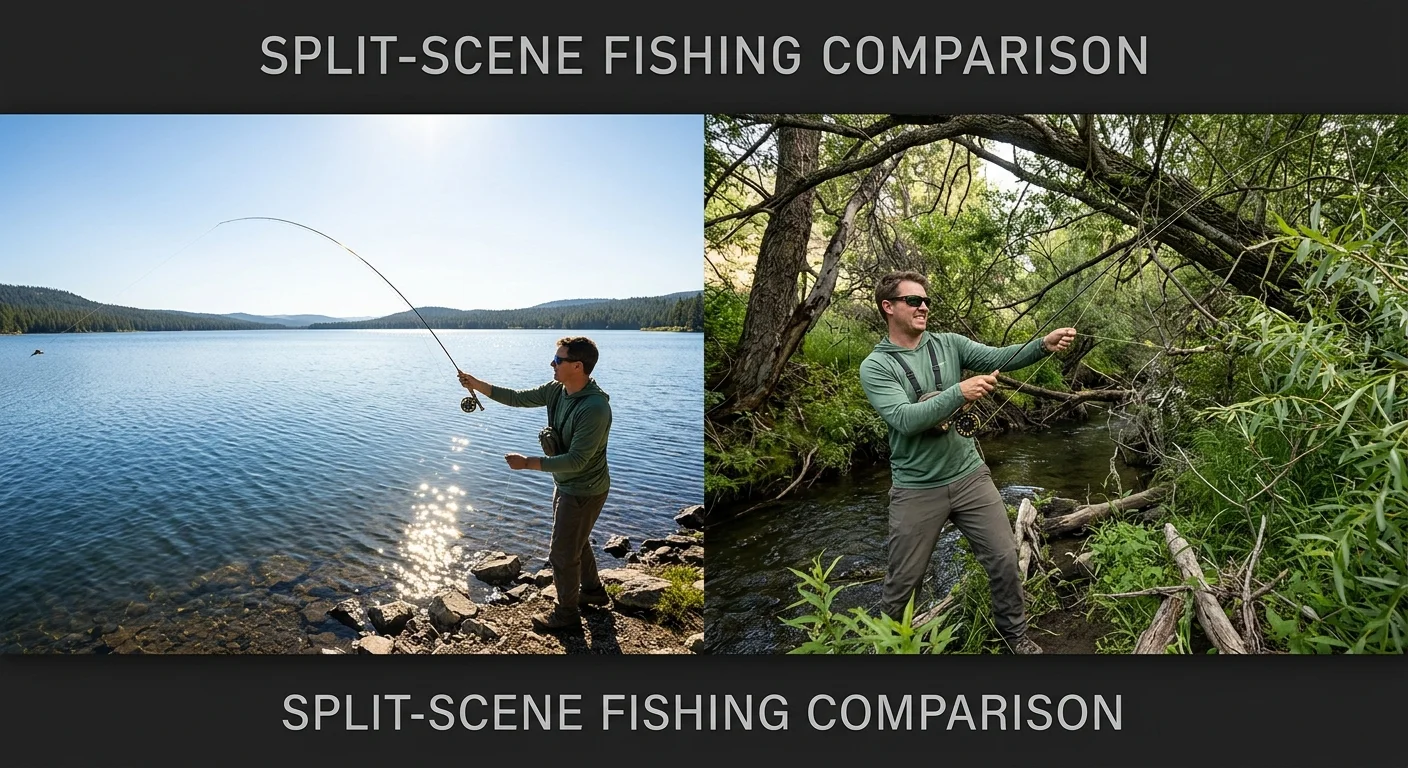
Numbers don't lie. Six dimensions separate anglers who put fish in the net from those who spend the day wondering what went wrong.
Here's the full breakdown. Study it before you spend a dollar.
Dimension | Long Rod (7 ft+) | Short Rod (Under 7 ft) | Edge |
|---|---|---|---|
Casting Distance | 15–30% farther on open water | Tops out at 30–40 ft | Long Rod |
Accuracy & Precision | Wide casting lanes only | Excels in tight, technical spots | Short Rod |
Sensitivity | Good on heavy rigs, deep structure | Superior on ultralight finesse setups | Short Rod (finesse) / Long Rod (deep) |
Fish-Fighting Leverage | Real winching power on big fish | Can be overpowered above 16 inches | Long Rod |
Portability & Maneuverability | Clips obstructions, hard to store | Compact, travel-friendly, kayak-ready | Short Rod |
Hookset Power | Moves massive line volume on deep sweeps | Fast, clean hookups at close range | Long Rod (depth) / Short Rod (close) |
What the Table Is Actually Telling You
Most anglers fixate on casting distance. That's the wrong starting point.
The real question is: where does the fight happen?
Working 20–30 feet of open water — lake flats, surf beaches, deep Carolina rigs — a long rod's hookset arc moves far more line per sweep. Fluorocarbon stretch absorbs your strike at depth. That's a real problem. A 7'5" heavy rod on a 30-foot sweep pulls more line than a 6'10" blank doing the same motion. You feel that gap in your catch rate.
Flip to a brush-choked creek or a dock-heavy cove. The math changes. Precision beats distance in tight cover, every time. A short rod's compact swing puts bait right where you aimed it — not close, not near it. Dead on.
Sensitivity gets its own note. Short ultralight rods send subtle ticks and takes straight to your hand. On deep structure with heavier jigs, though, a longer rod's reduced bend keeps you connected to what's happening 25 feet down.
Gear Note: Many global brands collaborate with OEM/ODM fishing gear manufacturers to develop rod series optimized for specific environments rather than one-size-fits-all designs.
The honest takeaway: neither rod wins across all six dimensions.
1.Long rods dominate distance, leverage, and deep-water hooksets.
2.Short rods own accuracy, finesse sensitivity, and portability.
Know which dimensions your fishing demands. That's the choice that puts more fish on the bank.
CTA SectionNeed Custom Fishing Apparel for Your Brand?
BeRun Sports manufactures high-performance fishing shirts, shorts, and accessories with full customization. MOQ from 100 pieces.
Get a Free QuoteFishing Environment Match Guide: Which Rod Length for Each Scenario
Every fishing environment punishes the wrong rod length — and rewards the right one.
The same angler with two different rods can have two very different days on the water. Here's what works where.
Freshwater Environments
Tight creeks and brush-lined streams — stay between 5'6" and 6'6". Overhead canopy kills your back-cast. A compact blank lets you flip, roll, and wrist-snap into spots a longer rod can't reach. Pair it with 12–20 lb test for accuracy in heavy cover.
Lakes and open river flats — 6'6" to 7'4" is your range. This is where most bass anglers fish. You get real casting distance. You also keep enough control to work structure. Run 8–15 lb test for versatility across techniques.
Fly fishing on open rivers — 8 to 9 feet is standard. That length handles line mending and drift management. On smaller, tighter creek sections, drop to 7'6".
Kayak and canoe fishing — cap yourself at 6'6" to 7'. Cockpit space is tight. Paddle clearance matters. Shorter blanks also track better in narrow river corridors.
Ice fishing — everything changes. You're working 28 to 48 inches of rod over a hole. Standard freshwater lengths don't work here at all.
Saltwater Environments
Surf and shore casting — go 9 to 12 feet. Distance is survival. You need to punch past breaking waves with heavy bait setups. That extra length also gives you solid line control in rough conditions.
Saltwater boat fishing — 7 to 8 feet handles most situations. Cockpit space is tight, so a shorter, manageable rod keeps things practical.
Gear Note: Understanding fishing gear wholesale prices helps outfitters balance performance rods with budget constraints for charter or rental fleets.
Quick-Reference by Target Species
Species | Recommended Length | Power |
|---|---|---|
Bass (general) | 6'6"–7'4" | Medium |
Bass (beginners) | 7' | Medium |
Panfish | 6'6" | Light/Fast |
Trout | 6'6"–7' | Light–Medium |
Walleye | 6'6"–7'6" | ML–M |
Musky | 7'–9'+ | Heavy–XH |
New to fishing? A 7-foot medium rod covers more scenarios than any other single length — lakes, rivers, bass, trout, light saltwater. It's the one rod that doesn't punish you for being in the wrong spot.
Target Species & Rod Length: Matching Your Rod to the Fish You're Chasing
Rod length isn't a universal setting — it's a species-specific decision.
Different fish need different tools. A bass finesse setup and a tuna rig share almost nothing in common. Pick the wrong length, and you're either breaking off fish or missing bites you should be landing.
Here's what works for each target.
Freshwater Species
Bass is where most anglers put in their time — and where rod length choices get surprisingly tight.
1.Finesse (Ned rig, dropshot): Run a 7'–7'2" ML/XF . The extra length picks up more line on slack and sends light takes straight to your hand.
2.Jigs and Texas rigs: Step up to 7'1"–7'4" MH/Fast . You get sweep leverage for clean hooksets without overpowering the fight.
3.Chatterbaits and spinnerbaits: A 7'–7'3" MH/Moderate-Fast gives you casting reach. It also keeps aggressive strikes from pulling off.
Trout is all about sensitivity. For stream fishing, stay in the 6'–7' Fast range. Precision beats distance here — you're throwing 1/64 to 1/8 oz in tight water. Steelhead float rigs are a different story. Go 9'6"–13' Moderate for drift control and the cushion you need against hard surges on light line.
Saltwater Species
This is where the standard logic falls apart.
Big fish — tuna, marlin — call for shorter rods. A 5'–9' Heavy+ blank gives you torque and leverage in close-quarters fights. A long rod risks snapping under sustained pressure. Distance doesn't matter when a 200-pound tuna is running straight at the boat.
Redfish flip the script. Inshore flats demand distance to reach spooky fish. A 7'–7'6" M-MH/Fast on braid-to-fluorocarbon gets you there with a clean cast.
Striped bass from the surf need reach. Go 9'–12' M-H for wave clearance and the payload capacity to handle heavy bait rigs in moving water.
Gear Note: Brands offering custom fishing gear services often align apparel design with species-specific techniques — especially for mobility and layering needs.
The One-Rod Compromise
Fishing multiple species in one session? A 7' spinning rod or 7'1"–7'3" casting rod covers bass, walleye, panfish, and light inshore work. You won't find yourself in a spot where the rod truly fails you.
Species | Length | Power/Action | Key Benefit |
|---|---|---|---|
Bass (Finesse) | 7'–7'2" | ML/XF | Sensitivity & line pickup |
Bass (Jigs/Power) | 7'1"–7'4" | MH/Fast | Leverage & hookset power |
Trout (Stream) | 6'–7' | UL–L/Fast | Precision on light presentations |
Redfish | 7'–7'6" | M-MH/Fast | Distance to spooky fish |
Tuna/Marlin | 5'–9' | Heavy+ | Torque in close-quarters fights |
Striped Bass (Surf) | 9'–12' | M-H/Moderate | Wave clearance & heavy payloads |
The rule: bigger fish in open water don't always mean longer rods. Let the fight location and presentation style drive your length decision — not the fish's size alone.
How to Choose Fishing Rod Length: A 4-Question Decision Framework for Beginners
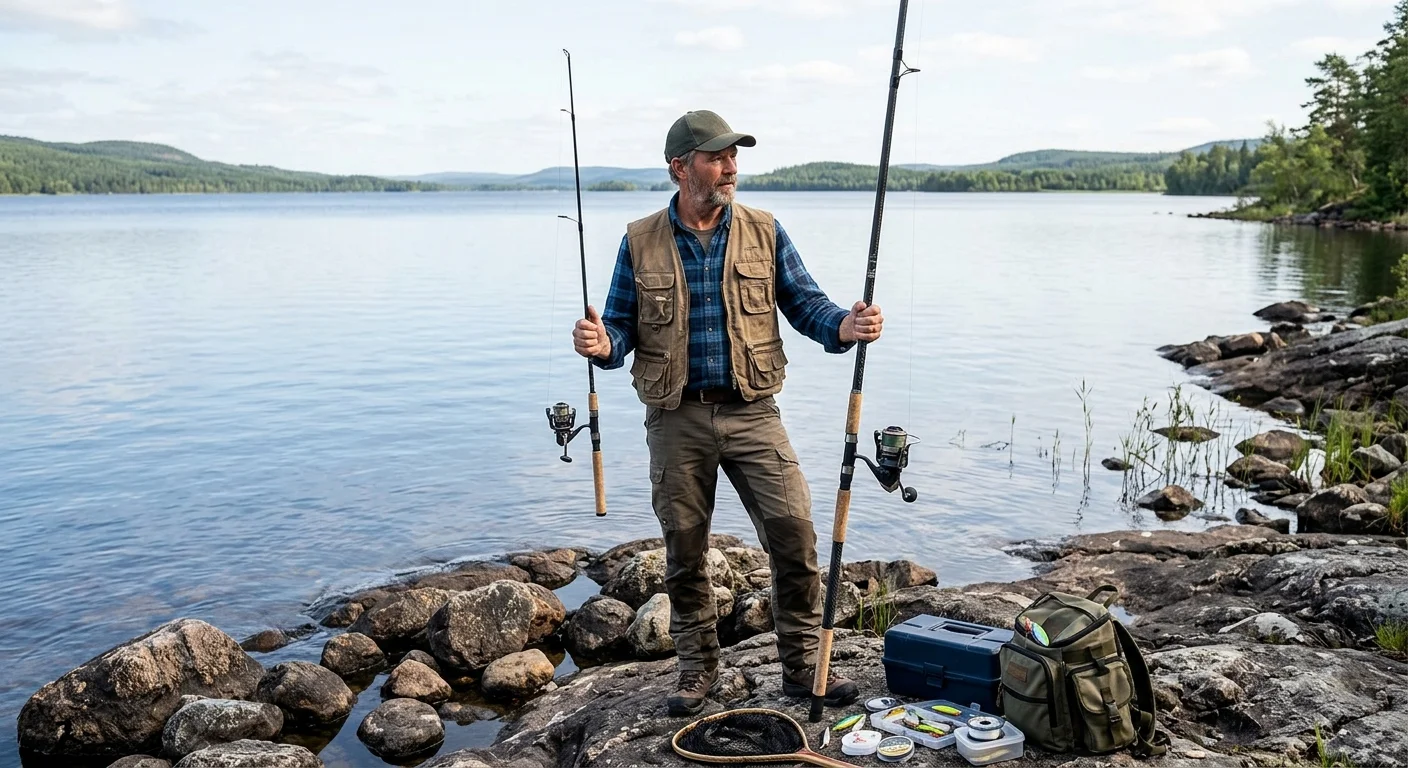
Four questions. That's all you need to cut through every spec sheet, every forum argument, and every tackle shop opinion between you and the right rod.
Answer these four questions straight, and your decision falls into place.
Q1: Where do you fish most?
Your environment sets the hard limits. Everything else comes after.
Location | Rod Length |
|---|---|
Lakes & freshwater rivers | 5–8 ft |
Surf & shore casting | 7–12 ft |
Deep-sea / offshore | 5–9 ft |
Kayak | 6'6"–7'2" |
Bank fishing | 6'10"–7'6" |
Q2: What species are you targeting?
Bass on finesse rigs? Stay in the 7'–7'2" ML/XF range. Jigs and Texas rigs push you to 7'1"–7'4" MH/Fast. Panfish and small trout? Drop to 5–6 feet with light action. The fish picks the tool.
Q3: Do you need distance or accuracy?
Pick one as your main goal. You can't max out both at once.
1.Accuracy first (tight cover, dock skipping): 6'6"–6'10"
2.Distance first (open water, surf, heavy cover): 7'6"–9'+
Q4: Are you fishing from shore or a boat?
Shore anglers need 6'10"–7'6" to clear brush and reach fish. Boat and kayak anglers stay tighter — 6'6"–7'2" — to avoid clipping the hull on every cast.
The Beginner's Safe Zone: 6'6"–7'
Just starting out? Stop overthinking it. A 7-foot medium-action rod covers about 90% of freshwater situations — bass, trout, walleye, light inshore work. It casts far enough. It feels precise enough. And it forgives the technique mistakes every beginner makes.
The 6'6"–6'10" range is your go-to for tighter spots with underhand casts. The 7-foot mark gives you control and versatility. It's easier to master and harder to misuse.
Two common mistakes that cost beginners real money:
1."Longer is always better" — An 8+ foot rod kills accuracy the moment you're near any cover. Great for surf. Terrible for bank fishing with brush.
2."Shorter is always safer" — A 5–6 foot rod works great at a dock. On an open lake, you can't reach the fish.
Quick picks: 7' M/F spinning rod for multi-species freshwater. 7'1"–7'3" casting rod once bass fishing becomes your main focus.
CTA SectionLooking for Wholesale Fishing Gear & Apparel?
We supply OEM/ODM fishing clothing to brands worldwide. UPF 50+, moisture-wicking, fully customizable designs.
Contact Our TeamRod Length + Rod Action + Rod Power: Why All Three Must Work Together
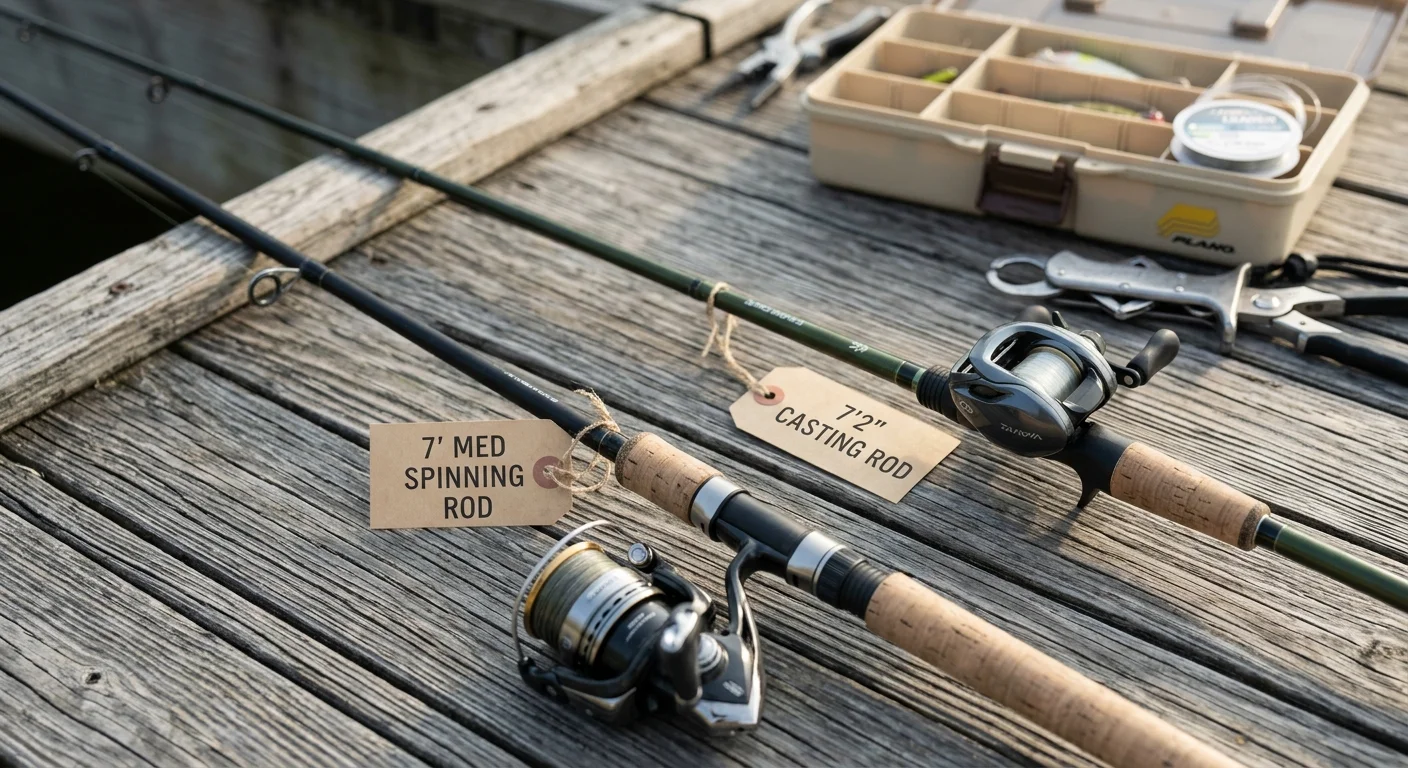
Most anglers shop for rod length and stop there. That's a mistake that costs real fish.
Length is one variable. Action and power are the other two — and all three interact. Get one wrong, and the other two can't save you.
Here's how the system works.
Length controls casting distance and fighting leverage. Action determines where the rod bends and how fast it recovers. Extra-fast loads the top 15–20% of the blank. Fast loads the upper third. Moderate bends through the full length. Power sets stiffness and lure range. Ultralight handles under 1/16 oz finesse rigs. Medium-heavy runs 3/8–1 oz cover setups.
Change any one variable, and the other two shift with it.
The Three-Step Selection Order
Don't start with length. Start with power.
1.Match power to your average lure weight first. Running a 3 oz swimbait on a medium-light rod gives you weak hooksets and blank fatigue. An ML belongs on 1/8–1/4 oz presentations — period.
2.Layer action to your hook type and technique. Single hooks on jigs and Texas rigs need extra-fast or fast action. That means quick, concentrated force right at the tip. Treble-hook baits like crankbaits need moderate or moderate-fast action. The deeper, slower bend gives fish time to commit before the hook drives home. On braid, lean moderate for trebles — zero stretch means zero forgiveness. No exceptions.
3.Adjust length last. Once power and action are locked in, length fine-tunes the rest. Need distance and sweep leverage? Go 7'6" and above. Need vertical precision in tight cover? Stay under 7'.
Same Length, Two Completely Different Rods
A 7'6" Heavy/Fast and a 7'6" Heavy/Moderate-Fast share the same length and lure weight range. They fish nothing alike.
The fast version loads at the tip. You get minimal droop under weight, sharp jig hooksets, and high sensitivity. The moderate-fast version bends deeper toward the handle. It delays the hookset a beat and stores more energy in each cast — better for moving baits.
Same rod on paper. Two different tools on the water.
A 7'2" MH/Fast is about as close as you'll get to a do-it-all freshwater casting rod. It balances distance and stiffness for 3/8–1 oz lures across cover fishing, medium-pressure fish, and most bass techniques. For finesse work, pair it with an ML/XF spinning rod on the other end of the spectrum.
Those two rods together cover around 90% of freshwater situations most anglers will ever face.
FAQ: Most Common Questions About Fishing Rod Length Answered
Real questions from real anglers — answered straight, no filler.
Does a 7-foot rod cast farther than a 6-foot rod?
Yes — but it's not guaranteed. A 7-foot blank stores more energy and creates more arc per cast. That means real distance on open water. A 6-foot rod gives up that distance for tighter accuracy. It's easier to handle in tight spots too. The difference is most clear on lake flats and wide rivers where extra reach matters.
What's the best rod length for bass fishing?
Stay in the 6'6"–7'6" range. That window gives you casting distance, enough sensitivity to feel strikes, and enough leverage to land the fish. Go above 8 feet and you lose the quick response bass fishing needs. The sweet spot most experienced bass anglers settle on? 7'–7'3".
Can a short rod work for bank fishing?
Yes, it can. A 5–6.5-foot rod handles bank fishing well in heavy vegetation, tight creek bends, or close-quarters structure. The trade-off is distance. You'll need solid technique and lighter lures to make up for it. For open banks with no overhead obstruction, push toward 6'6" to get some reach back.
What length should a beginner buy first?
A 7-foot medium-action rod. Full stop. It handles bass, walleye, trout, and light inshore without making you pay for technique mistakes. Skip the extremes:
- A 5-foot rod limits you too fast
- Anything over 8 feet gets hard to control before your casting form is solid
Does longer always mean better?
No. Longer adds leverage and distance — both useful on big, open water. But past 7'6", most anglers give up more control than they gain distance. The 6'6"–7'6" range covers the vast majority of freshwater and light saltwater situations. Anything outside that range is a specialist tool, not a step up.
CTA SectionStart Your Custom Fishing Apparel Line
From design to delivery, BeRun handles every step of custom fishing clothing manufacturing. Request samples today.
Request Free SamplesConclusion
Rod length isn't just a number. It's the difference between a frustrating day on the water and one you'll talk about for weeks.
Here's what it comes down to: short rods give you control and precision in tight spaces. Long rods give you distance and leverage in open water. Neither one is "better" across the board. The right choice depends on where you fish , what you're targeting , and how you like to fish .
You now have the comparison data, the scenario guides, and the decision framework. That's everything you need to stop guessing and start catching.
So here's your next move:
Pick your top two or three rod candidates
Run each one through the 4-question decision framework
Cross-reference with your fishing environment
Still building out your kit? Browse our fishing collection at berunclothes.com — built for anglers who take their setup with care.
The fish aren't waiting. Neither should you.
Video Section