The first time a woman dove into an Olympic pool, she wasn't just competing — she was challenging history. She was proving what she had the right to do.
More than a century later, the names in Olympic swimming history women will never forget are stunning. A teenager from Hungary who made backstroke look effortless. A 41-year-old mother sharing a relay podium with athletes half her age. A distance swimmer so far ahead of the field she seemed to be racing alone.Behind performances like these, advancements in custom women’s competitive swimwear have also played a quiet but important role — supporting speed, fit, and confidence at the highest level.
These ten women didn't just win races. They pushed the limits of what a woman's body could do in the water. You're about to meet all of them.
1. Katie Ledecky — The Distance Queen Who Rewrote the Record Books
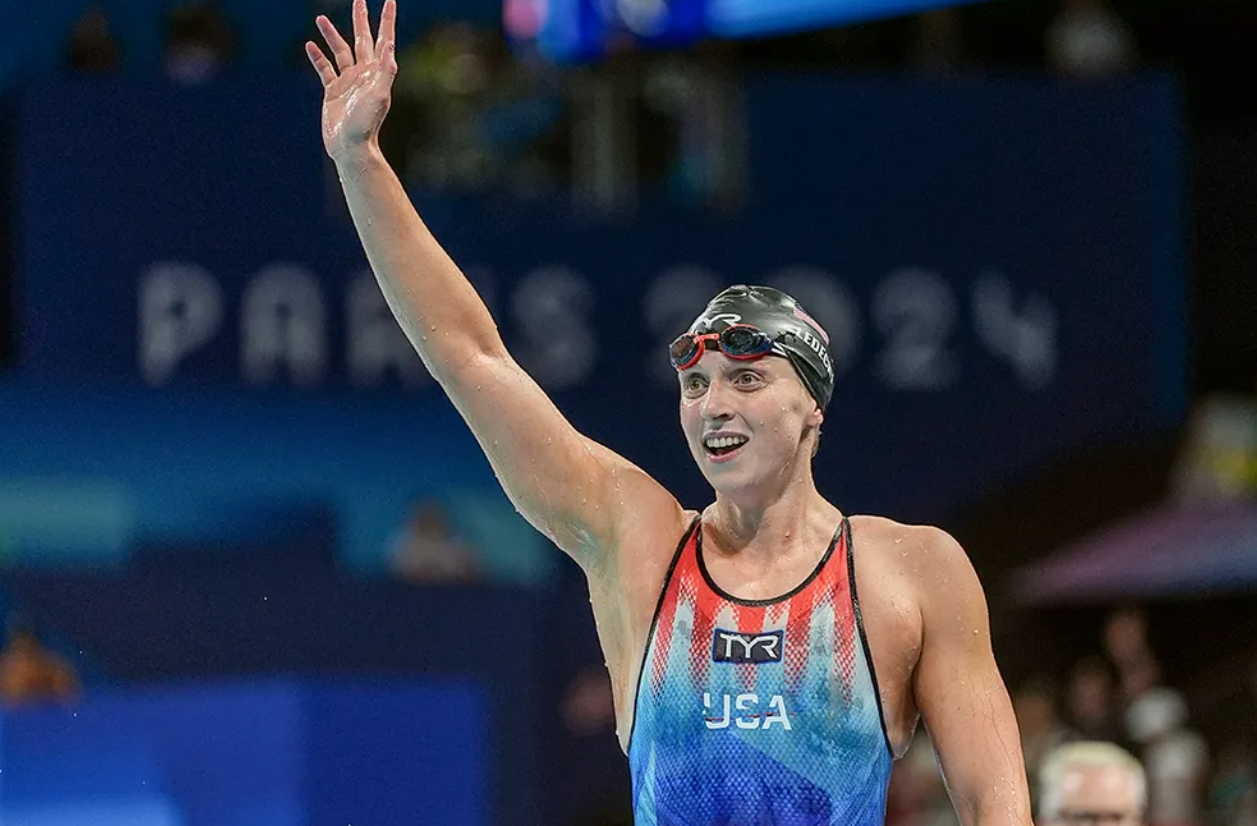
At the 2024 Paris Olympics, Katie Ledecky touched the wall in the 1500m freestyle. She looked up at the scoreboard. She had won by more than 17 seconds . Seventeen seconds. In a sport where hundredths decide careers, that margin isn't a victory — it's a different conversation.
Ledecky has been having that conversation alone for over a decade.
She showed up at the London 2012 Games as a 15-year-old. Nobody had heard of her. She won the 800m freestyle gold, went home, and got better. Four Olympic cycles later, she stacked up 9 Olympic golds and 10+ total medals , broke 17 world records , and claimed 18 individual World Championship golds — more than Michael Phelps ever did.
The numbers are almost rude in their clarity:
800m freestyle world record : 8:04.12 (set in 2025 — at age 28)
1500m freestyle world record : 15:08.24 (short course)
She holds 28 of the 29 fastest 800m times ever swum by a woman
At the 2016 Worlds, she won the 800m by more than 10 seconds . At the 2015 Worlds, she swept the 200m, 400m, 800m, and 1500m freestyle. No one had done that clean at a major international meet before. She set three world records in a single week.
She has been named Swimming World's Female Swimmer of the Year five times . No one else holds that record.
What makes Ledecky unsettling to watch isn't the speed. It's the patience. Distance swimming is about pain management — how long you can hold pace while your body screams at you to stop. Ledecky has a different relationship with that pain than everyone else in the field. Behind this level of dominance, elite performance gear developed through a women’s competitive swimwear factory has quietly evolved alongside athletes. At the same time, innovation from a custom Olympic female competitive swimwear factory continues to refine how suits reduce drag and support endurance events.She doesn't silence it. She just doesn't find it worth her attention.
2. Jenny Thompson — America's Most Decorated Female Swimmer Nobody Talks About Enough
Twelve Olympic medals. Eight golds. Four Games. Yet Jenny Thompson remains one of the most underappreciated names in Olympic swimming history .
Here's why she gets overlooked: every single one of those golds came in a relay. Not one individual event. American sports culture worships solo glory — the lone figure on the podium, hand over heart. Relay specialists get pushed out of the conversation. Thompson got pushed out so far that most casual fans have never heard her name.
That's a real shame, because what she built over 12 years is extraordinary.
She started at Barcelona in 1992, aged 19. She was still competing in Athens in 2004, at 31, as the oldest woman on the U.S. squad. At the same time, she was studying medicine. Think about that for a moment. She was training for the Olympics and preparing to become a doctor — at the same time.
Between those two bookends:
12 Olympic medals total (8 gold, 3 silver, 1 bronze), tying Ryan Lochte's all-time U.S. record
15 world records across long and short course events
Broke Mary T. Meagher's legendary 18-year-old 100m butterfly world record in 1999 with a 56.56
30 World Championship medals , 15 of them gold
85 international medals across her entire career — the most ever by an American female Olympian
The butterfly record deserves a closer look. Meagher's mark had stood since 1981. Everyone treated it as untouchable. Thompson broke it anyway.
She retired in 2004 and became a physician. That fits her perfectly. She spent her entire career doing the hard, invisible work that made everyone else shine — and then she went off to do it again in medicine.For teams and retailers supporting competitive swimmers, sourcing through reliable female competitive swimwear wholesalers ensures consistent access to performance gear. Meanwhile, understanding female competitive swimwear wholesale prices helps balance elite-level quality with scalable purchasing decisions.
3. Dara Torres — The 41-Year-Old Who Proved Age Is Just a Number
Sixteen months after giving birth, Dara Torres walked onto a pool deck and broke an American record. She was 40. Her teammates called her "Mom."
She won three silver medals at the 2008 Beijing Olympics. She was 41.
Let that sit for a second.
Torres first stood on an Olympic podium in 1984, at age 17. Her last Olympic medal came 24 years later. That span — 1984 to 2008, five Olympic Games — is a career arc that simply doesn't exist in swimming. It exists now because she refused to accept that it couldn't.
The 2008 numbers are almost disrespectful in what they prove:
50m freestyle : Silver medal, 24.07s — an American record, set at age 41
4×100m medley relay : Silver medal. Her 100m freestyle anchor split was 52.27s — the fastest relay split in history. That's more than a full second faster than the individual American record of 53.39s
4×100m freestyle relay : Silver medal — her fifth medal in that event across five Olympics
She didn't just show up. She broke three American records at the Games themselves .
The 50m freestyle record alone tells a story worth following. She broke her own American record ten times across her career. In 2000, she swam 24.63s. In 2007, 24.53s. At the 2008 Trials, she hit 24.38s in the semifinal, then 24.25s in the final. Beijing: 24.07s. Every number going down. Every year going up.
Middle-aged women stopped her on the street after the Games. They emailed her. They told her she made them believe they could still do things they'd talked themselves out of doing. Torres knew what that meant. She said it herself: "There are a lot of middle-aged women and men I know that contacted me, emailed or stopped me in the street to tell me that I am an inspiration to them and are now doing things that they thought they couldn't do."
She left Beijing with 12 Olympic medals total — 4 gold, 4 silver, 4 bronze. That tied Jenny Thompson's record for the most by a U.S. female Olympic swimmer. She also took home the 2009 ESPY for Best Comeback and the World Fair Play Award.
The age limit she shattered wasn't just personal. It was cultural.
4. Natalie Coughlin — The Backstroke Specialist Who Could Do Everything
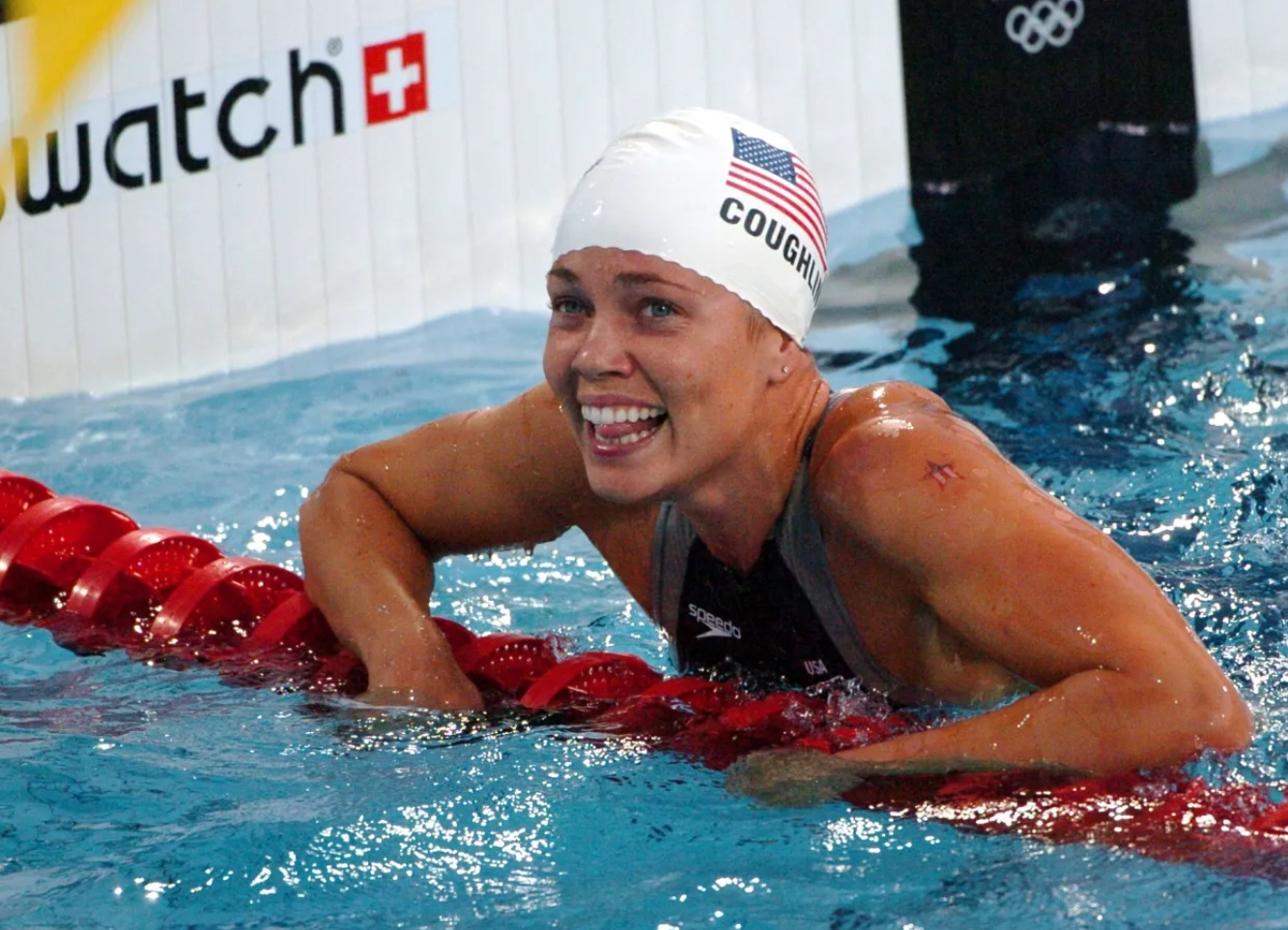
Six medals at a single Olympics. Not six medals across a career. Not six medals spread across a decade of effort, heartbreak, and pre-dawn practices nobody ever sees. Six medals at Beijing 2008 alone — backstroke, butterfly, freestyle, medley relay. That made Coughlin the first U.S. woman to do it in a single Games.
She got there by refusing to be just one thing.
Backstroke was her home, though. She was the first woman in history to break the one-minute barrier in the 100m backstroke — 59.58 at the 2002 U.S. Nationals. That swim changed what the event was allowed to be. Then she broke it again. And again. She touched the wall in Athens with a 59.44 world record and had already rewritten the rulebook by then. Beijing pushed it down further to 58.94 .
She won back-to-back Olympic gold medals in the 100m backstroke — 2004, then 2008. That made her the first American woman to defend that title.
Her 2008 medal count shows the full picture of her range:
Gold : 100m backstroke, 4×100m medley relay, 4×200m freestyle relay
Bronze : 100m butterfly (57.34, an American record), 4×100m freestyle relay, 200m individual medley
That's not a backstroke specialist. That's someone who happened to be great at backstroke and also competitive across almost everything else the pool had to offer.
Twelve Olympic medals total. Three gold, four silver, five bronze across three Games. The run goes from Athens in 2004 to London in 2012 — eight years of showing up and being hard to beat in events she wasn't even expected to threaten.
She trained at UC Berkeley under coach Teri McKeever. No drama. No big mythology around it. Just focused, grinding work that produced records nobody thought were possible — until she swam them.
5. Krisztina Egerszegi — The 14-Year-Old Who Became a Backstroke Legend
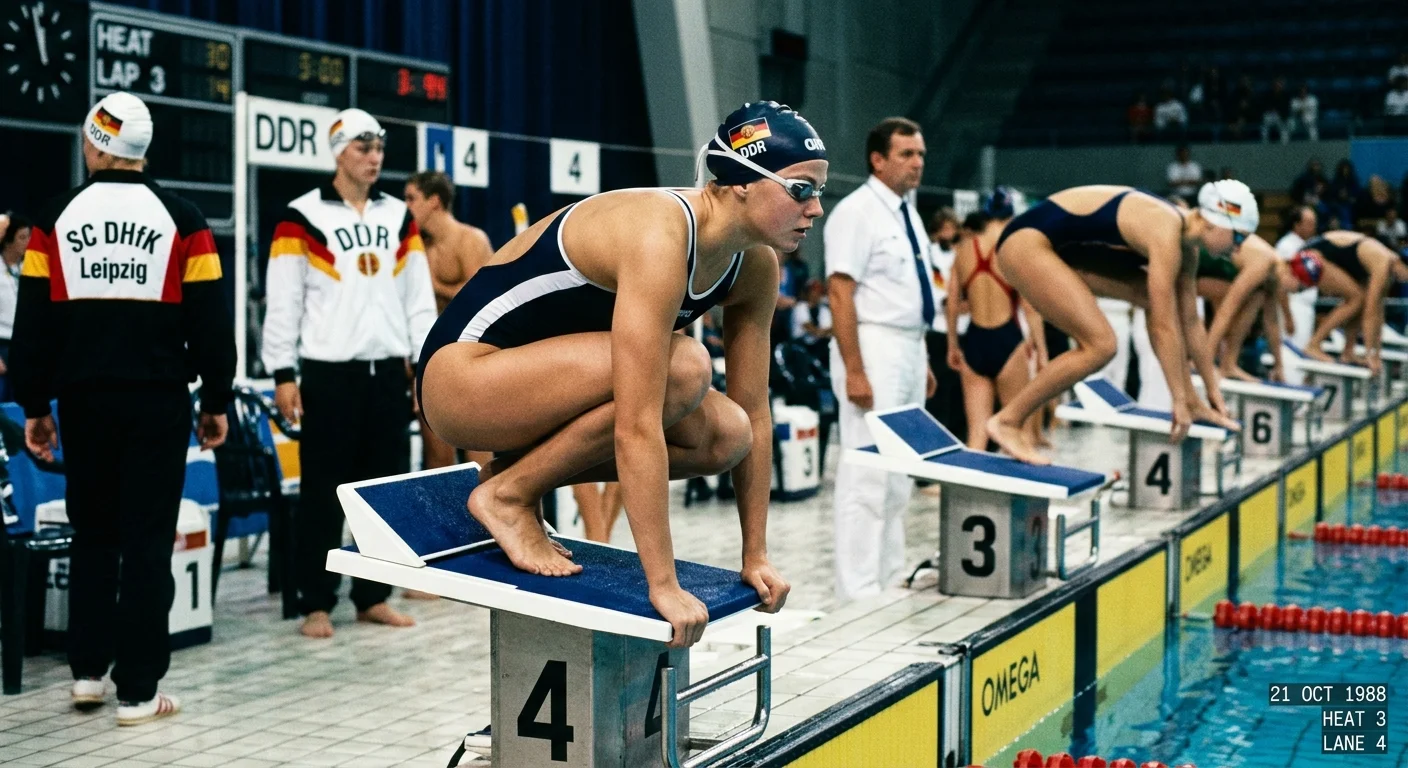
She was 14. The East Germans were a machine.
The GDR program in 1988 wasn't just competitive — it was state-engineered. Kristin Otto, Cornelia Sirch, Katherin Zimmerman. These women had government funding, scientific training programs, and resources no teenage girl from Budapest could match. Egerszegi arrived in Seoul ranked 9th in the world in the 200m backstroke. By the numbers, she had no business standing on that podium.
She won. Olympic record: 2:09.29 . She passed Sirch on the third lap — 15 meters before the final turn — and never looked back.
What followed was a career that makes you question whether records are meant to last. Three straight Olympic golds in the 200m backstroke: 1988, 1992, 1996 . No swimmer had done that before. At Barcelona in 1992, she added gold in the 100m backstroke and the 400m individual medley. Three golds in one Games.
Then there's the world record that refused to die. Her 2:06.62 in the 200m backstroke, set in Athens in August 1991, held for 16.5 years . It stayed the oldest European swimming record on the books until 2009. That's not just longevity. That's closer to something permanent.
She wrapped up her career with 5 individual Olympic golds — the most among women until the Phelps era changed every standard for what was possible.
6. Katinka Hosszu — The Iron Lady Who Dominated Every Stroke at Once
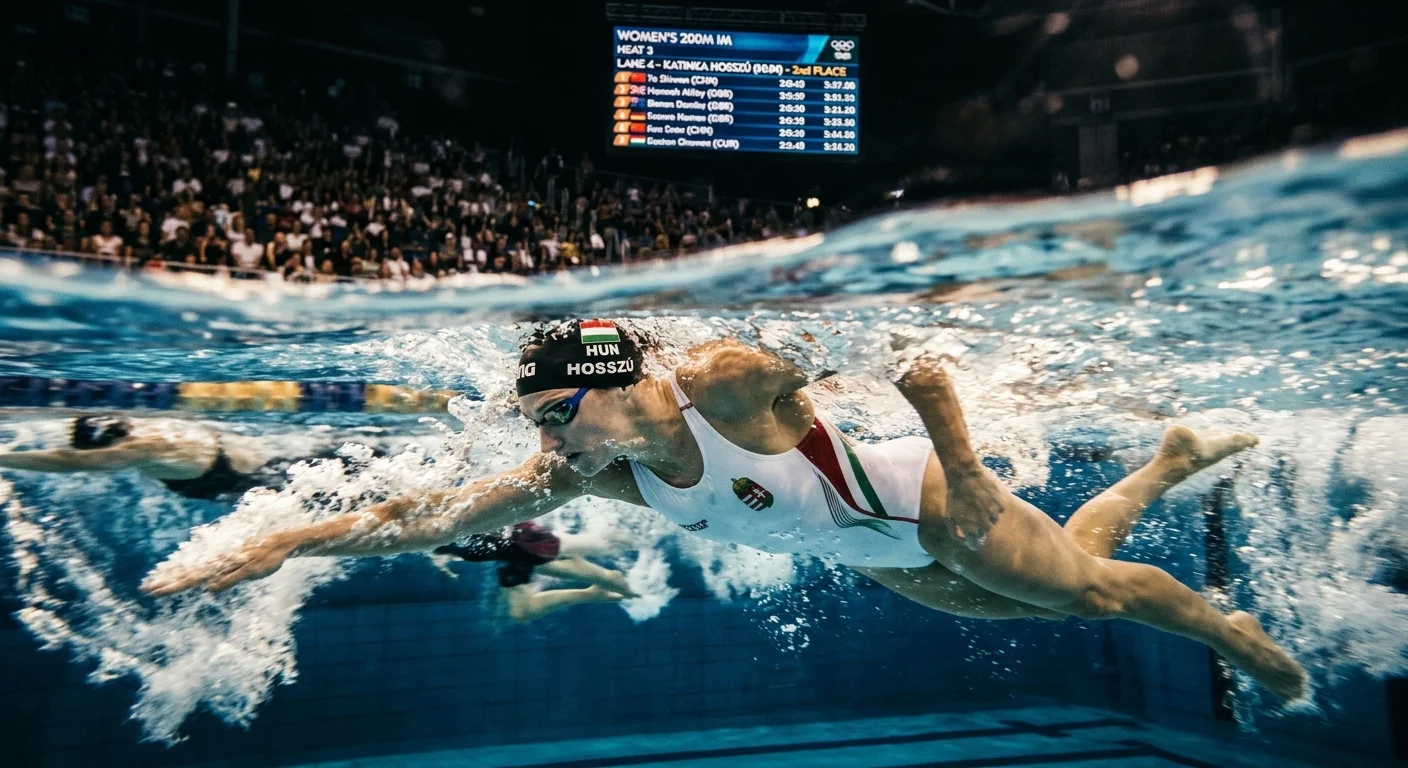
Four hundred races in a single season. Not four hundred laps. Not four hundred training sessions. Four hundred individual races. Each one demanded she outswim everyone else in the water that day. Most elite swimmers race thirty or forty times a year and call that a full load. Hosszú looked at that number and treated it like a warm-up.
That's how she became the Iron Lady. Not from one brilliant performance. From brutal, near-irrational race volume — kept up year after year.
At the 2016 Rio Olympics, she made it look easy. Three golds in three days: the 400m IM (4:26.36, a world record that cut more than two full seconds off the previous mark), the 200m IM (2:06.12, another world record she had already set the year before in Kazan), and the 100m backstroke (58.45). She also took silver in the 200m backstroke. Four events. Four medals. That 400m IM record stood for seven years .
The IM is the event that hides nothing. Butterfly, then backstroke, then breaststroke, then freestyle — all four strokes, one after another, with no chance to lean on your best one. Hosszú didn't just get through the transitions. She was the first swimmer ever, male or female, to hold world records in all five IM events at the same time . She built a 67-race winning streak in the 200m IM. She claimed four straight 200m IM world titles — no woman had reached that before her.
Her career totals are a lot to take in:
3 Olympic golds , 4 total medals
9 long-course World Championship golds , 15 total
17 short-course World Championship golds — more individual golds than Ryan Lochte's 14, the previous record
20 world records across her career
FINA Swimmer of the Year : 2014, 2015, 2016, 2018
She retired in 2024 at 35. The pool got quieter.
7. Fanny Durack — The Pioneer Who Had to Fight Just to Compete
Before Fanny Durack could race anyone in the water, she had to beat the people standing on dry land.
The year was 1912. Stockholm. The first-ever Olympic women's swimming competition ran two events with 27 women total. The men got seven events. The Australian swimming establishment tried to block Durack from going at all. Conservative officials ruled that women had no place competing on an international stage. The ban was real. So was Durack's response: she went public, lobbied until the ban lifted, then funded her own trip to Sweden. She earned her spot by fighting for the right to show up.
Then she showed them why they should have been afraid of letting her.
She broke the world record twice in qualifying — hitting 1:19.8 in the heats alone. In the final, she won by more than three seconds, finishing in 1:22.2 . Silver went to her compatriot Mina Wylie. Both women were Australian. The podium looked more like a domestic training session than an international stage.
The medal tells only part of the story. From 1910 to 1918, Durack held every world freestyle record from 100 meters to one mile — all at once . No swimmer — male or female, from any era — has matched that kind of range. She set 11 to 12 world records in total. Her mile record of 26:08 , set in 1914, stood for twelve years.
She deserved more. Australasia got left out of the relay, despite Durack and Wylie each offering to swim two legs. Then the 1920 Olympics slipped by while she battled appendicitis, typhoid, and pneumonia. More races, more records, more podiums — all of it out of reach.
She earned her place in the International Swimming Hall of Fame in 1967 . The first woman to win an Olympic swimming gold. Not just a pioneer — the original.
8. Gertrude Ederle — From Olympic Bronze to Conquering the English Channel
Two million people lined the streets of New York City to welcome her home. Not a war hero. Not a president. A 20-year-old woman who had just swum across the English Channel.
Ederle's Olympic record alone was worth celebrating. She won gold in the 4×100m freestyle relay at the 1924 Paris Games. She also took bronze in the 100m and 400m freestyle. By 21, she had set 29 U.S. national and world records . She broke seven world records in a single 500m swim at Brighton Beach in 1922. She held the 880-yard freestyle world record at age 12.
But the Channel was something else. A different challenge altogether.
On August 6, 1926, she stepped into the water at Cap Gris-Nez, France, at 7:08 AM. The seas were rough and gray and cold. A trainer had pulled her out at 18 miles the year before. This time, nobody was pulling her out. She landed at Kingsdown, England, 14 hours and 31 minutes later . She beat the existing men's record by close to two full hours.
Five men had crossed before her. None of them had done it faster.
The world shifted a little that day. Not just in the record books — in the way people thought about what women's bodies were capable of. She didn't just beat the men's record. She proved the ceiling wasn't where everyone said it was.
Her crossing record stood for 24 years . The parade record — two million people — stood far longer.
9. Shane Gould — The Teen Who Held Every Freestyle World Record at Once
For eight months, Shane Gould owned every freestyle world record that existed — 100m, 200m, 400m, 800m, 1500m — all at the same time. She was 14 when it started. Nobody has done it since.
That window ran from December 12, 1971, to August 4, 1972. For those eight months, no other woman held the benchmark at any freestyle distance on earth. Sprint to ultramarathon. All of it, hers. Think about what that actually means physically. A 58.5-second 100m and a sub-17-minute 1500m pull your body in completely opposite directions. One demands pure explosive speed. The other requires deep endurance. She dominated both.
Munich 1972 was the proof. Fifteen years old. Twelve races. 4,200 meters swum across eight days. She walked away with three golds, a silver, and a bronze. No other person in Olympic history — male or female — has medaled in all five individual freestyle events plus the 200m IM in a single Games.
1.Gold : 200m freestyle (WR 2:03.56), 400m freestyle (WR 4:19.04), 200m IM (WR 2:23.07)
2.Silver : 800m freestyle
3.Bronze : 100m freestyle
She set 11 world records total. In January 1972, she broke Dawn Fraser's 100m world record — a record that had stood for 16 years. She also became the first woman to crack 17 minutes in the 1500m.
Then she retired. She was 16. The burnout was real. Seven world records in nine months will break anyone down. She left with more records than most swimmers collect in a full career. She closed that chapter and never came back.
10. Lisbeth Trickett — Australia's Multi-Stroke Weapon Across Two Olympic Cycles
Sprint events are brutal in their honesty. There's nowhere to hide. No pace strategy to fall back on. No second half to mount a comeback. Fifty meters. One hundred meters. You either have it or you don't.
Lisbeth Trickett had it — in butterfly, in freestyle, and in relay lanes where Australia needed someone who wouldn't crack.
She collected medals across two full Olympic cycles. At Athens 2004, she grabbed bronze in the 50m freestyle and added a world-record split to Australia's 4×100m freestyle relay gold. At Beijing 2008, she pushed further. She took gold in the 100m butterfly and silver in the 100m freestyle — Britta Steffen out-touched her after she led at the turn. Then came another relay gold in the 4×100m freestyle.
Between those Games, she built a record that's hard to argue with:
1.2007 World Championships : Gold in the 100m butterfly (57.15s, a championship record). She finished 0.09 seconds ahead of both Jessicah Schipper and Natalie Coughlin — two swimmers who had no business losing by that margin
2.2008 Australian Trials : World records in both the 50m freestyle ( 23.97s — the first woman ever under 24 seconds) and the 100m freestyle ( 52.88s )
3.2006 Short Course Worlds : Gold and a world record in the 100m butterfly
4.2006 Commonwealth Games : Five golds, including a 4×100m freestyle relay world record
That last number matters. Five golds at a single Commonwealth Games is not a rounding error. That's total control across an entire meet.
She was part of an Australian sprint core alongside Leisel Jones and Stephanie Rice. That group made the mid-2000s a rough stretch for every other swimmer in the pool. Australia claimed 12 golds at the 2006 Short Course Worlds. Trickett alone took five of them.
What set her apart from a one-stroke specialist was range. Most sprinters pick one event and dig in. Trickett competed at the top level in both butterfly and freestyle — and was a real threat in each. Her 51.70s short course 100m freestyle in 2005 was the kind of number that makes coaches look at the scoreboard twice.
She left competitive swimming in 2009. That exit was quiet compared to the decade that came before it.
How We Ranked the Greatest Female Olympic Swimmers: The Criteria Explained
Medal counts lie. Not on purpose — they just leave out too much.
Twelve medals sounds more impressive than five. But those twelve came from relays. Those five each broke a world record in a championship final. That tension drives every ranking decision here.
Six criteria shaped the list: individual dominance , versatility across strokes and distances , competitive longevity , big-race performance , relay contributions , and world records broken .
Individual Olympic golds carry far more weight than relay medals. A swimmer who owned one event for a decade scores differently from one who threatened everywhere but won nowhere.
No ranking system is clean. It never is.
The Legacy of Female Olympic Swimming: What These Champions Changed Forever
The numbers tell one story. The change behind them tells another.
In 1912, Stockholm gave women two swimming events. Two. By Paris 2024, that number grew to 35-plus disciplines. That expansion didn't happen on its own. Women kept showing up, kept winning, and kept making the argument too strong to ignore.
What these ten swimmers changed isn't just the record books. It's the assumption. The quiet, stubborn cultural belief that women's bodies have a ceiling — in speed, in endurance, in competitive lifespan. Durack broke that ceiling in 1912. She funded her own trip to Sweden just to earn the right to race. Torres broke it in Beijing at 41. She split faster than swimmers who were born after she had already started collecting medals. Ledecky broke it so completely that her competitors now race for second place — and treat that as a win.
Records fall. What stays is what these women proved was possible.
Conclusion
These ten women didn't just win races — they rewrote what we thought was possible in a pool, and outside of one too. Fanny Durack fought for the right to show up at all. Katie Ledecky made world records look like a Tuesday morning habit. The arc of Olympic swimming history women have shaped is nothing short of breathtaking.
What ties them together isn't gold medals or split times. It's a stubborn refusal to accept limits — physical, cultural, or any other kind. That's the thing about greatness: it doesn't ask for permission.
So you're here because you love the sport. Or you study it. Or you're the person who cries watching the 800m freestyle final at 2am. All of that is welcome. You belong here.
Now go swim something. Do it in gear worthy of the women who inspired you. Check out berunclothes.com's women's swim collection — because champions aren't built in ordinary equipment.
Video Section